
I often used to say that a low carb diet is the only one where you can eat the butter, sour cream, bacon, and cheese on a loaded baked potato, but not the potato! That may not be true …
To listen to this post, please click the play arrow below:
0:00
-15:18

Some of us don’t get the luxury of a high carb threshold.
Some people can eat a baked potato the size of a toddler’s shoe and stay lean.
Others — like me — can look at a banana and gain half a pound.
If you’ve ever followed Atkins the old‑school way — starting at 20 net carbs, adding foods back one at a time, watching your body like a science experiment — you know exactly what I mean. That slow, methodical climb up the carb ladder is how many of us discovered our personal carb threshold.
Mine is around 23 net carbs a day.
Yours might be similar.
And if you’re reading this, you probably know the feeling: one wrong food and the cravings come roaring back like a dragon you thought you’d slain.
But here’s the part that feels like a secret no one tells you:
Your carb threshold isn’t fixed. And not all carbs behave the same way in the body.
One day, someone posted a comment that if you make potatoes, then let them get cold, they have no carbs in them. Wishful thinking, I thought. But they were partially right. Read on.
Some carbs hit like sugar.
Some act like fiber.
And some — when treated right — become something in between.
Let’s talk about that “in between,” because it’s where the magic happens.
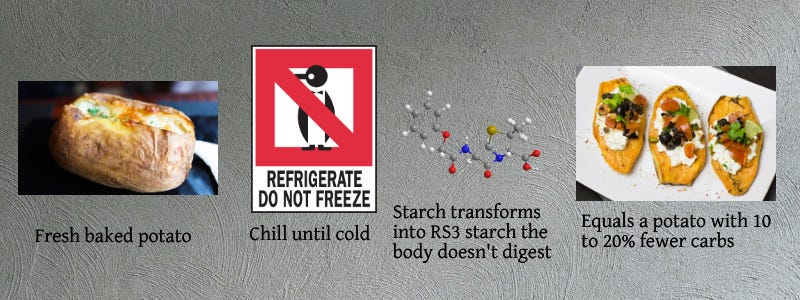
When you cook a starchy food — rice, potatoes, pasta, oats — the starch granules swell and become digestible. Your enzymes can break them down into glucose, and your blood sugar responds accordingly.
But when you cool those same foods, something fascinating happens:
The starch recrystallizes into a form your body can’t digest.
This is called resistant starch — specifically RS3 — and it behaves like fiber.
It doesn’t turn into glucose.
It doesn’t spike insulin.
It doesn’t contribute full calories.
And it doesn’t push you over your carb threshold the way fresh starch does.
This is why:
leftover rice
potato salad
cold pasta
beans
lentils
oats baked into bars and cooled
…all hit differently than their freshly cooked versions.
They’re not low‑carb — but they’re lower‑impact carbs, and that matters when you’re living at 23 net carbs a day.
Oatmeal is naturally rich in soluble fiber and already contains some resistant starch. When you bake it into a breakfast bar and let it cool, it forms even more. Not a huge amount — but enough that 2 tablespoons in a recipe behave more like a binder than a carb bomb.
Cream of Wheat, on the other hand, is made from refined farina. It doesn’t form much resistant starch when cooled, so it stays a high‑impact starch. In tiny amounts, it’s fine — but it’s not a “safe starch” the way cooled rice or beans are.
These are the starches that give you the most satisfaction for the least metabolic impact.
These behave more like fiber than starch.
green banana or plantain (raw or minimally heated)
beans & lentils (¼ cup)
konjac noodles
hearts of palm pasta
low‑carb breads
zero‑carb tortillas
These form RS3 resistant starch and become gentler on your metabolism.
rice
potatoes
pasta
quinoa
Use sparingly — 2–3 tablespoons at most.
sweet potatoes
corn
barley
farro
Your carb threshold is the point where your body can still burn fat efficiently without switching back into fat‑storage mode. It’s not just about carbs — it’s about:
insulin sensitivity
muscle mass
gut microbiome
metabolic flexibility
hormonal signaling
When I followed the Atkins carb ladder — starting at 20 net carbs, adding foods back slowly, watching hunger and cravings like a hawk — I was essentially running a controlled metabolic experiment.
That’s how I discovered my threshold.
And it’s why I can maintain it so well now.
You can do the same thing. Those initial 20 carbs are recommended foods from Atkins—safe foods that are low in carbs without too much natural sugar. Although most meat has no carbs, that is not a free license to eat all you want. Keep to reasonable proportion’s, usually 4 to 6 ounces.
The first two weeks of Atkins (and most Keto diets) stay with this initial range of 20 net carbs to adapt your body’s fat burner to the new plan. You can feel like you have the flu or just the blahs on some days, so drinking a cup of chicken or beef broth is often a solution to that.
After the first two weeks, begin adding recommended foods back into your diet one at a time. Try it for a few days, weigh and see if you’re losing or gaining weight. If you lose, the food works in your diet and you can have those additional carbs. Never add more than five carbs to the baseline at a time. You repeat the process until you come to a point where any carbs over the amount you have cause a weight gain. The carb threshold has been reached. Where the weight is stable is the threshold. Eat a little fewer carbs and you will lose.
Don’t take my word for it, but check out Atkins website for more information.
Lose Weight While Enjoying Every Bite | Atkins
Most people can raise their threshold by 5–15 net carbs/day if they:
build a little muscle
walk more
keep protein high
eat resistant starch regularly
add carbs in 5‑gram increments
You won’t jump to 100g/day — but you can gain more flexibility.
Calorie‑only dieters aren’t wrong.
Carb‑threshold eaters aren’t wrong either.
They’re just talking about different layers of the same system.
Calories determine whether you lose weight.
Carbs determine how easily you lose weight — and whether you can maintain it without hunger, cravings, or regain.
Think of calories as the budget, and carbs as the interest rate.
You can lose weight on any budget, but the interest rate determines how painful it is.
Resistant starch is the loophole that confuses calorie‑only thinkers:
the label might say 150 calories, but your body may only absorb 110–120.
Biology isn’t neat.
But it is predictable — once you understand your threshold.
Here’s the part I wish someone had told me years ago:
carb counting isn’t about deprivation — it’s about predictability.
When you live with a low carb threshold, the world suddenly becomes calmer. Hunger stops being an emergency. Food stops being a negotiation. And you always, always have options.
If you’re hungry, you can eat — truly eat — without blowing your day:
meat
cheese
eggs
tuna
chicken salad
pepperoni
cottage cheese
low‑carb breads
zero‑carb tortillas
A cheese quesadilla with bacon on a zero‑carb tortilla?
That’s lunch.
That’s comfort.
That’s control.
Cravings happen too — because cravings aren’t hunger. They’re chemistry. But even then, you’re not helpless. The modern low‑carb world is full of ways to satisfy the craving without waking the carb dragon:
low‑carb ice creams
sugar‑free chocolates
almond‑flour cookies
ricotta or cream cheese‑based desserts
protein bars
cinnamon crisps made from low‑carb tortillas

A low carb, no bake pistachio cheesecake at about 4.5 net carbs.

You can soothe the craving without losing your footing.
Calories tell you how much you can eat.
Carbs tell you how stable you’ll feel while eating it.
And stability — hormonal, emotional, metabolic — is what makes maintenance possible.
Your carb threshold isn’t a punishment.
It’s a map.
And once you understand how different starches behave — how cooling changes them, how resistant starch works, how your body responds — you gain something far more valuable than weight loss:
You gain peace with food.
People love to say low‑carb is “too complicated,” and I always smile a little when I hear it. Because once you understand your carb threshold, it becomes one of the simplest ways to eat.
Think of your carb threshold like money in your wallet.
You wake up each day with a set amount — maybe 20 net carbs, maybe 30, maybe 50. That’s your spending money. That’s what you’ve got to work with.
And just like money:
Some foods are expensive.
Some are cheap.
Some are practically free.
And some are worth splurging on once in a while.
After a while, you don’t even have to think about it. You know the “price” of your meals by heart.
A cheese quesadilla on a zero‑carb tortilla? That’s a freebie.
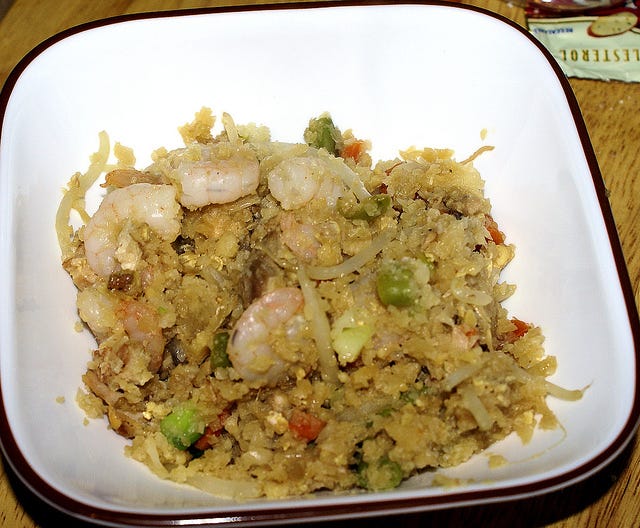
A half‑cup of cooled rice in fried rice? That’s a small, planned purchase.
A baked potato the size of a football? That’s blowing your whole paycheck before noon.
Once you learn your personal carb budget, you stop guessing. You stop stressing. You stop feeling like food is a trap.
You simply spend your carbs where they matter most — on foods that satisfy you, nourish you, and keep you in that calm, steady metabolic zone where maintenance becomes second nature.
And that’s the real beauty of low‑carb living: it gives you control without taking away joy.
I’ve been a yo‑yo dieter for most of my life. (I have clothes from sizes 10 to 3X - American sizing)! I’ve lost and regained weight at least five times, and every cycle taught me something — mostly the hard way.
As a child, I was put on low‑calorie diets that left me hungry all the time. Imagine going to school with half a sandwich and an apple and being told that was “healthy.” I tried weight‑loss shots that didn’t work, exercised until I was exhausted, and fought my body every step of the way.
When I turned 18, I discovered the Atkins Diet — the original version, the one with 40 carbs a day (not net carbs) and the reputation as the “Drinking Man’s Diet” because hard alcohol has zero carbs. I ignored the alcohol part and embraced the rest. I lived on dinners of meat, half of a baked potato, green beans, and a few low‑carb berries for dessert. And it worked. I lost the weight and kept it off for eight years.
But eventually, life shifted — as it always does — and the weight crept back.
I tried low‑calorie frozen dinners. I tried the popular branded low‑calorie programs. I lost weight again. And then, when I stopped, the pounds returned… with friends. More than I’d lost.
So back to low‑carb I went. And the cycle repeated.
It took me decades to realize the truth I now tell everyone who struggles the way I did:
Whatever you did to lose the weight is what you’ll need to keep doing to maintain it. So, if it was a low carb diet and exercise, that’s what you need to maintain. You can relax a little, but you can’t go back to eating “whatever you want” without consequences.
For me, carb‑counting has been the most sustainable, sane, and forgiving way to keep my weight down. It gives me structure without punishment, freedom without chaos, and enough predictability that I don’t feel like I’m fighting myself every day.
Do I still struggle sometimes? Of course. I’m human. But carb‑counting is the first approach that has ever felt like it works with my body instead of against it.
And that’s why I share what I’ve learned — because if my decades of trial‑and‑error can help someone else skip a few of the painful parts, then all those yo‑yo years weren’t wasted.
If you’re looking for real‑food low‑carb recipes that actually satisfy — the kind of meals that make this lifestyle livable — you’ll find them on my recipe website and in my cookbooks. They’re built from the same philosophy as this post: simple, sustainable, and grounded in what actually works.

Join the Conversation
I’d love to hear from you. If you’ve struggled with yo‑yo dieting, carb thresholds, resistant starch experiments, or just figuring out what foods actually work for your body, you’re in good company here.
Share your thoughts in the comments — your questions, your stories, your “aha” moments, or even the foods you’ve discovered that keep you satisfied without derailing your day. We learn so much from each other, and your experience might be exactly what someone else needs to hear.
And if there’s something in this post you want me to dig deeper into — resistant starch, cooled grains, carb budgeting, low‑carb cooking, or anything else — just ask. I’m always happy to explore it with you.
No posts
Comments
Nothing yet. Say the first thing.
Sign in to join the conversation.