
It cost more than ten million pounds. By all accounts, it has been beautifully done. There is a new exhibition, a café, a shop, improved parking and better facilities. The monument will be protected. Visitors will be managed. Money will be raised for conservation and for the local community.
Everyone seems pleased.
And I find myself filled with grief.
Not mild disappointment. Not irritation at having to buy a ticket. Something far deeper has been touched. I feel as though something has been taken from me.
That sounds absurd. The stones are still there. I will still be able to visit them. They may even be better protected for the future. What, precisely, have I lost?
I have tried to follow the pain down into myself.
At first I wondered whether it resembled the pain of losing someone I love. But that is not quite it, and such comparisons become dangerous very quickly. Then I wondered whether it was closer to having my freedom taken away: being imprisoned, prevented from travelling, denied some fundamental power of movement and choice.
That comes nearer.
But the wound seems to lie deeper still, in a layer where freedom, belonging and religion have not yet separated from one another.
Something I regarded as a sanctuary has been enclosed.
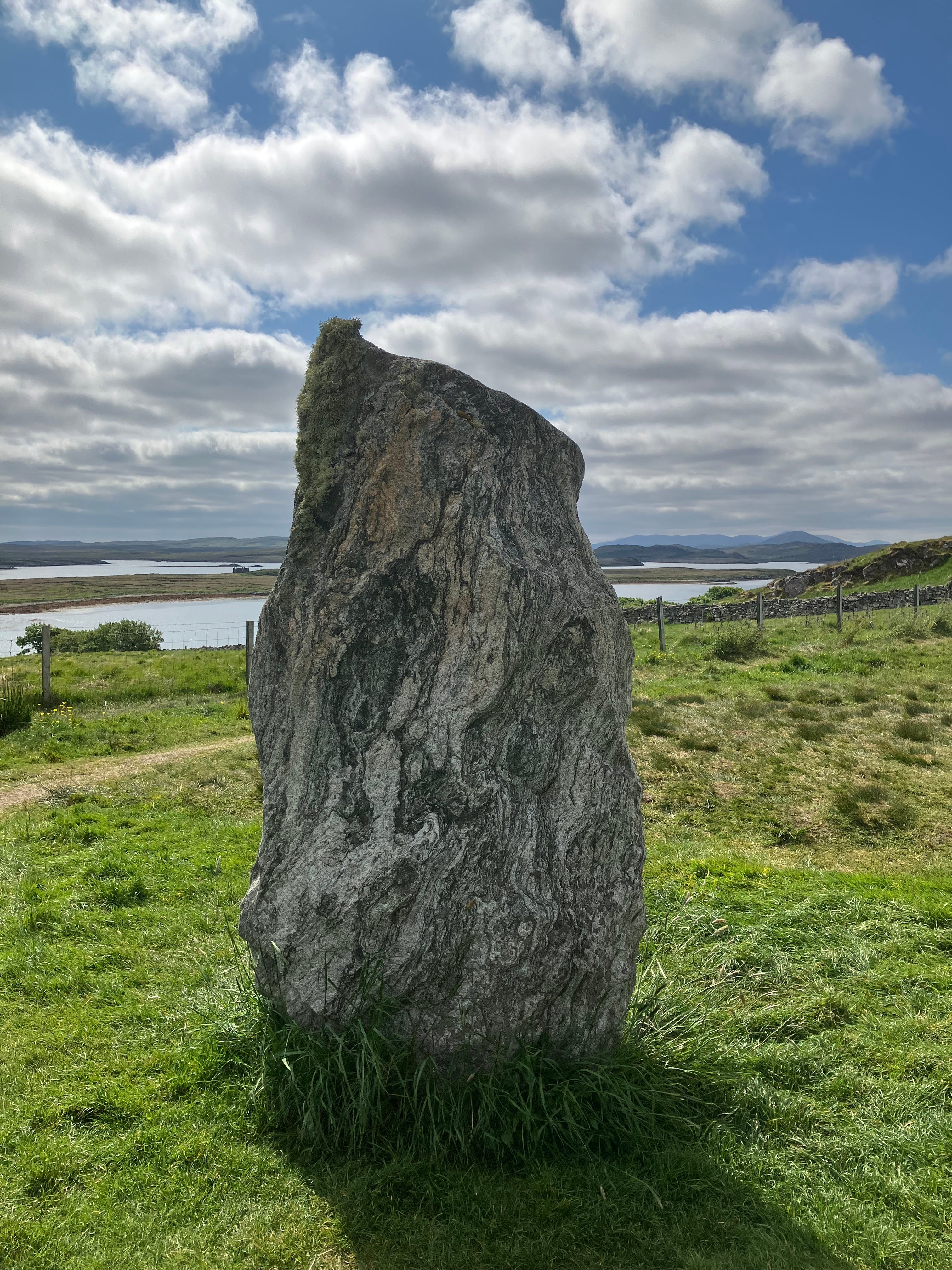
Calanais is not simply an archaeological attraction to me. Nor is it merely one of the most beautiful stone circles in the world, although it is certainly that: the extraordinary Lewisian gneiss, the pale veins of quartz, the glittering surfaces, the wonderfully individual forms of the stones and their astonishing arrangement within the Hebridean landscape.
There are mountains in the distance, water winding through the land, moor and meadow, wind and birdsong. When I have walked away from the stones along the shore or across the wet fields, among flowers, moving water and the cries of birds, I have felt younger.
Not merely refreshed, but returned to something.
I have felt like a seven-year-old boy setting out to conquer the world, while still knowing that the world carries him. Full of energy, trust, curiosity and hope. The stones give me access to that layer of experience: a primal sense of being at home.
Not homeliness. Not comfort.
Home in the deepest sense.
They bring me close to something that is both within me and beyond me—my own being, perhaps, or my spirit: something that seems to hover around the edges of ordinary consciousness, never entirely realised, yet unmistakably present. Something sensed rather than possessed. Almost within reach, but never captured.
Places such as Calanais help me approach that mystery.
That is why they are temples to me.
A sacred place is not sacred because somebody has officially designated it so. It is sacred because, through it, we gain access to the sacred riddle within ourselves.
And now there is a fence around it.
The problem is not primarily the entrance fee. The problem is the gesture.
A place that belonged to the open landscape has been inserted into a controlled commercial passage. One now enters by permission. One follows the prescribed route. One purchases entitlement. One is admitted—or remains outside.
The stones have become the thing on the other side.
That changes the experience fundamentally.
The power of Calanais lies partly in the absence of a hard boundary between monument and world. The stones rise from the same earth as the moor. Wind moves freely between them. Sky, water, rock, weather and human presence penetrate one another. You approach them across the land. There is no precise moment at which ordinary landscape ends and sacred space begins.
That openness is not incidental. It is part of what the place is.
It also corresponds to something primary in perception itself. Before we divide the world into subject and object, inner and outer, mine and yours, there is encounter. There is participation. There is a field in which the perceiver and the perceived have not yet withdrawn into separate camps.
The free approach to the stones allowed something of that original unity to remain outwardly possible.
The fence contradicts it.
Inside and outside. Public and private. Paid and unpaid. Authorised and unauthorised. The sacred object and the visitor looking at it. The living place has been forced into the familiar machinery through which our civilisation organises almost everything.
Perhaps the centre is necessary. Perhaps the number of visitors made some form of intervention unavoidable. Perhaps the project will bring jobs, knowledge and resources to Lewis. I do not dismiss any of that.
But necessity does not make a loss unreal.
We have become remarkably skilled at protecting places by destroying the quality for which they needed protection. We preserve the object while altering the relationship. We safeguard the stones and regulate the encounter. We defend the sacred place from damage by enclosing it within precisely the logic from which many people seek refuge there.
Calanais reminded me that the world is not entirely owned, arranged and administered.
Now it has been drawn further into that world.
This is why my grief feels so personal. The fence does not merely stand around a prehistoric monument. I experience it as standing between me and something I need in order to live: the reminder that another relationship with the world is possible.
One based not on possession, consumption or controlled access, but on presence.
On approach.
On trust.
On belonging.
The stones remain. The landscape remains. And perhaps, when I return, the place will prove stronger than the structures imposed upon it.
But something has nevertheless happened.
A line has been drawn across what, for me, was sacred precisely because it had no line.
No posts
Comments
Nothing yet. Say the first thing.
Sign in to join the conversation.