
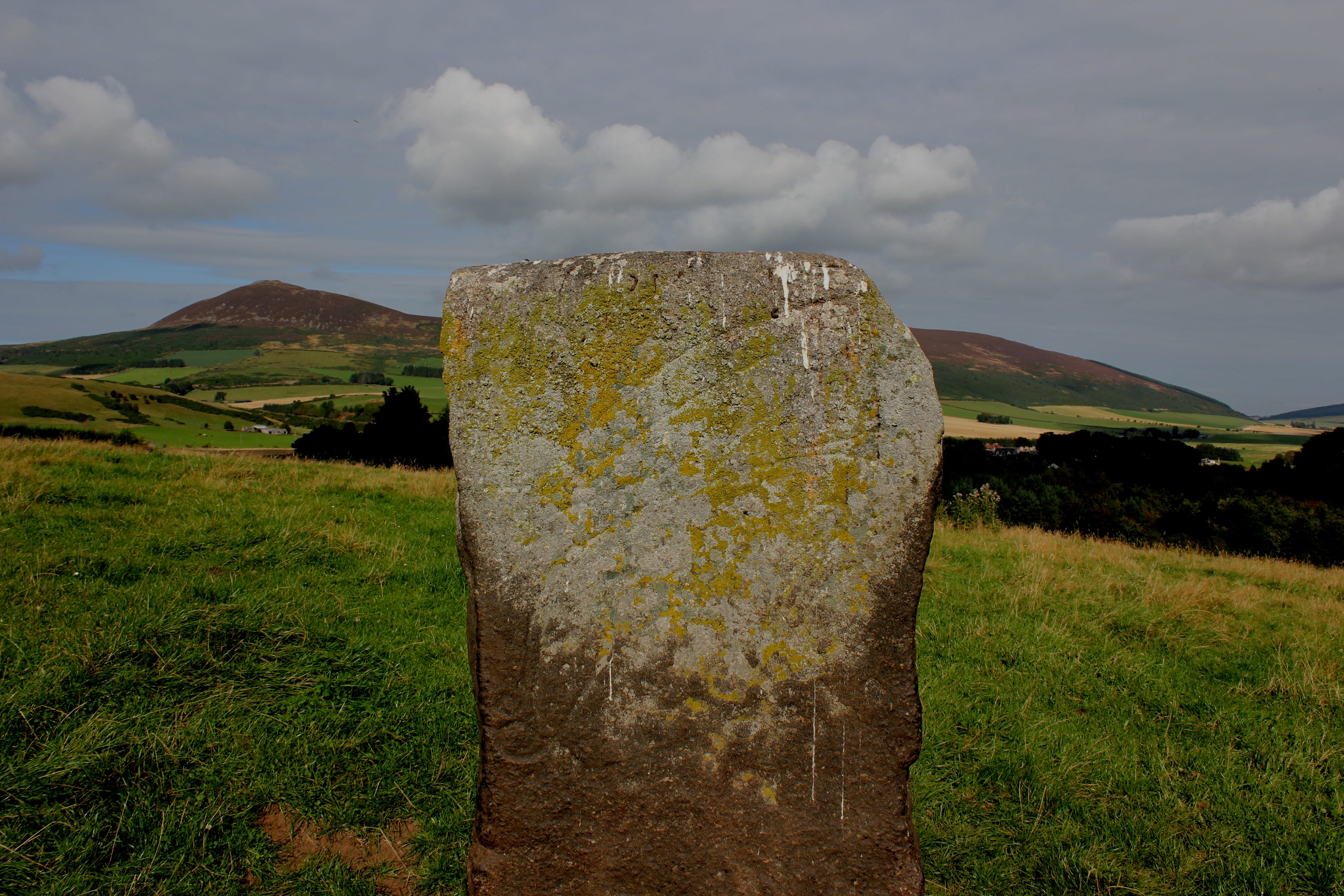
You stand before a Pictish symbol stone. A crescent curves across the surface. A double disc is crossed by a rod. A beast appears that is not quite horse, not quite dolphin, not quite anything the eye can settle upon. The stone is silent, but not empty. It holds attention with the strange authority of something that has not asked to be understood.
And almost immediately the mind begins its work.
What does it mean?
The question feels innocent. It feels intelligent. It feels like the proper beginning of study. Yet I increasingly suspect that this question, asked too quickly, may not be the beginning of understanding at all. It may be the moment when perception begins to close.
The Pictish stones have suffered, and benefited, from centuries of interpretation. Scholars have seen in them names, lineages, dynastic claims, territorial boundaries, ritual functions, political authority, Christian transition, sacred animals, cosmologies, calendars, astronomical codes, magical protections, maps of landscape and resource, even traces of lost civilisations. Somewhere, inevitably, Atlantis appears. This is both absurd and revealing. The stones have become a screen onto which every age projects its own hunger for meaning.
But perhaps that is not only a problem of the stones. Perhaps it is a symptom of us.
The modern mind is remarkably uncomfortable with not knowing. When something unfamiliar stands before us, interpretation rushes in like a rescue party. It gives us handles. It offers names. It reduces the pressure of presence. Interpretation can be beautiful and necessary, of course; without it we would remain mute before the world. But interpretation that arrives too soon becomes a form of possession. It takes the living strangeness of a thing and pins it down.
Perception moves differently. Perception waits. It does not immediately ask, “What does this mean?” It first asks, “What is happening here?” What is altered by this presence? What kind of attention is being called forth? What relationship is being established between stone, body, land, memory, and the one who stands before it?
This is the exercise.
Stand before a Pictish stone and do not ask what it means. Not for five minutes. Perhaps not for an hour. Let the carved forms work upon the eye before the mind turns them into answers. Notice the discomfort that arises. Notice how quickly thought begins to manufacture explanations. The mind wants the symbol to become a sign, the sign to become a word, the word to become a concept, and the concept to become something safely stored away.
But the stone resists this. It remains more than the interpretation placed upon it.
This resistance is not a failure. It may be the beginning of its power.
In recent academic research, there is a cautious convergence around the idea that the Pictish symbols were not random decoration, nor a straightforward alphabet waiting to be deciphered. They appear to form a structured system, likely concerned with identity, kinship, status, authority, memory, and belonging. That already changes the question. The stones were probably not simply “saying” something. They were doing something. They were not only carriers of information. They were acts in the landscape.
And this distinction matters.
A stone raised in a landscape does not simply occupy space. It changes the field of perception around it. A standing stone alters a moor before anyone explains it. A church changes a village before anyone reads its theology. An ancient tree changes a woodland before anyone names its species. Certain presences gather the world differently around themselves.
The Pictish stones belong to this family of presences. They mark, but they also make. They do not merely indicate that something once happened here. They establish a relationship. Between a person and a people. Between a lineage and a place. Between authority and memory. Between the visible land and an invisible order that once made sense within it.
Perhaps this is why the question “What were they made for?” also feels too small. It assumes a function, as though the stone were a tool. But the stone is not a hammer. It does not have one use. It gathers several powers into one place. Political authority, sacred presence, ancestral memory, social identity: these are not separate categories in the world that produced the stones. They belong together.
To stand before such a stone, then, is not only to look at an archaeological object. It is to enter the remains of a relationship.
This is where the Pictish stones become important for a school of perception. They teach that perception is not passive reception. To perceive is to be reorganised by what one meets. The stone does not give itself away, but it changes the manner of our attention. It draws the eye, frustrates the intellect, thickens the atmosphere, and makes the surrounding land less neutral. Suddenly the place is no longer merely scenery. It is inhabited, claimed, remembered, charged.
The stone does not explain the landscape.
It alters it.
And if we stay with it long enough, it alters us as well.
This may be the deeper meaning of symbol: not a hidden message behind the visible form, but a visible form that changes the way the world can be encountered. A symbol is not simply something that stands for something else. It is something through which relationships become perceptible.
This is why the hunger to decode the Pictish symbols can become a trap. To decode is to translate the unknown into the already known. But initiation works the other way around. It allows the unknown to enlarge the one who meets it.
Perhaps the Pictish stones are not asking us, “Can you solve me?”
Perhaps they are asking, “Can you perceive the world that made me necessary?”
That question cannot be answered quickly. It cannot be extracted like data. It requires the old discipline of standing still before something that exceeds us.
And perhaps this is why these stones still matter. They reveal our impatience. They show us how quickly we convert encounter into explanation. They expose the poverty of a culture that has become rich in interpretation and poor in attention.
The mystery of the Pictish stones is therefore not only historical. It is also contemporary. It belongs to the way we look, the way we think, the way we flee from presence into meaning.
For the first task of perception is not to solve the world.
It is to let the world become present before we begin to explain it.
No posts
Comments
Nothing yet. Say the first thing.
Sign in to join the conversation.