
The first day of a course is rarely the beginning.
People have arrived, yes. Bags are in the hallway, boots by the door, ferry salt still in their hair, damp jackets steaming gently in the warmth of the room. Someone has made tea. Someone is looking for the bathroom. Someone needs to know where they sleep. Someone is hungry but too polite to say so. Someone has travelled too far and is quietly waiting for the week to justify the journey.
The room is full before the work has begun.
Full of timetables, missed connections, hopes, private worries, bodily tiredness, unspoken questions. Will the food be enough? Will the group be strange? Will I get what I came for? Will this be too intense, too vague, too emotional, too spiritual, not spiritual enough?
Very little of this is usually said. It appears sideways: in a question about the programme, in the urgent need to unpack, in the wish to see the bedroom immediately, in a small disappointment about something entirely practical. These are not interruptions of the work. They are the first layer of it.
Before a person can look deeply at a stone, a flower, a shoreline, a face, or a question, they must arrive.
This sounds obvious until one notices how rarely we do it.
We arrive with bodies, yes. The rest of us is still on the road, still in the inbox, still in the old conversation, still rehearsing what might happen next. The place is already there. The sea moves. The gulls cry. The light changes on the hill. But we are still crowded with ourselves.
So I often begin with a simple round.
Where are you right now?
What did you arrive with?
What is still occupying you?
What needs to be spoken before you can begin?
Sometimes the shift is immediate. A worry that has filled the inner room becomes smaller as soon as it has words around it. Someone laughs. Someone nods. The group exhales. Shoulders drop a little. People begin to see one another.
This is already perception.
Before the stone circle, before the sacred well, before the exercise in attention, there is this quieter threshold: the movement from being full of what we brought to becoming able to receive what is here.
Before a recent course on Arran, I travelled to the island a day early. Sensible, I thought. I would settle in, walk, breathe, prepare inwardly, tune myself to the place before the group arrived.
A noble thought. Very wise. Very guide-like.
In practice, much of the day was ridiculous.
Arran was there in all its generosity: the line of the coast, the soft lift of the hills, the smell of wet grass and bracken, the sea opening and closing between veils of weather. But inwardly I was nowhere near it.
Would everyone make their flights? Would the car hire work? Would the ferries behave? Would the group fit together? Would the teaching land? Would someone need support? Had I forgotten something small that would become large at the wrong moment?
I walked because walking usually helps. The road took the anxiety down through the soles of my feet. The body began doing what the mind could not. Step, breath, step, breath. The island was no longer an idea. It was gravel, wind, sheep, gorse, salt, cloud-shadow moving over the slopes.
For a few moments, I arrived.
Then the phone came out.
A message. Nothing disastrous. Just uncertainty. And immediately I was back inside the machinery of control, trying to secure the future before it had happened.
At some point I had to make a small, undramatic decision. I had done the preparation I could do. I had sent the information. I had checked what could be checked. The better preparation now was to switch the phone off and walk.
To let the island begin to work on me before I tried to guide anyone else into it.
That is where becoming available begins: with the honest recognition that we usually arrive crowded.
The world is often much more open than we are.
One of the quickest ways we keep reality away is by understanding too soon.
There is a small inner movement, almost too fast to catch. The eye sees, the mind names, and the thing is filed away before it has had time to appear.
Robin.
Willow warbler.
Oak.
Granite.
Cup-and-ring mark.
Standing stone.
Sadness.
Resistance.
Beauty.
Useful words, all of them. Necessary, often. But when the name arrives too quickly, it can close the door it was meant to open.
A bird sings from a hedge. The first temptation is to identify it. If I know the species, I feel I have received the song. But the name is not yet the song.
Before robin, there is the small bright pressure of sound in the morning air. A phrase thrown out from the thorn hedge. A liquid turn. A pause. A finer thread continuing after the louder notes have gone. There is the place where it enters the body: throat, chest, skin. There is the way the sound changes the space around it, making the hedge suddenly inhabited.
Then, later, the name may come.
The name can deepen the meeting if it arrives in the right order. First the living sound. Then the bird. Then the knowledge. Then, perhaps, the pleasure of recognising an old neighbour.
Perception needs that little delay.
A breath before naming.
A moment before interpretation.
A hand that does not close too quickly.
At Machrie Moor, the standing stones lie open in one of the great landscapes of Arran. The moor stretches wide, the stones rise dark from the grass, and beyond them the mountains gather the eye upward. On a bright day the whole place can feel almost too composed: stone, sky, bog, distance, Goatfell lifted into the weather like a thought the island keeps having.
During one course, I asked the group to spend time there quietly. No task beyond walking, standing, looking, listening.
When we gathered again, people began to speak. One had noticed how the stones seemed to collect the surrounding hills. Another spoke of the different moods of the circles. Someone else had felt a stillness that did not belong to silence alone, more like a held breath in the land.
One participant said almost nothing.
When I asked him what he had noticed, he tried to avoid the question. Then frustration broke through.
“I don’t get what you’re all talking about. You’re all having these experiences, and I think I’m just stupid. Nothing happened. The stones don’t mean anything to me.”
The air tightened.
These moments are precious, though they feel awkward at first. Someone has stopped performing. The polite surface has cracked. Now the work can become real.
So we stayed close to what had happened.
He had walked from stone to stone. He had felt drawn to one circle and uneasy near another. He had noticed distance, exposure, a kind of refusal in one place, a more settled feeling somewhere else. But each impression had been dismissed almost before it could unfold.
Too small.
Too ordinary.
Too uncertain.
Not enough.
He had expected something stronger: a clear spiritual feeling, a message, a wave of emotion, perhaps the unmistakable sense that the stones were “speaking”. Because the experience came quietly, bodily, indirectly, he decided it did not count.
This is one of the most common ways perception is lost.
Something does appear, but in a form we were not waiting for.
A faint unease.
A leaning of attention.
A warmth in one place and withdrawal in another.
A detail that will not leave us alone.
A change of breath.
A silence with texture.
These are often the first arrivals. They are shy creatures. They do not survive rough handling.
Expectation stands at the threshold with a clipboard, deciding what counts as meaningful. Perception usually enters by another door.
On another day on Arran, I took a group to a place I almost felt embarrassed to show them.
We were following a biographical thread connected with a figure who had grown up on the island. As a child, he had gathered with friends among certain rocks and, with a boy’s solemnity and imagination, preached to them there from the Gospel of St John.
The story moved me. The place itself seemed modest.
A scatter of rocks. Small hollows. Little cave-like spaces. Nothing grand. No sweeping ceremonial landscape. No great alignment of stone and mountain. No obvious hush.
I thought of it as a minor stop, a footnote between more impressive places.
The group received it otherwise.
For some, it became one of the most important places of the journey.
The very smallness opened the door. They could imagine the child there: the rocks becoming pulpit, house, cave, kingdom, secret chapel, animal, friend. They began to remember their own childhood places: dens under bushes, stones beside streams, corners of gardens, hollow trees, the invisible kingdoms adults walked past without seeing.
The great stone circles had moved them, yes. The mountains had opened the scale of the ancient world. But this small place returned them to the scale at which imagination first enters matter.
I had almost missed it because I was still carrying a guide’s vanity: the wish to deliver the visibly impressive, the unquestionably meaningful, the place that announces its importance before anyone has to work.
The group taught me better.
Depth does not always stand where we have placed the spotlight.
Sometimes it waits in the footnote, among damp stones and child-sized hollows, until someone kneels down inwardly enough to enter.
There is a kind of attention that leaves the world intact.
It does not grab. It does not rush to use. It does not immediately turn what appears into teaching material, identity, memory, interpretation, proof.
It lets the other thing stand forward.
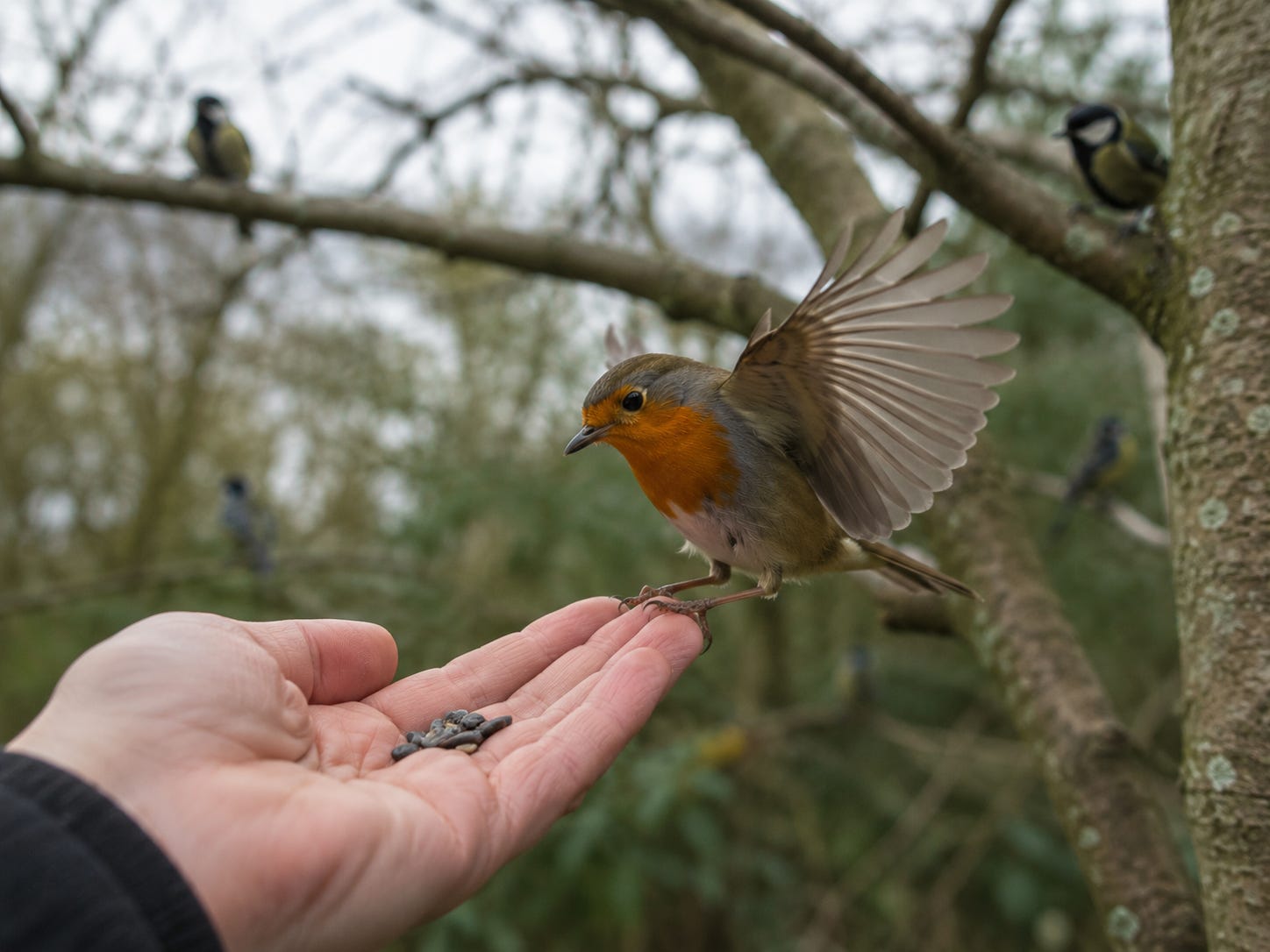
A winter bird teaches this perfectly.
You stand in a park with sunflower seeds in your open palm. The air is cold. Your hand begins to ache slightly. In the branches above you, blue tits and coal tits flicker from twig to twig, watching.
Every unnecessary movement matters.
The impulse to coax, reach, lean forward, make it happen — all of that would ruin the meeting. You cannot pull a bird into trust. You can only become still enough to be considered.
Then, if you are lucky, one comes.
A coal tit lands on the edge of your hand, almost weightless, yet entirely precise. Tiny claws touch skin. The body is so light it seems barely earthly, and still there it is: warm, quick, living, choosing. It takes one seed and is gone.
Nothing has been possessed.
Nothing has been proved.
The bird came freely and left freely. The whole event lasted perhaps one second, and yet the body knows it happened.
This is close to what I mean by reverence.
An open hand.
A form of attention that does not consume what it receives.
This becomes especially important when we love something.
On Arran, there is a prehistoric rock art panel very dear to me. The markings are modest: cups, rings, grooves, small channels running through the stone. At first glance, one could pass over them quickly. The carvings do not leap out. They wait close to the surface, half-given, half-withheld.
Over time, after many visits, they began to work inwardly on me. Some of the forms started to feel like small beings: childlike, angelic perhaps, hovering around their own centres, arms lifted around their heads, playful and not quite incarnated.
That is my experience of them.
And it would be a mistake to begin there.
If I say too quickly, “Look, they are like children or angels,” I have already stepped between the person and the stone. I have given my image before the phenomenon has had time to form its own image in them.
So I try to hold the group longer at the level of description.
Where is the panel in the landscape?
How does the stone lie?
Where does rainwater run?
Which marks are clear?
Which are uncertain?
Where does the eye begin to move?
What belongs to the rock, and what has been carved into it?
What changes when you look from the side?
What changes when the light shifts?
Description is not a dry preliminary to perception. Description is a way of staying. It keeps the attention from flying upward too quickly into meaning.
And sometimes, after a while, the stone begins to move inwardly for someone else. A rhythm appears. A tenderness. A strange intimacy. A person notices that one line seems to gather the others. Someone sees something childlike. Someone becomes quiet.
Then words may help.
Before that, words can steal.
Birds taught me another difficult lesson: the world does not appear on command.
You can travel to the right place, wake early, walk quietly, know the habitat, read the reports, bring the binoculars, and still the bird does not come.
Or it calls once from somewhere impossible and vanishes.
Or everyone else saw it ten minutes before you arrived.
This is maddening, and therefore useful.
It reveals the contract we thought we had made with reality: I came all this way, I prepared, I waited, therefore something should appear.
But living beings have their own timing. Places too. People too. Even thoughts.
Some encounters cannot be improved by effort. They can only be made possible by readiness.
Waiting, in this sense, is active. The body stays. The will softens. The hunger to move, capture, conclude, improve, and report is asked to become quiet. The world is allowed to continue without being pushed by our wanting.
Sometimes nothing comes.
Sometimes the waiting itself becomes the encounter.
Sometimes, just when we have stopped arranging the moment around our own appetite, something moves at the edge of the field.
To become available is to become less in the way.
This is humble work, almost embarrassingly practical.
We notice the luggage we brought and put down one bag.
We notice the quick hand of interpretation and let it remain open a little longer.
We notice the experience we were secretly demanding and return to the smaller thing that actually happened.
We notice the wish to impress, to explain, to deliver depth, and let the place breathe without our performance.
We describe before we interpret.
We wait before we conclude.
We receive before we use.
The world may already be touching us through colour, sound, weather, stone, birdcall, silence, unease, attraction, resistance, memory, breath. Perception rarely begins as thunder. More often it begins as a slight alteration in the texture of the moment.
A sound enters differently.
A stone holds the eye.
A place refuses us.
A path draws us on.
A childhood memory rises because a hollow in the rocks has the exact size of a forgotten kingdom.
Something wants to appear.
Our task is not to force it into revelation.
Our task is to become quiet and truthful enough that it does not have to fight its way through our noise.
Arrive.
Feel the ground.
Let the phone sleep.
Let the name come later.
Let the stone remain strange.
Let the bird sing before it becomes a species.
Let the small place be small until it opens.
Let the world, if it will, come closer.
No posts
Comments
Nothing yet. Say the first thing.
Sign in to join the conversation.