
Not much is known about Dino and Roberto Falcone.
There’s been the occasional Instagram post with a quick carousel of photos. Minimal information. The obligatory comparison to the Cartier Crash, which is usually left unfavorable towards the Italian side. As a general rule, not many are aware these watches exist. Even fewer know their story.
Compared to Instagram pixels, even less ink has been spilled on their work. Tony looked at them briefly back when Unpolished was still Rescapement, in an overview of some lovely shaped watches.
But the piece they’re ranged against there—in particular, the Exaequo Softwatch—doesn’t even come close.
I’ve been waiting to write this story since before Remontoir existed.
Now, for the first edition of Remontoir Magazine, I think it’s time to immortalize some of my watchmaking heroes.
Let’s talk Falcone.
This article originally appeared in the first print edition of Remontoir Magazine. Available monthly for just $7/month, this minimag is the most affordable fully independent watch magazine on the market today. Sign up here. Print subscriptions also include a free digital subscription to the full Remontoir archive.
Very little is known about Dino and Roberto’s personal life. Based in Milan, the two were a father-and-son duo who acted as both watchmakers and casemakers.
And… that’s about the majority of what we know. Publicly, there is very little else available. What they looked like, talked like, where they trained, is all obscure for now. I hope one day to publish a second article, if more information arises.
We know, thankfully, what they made. That work alone speaks for itself.
Their work falls into three eras: the first and earliest, made by Dino alone; the second, created by both Dino and Roberto; and the third, Roberto alone. These are signed, respectively: DF; D&RF; and RF.
Their work is at once continuous and experimental, both establishing a clear design style and simultaneously refusing to be tied down to it. It’s intensely avant-garde for its time, laying a foundation for the synthesis of watches and art that has taken hold in recent years. Dino and Roberto truly left a legacy.
Let’s begin.
Editor’s note: As it turns out, licensing images from auction houses is extraordinarily expensive. For the moment, far beyond the reaches of this little publication. As such, as Remontoir grows, I will return to this article digitally and update it with as many images as I can. Until then, QR codes and links will be used. Thanks for your patience.
In the beginning, Dino Falcone worked—or at least signed his work—alone.
This early era of pieces, each bearing simply DF on the dial, begins mesmerizingly with a watch that looks as if it once filled the pocket of a 17th-century nobleman’s waistcoat. Crafted as part of a revival movement that took the watchmaking world by storm in the 1960s and 1980s, it’s apocryphally signed Jacques Jolly and known merely as “The Hunt.”
Key-wind, hand-engraved, fusée and verge—these are not terms regularly applied to watches in the 20th century. And yet the earliest piece by Falcone that remains to watch collectors today is indeed this very one. It’s astonishingly distinct from all the creations that followed it.

The verge escapement, in common use, had died out almost completely by around 1860. The Hunt brings it back. The watch is named for its hand-engraved case featuring hunting scenes, which immediately shows Dino Falcone’s talent as an engraver as well as a casemaker for its peculiar oblong body. Measuring 103mm by 84mm, it uses only one blued steel hand to tell the time due to the inaccuracy of its escapement. And that’s exactly the point.
For the Falcones, an experience in crafting a verge escapement—inherently inaccurate and inefficient—is a lesson in watchmaking as a study divorced from accurate timekeeping. I’m not making a point here about whether or not watches need to be accurate. Much breath has been spent on that subject, and I’ll refrain from delving into it here. But in this pre-Quartz Crisis era, Falcone was experimenting with watchmaking as a decorative art form. Pocket watches made in a beautiful and above all historical style.
This piece has appeared twice at auction: both at Antiquorum, where it sold in 2003 for CHF 3,450 (high estimate CHF 4,000) and again in 2020 for CHF 2,500 (high estimate 1,800).
1A, on the other hand, is the beginning of a legacy.
Bearing no other name, no other nickname, it nonetheless represents the beginning of a monumental, legendary style. It’s the first Falcone as anyone would picture that name on a watch today.

Christie’s dates it circa 1985. For the time, it’s astonishing. Let’s start with the dial.
The hands and numerals are obviously inspired by Breguet, but fascinatingly twisted. Melted. Complications are scattered almost haphazardly over the dial surface. A gorgeously framed moon phase at 1:30. Day of the week at 10:30. Minutes around 7. Small seconds at 4. One great big blued steel hour hand in the middle. A tiny, discreet DF signature at 12:00.
The case is even more of a masterclass. True casemaking, as an art, is perishing today in modern watchmaking. With the tragic passing of J.-P. Hagmann, there’s not much of a legacy left here apart from what we find in vintage. And those who have held a JPH Akrivia or Rexhepi case will know that this is an art unto itself.
Dino Falcone was a master of casemaking. The 1A’s 32mm form is intimately fluid, rippling almost like molten metal around bulges and crevices. Soldered lugs, like twisted bull’s horns—cornes de vache for my Vacheron lovers—hug the strap close. A quiet matte finish adorns the body of the watch. A beautiful mirroring covers the lugs.
The watch is in perfect harmony with itself. The case, the dial, the lugs, the hands, all follow one common theme. One principle of design. Fluid abstraction. Even the moon on its disk is visibly handpainted, an imperfect circle that feels just as molten as the rest.
All, that is, except the crown. Sticking out like a sore thumb in yellow gold on pink, I’m almost certain it’s aftermarket or tacked on as an afterthought. Perhaps 1A was never truly finished. For now, I’m choosing to dismiss it. The choice of such a mismatched crown is inexplicable given the Falcones’ supreme attention to composition throughout the whole piece.
1A in pink gold passed through the hands of Christie’s in 2013, where it hammered for CHF 35,000 against a high estimate of CHF 30,000. That’s the beginning of a continual pattern of the market’s underestimation of Falcone. Almost every time these pieces appear at auction, they beat estimate. Considerably. And yet nobody is talking about them.
As a final note, for those of you who are used to Berneron, you may be disappointed in hearing that the movement is not form-fitting to its asymmetrical case. This is, after all, the 1980s. Christie’s only tells us that under the hood is a circular, 17j, gilt-finished movement, without describing any more.
Regardless, the 1A is the beginning of an artistic legacy. We’re told it was inspired directly by Dalí’s The Persistence of Memory, and it certainly does a superb job of mimicking that effect of melting time. Not only, then, is this piece a work of art on its own, but it’s also engaged in a dialog with art itself—without directly mimicking it.
Much more was soon to come.
The 1A set an archetype for Falcone case shapes that I affectionately call “lumpy oval”.
The 1B is my beloved “mostly round”.

These two shapes would come to define a huge proportion of the output of the Falcone workshop, so establishing them extremely early on in their work is nothing short of astonishing.
Also estimated to be created around 1985, the 1B measures around 35.5mm in diameter and is in nearly every way far more subtle than its older brother.
Of course, I’m using that term very relatively. Its form is even more fluid than the 1A: bulges and divots abound, the lugs meld further into the case, and even the crown receives a rather strange-looking protrusion. The complications have been pared back too: a moon phase is set slightly off-center around 12:00, and day of the week smack dab at 6. Hours, minutes, and numerals follow the same “Falcone Breguet” style. And that same, humble, DF signature is dotted right under the moon phase.
We know a bit more about the movement of this one, thanks to the obliging team at Christie’s where it also sold in 2013. It’s also circular, 17 jewels, and a lever escapement, but we’re told it’s signed Sarcar Genève. That brand name is still in use today, although it’s now focused on creating ultra high-luxury gem-set pieces. The historical brand was notably said to be, by its founder Carlos Sarzano, “large enough to be strong, yet small enough to be free.” How very apt for a similarly individualistic workshop based just across the border in Milan.
I haven’t yet handled a Falcone in person, but I’m almost convinced the 2A is an exact molding of 1B. The case is identical in form, in bulges, and in almost every way save the lug shape and length—and these are visibly soldered on after the main body of the case is formed.

Whatever the method of manufacturing, this second generation of Falcone watches clearly represents an even further refinement of their design. The 2A has no complications at all save a small seconds at 6:00. Compared to 1A, the design changes are clear. The numerals have been enlarged in relation to the dial size, the hands bent at even more extreme angles, and the bend of the lugs changed to flow more fluidly from the case.
As the most restrained of Dino Falcone’s works, it’s also a clear step forward in codifying and developing his own design language. He’s messing with proportions, shape, size, and every element he can to perfect this style. His own style.
This example has appeared twice at auction: in 2001, where it sold at Christie’s for CHF 41,125 against a high estimate 40,000; and again at Christie’s in 2011, where it over doubled its high estimate of CHF 15,000 to hammer at CHF 32,500.
Let me just pause and reiterate that we’re talking about the 2011 watch market here. Appreciation for shaped watches then was nowhere near what it is now. Christie’s estimate is almost criminally low. The market absolutely smashed it.
And for some reason we don’t talk about Falcone like we talk about other design icons of this era.
And yet well-heeled auctiongoers seem to think there’s something in a Falcone worth fighting over.
Yes, you read that right—we’re going straight from 2A to 2C. As far as I’m aware, 2B has never publicly appeared at auction. Or if it has, the auction house didn’t label it according to its stamp… we’ll talk about a few at the end here that have gone unnamed.
In any case, the 2C represents a sort of “doubling down” on the “mostly round” case shape. It’s different this time, however: in juxtaposition with 2A, it’s quite visibly distinct in nearly every bulge and outline.
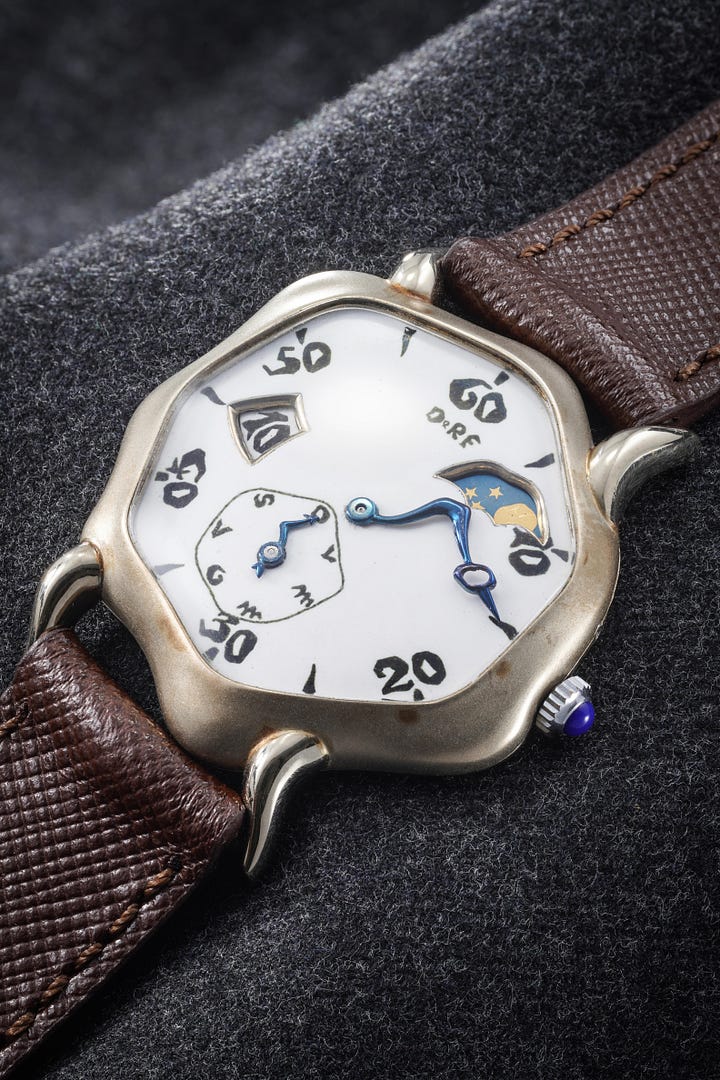

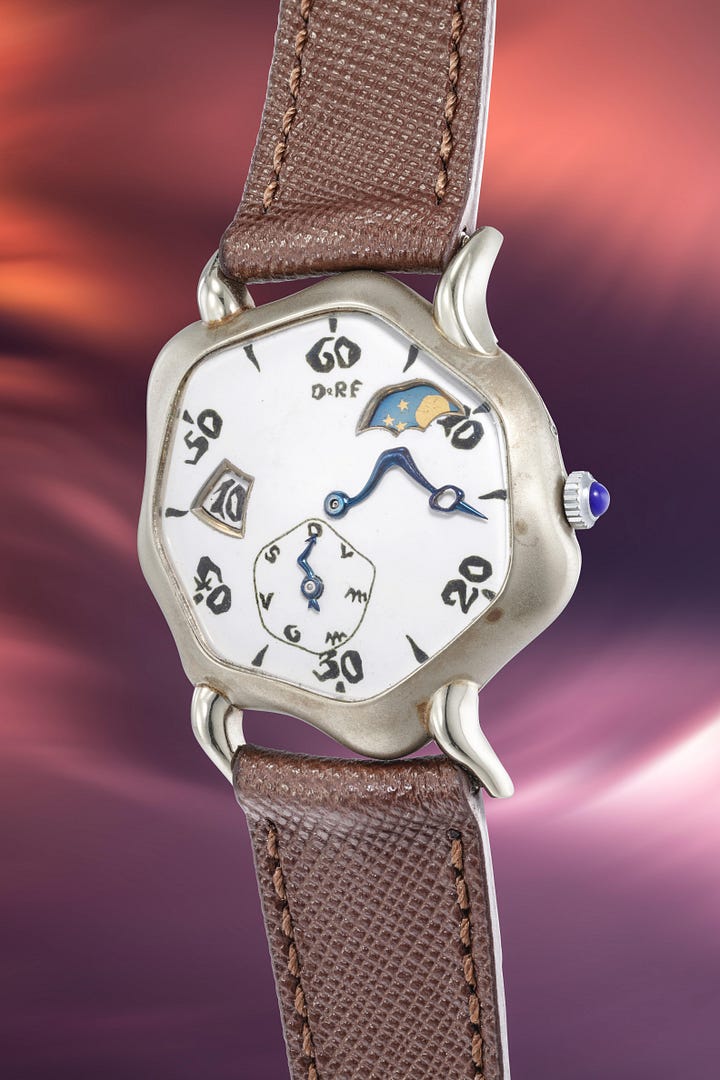

Oh, and in case you didn’t notice: our dear Roberto has joined the fray.
Now signed D&RF, the 2C represents quite a few other “firsts” for the Italian duo. A new precious metal. A blue sapphire cabochon crown. A beautifully framed jump hour complication at 9:00, alongside the traditional moon phase and day of the week. Larger numerals.
And a new movement. Bemusingly, Christie’s in their 2013 auction tells us it’s a caliber 7001, lever escapement, 17 jewels… but doesn’t explicitly give us the name of the manufacturer. Of course, this editor’s best guess would have to be the ETA/Peseux 7001, which was in production since 1971 by Peseux before it was acquired by ETA in 1985. At that point, it changed brand names and kept right on being produced.
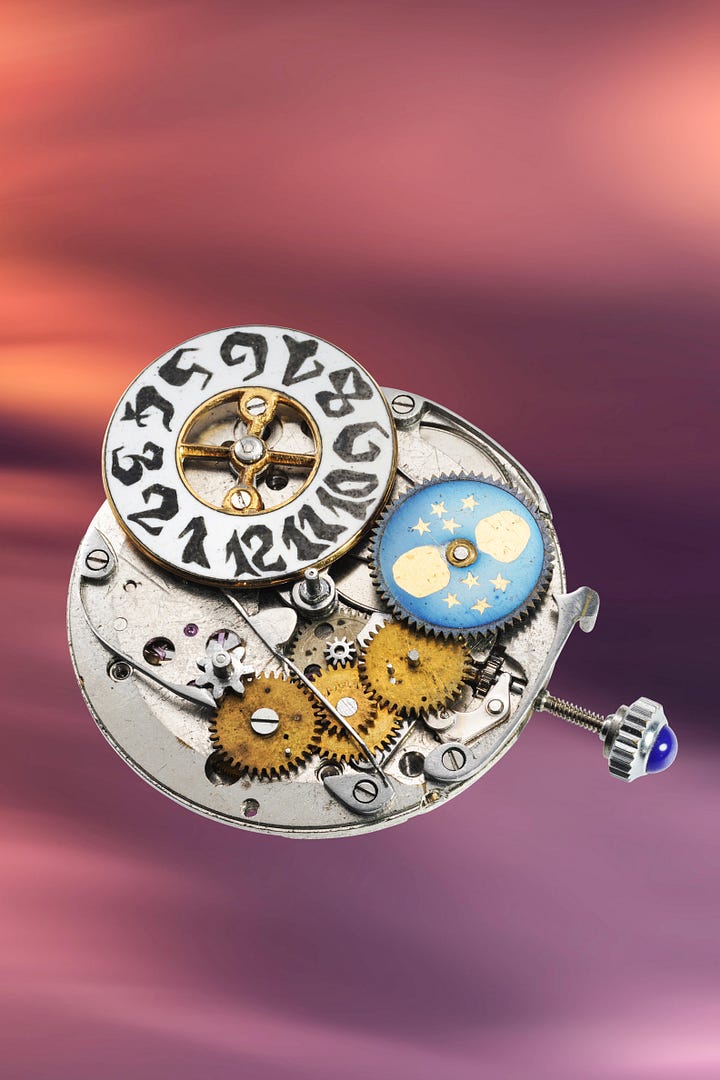
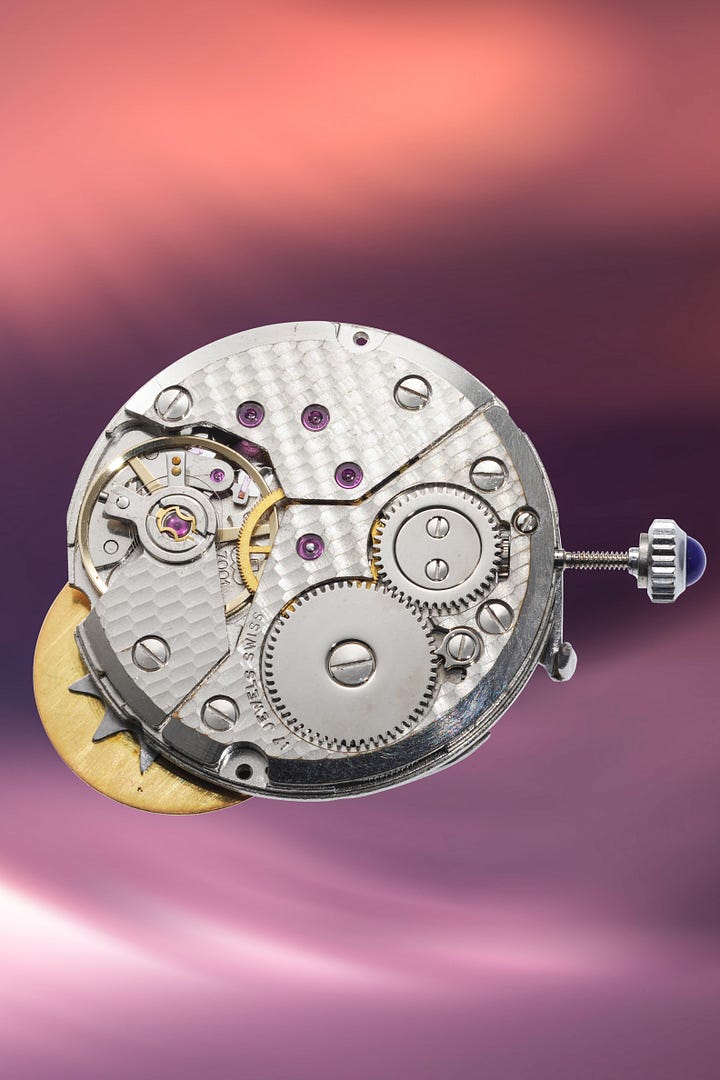
The same watch also just appeared at Phillips in 2026, showing quite a few more patina marks (yikes!). This time, it obliterated all estimates: against a high estimate of CHF 120,000(!!) it reached a whopping CHF 889,000.
Can we sit for a second and talk about that? At Christie’s in 2013, this watch went for CHF 50K. Its high estimate this year was well over double that. Its actual earnings were almost seven and a half times the estimate.
Here’s a chart that shows just how insane these results are. All Falcone pieces, their estimates, and realized prices are here in a chart.
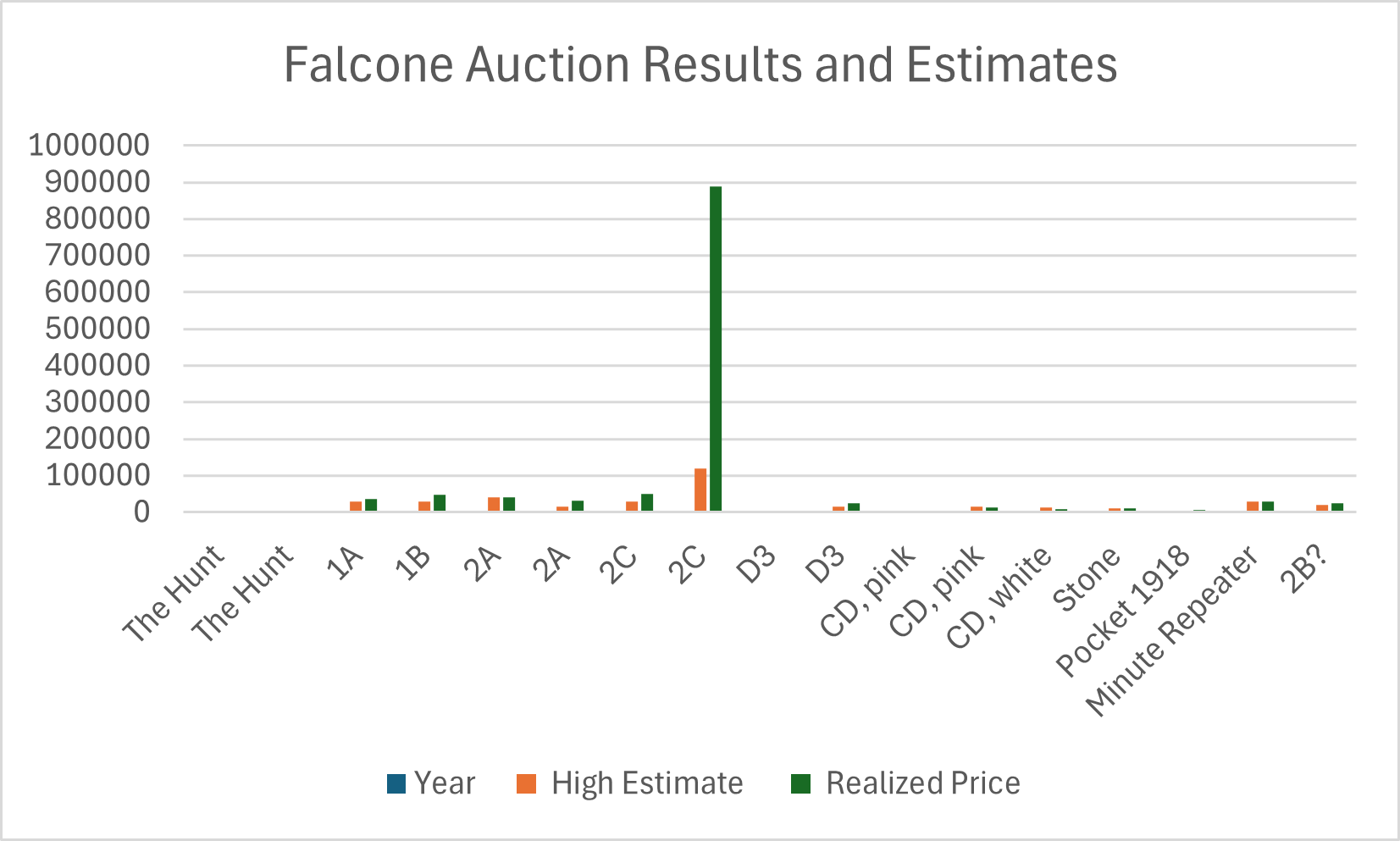
Everything else is massively dwarfed by how much this last auction just brought in. You can barely even see the other blips on the graph. Its estimate is microscopic.
The results are nothing short of exceptional. The market has shown these pieces are not to be ignored.
Like I said, it’s time to talk about Falcone.
After the 2C, we reach something new. Roberto strikes out on his own, presumably after his father’s retirement. Or perhaps the two continue to work together, with Roberto signing his name alone. The timeline is, for now, uncertain.
The numbering system gets a little weird here. Why is it D3 and not 3D? Christie’s, however, tells us that this is a stamp, not a “number” in the same sense as the others. I haven’t seen this watch in person, so I’m not sure exactly what’s going on.

In any case, this watch is extremely interesting for quite a variety of reasons. First, it’s the only “melted” watch that we have bearing Roberto’s signature alone. Second, it’s not the same shape as the 2C, which Roberto worked on with Dino. Most interestingly, it’s a return to the original “mostly round”, found in 2A and 1B. That’s a fascinating choice, perhaps taken to study or commemorate Dino’s work. Or perhaps the timeline is twisted here, and Roberto worked solo alongside Dino before the two collaborated.
In other aspects, however, the D3 is very continuous with the rest of their work. Time-only with a small seconds display at 6:00. “Falcone Breguet” numerals and hands. And, interestingly, a small jewel set at the pivot of the hands. Another thing we’ve never seen before in their work.
Under the hood here is also a new movement: a Baume & Mercier BM1050, another hand-wound movement. This too is fully circular, and shows the continued preference of the Falcones for manually wound watches. Whether this is to slim the watch or encourage the wearer to engage with it in winding each day is unclear, but the choice is certainly a romantic one.
This watch has also appeared twice at auction: once at Sotheby’s in 2003, and again at Christie’s in 2013, where it sold for CHF 23,750 against a high estimate of CHF 15K.
The Falcones were very, very far from a one-trick pony. They refused to be tied down into one design language or style. They made, quite clearly, whatever the heck they wanted to. Roberto, in particular, seemed fond of experimentation. Let’s dive into some of these.
Two different concealed-dial wristwatches, following the same design and layout, are signed RF. One in 18K pink gold and the other in white gold, with caseband set with diamonds. We’re told that at least the white gold model is just 20mm in diameter, and no information is available about the pink gold.


Both feature the same hidden dial: an erotic scene, which appears to be hand-painted. This is revealed at the press of a button and slide of a lever, disengaging the dial cover—which, in itself, is quite lovely.
These pieces are estimated to be made around 1989 and feature the Blancpain caliber 2046. The pink gold model appeared at Christie’s in 2013 (CHF 12,500 against an estimate of 10K-15K) and at Sotheby’s in 2003, while the white gold was at Christie’s in 2014 and sold for just HKD 81,250 against an estimate of 70K-120K. It’s clear that Falcone collectors have their tastes: “melty” models perform far better in the market than anything else.
Another example of Roberto’s willingness to experiment, this piece brings together quite an exceptional skillset of artisanal mastery. The movement is highly skeletonized—which is in itself an art when done by hand—and engraved with lovely fluid and natural patterns. It’s also been gilded and is set inside the rim of a cut hard stone of some green variety. Sotheby’s, where it appeared at auction in 2019, wasn’t able to identify the exact stone, but my best guess is a variety of jade or serpentine.

This dial, which of course is meant to be the star of the show, is set in one of the Falcone’s most restrained cases, a lovely display of mirroring and sharp angles. It’s signed simply “FR”, which is the only example of Roberto using this signature instead of the usual RF. Oh, and this particular model sold for just $15,000, which was its high estimate. Astonishing just how much of a steal vintage watches can be sometimes!
Just when you thought all that melty goodness couldn’t get any better, it did. And no, we’re not talking about chocolate.

Though this piece is unsigned, it’s so clearly a Falcone that it doesn’t even need a signature. That’s enough to make me think that it’s a later work, in the same way that H. Moser have stopped signing visibly signing their dials now that people know their look, but there’s no clear estimated date of creation.
This time-only, 51mm pocket watch is made from silver and crafted in the Falcones’ unique fluid style. It’s stamped simply H and features a circular, gilt-finished movement signed CYRUS.
That brand name is also around today, likewise focused on making bold and ultra-high-end watches. Not much else seems to be available about their historical work.
Even against an estimate of just CHF 2,000-3,000 this pocket watch went for CHF 6,000. Another remarkable result for another remarkable watch.
Many consider the tourbillon to be the ultimate symbol of haute horlogerie. I’d propose the minute repeater, which in this example is at its highest art.
Signed DF for Dino—which of course makes it an earlier piece—it features a highly skeletonized, wildly intricate minute repeater on full display through its openworked dial. I have not much else to say here—the beauty of that movement speaks for itself. It’s surrounded by a rehaut to help read the time, which actually makes this watch quite legible paired with the broad leaf hands.

The minute repeater is, of course, actuated by the prominent slide at 9:00. Not having handled this watch in person, I can’t speak to the quality of its sound. I’d like to add, however, that a master casemaker of the caliber and quality of Dino Falcone would almost certainly know how to make a minute repeater truly sing. Regardless, the inclusion of a minute repeater in the master’s “discography” is yet another demonstration that his work supersedes genres, refusing to be tied down into any specific category.
One final model has been left to us by posterity. It’s appeared at auction only once (Sotheby’s, 2015, £22,500 against high estimate £18,000), where Sotheby’s didn’t note any numbering or stamping whatsoever. That said, its shape appears to be very nearly identical to 2C, but with a yellow gold case and a new layout of complications. As such, my best guess is that this piece is actually the missing 2B, given both its similarity to 2C and the fact that it’s in a more familiar metal for the Falcones, yellow gold rather than white gold.

This potential 2B also features a new layout of complications, with a day of the week (10:30), moon phase (1:00), and small seconds (6:00). Of note here as well is the rather more prominent framing carved around the moon phase, which is always one of my favorite parts of their design. The “Falcone Breguet” hands also seem to be in great condition on this piece, and they’re of course paired as ever with a set of black Falcone Breguet numerals.
All we’re told about the movement is that it’s manual-wind and a lever escapement, sadly, but that puts it rather among its peers. Hopefully one day very soon many of these watches will return to auction, and we’ll be able to get a better look at what makes them tick.
I still remember the day when I first found out about the Falcones.
I was waiting for a bus into the city, scrolling old auctions just to find all the cool stuff that I could. Inspiration for future articles and all that.
The first Falcone I saw blew me away. It’s like nothing else I’d ever seen—the Crash comes closest, and as much as I like the Crash, this is better. (Hot take alert.)
Just a bit of research quickly revealed that we know very, very little about these watches. I’ve just written a 15-minute read about the Falcones, and even with all this, it’s still exceptionally little compared to the depth and breadth of their body of work. Or even compared to their peers in this time period.
Over and over again, people ignore the quality and importance of these watches. And yet they continue to smash auction expectations—in the case of the 2C, by almost 900%. Here’s another look at those auction results in chart form, this time without 2C ruining our scale.
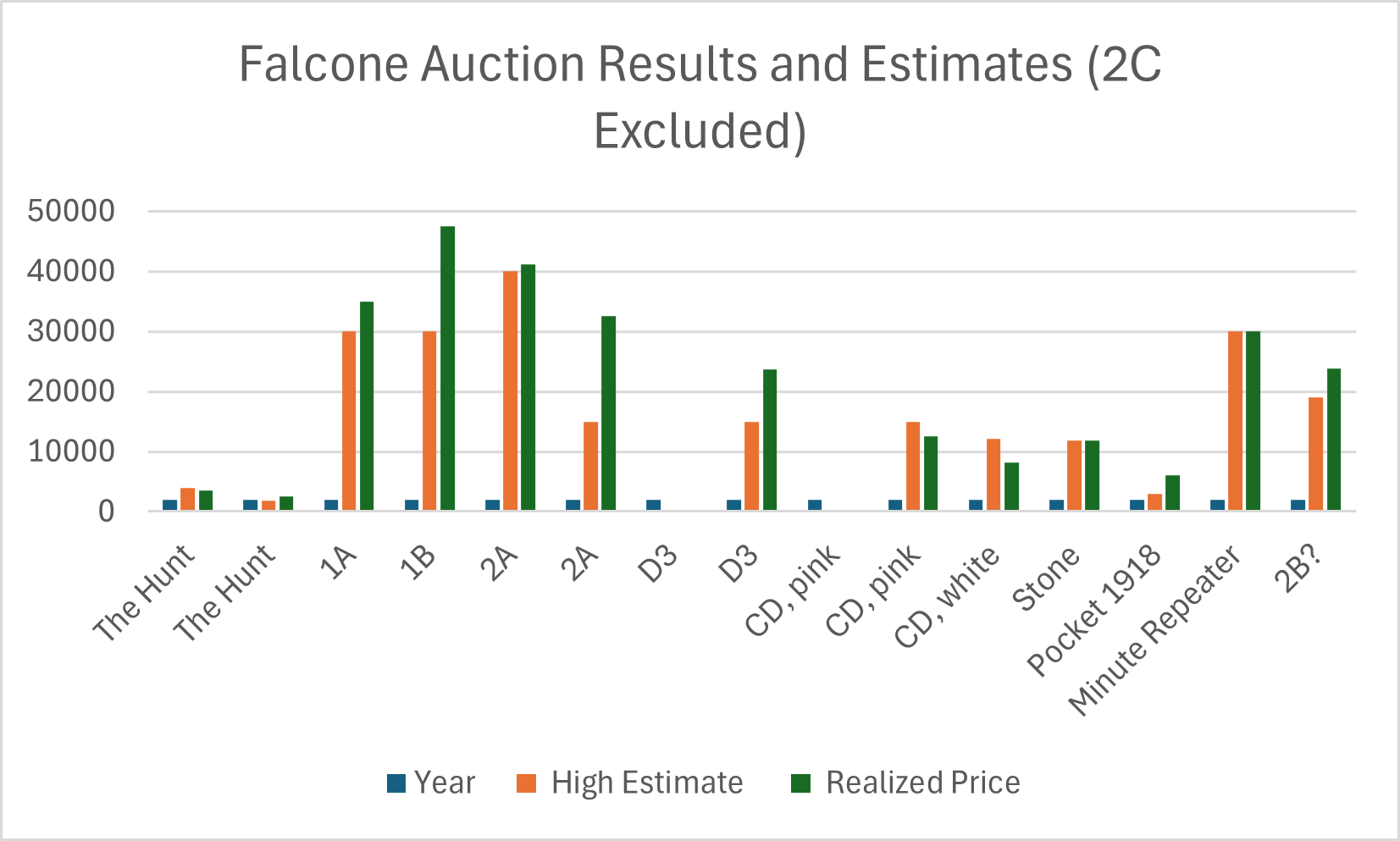
They’re even famous enough to be faked: a replica that seemed to be made by the seller himself once appeared on Yahoo Auctions Japan. I can’t find the exact listing anymore, but it’s just another example of the appeal of these timepieces. You know you’ve made it when you’ve been faked. They may not be well-known, but the design is so beautiful that it’s apparently worth replicating.
I get it. They’re not for everyone. You might be one of those who practically gets nauseous looking at this type of dizzying, melted watch. I’d encourage you to be a bit more open and really try to engage with the design over a period of time. It’s not your standard watch design that’s eye candy at first glance. It’s something you have to learn to appreciate.
That’s a point I’d really like to dwell on for a moment. This is not the type of “instant gratification” watch design that falls clearly into a simple archetype and makes you feel a certain way. Just like I discussed in the Watches and Fine Art article earlier, there’s a need for timepieces that reward attentive appreciation. Watches that demand that you care.
And if it’s just not for you, that’s fine. Keep auction prices low for me! I could do without a few hundred other people clamoring for a watch like this one. But these pieces, and what they represent, are nothing short of exceptional.
This is watchmaking as true art. Some of the greatest timepieces ever made.
Nobody talks about them. So I decided to change that.
And, if by some miracle anyone out there reading this has more information… please reach out. I’d love to have a part two with all the missing pieces. I’m sure there are other watches out there that haven’t appeared at auction. And the lives, the work of these watchmakers deserves to be better-documented. So if you know anything, let’s chat.
No posts
Comments
Nothing yet. Say the first thing.
Sign in to join the conversation.