
For years, I believed I was doing the right thing. I stayed because I believed God would change the other person. I stayed because I believed in forgiveness. I stayed because I believed marriages were worth fighting for. I stayed because every time I saw something that troubled me, there was always a reason to explain it away. Maybe he was wounded, or maybe I needed to pray more. Maybe God was still working on him. Maybe I needed more patience or to extend more grace. After all, wasn’t I told that there was no number attached to “seventy times seven”? What no one had prepared me for was the possibility that those very truths I hold onto could be used in ways that actually trap a believer.
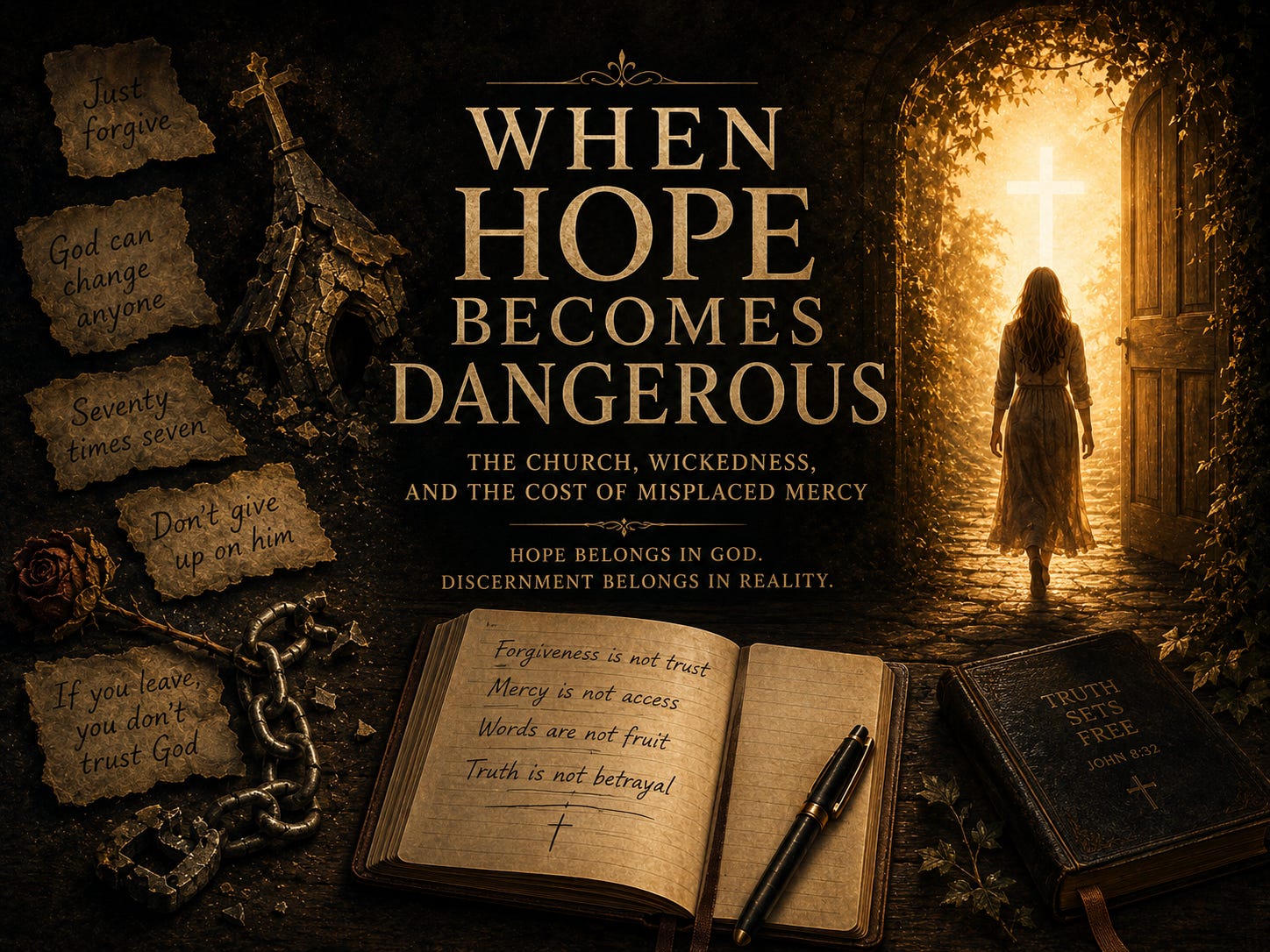
The truths themselves aren’t wrong. God can change anyone. Prayer and grace are highly important, as is forgiveness. The problem is that these truths can become disconnected from discernment.
Year after year, I had been watching the same fruit. The same patterns were always there, the same promises, the same apologies, the same declarations that things would be different this time. The same Christian language. The same professions of faith. The same claims of repentance. Every time reality became impossible to ignore (or deny), there always seemed to be another reason to keep hoping. What made it even harder was that the voices around me could not agree.
There were some people who wanted to know why didn’t leave sooner, while others implied that if I left the marriage, I did not trust God. Some believed I was enabling while others believed I was giving up too quickly. I was trapped between two opposing messages, in which one side seemed to believe discernment was a lack of faith and the other seemed to believe faith meant I should have recognized reality years earlier. Both missed what was actually happening.
The real battle was never between hope and hopelessness. It was between hope and truth. There comes a point where every believer must wrestle with difficult questions…
What happens when the person you love keeps saying the right things while producing the same fruit? What happens when your desire for redemption becomes stronger than your willingness to acknowledge reality? What happens when hope stops pointing you toward God and starts blinding you to what is standing directly in front of you? That is the place I lived for too long, and I suspect I am not the only one. The threshing floor is here, it is real, and marriages are seeing the impacts in real time.
I need to be clear about something before I go any further. Hope is not the enemy. Neither are mercy or forgiveness. I am so deeply grateful that our Father is merciful because if He were not, none of us would have any hope at all. And the problem was never that I had hoped. The problem was where that hope slowly migrated. Without realizing it, I stopped placing my hope in God and started placing it in what another person kept promising. I hoped this apology was different. I hoped this realization was real. I hoped this confession meant something had finally clicked. I hoped this was the time the fruit would finally match the words. Looking back, I can see that much of what I called hope was actually expectation. Not expectation of God, but expectation of a person.
A person who kept saying the right things and who knew exactly what I wanted to hear. A person who could talk about repentance, change, healing, accountability, and God while continuing to produce the same fruit. That is where things became dangerous. Biblical hope is anchored in who God is. Dangerous hope is anchored in what a person keeps saying. Biblical hope trusts God’s character. Dangerous hope keeps waiting for someone else’s character to become what it has never consistently been. Biblical hope leads to peace while the other traps you in an endless cycle of disappointment, confusion, and self-doubt.
The enemy does not always destroy hope by removing it. Sometimes he destroys it by attaching it to the wrong thing, and this is what I wish more believers understood. The answer is not to stop hoping. The answer is to make sure our hope is anchored in the One who never lies rather than the person who keeps proving that they do.
This is what the Lord says:
“Cursed is the man who trusts in mankind
And makes flesh his [a]strength,
And whose heart turns away from the Lord.
For he will be like a bush in the desert,
And will not see when prosperity comes,
But will live in stony wastes in the wilderness,
A land of salt that is not inhabited.
Blessed is the man who trusts in the Lord,
And whose trust is the Lord.
—Jeremiah 17:5-7
One of the cruelest parts of living through something like this is that no matter what you do, someone will tell you that you should have done the opposite. If you stay, people eventually ask why you stayed so long. If you leave, others imply you did not trust God enough. Somehow, the person trying to survive the situation becomes the one on trial.
People love to ask that question after the fruit has become obvious. Why didn’t you leave sooner? Why didn’t you see it? Why did you keep believing him? Why did you give him another chance? From the outside, I understand why they ask.
When you are not the one living inside the cycle, the pattern can look painfully clear. You can see the fruit without being tangled in the history, the promises, the apologies, the prayers, the covenant, the fear, the hope, the confusion, the trauma, and the spiritual pressure wrapped around it. What many people fail to understand, however, is that the person inside the situation was not simply ignoring reality. They were often taught to explain it away.
I was told to hope. I was told to forgive, to wait, to pray, to trust, to endure, to believe, and that love covers a multitude of sins. These very true statements can become dangerous, however, when they are applied without wisdom.
What happens when the person being told to forgive is the only one actually carrying the weight of repentance? What happens when the person being told to hope is the only one telling the truth? What happens when the person being told to wait is waiting on fruit that never comes? That is the part people outside the situation often miss.
Then there is the other side, which implies that boundaries are faithlessness. Separation is rebellion and leaving means you gave up. Telling the truth means you are bitter and refusing access means you are unforgiving. Suddenly the message becomes, “If you stay, you are faithful. If you leave, you lack trust. If you keep enduring, you are honoring God. If you finally tell the truth, you are dishonoring the person who harmed you.”
That kind of thinking places people in an impossible position. It makes them feel like the only way to prove they trust God is to keep ignoring what God has already shown them. It creates confusion where Scripture calls for discernment. It teaches people to treat observable fruit as less important than spoken promises, and that is not biblical.
God never told us to pretend darkness is light in order to prove we have faith. He never told us to call wickedness weakness just because someone uses Christian language. He never told us to keep handing access to someone who keeps producing the same fruit while calling it a process.
The choice was never between trusting God and recognizing reality. That was the lie. The real challenge is learning to do both. To trust God fully, and to tell the truth fully. To hope in His power, while also acknowledging the fruit in front of you. To believe He can redeem anyone, and stop pretending that someone is walking in repentance when they are not.
Faith is not denial and discernment is not betrayal. Recognizing reality does not mean I stopped trusting God. It means that I finally stopped confusing another person’s promises with God’s voice.
And you will know the truth, and the truth will set you free.
—John 8:32
Woe to those who call evil good, and good evil;
Who substitute darkness for light and light for darkness;
Who substitute bitter for sweet and sweet for bitter!
—Isaiah 5:20
Before anyone misunderstands what I am saying, I need to make something clear. I am not making an argument for divorce or an argument against marriage. It isn’t meant to be an argument for giving up on people nor is it an argument for abandoning hope.
I am not someone who takes marriage lightly. I never have. I believe marriage is sacred and I believe that covenant matters. I know that vows should definitely matter and I know (and I am proof) that God can redeem what appears impossible. I also believe He can resurrect what looks dead. So, no, this is not me trying to make divorce sound holy. It’s not. God flat out says He hates it.
If this article were about my heart alone, I probably would have stayed forever. I would have kept hoping, kept praying, kept waiting, kept believing the next apology would be the real one, kept believing the next confession would finally produce fruit, and kept believing that if I just loved harder, forgave faster, endured longer, or had more faith, maybe the story would end differently. The problem with all of this is that we are not called to follow our hearts. We are called to follow Him.
Sometimes our hearts want something so badly that they start fighting the truth God has already shown us. Sometimes our hearts call it faith when it is really attachment. Sometimes our hearts call it mercy when it is really fear. Sometimes our hearts call it hope when it is really refusal to accept reality.
The question is not, “Do I believe in marriage?” I do. The question is not, “Do I believe God can change someone?” I do. The question is whether I am willing to obey God when His will confronts what my heart desperately wants. Marriage is sacred, but marriage is not God. Covenant matters, but covenant was never meant to become an altar where truth, safety, discernment, and obedience are sacrificed.
This is not about advocating for divorce. I never want to do that. It is about His will over our own will and His desires for us over what our hearts think we need and want.
Trust in the Lord with all your heart
And do not lean on your own understanding.
In all your ways acknowledge Him,
And He will make your paths straight.
—Proverbs 3:5-6
One of the verses that people love to bring up in situations like this is “seventy times seven.” And yes, Jesus taught radical forgiveness. I am never going to argue with Yeshua and I am no longer willing to try to soften His words. I am not trying to find a loophole around forgiveness because forgiveness is hard. I do, however, think that many of us have been taught to apply His words in a way He never commanded.
Jesus told us to forgive, but He didn’t tell us to hand endless access to a person who keeps using that access to sin against us. Forgiveness is not the same as trust. It is not the same as reconciliation. It is not the same as pretending that nothing happened. Forgiveness definitely isn’t the same thing as placing yourself back under the power of someone who has shown no real repentance. This is where the Church has to mature, because forgiveness is frequently treated like a spiritual reset button.
Someone sins, then they cry and apologize. They use the right words. Suddenly the wounded person is expected to move forward as though the fruit does not still matter. Forgiveness, however, does not erase discernment, wisdom, patterns, consequences, or the need to look at what a person is actually producing.
When I forgive, I release vengeance to God. I give up my right to repay evil for evil. I place judgment in His hands. That doesn’t mean I lose the right to tell the truth. It doesn’t mean that I am required to keep giving access. It definitely doesn’t mean that I have to call danger “growth” or manipulation “struggle” or wickedness “weakness.”
Forgiveness deals with vengeance. It does not require the suspension of wisdom. I think this is where so many believers get trapped. They are told that if they still have boundaries, they have not forgiven. They are told that if trust has not been restored, their heart must be hard. They are told that if they recognize the pattern, they are bitter. Trust is not owed simply because someone says they are sorry, however. It is built by fruit. Reconciliation requires truth, and access should never be handed back to someone merely because they know how to ask for it in Christian language.
Seventy times seven is not permission for endless exposure to unrepentant behavior. It is not a command to keep placing yourself where wickedness can continue unchecked. It is not a call to confuse mercy with blindness. Jesus taught forgiveness. He did not teach denial.
Behold, I am sending you out as sheep in the midst of wolves; so be as wary as serpents, and as innocent as doves.
—Matthew 10:16
This is one of the most misunderstood truths in the Church. Yes, it is true that anyone can be saved and that God can transform anyone. I have never questioned that and I have always believed that miracles can and do happen. I’ve witnessed many. I know that the person that everyone else gave up on can be the very person God brings to their knees. I believe that with all of my being. This, however, is where some of us get into trouble.
We take the truth that God can change anyone, and we start acting as though that means a person is changing, when that’s not how it works. Possibility is not evidence. Potential is not fruit. Future repentance is not present repentance. The fact that God could one day break someone does not mean I am required to pretend they are currently surrendered.
This is where so many believers lose discernment. They look at a person’s potential and call it fruit. They look at a person’s words and call it repentance. They look at a person’s tears and call it transformation. They look at what God could do and ignore what the person is actually doing. Scripture, however, never tells us to evaluate people by their potential. It tells us to evaluate fruit. Not to evaluate what they could become, what they promise they want to become, or what they say God is doing in them.
We, as followers of the Way, are called to examine fruit. What is being produced? What keeps coming out of them when they are confronted? What happens when they are corrected? What do they do when truth costs them something? Do they humble themselves? Do they confess without shifting blame? Do they bring forth fruit in keeping with repentance? Or are they continuing to use the language of change while protecting the same old self? The answers to these questions do matter.
The saying that “anyone can be saved” is true, but it should never be used as a blindfold. It should never be used to silence discernment. It should never be used to make someone ignore wicked fruit because a miracle is theoretically possible.
God’s power to redeem someone does not erase our responsibility to tell the truth about what is currently in front of us, and that is the part I wish more people understood. Hope for salvation belongs to God. Evidence of repentance shows up in fruit. Until the fruit changes, wisdom does not require us to pretend the tree has.
You will know them by their fruits. Grapes are not gathered from thorn bushes, nor figs from thistles, are they? So every good tree bears good fruit, but the bad tree bears bad fruit.
—Matthew 7:16-17
This is the part I think many believers do not want to face. Wickedness does not always announce itself as wickedness. Sometimes it speaks fluent Christian. Sometimes it knows the verses and says the right things about repentance, healing, and God. But it does so while continuing to resist the very authority of God. That is what is terrifying when you finally see it.
Some of the strongest warnings in Scripture are not directed at people who openly reject God. They are directed at people who know His language while resisting His rule. People who can speak of righteousness while practicing wickedness. People who can honor Him with their lips while their hearts remain far from Him. This is why religious vocabulary is not proof of transformation.
Tears are not proof. Neither are promises, apologies, or displays of emotion. The test is always fruit. What does the person produce when truth confronts them? What comes out when they are corrected? Do they humble themselves, or do they defend, deflect, blame, minimize, rage, sulk, and then return with softer language once they want access again?
And here is where it gets dangerous, because some phrases sound genuinely holy. They sound like humility. They sound like someone who understands repentance and their need for God. “God is still working on me.” “Nobody is perfect.” “You need to forgive.” “Don’t give up on me.” “God hasn’t given up on me.”
The hard part is that sometimes those words are sincere. Sometimes a person really is broken before God. Sometimes the fruit is slow, but it is real. But sometimes those same words become a shield. A way to avoid correction. A way to escape consequences. A way to make the wounded person feel guilty for naming what is true. A way to keep access without producing repentance.
“God is still working on me” should never mean “you are not allowed to confront me.” “Nobody is perfect” should never mean “you are not allowed to name my sin.” “You need to forgive” should never mean “I get to avoid accountability.” “Don’t give up on me” should never mean “keep letting me harm you.”
That is not repentance. It is spiritual language being used as cover. And when the Church cannot tell the difference, people become trapped. They keep hoping because the words sound right and they keep waiting because the language sounds Christian. They keep doubting what they see because someone keeps wrapping the same fruit in better vocabulary.
Christian language does not sanctify wicked behavior. At some point, the words have to be tested against the fruit. The Pharisees had Scripture. They had religious authority, public respect, and the appearance of devotion. Yeshua still called out what they were. He did not mistake religious language for surrender, and neither should we.
A person who is truly being worked on by God will eventually stop using God’s name to hide from correction. They will not only speak of repentance, but they will also submit to it.
This people honors Me with their lips,
But their heart is far away from Me.
—Matthew 15:8
We live in a time when people are very uncomfortable with moral categories. It’s not that they are uncomfortable with preferences, personalities, or different communication styles. They are uncomfortable with actual moral categories. Words like “evil”, “wicked,” “deceived,” “rebellious,” or “hard-hearted” make people uncomfortable now. Honestly? Too much of the Church has become uncomfortable with them too. Which, to me, is strange, because Scripture is not uncomfortable with these words at all.
The Bible does not speak as though all behavior is simply brokenness. It doesn’t treat every sin pattern as a wound. It does not call every refusal to repent a “struggle.” There are times Scripture calls things exactly what they are. Evil, wickedness, rebellion, deception, and darkness. Somehow, however, we have reached a point where naming the thing is treated as harsher than the thing itself.
A person can lie, manipulate, exploit, abuse, deceive, coerce, and continue refusing correction, and the moment someone says, “This is wicked,” suddenly that becomes the problem. They don’t see the fruit as the problem. Nor the harm. They don’t look at the repeated refusal to repent. They call the one naming it judgmental, harsh, bitter, unforgiving, or unloving. But what if the word is actually accurate? What if calling something wicked is not cruelty at all? What if it’s actually clarity? I think, perhaps, the real danger isn’t that we name wickedness to quickly, but, rather, we have become so afraid of sounding harsh that we leave evil unnamed.
When the Church loses the courage to call wickedness wicked, it isn’t being loving. It makes it easier for wolves to deceive, it becomes easier for the wicked to manipulate, and it becomes easier for people who know Christian language to hide behind softer words. I know in my heart that Scripture absolutely doesn’t give us permission to do this.
We are not more holy because we refuse to name darkness. We are not more merciful because we keep calling rebellion “brokenness.” We definitely aren’t more Christlike because we protect someone’s image while their fruit destroys other people. Yeshua was full of mercy, but He was also full of truth, and He didn’t confuse them.
Do not participate in the useless deeds of darkness, but instead even expose them;
—Ephesians 5:11
This is where people often accuse one of going too far. They hear someone say, “This behavior is wicked,” and they respond as if you just claimed to know that person’s eternal destination. Examining their current fruits, however, is not the same thing as final judgment. Saying, “This is wicked behavior,” is not the same as saying, “This person can never repent.” Saying, “This person is acting wickedly,” is not the same as saying, “I know their final judgment before God.”
These are not the same things. One is discernment, and the other belongs to God alone. Scripture never forbids us from recognizing fruit. It commands us to do just that. We are told to test the spirits, watch for wolves, and know them by their fruit. We are told not to call evil good or good evil. So when we see someone lying, deceiving, manipulating, harming, refusing correction, or hiding behind spiritual language, and they continue producing the same rotten fruit, it is not unbiblical to say, “This is wicked.”
Examining fruits and naming wickedness isn’t someone trying to sit on God’s throne. They are agreeing with what Scripture already says about fruit. While I cannot say, “This person is beyond repentance” and I cannot say, “God will never save them” or “I know exactly where their soul will stand on the last day,” I must also not pretend that fruit does not show what it shows. I have absolutely no right to weigh or assume one’s final judgment, but we all have a duty to address rotten fruit. The Church needs to recover this posture.
Final judgment is left to God alone, but it is done so without surrendering discernment. We can pray for someone’s repentance without lying about their current rebellion. We can hope God saves them without calling their wickedness a struggle. We can refuse to condemn their eternal soul while still telling the truth about what they are producing right now. Discernment is not final judgment but, rather, it is obedience to truth. God never asked His people to become blind in order to prove mercy, love, and faithfulness.
For what business of mine is it to judge outsiders? Do you not judge those who are within the church?
—1 Corinthians 5:12
One of the hardest parts of telling the truth is that it can feel like betrayal. Especially when the person being exposed is someone you loved, prayed for, covered, hoped would change, or remember differently than who they have now proven themselves to be. This is where the battle gets brutal. You don’t just remember their wickedness. You remember the good moments too. You remember the laughter, tenderness, conversations, and the parts that made you believe there was still something worth fighting for. Those moments were real to you. So telling the entire truth can feel like you are betraying the person you once loved. Truth, however, is never betrayal. Lies are betrayal and so, at times, is silence.
Covering what God is exposing in a person can be betrayal to the One who matters most. Protecting someone’s image while they continue producing destruction can be betrayal. This was the part that was hard for me to face in the end.
Telling the truth about what someone did does not mean we never loved them. It means we refuse to keep lying for them. It means we refuse to keep carrying a false version of the story so they can avoid consequences. It means we refuse to keep confusing loyalty with concealment. Love never requires us to participate in deception, nor does it ever demand that we hide another’s wickedness. Love doesn’t mean protecting someone from the truth God is bringing into the light. We can still care what happens to them, grieve and pray for their repentance, and mourn what was lost. Caring about someone, however, doesn’t mean we are called to cover their sins or rebellion.
At some point, silence stops being mercy and it becomes agreement. At some point, protecting someone’s image becomes active participation in the lie. There is a point where not revealing the entire truth protects darkness, not love. That is not obedience.
One who declares truth tells what is right,
But a false witness, deceit.
—Proverbs 12:17
Hope is holy when it is anchored in God. It is beautiful when it is rooted in His character. It is right to believe He can save. It is right to believe He can redeem. It is right to believe no one is beyond His reach. But hope becomes dangerous when it is no longer anchored in God and starts attaching itself to a person’s promises.
That is where I got lost. I thought I was hoping in God, but much of the time I was actually hoping in the next apology. The next moment of clarity. The next “I finally see it.” The next “I’m really going to change this time.” And because God can change anyone, I kept treating every promise like it might be the beginning of a miracle. But a promise is not fruit, a moment is not repentance, a breakdown is not surrender, a person saying the right thing is not the same as a person becoming obedient to God.
This is why hope has to bow to truth. Not because truth is stronger than God, but because God is truth. He will never ask us to keep hoping in a lie. We can hope God saves someone, pray for repentance, desire redemption, and grieve for what sin has done to them. We can even want good for them. None of those things, however, require us to deny reality. None of those things require us to ignore fruit or keep believing words that have been contradicted by years of actions.
Hope does not require blindness. Faith does not require pretending. Love does not require denial. If our hope is truly in God, then we do not have to keep clinging to a false version of a person. We can release them to Him. We can tell the truth and stop trying to make their promises carry the weight only God can carry. Because hope belongs in God. Not in someone’s ability to keep saying what they know we want to hear.
and hope does not disappoint, because the love of God has been poured out within our hearts through the Holy Spirit who was given to us.
—Romans 5:5
Somewhere along the way, many believers started treating discernment like doubt. As if seeing fruit clearly means we lack faith. As if setting boundaries means we stopped trusting God. As if leaving danger means we gave up on His power to redeem. As if speaking the truth means we are bitter. As if calling wickedness wicked means we have forgotten mercy. But that is not at all biblical.
Setting boundaries is not lack of faith. Neither is leaving danger, speaking truth, calling wickedness wicked, or trusting God does not require pretending fruit does not exist. In fact, I would argue the opposite. Sometimes faith is what gives us the courage to finally stop pretending. Because if we truly trust God, we do not have to keep managing the image of someone who refuses repentance. We do not have to keep protecting a false version of the story. We can tell the truth and trust God with the consequences. That is what faith looks like. Not denial, pretending, or spiritually bypassing what is right in front of us because we are afraid of what obedience may cost.
The Bible does not tell us to ignore fruit. Jesus told us we would know them by their fruit. So why are we acting as though noticing fruit is unloving? Why are we acting as though discernment is rebellion? Why are we acting as though the only way to prove we trust God is to keep ignoring what He has already shown us? That is not faith. That is confusion. Faith does not require blindness, silence, or access. It doesn’t require that we to place ourselves, our minds, our bodies, our children, or our callings under the ongoing destruction of someone who keeps refusing truth.
God can redeem anyone. I believe that. But God’s ability to redeem someone does not cancel my responsibility to walk in wisdom. It does not cancel the command to test fruit. It does not cancel the call to bring darkness into the light. Biblical discernment is not lack of faith. It is obedience to the God who is Truth.
For God has not given us a spirit of timidity, but of power and love and discipline.
—2 Timothy 1:7
The Church does not need less mercy. It does not need less forgiveness or less hope. What it needs is for those things to be brought back into agreement with truth. Mercy without discernment can become enabling. Forgiveness without truth can become silence. Hope without reality can become a prison. I think this is where many of us have gone wrong.
We have treated these things as though they are opposites. As if mercy means that we can’t name wickedness or as if forgiveness means we can’t have boundaries. We have begun to act as if hope means we cannot acknowledge fruit and as if believing God can save anyone means we have to keep pretending someone is repenting when they are not.
Scripture does not call us to choose between truth and mercy. It calls us to walk in both. So yes, we forgive. We pray. We believe God can save anyone. We hope for redemption. We leave room for God to do what only God can do. But we cannot allow ourselves to confuse possibility with fruit, words with repentance, mercy with access, forgiveness with trust, or hope with blindness. We can never call truth betrayal just because it exposes someone you once loved.
Telling the truth may break your heart. It may cost you the version of the story you wanted. It may force you to grieve what you kept hoping would be redeemed. It is important to remember, however, that truth is not the enemy of God’s will. Truth is part of His will. There comes a point where obedience requires us to stop protecting the lie just because we are still grieving the person attached to it.
Hope belongs in God. Discernment belongs in reality. Telling the truth is not betrayal. It is obedience.
This ministry/work is reader-supported. If you would like to help support my writing, ministry, and help me as I support myself and my children during a very difficult season, you can do so here: Buy Me a Coffee.
No posts
Comments
Nothing yet. Say the first thing.
Sign in to join the conversation.