
A few years ago, I wouldn’t have even realized it, but looking back, it’s clear to me that I have walked through fire after fire in my life. Different seasons with different people who caused (and/or had) different wounds. One theme, however, keeps appearing. The issue of fake Christianity.
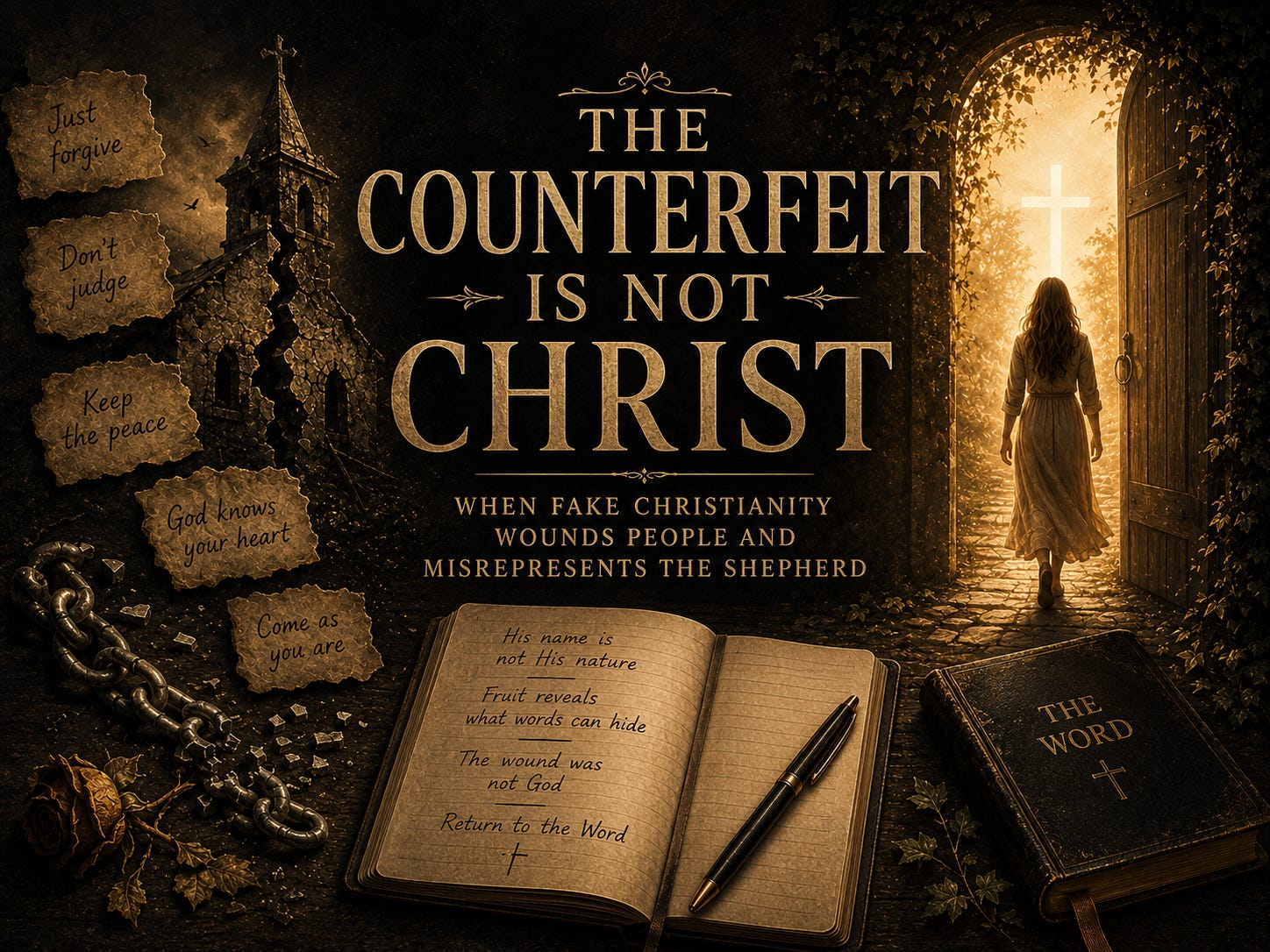
God has never been (and never will be) the problem. The human condition is. The wounds I’ve endured? They weren’t God. The wounds were caused by people who used His name while they bear fruit that shows nothing of Him. People who wore the label of “Christian” and used His language living in an entirely different manner. People who claimed His name but lacked any of His nature. People who knew how to say the right words, but whose words and actions did not align.
When you’re young (or wounded or just someone who really does believe God is trustworthy), counterfeit Christianity can do very real damage. The reason is, when someone truly trusts God and maintains childlike innocence, they naturally trust those who claim Him. I know I did. I always knew I could trust Him. I knew that deep within my soul before I even had language for it. What I didn’t understand until recently, however, was that claiming His name and carrying His nature are not at all the same thing. The confusion that eventually became a door.
This article isn’t about imperfect believers who are (all of us) stumbling toward holiness. I understand the difference between a wounded sheep that is learning to walk and a counterfeit that is using His grace as a costume. I know that believers can (and do) struggle, fall, repent, grow, and still belong to the King. People who actually do love and follow Him? They aren’t the ones I am talking about. I am talking about blatantly fake Christianity. The kind of Christianity that uses our Lord’s name while refusing His rule. The type of Christianity that teaches people to trust what sounds holy, often ignoring what bears rotten fruit. This Christianity protects the unrepentant and burdens those who have been wounded. It causes people to walk away from the Way. Not because they reject Christ, but because they were given a counterfeit version of Him. That damage? It is very real and I will no longer ignore it. We, as His Church, can no longer ignore it.
As I’ve said many times, I knew as a child I could trust God. I knew that somewhere deep in me before I even had language for theology, before I understood doctrine, before I could explain Scripture, and well before I knew the difference between religion and relationship, church culture and truth, His name and His nature. I knew, as far back as I can remember (and I have memories that go back to 2 years of age), that He was real. I knew He was safe, so when people claimed Him, I trusted them and thought they were safe too. That was the first wound.
God didn’t betray me. Not once. When people proclaimed God, however, I tended to assume that their actions could be trusted. When they used Christian language, I assumed there would be Christian fruit. When they stood under religious authority, wore the label, taught the lessons, said the prayers, or claimed to represent Him, I assumed something holy was there. I assumed “Christian” meant safe. I assumed God language meant God fruit. The problem is that, as I look back, I see how the words and the fruit just didn’t align. When a child sees that but cannot name it yet, confusion becomes a doorway.
I was born Jewish. I follow Messiah and I was sent to Catholic schools. Before I go into that, I need to be careful, because this is not me saying every Catholic is false. I’ve met many who aren’t. And this is definitely not me saying God cannot reach people there nor is it me saying that I can judge every heart in every pew. I would never dare to try. What this is, is part of my testimony.
What I was given in Catholic churches and schools did not lead me to Jesus. It really just confused me. I had known Yeshua in my heart as far back as I can remember, even if I did not yet know how to say that. I knew the real One was there. I knew there was something true, something holy, something living. What I was being shown did not look like Him, however.
The system around me seemed tied to payment, performance, institutional authority, and tradition. It felt like God had been placed behind layers of rules, rituals, and human control. It felt like access to Him had been complicated by people who claimed to speak for Him. I was much too young to sort that out.
I was too young to understand why a Messiah who came to set captives free seemed to be represented by systems that made people afraid, burdened, or confused. I was too young to understand why people who claimed God could reflect fruit that felt cold, prideful, cruel, or empty. I was too young to understand fruit of the enemy. I only knew something did not align. So when I refused to call a priest “Father,” because my King tells me not to, I wouldn’t. I was called the “b” word by a priest for that. When I explained that Peter didn’t take that title either, worse was done.
This is important. As a child, I didn’t have the words, but I could still feel the contradiction. I couldn’t explain theology, but I could sense when what was being said and what was being lived were not the same thing, and the contradiction did damage.
Instead of being led closer to the Way, I began to lose faith in my teens and 20s. It wasn’t because Jesus is false. He’s not. I now understand that it was because the version of Jesus they put in front of me was false, and the counterfeit confused me and the hypocrisy wounded me. I hadn’t yet learned to separate God from the people who were misrepresenting Him, so I began to drift. I lost the Way for a time. So I understand how much fruit matters.
Jesus didn’t tell us to ignore fruit. He didn’t tell us to trust labels or to follow those who just say the right things. He said, “You will know them by their fruits.” There are times I wish I had known this sooner. It would have made life much easier. But then, I wouldn’t be who He made me to be, so in the end, it is all for His glory.
The name alone is not enough. When people use His name without showing His nature, it can cause deep wounds in those who need to grow in the faith. I am done pretending otherwise.
You will know them by their fruits. Grapes are not gathered from thorn bushes nor figs from thistles, are they?
—Matthew 7:16
Then there came the call to the wilderness, and I don’t mean that lightly. I mean a wilderness of fire after fire, loss after loss, and stripping after stripping. The kind of wilderness where everything you thought you understood begins to be tested. The kind where the props fall away and the voices become quieter because the Father is teaching you to hear His.
At first, the wilderness felt like breaking. Now I understand that it was actually separation. The wilderness didn’t destroy my faith. It stripped away what had been pretending to be faith. It stripped away the religious fog, the church culture, the emotionalism, the performance, the fear of man, and the need to trust someone because they knew how to say the right words. It stripped away the counterfeit. In its place, I grew to learn the difference between God and people who use His name.
The lesson may sound simple enough, until you’ve lived the damage of confusing the two. It took me a very long time to learn that I needed to stop assuming that Christian language meant Christian fruit. It took me longer than most to learn that just because someone could quote scripture, say a beautiful prayer, worship loudly, or speak confidently about God, it didn’t mean they were safe. I learned that charisma and character are not the same thing. I learned that a platform wasn’t necessarily an anointing and I stopped measuring truth by the emotions I felt toward people.
I learned that there is a counterfeit Christianity that sounds holy. It uses scripture, can say the words “grace,” “love,” “forgiveness,” “God told me,” and it can even make people cry. Fruit, however, is what reveals what words can hide. So, my Abba brought me back to the only measuring tool that doesn’t move. The Word.
I wasn’t called into a church culture. I wasn’t pulled toward a personality, platform, denomination, tradition, or title. I was pulled toward the Word into a trust fall with the Spirit. It wasn’t about trusting what looked religious anymore or what sounded spiritual. It definitely wasn’t about trusting what most approved of. When I began to take issue with a large local church that has a Starbucks-style coffee shop (including prices), I was called legalist and there were few who agreed with me. The wilderness did not make me more popular, but it wasn’t intended to. It was about trusting Him enough to let him rip down what I had mistaken for Him. And it was a painful lesson.
When God strips away the counterfeit, He also exposes how much damage it did. He shows you where you trusted the wrong voices and where you confused His name with the nature of others. He shows you where you called something holy because it was standing close to holy language. He shows where even scars our parents left impact the way we see Him.
The beautiful thing is, He does not expose to shame. He exposes to heal and, as such, the wilderness became the place where my eyes started opening and my heart started being healed. It was the place where I began to see that not everything calling itself Christian belongs to Christ. Not everything that says “Jesus” reflects Yeshua. Not everything that gathers in His name carries His Spirit. Once the Word became the measuring rod again, clarity was restored.
You shall remember all the way which the Lord your God has led you in the wilderness these forty years, that He might humble you, testing you, to know what was in your heart, whether you would keep His commandments or not. He humbled you and let you be hungry, and fed you with manna which you did not know, nor did your fathers know, that He might make you understand that man does not live by bread alone, but man lives by everything that proceeds out of the mouth of the Lord.
—Deuteronomy 8:2–3
With the Spirit leading me through the Word, the counterfeits became easier to see. That is the thing about counterfeit Christianity… It doesn’t always look the same as it can wear different faces, different labels, different worship styles, different buildings, and different language. Sometimes it can look traditional. Sometimes it can look more modern. Sometimes it’s emotional and sometimes it’s polished. It can sometimes look humble or successful. No matter the appearance, the root is often the same. Self is placed at the center instead of Christ.
This is where the corruption begins. The Word becomes softened, twisted, rearranged, or weaponized. The cross is removed from the center as repentance becomes offensive, obedience becomes legalism, holiness becomes judgmental, and suffering becomes failure. Conviction even becomes shame and, suddenly, Christianity has His name on it, but His nature just isn’t there. This is how people become deceived (and even how some of the self-deceived are able to further embrace that deception).
One of the first counterfeits I began to recognize was shallow grace. The kind that says, “Come as you are,” but then seems to do away with the part where Jesus changes you if He actually dwells within you.
This is a message we need to clarify in the Church. “Come as you are” is beautiful when it means Jesus receives sinners, because He absolutely does. I am one of them. He receives the broken, the filthy, the ashamed, and the ones who know they have nothing clean to bring Him. That is mercy and grace. But “come as you are” was never supposed to mean “stay as you are.”
Hence, this is where the counterfeit enters. The counterfeit says come and stay prideful or tells people they can come and stay addicted. They can come and stay abusive, deceptive, unholy, and unchanged. They are told, if not outright, that they can come and keep the sin, the rebellion, the flesh, the excuses, the self-protection, the image, and the idols. All you have to do is add Jesus language to it. That isn’t grace. It’s a corruption of it.
Jesus receives sinners. He absolutely does. What He does not do is leave them in bondage and call it love. He doesn’t pull someone out of darkness just so they can decorate the darkness with Bible verses, nor does He forgive sin so we can make peace with it.
Jesus said, “Go and sin no more.” The sentence can’t be ignored. No one becomes sinless overnight, and sanctification is a process. Struggling believers do fail and that doesn’t make them fake. Real grace, however, doesn’t teach us to excuse bondage to sin. It breaks it. It doesn’t protect sin. It exposes sin so that we can be free from it.
I find that this is where so many seeker-friendly churches become dangerous. They may begin with milk, and milk absolutely has a place. Scripture is clear on that. Babies need milk and new believers need patience. Wounded believers need to be treated with gentleness and the lost need invitation. Milk, however, is mercy for infants. It is not meant to become a lifetime diet. A church that keeps people comfortable but never convicts them is not protecting them.
When sin goes unnamed, repentance becomes impossible. When holiness goes untaught, growth stalls. When those who are obedient are labelled as legalists, discipleship collapses. When people stop fearing the Lord, they start mistaking emotional comfort for spiritual health. Over time, the Word is softened until it no longer cuts. That’s a problem, because if the Word doesn’t cut as it’s supposed to, discernment is affected.
Hebrews says the Word of God is sharper than a two-edged sword and that it discerns the thoughts and intentions of the heart. It doesn’t exist to flatter the flesh or to make rebellion feel safe. It’s not there to fill pews and leave lives unchanged.
Jesus didn’t tell us to go out and bring him fans. He told us to make disciples. Disciples are taught to obey, so when a church avoids repentance, holiness, obedience, and judgment because those things might make people uncomfortable, it’s a serious issue. It may still gather crowds, play worship music, and still say “Jesus.” But if it doesn’t call people out of sin, it isn’t being loving or Christlike. It’s leaving people in sin.
Go therefore and make disciples of all the nations, baptizing them in the name of the Father and the Son and the Holy Spirit, teaching them to observe all that I commanded you; and lo, I am with you [b]always, even to the end of the age.”
—Matthew 28:19–20
For the word of God is living and active and sharper than any two-edged sword, and piercing as far as the division of soul and spirit, of both joints and marrow, and able to judge the thoughts and intentions of the heart.
—Hebrews 4:12
Prosperity gospel is the same corruption wearing a different costume. It offers a shallow grace that says, “You do not have to change” and “God owes you comfort.” It makes the flesh the point and promises the flesh rewards if we can just learn the right spiritual formula. It is also centered on self instead of Christ.
Prosperity gospel measures God’s favor by money, health, success, comfort, influence, and worldly increase. It teaches people to look at their circumstances as proof of whether God is pleased with them (seeming to forget Job’s story). It makes suffering look like failure, poverty look like lack of faith, sickness look like spiritual deficiency, and giving look like a transaction.
Sow this seed and speak this declaration. Use this formula, prove your faith, unlock your blessing, and suddenly God is no longer being treated as holy. Rather, He is being treated like a vending machine with a Scripture reference on the side. That is not the gospel. That is the flesh using God’s name to chase what the flesh already wanted.
Jesus didn’t invite us to a playground and he did not promise comfort. He told us to take up the cross. He said we would have tribulation in this world. He said not to store up treasures on earth. This is why the apostles did not preach worldly wealth as proof of faithfulness and they definitely didn’t measure spiritual authority by bank accounts, platforms, buildings, or visible success. Many of them suffered because they were faithful. Prosperity gospel cannot account for Paul in prison. It cannot account for Stephen being stoned, the prophets being hated, the apostles being persecuted, or Jesus on the cross.
If comfort, wealth, health, and worldly success are the proof of God’s favor, then the cross makes no sense. But the cross is the center, which is why counterfeit is so dangerous. It doesn’t just distort money. It distorts God Himself and teaches people to seek His hand while ignoring His heart. It teaches people to chase blessing without having to surrender and to measure faith by outcomes instead of obedience. As such, when suffering comes (as Jesus told us it would), people are left confused. They wonder why God failed them or why their faith did not work. They ask what they did wrong. The problem, however, was never God. It was a false gospel that taught them to expect something that our Lord never promised us.
It’s what counterfeits do. They use His name while refusing His nature and take pieces of truth, bending them around the flesh. They offer grace without the need for repentance and blessing without surrender. They offer Jesus without obedience. That’s not the Word. It’s the self wearing Christianity like a costume.
If anyone advocates a different doctrine and does not agree with sound words, those of our Lord Jesus Christ, and with the doctrine conforming to godliness, he is conceited and understands nothing; but he [b]has a morbid interest in controversial questions and disputes about words, out of which arise envy, strife, abusive language, evil suspicions, and constant friction between men of depraved mind and deprived of the truth, who suppose that godliness is a means of gain. But godliness actually is a means of great gain when accompanied by contentment. For we have brought nothing into the world, so we cannot take anything out of it either. If we have food and covering, with these we shall be content. But those who want to get rich fall into temptation and a snare and many foolish and harmful desires which plunge men into ruin and destruction. For the love of money is a root of all sorts of evil, and some by longing for it have wandered away from the faith and pierced themselves with many griefs.
But flee from these things, you man of God, and pursue righteousness, godliness, faith, love, perseverance and gentleness. Fight the good fight of faith; take hold of the eternal life to which you were called, and you made the good confession in the presence of many witnesses.
—1 Timothy 6:3-12
Counterfeit Christianity isn’t just an abstract idea. It is where bad doctrine becomes someone’s nervous system, marriage, childhood, testimony, and even their faith barely hanging on by a thread. Fake Christianity doesn’t just distort what people believe. It changes who is protected. Again and again, I have seen the wounded be the ones handed the burden to forgive quickly, not be bitter, keep the peace, submit, be quiet, stop talking about it, stop exposing it, and stop making people uncomfortable. But where is that urgency when it comes time to confront the person causing destruction? Where is the urgency for repentance, fruit, and truth? Where is the urgency to protect the sheep? I’ve seen it’s nowhere to be found in some churches.
I’ve seen the pressure land on the wounded. The one bleeding is told to calm down and the one who is telling the truth is treated as if they are the threat. The one who is naming darkness is accused of causing division, while the one producing the darkness is handled gently, privately, carefully, and with endless concern for their reputation. That is not biblical order. It is institutional self-preservation that has gone on for too long under the name of God.
Fake Christianity protects appearances, platforms, reputations and comfort. Not the sheep. When the sheep aren’t protected, they begin to wonder where the Shepherd is. There is very real damage in this. People start to question God because other people lied about Him with their lives. They begin to wonder why He feels unsafe, when the truth is, unsafe people stood under His name as cover. They begin to wonder why justice feels absent, when the truth is, image was chosen over righteousness. Then we wonder why people leave.
Scripture isn’t silent about this, as Ephesians says to have no fellowship with the unfruitful works of darkness, but rather expose them. Luke 17:3 records Yeshua saying, “If your brother sins against you, rebuke him; and if he repents, forgive him” and the order here is important. First, rebuke, then repentance and forgiveness. He didn’t tell us to pretend nothing happened. He didn’t teach us to silence those who have been harmed nor did he tell us to protect the unrepentant or call exposure “bitterness” just because truth makes people uncomfortable.
Matthew 18 gives a process for correction and accountability. It does not teach a lawless forgiveness that allows sin to keep hiding and it definitely doesn’t tell those who have been wounded that they have to to absorb endless harm so everyone else can be comfortable.
If your brother sins, go and show him his fault in private; if he listens to you, you have won your brother. But if he does not listen to you, take one or two more with you, so that by the mouth of two or three witnesses every fact may be confirmed. If he refuses to listen to them, tell it to the church; and if he refuses to listen even to the church, let him be to you as a Gentile and a tax collector.
—Matthew 18:15–17
And then there is Ezekiel 34.
Son of man, prophesy against the shepherds of Israel. Prophesy and say to those shepherds, “Thus says the Lord God, “Woe, shepherds of Israel who have been feeding themselves! Should not the shepherds feed the flock? You eat the fat and clothe yourselves with the wool, you slaughter the fat sheep without feeding the flock. Those who are sickly you have not strengthened, the diseased you have not healed, the broken you have not bound up, the scattered you have not brought back, nor have you sought for the lost; but with force and with severity you have dominated them.
—Ezekiel 34:2–4
We need to stop and look at this for a second. The shepherds that God is rebuking aren’t outsiders and they aren’t pagans just mocking Him from a distance. They are the ones who were supposed to care for His flock and, instead, fed themselves. They used the sheep, ignored the weak, failed to strengthen the sick, and didn’t bind up the injured or bring back the scattered. They ruled with force and harshness, and God didn’t call it a misunderstanding. He called it evil.
When people who claim to represent God consume the vulnerable instead of protecting them, Heaven is not confused about what is going on and God sees the difference between shepherding and feeding on sheep. He sees the difference between true peace and a cover-up. He sees the difference between forgiveness and enabling, correction and cruelty, and a repentant sinner and an unrepentant destroyer that is hiding behind religious language.
This isn’t only a problem of pastoral failure. It’s a problem with fruit because fruit reveals what words can hide. If the fruit of a system is wounded sheep, protected wolves, silenced truth, and unrepentant destruction, then we need to stop asking why people are leaving something they never should have been inside of.
I need to make something clear. A counterfeit doesn’t have to deny Jesus. It just has to use His name while refusing His nature. It borrows his vocabulary, songs, verses, mercy, forgiveness, and cross and rearranges all of it around the ideas of self, image, comfort, power, money, silence, or control. That is not discipleship. What it is, is misrepresentation.
I wonder how many people are not actually rejecting Christ at all. I wonder how many are rejecting what wounded them in His name. Rejecting religion that buried Him under performance and rejecting hypocrisy that dresses in worship language. They aren’t rejecting the King. They are rejecting the systems that protected darkness and burdened the wounded and are confusing the two. They are rejecting leaders who claimed to shepherd while feeding themselves and they are rejecting believers who knew how to say “Jesus” but bore fruit that looked nothing like Him.
That rejection is not the same as rejecting Yeshua himself, because Jesus is still the Way. He is still the Truth and He is still the Life. There isn’t a single counterfeit that can change that. The counterfeit may obscure Him for a season, but it cannot become Him. It may cause people to stumble and it may confuse those who are wounded and make the narrow road harder to see at times. It may cause someone to lose the Way because what they were handed was not the Way at all. What it cannot do is erase Him or change His voice. It definitely can’t change His Word or His nature and it cannot steal His sheep from His hand.
The answer is not to abandon Christ because people misrepresented Him. The answer is to return to the real Christ. Return to the Word and not church culture. Return to truth and reject performance. Return to repentance and refuse to bow to image. Return to holiness at the cost of comfort. Return to Yeshua. Come home to the One who still binds up the brokenhearted, still exposes darkness, still calls sinners to repentance, still protects His sheep, and still knows how to find those who wandered after being wounded by what claimed to represent Him.
Fake Christianity may have caused people to lose the Way for a season, but the counterfeit is not Christ and the real Shepherd still knows how to call His sheep home. We, as the Church, must not let these wrongs continue to go unaccounted for. We are required to call them out.
This ministry/work is reader-supported. If you would like to help support my writing, ministry, and help me as I support myself and my children during a very difficult season, you can do so here: Buy Me a Coffee.
No posts
Comments
Nothing yet. Say the first thing.
Sign in to join the conversation.