
In the winter streets of 14th‑century Cologne, people whispered about a Dominican friar whose sermons made them feel strangely awake—alive in a way they couldn’t quite explain. His name was Meister Eckhart, and he spoke with a calm, disarming confidence that unsettled the most powerful institution in Europe.

He told ordinary people—farmers, widows, merchants—that God was not far away, not locked behind cathedral walls, not mediated by clergy, not perched on a throne in a distant heaven.
He told them that the deepest part of their soul was already one with the Divine.
And that was the beginning of his trouble.
The medieval Church needed God to be a king—remote, majestic, and accessible only through its sacraments and hierarchy. A distant God meant a dependent people. A dependent people meant a powerful clergy.
But Eckhart stood in the pulpit and said things like:
“The eye with which I see God is the eye with which God sees me.”
“There is something in the soul that is uncreated and uncreatable.”
“God’s ground and the soul’s ground are one ground.”
To the people, these words felt like liberation.
To the Church, they sounded like rebellion.
Because if God is already inside you—if the divine spark is your own deepest nature—then the clergy are no longer gatekeepers. The hierarchy loses its monopoly on salvation. The entire medieval system trembles.
So the Church accused Eckhart of heresy.
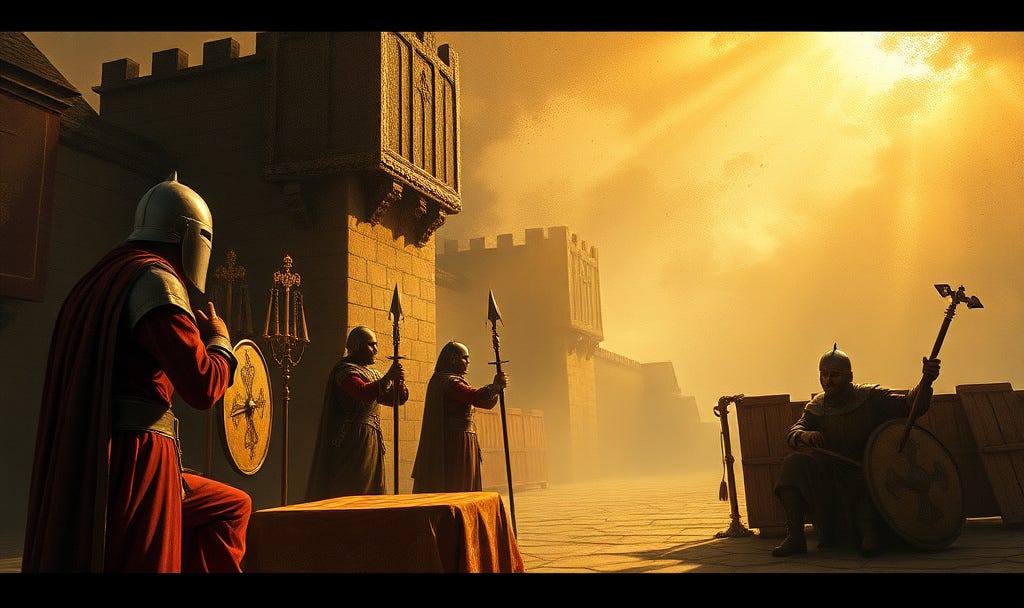
Eckhart was dragged before an inquisitorial court in Cologne. His sermons were dissected line by line. Twenty‑eight propositions were declared heretical or “dangerously misleading.”
His crime?
Not immorality.
Not disobedience.
Not political sedition.
His crime was teaching people that they were not small.
That the soul was not a servant but a participant in the divine life.
That God was not a king but a presence.
That heaven was not elsewhere but here, in the quiet center of one’s being.
Eckhart defended himself with clarity and humility. He insisted he was loyal to the Church. But he refused to retract the heart of his message: that God is closer than breath, and the soul is more spacious than the sky.
He died before the final verdict reached him. Some say that was a mercy.

What made Eckhart so threatening was not just theology—it was anthropology.
It was his view of what a human being truly is.
He believed that beneath our fears, roles, and ego‑stories lies a divine ground, a stillness untouched by time or suffering. In that ground, the soul and God are not two.
This was not a metaphor.
It was a metaphysical claim.
And it echoed ideas found in the Vedas, Buddhism, and—astonishingly—modern theories of quantum consciousness.
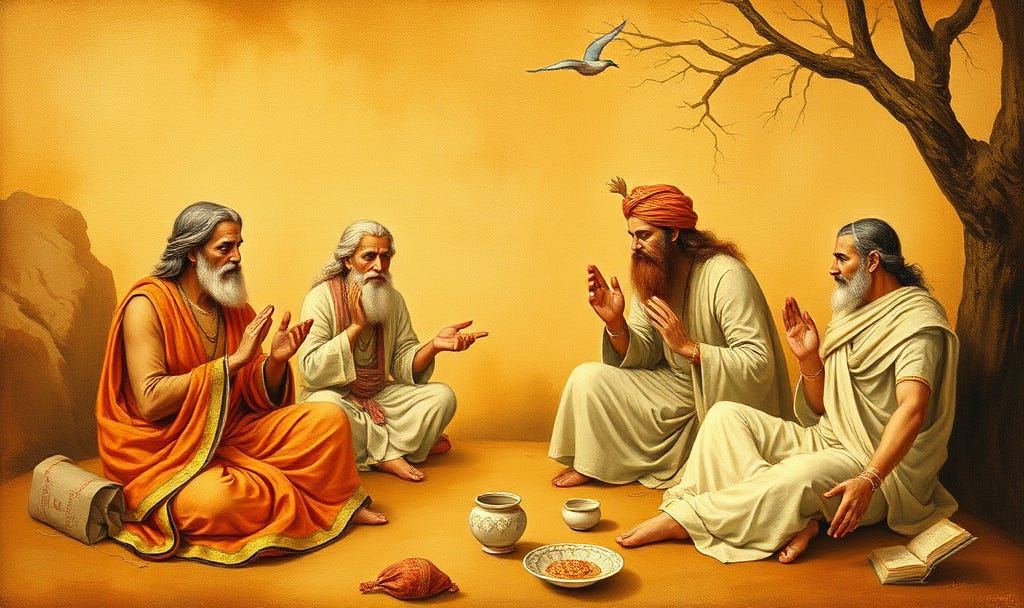
In the Upanishads, the sages whisper:
“Tat tvam asi.”
“You are That.”
The deepest self (Atman) is identical with the infinite (Brahman).
The world is a play of appearances.
The divine is not elsewhere—it is the essence of your being.
Eckhart said the same thing in Christian language.
He called it the “spark of the soul,” the place where God is born in us.
The Church needed a God who ruled from above.
Eckhart revealed a God who bloomed from within.
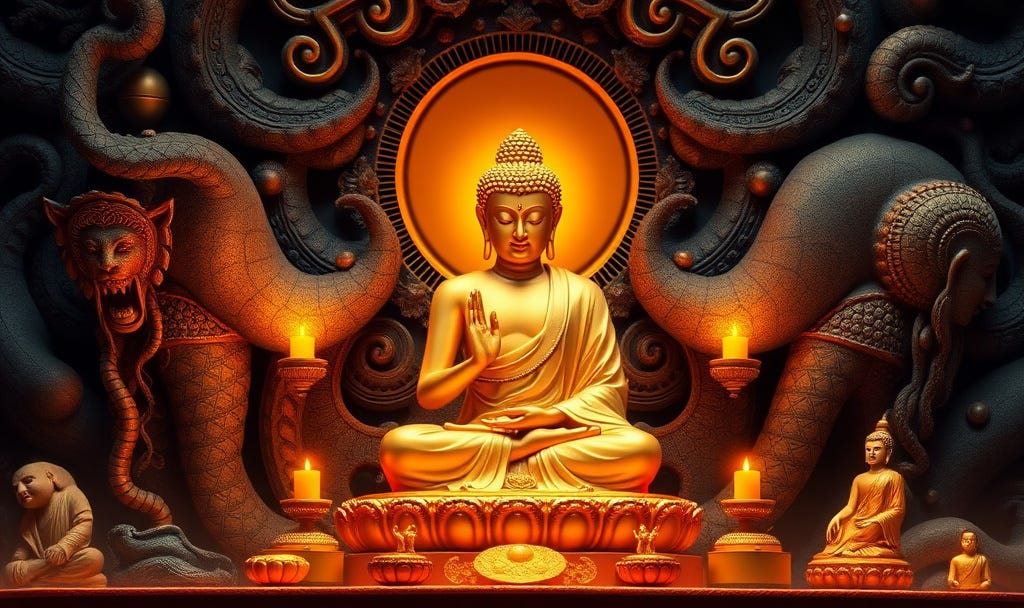
Buddhism teaches that ultimate reality is empty of separateness.
The boundaries between self and world dissolve.
Awakening comes from letting go of grasping and fear.
Eckhart’s “detachment”—living “without a why”—is nearly identical.
He taught that when we release our clinging to images, concepts, and ego, we fall into the Godhead, a silent, boundless presence beyond all names.
To the Church, this sounded like abandoning the personal God.
To Eckhart, it was discovering the God beyond our small ideas of God.

Modern physics—strangely—circles back to Eckhart’s intuition.
Quantum theory suggests:
The observer participates in reality.
Consciousness may be fundamental, not accidental.
The universe behaves like a unified field of information.
Boundaries between “self” and “world” are porous.
Eckhart would have smiled.
He believed the soul was a window through which the universe becomes aware of itself.
He believed God was not a distant monarch but the living ground of consciousness.
He believed you were not a subject looking at an object—you were part of the same luminous field.
Eckhart’s message was spiritually electrifying but politically dangerous.
A God within you means:
You cannot be spiritually controlled.
You do not need intermediaries.
You are not spiritually inferior.
You carry dignity that no institution can take away.
A person who knows their own divine ground is not easily manipulated.
Not easily frightened.
Not easily ruled.
Eckhart wasn’t trying to overthrow the Church.
He was trying to awaken the human soul.
But awakening is always threatening to systems built on fear.
Eckhart’s words survived in hidden manuscripts, whispered among mystics, rediscovered centuries later by philosophers, poets, and psychologists.
Today, he stands as a bridge:
between Christianity and Vedanta,
between medieval mysticism and Buddhism,
between ancient metaphysics and quantum consciousness.
He reminds us that the deepest truths are not owned by institutions.
They rise naturally in every human heart.
And he reminds us of something the Church feared most:
You are not small.
You are not separate.
You are not dependent on a distant king in heaven.
You are the living place where the infinite becomes aware of itself.
That was Eckhart’s heresy.
And his gift.
Comments
Nothing yet. Say the first thing.
Sign in to join the conversation.