
America does not need a command economy. It needs a governing compact capable of seeing the whole power system, assigning costs honestly, and protecting the people who already pay for it.
The Energy Marketplace
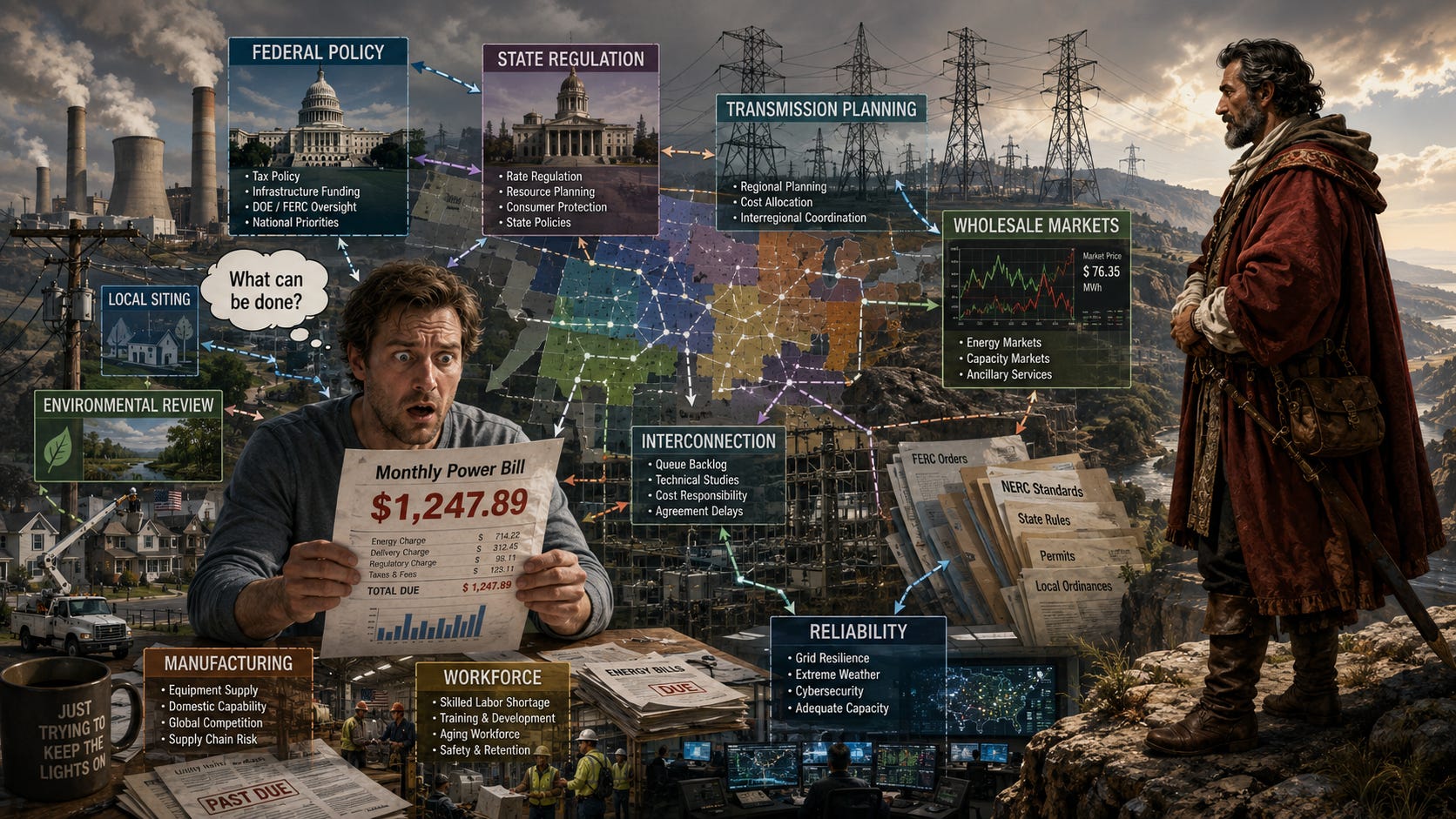
America does not have one energy marketplace. It has a collection of overlapping institutions, jurisdictions, markets, utilities, regulators, planning authorities, and private actors - each responsible for one part of a power system that must ultimately function as a single physical machine.
Viewed from within any one institution, the arrangement can appear rational. State commissions protect utility customers. Regional grid operators maintain reliability and administer wholesale markets. Federal agencies oversee interstate commerce, environmental obligations, nuclear safety, and energy security. Local governments make land-use decisions. Utilities plan and operate networks. Large customers seek timely and economical service.
Viewed as a whole, however, the system is fragmented. Each participant sees only part of the picture, operates under a different mandate, and works on a different timetable. No single institution is responsible for ensuring that generation, transmission, distribution, fuel, manufacturing, workforce, siting, security, and consumer protection advance together.
The physical grid does not recognize those institutional boundaries. Electricity must still be produced when it is needed, delivered through equipment with sufficient capacity, balanced continuously, and supported by dependable fuel, skilled workers, communications, and emergency preparation. The system is interconnected even when its governance is not.
That is the central policy challenge. America does not need to erase federalism, eliminate local authority, or replace private investment with central command. It needs a common operating framework: shared assumptions, credible data, coordinated schedules, clear cost responsibility, and explicit consumer protections. Federal agencies, states, regional grid operators, utilities, communities, manufacturers, and large customers should continue to exercise their lawful roles—but against the same national picture.
Without that shared picture, individually reasonable decisions can combine into a system that is slower, more expensive, less reliable, and increasingly difficult for the public to trust.
The Average American Is the Residual Payer
When a new thousand-megawatt load is announced, the American power system does not respond as one system. A county may approve the land use because it sees jobs and tax revenue. A utility may seek a new substation and a larger transmission connection. A regional grid operator may begin a study based on a request that is still changing. A state commission may not see the rate consequences until the facilities are already in motion. A generator may retire under one set of market signals while another agency assumes replacement power will arrive on a different schedule. A federal permit, a local hearing, a fuel contract, a transformer order, and a workforce program may all proceed on separate clocks.
If everything arrives as expected, the fragmentation is hidden. If the load is delayed, the line is contested, the plant is retired too early, the equipment is late, or the forecast proves speculative, the costs do not disappear. They migrate. They appear in a capacity price, a transmission rider, an emergency contract, a distribution upgrade, a property taking, a reliability warning, or a utility bill.
The average American is the residual payer of fragmented energy governance.
That burden is not limited to money. The quickest visible response to a shortage is often a new transmission corridor, and the people beneath the proposed line experience the national power problem as a local loss of land, view, control, and confidence. Other families never see the line but pay for it. Still others live near an aging plant whose closure removes jobs and dependable capacity before the promised replacement exists. A system that treats each of those consequences as someone else’s jurisdiction eventually loses the public permission to build anything.
The policy challenge is therefore larger than permitting reform, market reform, or a new subsidy. America needs rules that allow the country to see the whole physical system before separate institutions commit the public to its pieces.

Thirteen Systems, One Physical Grid
The United States has separate systems for federal energy policy, state utility regulation, regional transmission planning, wholesale power markets, local land-use decisions, environmental review, fuel development, nuclear licensing, large-load interconnection, manufacturing incentives, workforce development, grid cybersecurity, and emergency reliability planning.
Each has a rationale. State commissions protect captive customers. Local governments protect communities and determine land use. Environmental laws require consequences to be examined before they are imposed. Regional markets coordinate resources across utility boundaries. Federal agencies protect interstate commerce, safety, national security, and the public interest. The Nuclear Regulatory Commission exists because nuclear safety cannot be reduced to a local building permit. NERC reliability standards exist because one operator’s failure can propagate beyond one utility’s territory.
Those responsibilities should not be discarded. Many were created in response to real abuses, real hazards, and real failures.
But much of the operating logic beneath them was formed for another era: slow and relatively predictable load growth; vertically integrated utilities or stable market structures; large central power plants with known performance; domestic equipment supply that could be taken for granted; generous planning margins; and projects that could spend a decade moving among agencies without placing the wider system immediately at risk.
That world no longer exists. Large loads can arrive in increments once associated with cities. Generation can be built quickly in one place and remain trapped behind a congested interface. A plant can be economically pressured to retire even while the system still depends on services the market does not price. A transformer or turbine can become a schedule-determining national asset. Cybersecurity reaches from the bulk-power system into distribution devices, cloud platforms, telecommunications, pipelines, and third-party vendors. Emergency reliability may depend as much on fuel, communications, and restoration sequencing as on nameplate capacity.
Fragmentation is not federalism. Federalism assigns responsibilities across levels of government. Fragmentation allows every level to perform its own task while no one is responsible for whether the complete system works.
A Compact, Not a Command Economy
The answer is not a federal office choosing every generator, dictating every state resource mix, or drawing every transmission route from Washington. Central planning would suppress the local knowledge, private initiative, competition, and regional diversity that make the American system productive.
The answer is a National Power Compact: a congressionally authorized framework of common obligations, shared data, coordinated schedules, and explicit consumer protections under which federal agencies, states, regional grid operators, utilities, communities, and large customers continue to exercise their lawful roles - but do so against the same national picture.
Under the compact, private companies would still decide what to invest in. States would still regulate retail utilities and choose among resource portfolios. Regional organizations would still plan and operate their systems. Local communities would still participate in siting. Federal regulators would still apply safety, reliability, environmental, and interstate-commerce law.
What would change is the absence of a common operating plan. Every major decision would have to answer the same questions: What demand is real? What physical resources will serve it? When will those resources be available? What reliability services are required? Who benefits? Who pays? What happens if the project does not arrive? What useful capacity remains if it leaves? What supply-chain, workforce, cybersecurity, fuel, and emergency assumptions must also be true?

A Coast-to-Coast Power Outlook
The compact should begin with a biennial National Power Outlook prepared by the Department of Energy with FERC, NERC, the states, regional reliability entities, Tribal governments, and industry. It should look at least twenty years ahead, but it should not pretend that one forecast is certain.
The outlook should publish several locational scenarios: a committed-demand case, a probable-growth case, a high-growth case, and severe reliability stress cases. It should distinguish energy from capacity, capacity from deliverability, and deliverability from the supporting services required to keep voltage and frequency within limits. It should identify where generation, transmission, distribution, fuel infrastructure, transformers, turbines, reactor components, skilled labor, and restoration capability are likely to become binding constraints.
The outlook would not select a national fuel mix. It would create a common factual map. States and regional operators would then prepare conforming ten-year delivery plans showing how their own policies, markets, utilities, and projects fit together. Where the plans reveal a gap, the responsible institutions would be required to name the gap, the decision-maker, the schedule, and the consumer consequence.
A coast-to-coast resource plan should not mean one answer for every coast. It should mean that no region is permitted to make assumptions about generation, imports, fuel, transmission, or emergency support that are invisible to the regions expected to provide them.
The National Power Compact

1. Forecast What Is Real
Large-load planning should begin with a project-readiness standard. Applications above a defined threshold should include site control, a credible construction schedule, financing evidence, expected hourly and seasonal demand, ramp rates, power-quality requirements, redundancy needs, backup-generation plans, and the milestones by which the request will mature.
The load should then be classified as committed, probable, or speculative. Deposits, minimum financial commitments, and periodic certifications should rise with the amount of capacity being reserved. Duplicative requests for the same corporate project in several regions should be identified and probability-weighted rather than counted as if every site will be built. A project that misses milestones should lose priority, reduce its reservation, or pay the carrying cost of keeping infrastructure available.
Commercially sensitive details can remain protected. The system-level assumptions cannot. Regulators, utilities, and the public should be able to see how much planned demand rests on signed contracts and active construction, how much rests on early development, and how much is still an option.
A reservation without consequence is not a forecast. It is an option written by ratepayers.

2. Make Growth Carry Its Weight
New large loads should pay a fair portion of the generation, transmission, reserve, substation, and distribution investments they make necessary. That principle should apply whether the customer connects conventionally, colocates with a generator, builds behind-the-meter supply, or requests a flexible form of transmission service.
Fair allocation does not mean every shared facility is charged entirely to the newest customer. Some upgrades create broad regional value: they relieve chronic congestion, improve resilience, reduce losses, or allow several communities to grow. Those benefits can justify wider allocation. But the benefit must be demonstrated, and the public should be able to see the calculation.
Large-load tariffs should include meaningful contract terms, minimum billing obligations, collateral, exit fees, ramping and standby provisions, and clear responsibility for stranded costs. If a state wishes to offer an economic-development incentive, it should do so openly through an appropriated program or transparent tax policy - not hide it in the electric bills of families and small businesses.
Growth should leave the power system stronger even if the first customer eventually leaves.
3. Pay for Reliability, Not Labels
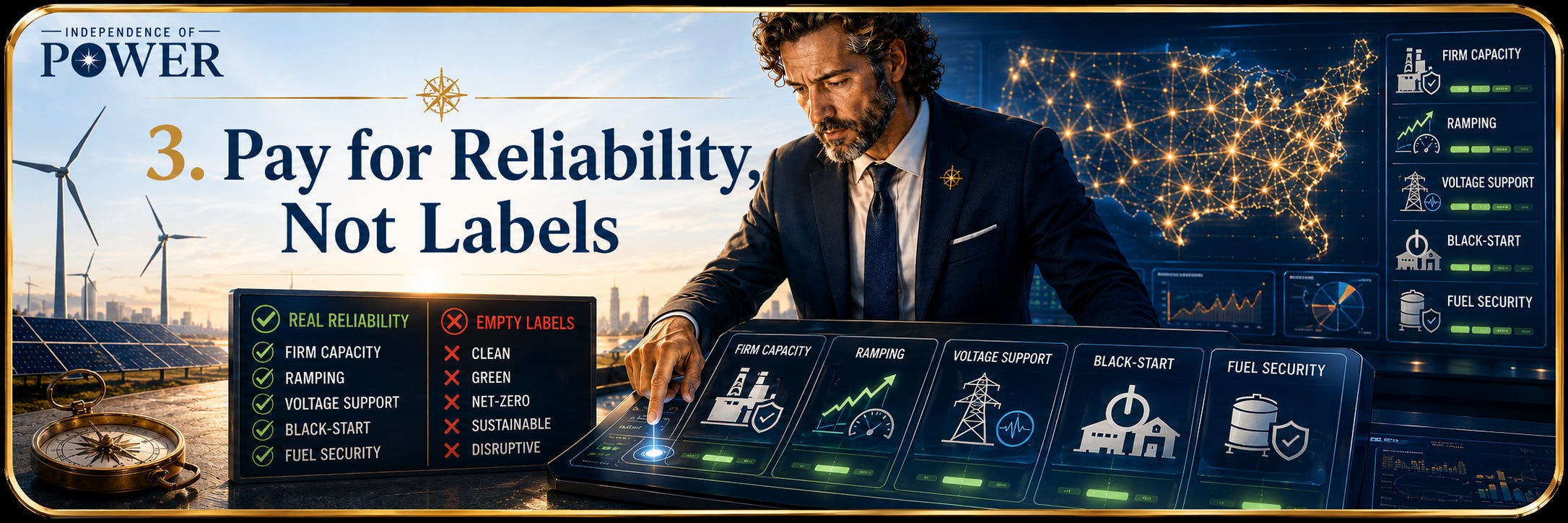
Technology-neutral policy is often misunderstood as indifference to performance. The opposite is required. The grid should compensate the services it actually needs: dependable capacity, ramping, operating reserves, voltage and reactive-power support, frequency response, inertia or equivalent system-strength capability, black-start service, fuel assurance, local deliverability, and restoration value.
Not every service must become a separate market product, and not every region needs the same procurement design. But every regional operator and state plan should show how the required reliability attributes will be maintained as the resource mix changes. Resources should be allowed to compete to provide them if performance can be tested, measured, and enforced.
A synchronous generator should not receive a permanent entitlement merely because it is old. A battery or grid-forming inverter should not receive assumed credit merely because it is new. Each should be paid for what it can reliably deliver under the conditions in which the system will call upon it.
Technology-neutral cannot mean physics-neutral.

4. Permit on a Clock, With Communities at the Table
Faster siting should mean one coordinated record, concurrent agency work, a public schedule, early identification of disputed issues, and a date by which a decision will be made. It should not mean that communities first learn of a preferred route after the major engineering and financial choices have already been made.
For projects with federal and state approvals, a lead-agency process modeled on the best features of FAST-41 should synchronize the environmental review, property, water, air, safety, cultural-resource, and land-use calendars. Agencies should share a common data room, resolve requests for additional information on a defined schedule, and explain publicly when a deadline changes.
Congress and the states should also establish Energy Reuse Zones at retiring and retired power plants, industrial brownfields, former mines, and other energy-bearing sites with existing grid connections, transportation access, water rights, industrial land use, and a trained workforce. Reuse should not be automatic; safety and environmental obligations remain. But the existing site, studies, rights-of-way, and interconnection should be treated as assets rather than erased from the record.
Transmission planning should begin with the full toolbox: advanced reconductoring and high-temperature conductors on existing structures, grid-enhancing technologies, dynamic ratings, underground or HVDC use of existing utility, rail, and transportation corridors, high-temperature superconducting cable in constrained high-density locations, and only then new corridors where they are the best answer.
Speed is not silence. It is the discipline of deciding.

5. Preserve the Bridge to the Future
Reliable generation should not be retired casually before replacement capacity, transmission, fuel, and supporting services are demonstrably available. Before a major retirement becomes final, the responsible state and regional authorities should certify what replaces the plant’s energy, capacity, local voltage support, inertia, black-start capability, fuel security, and restoration role - and when each replacement will be operating.
That requirement should not become a permanent subsidy for every aging asset. Bridge agreements should be finite, transparent, and tied to a specific reliability need. But the system should evaluate uprates, rerates, life extensions, efficiency improvements, fuel conversions, emissions upgrades, restarts, or conversion to synchronous-condensing and grid-support service before discarding equipment, sites, and skilled workforces that took decades to assemble.
A retirement date on a corporate schedule is not proof that the physical service is no longer needed. A planned replacement on a presentation slide is not proof that it will be available during the next heat wave.
Retirement can look easy on an annual spreadsheet and become impossible in August.

6. Rebuild the Sovereign Energy Supply Chain
Transformers, switchgear, generators, gas turbines, advanced conductors, power electronics, control systems, reactor vessels, nuclear steam generators, pumps, forgings, uranium conversion and enrichment, fuel fabrication, critical minerals, specialty alloys, and cybersecurity hardware are not ordinary commodities when the country cannot build without them.
The compact should require a recurring energy-industrial-base assessment and a national list of schedule-critical components. Congress should support multi-year procurement, loan guarantees, production tax incentives, Defense Production Act authorities, strategic inventories, standardized designs, aggregated orders, and qualified allied sourcing where domestic self-sufficiency is neither economical nor necessary.
Workforce policy should follow the order book. Community colleges, apprenticeships, unions, universities, utilities, laboratories, vendors, and construction firms should know which projects are real, which skills are needed, where the work will occur, and when people must be ready. Training without committed demand creates disappointment. Committed projects without trained people create delay.
Reducing remaining exposure to unstable Middle Eastern fuel routes is sensible, but the electricity system should not be diagnosed with yesterday’s dependency. The United States already obtains a relatively small share of its crude imports from the Middle East Gulf, and the electric grid is not principally powered by imported oil. Its more immediate strategic vulnerabilities include foreign enrichment, concentrated component supply, long-lead transformers and turbines, critical materials, and single-source industrial capacity.
Independence is not isolation. It is the ability to endure interruption and choose partners.
7. Treat Flexibility as Infrastructure
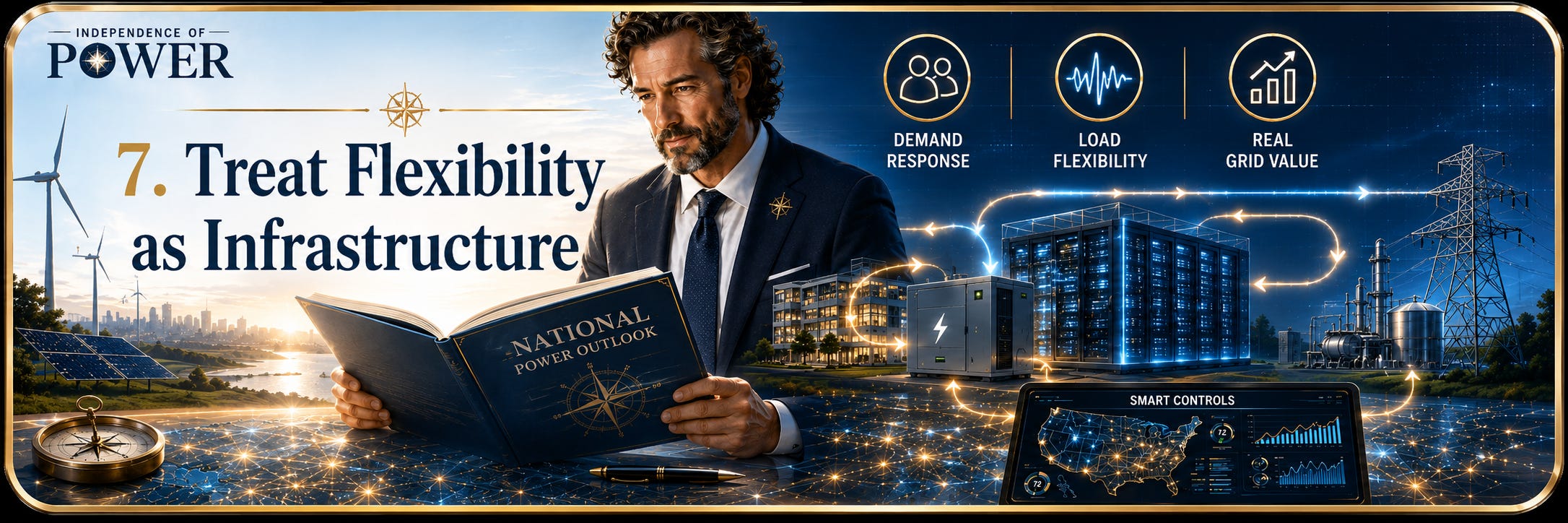
Some large data centers and industrial facilities must operate continuously. Others can move workloads, use thermal storage, shift charging, reduce noncritical processes, or draw temporarily from on-site resources. That capability should be treated as a real grid resource when it is contractual, telemetered, tested, secure, and available on command.
A customer could define a non-curtailable core load and one or more flexible tranches with different notice times and durations. Regional operators and utilities could compensate verified performance through lower connection costs, service credits, capacity arrangements, or emergency programs. Failure to perform should carry consequences, just as failure by a generator does.
Flexibility must not become an accounting excuse for chronic underbuilding. It is most valuable for rare peaks, contingencies, maintenance windows, and temporary constraints. A system that depends on routine curtailment to cover ordinary demand has not created flexibility; it has institutionalized shortage.
A megawatt that can reliably disappear for thirty minutes may be as useful in an emergency as a megawatt that can appear - provided it is real, measured, and available when called.

8. Put the Household First
Every major power decision should include a public consumer-impact statement before approval, not years afterward. It should show the expected bill effect by customer class; the costs directly attributable to new large loads; the costs allocated because of broader benefits; the risk if the customer is delayed, downsized, or leaves; and the collateral or reserve established to protect the remaining customers.
Utilities and regional organizations should publish annual cost-shift audits in a common format. State commissions should require large-load tariffs or special contracts to include minimum bills, credit support, termination protection, and transparent treatment of generation and transmission obligations. Economic-development benefits should be reported alongside utility-system costs rather than used as a substitute for them.
Households should also receive the benefit of system improvements they finance. If a new customer funds a line, plant, substation, or flexible-load arrangement that lowers regional costs or improves reliability, that value should be reflected in future rates rather than retained as an invisible windfall.
Families should not discover years later that a large corporate load was effectively subsidized through higher utility bills. The average American should not be the power system’s shock absorber.
Security and Emergency Reliability Belong Inside the Plan
A National Power Compact that coordinates only ordinary construction would still be incomplete. The electric system now depends on digital controls, telecommunications, satellite timing, natural-gas pipelines, water systems, cloud services, equipment vendors, and distribution-level devices that often sit outside the traditional bulk-power security boundary.
Each regional delivery plan should therefore include a joint cyber, physical-security, fuel, and restoration annex developed with DOE’s emergency and cybersecurity office, NERC, state emergency agencies, utilities, pipeline and communications operators, and major customers. It should identify black-start paths, priority loads, fuel inventories, spare transformers, mutual-assistance arrangements, communications fallbacks, and the consequences of sudden large-load loss as well as sudden load growth.
The plan should be exercised, not merely filed. A restoration sequence that has never been tested against a communications failure, a cyber incident, an extreme-weather event, or a disrupted fuel supply is an assumption, not a capability.
Abundance that cannot survive disruption is only capacity on paper.
What Congress Should Actually Enact
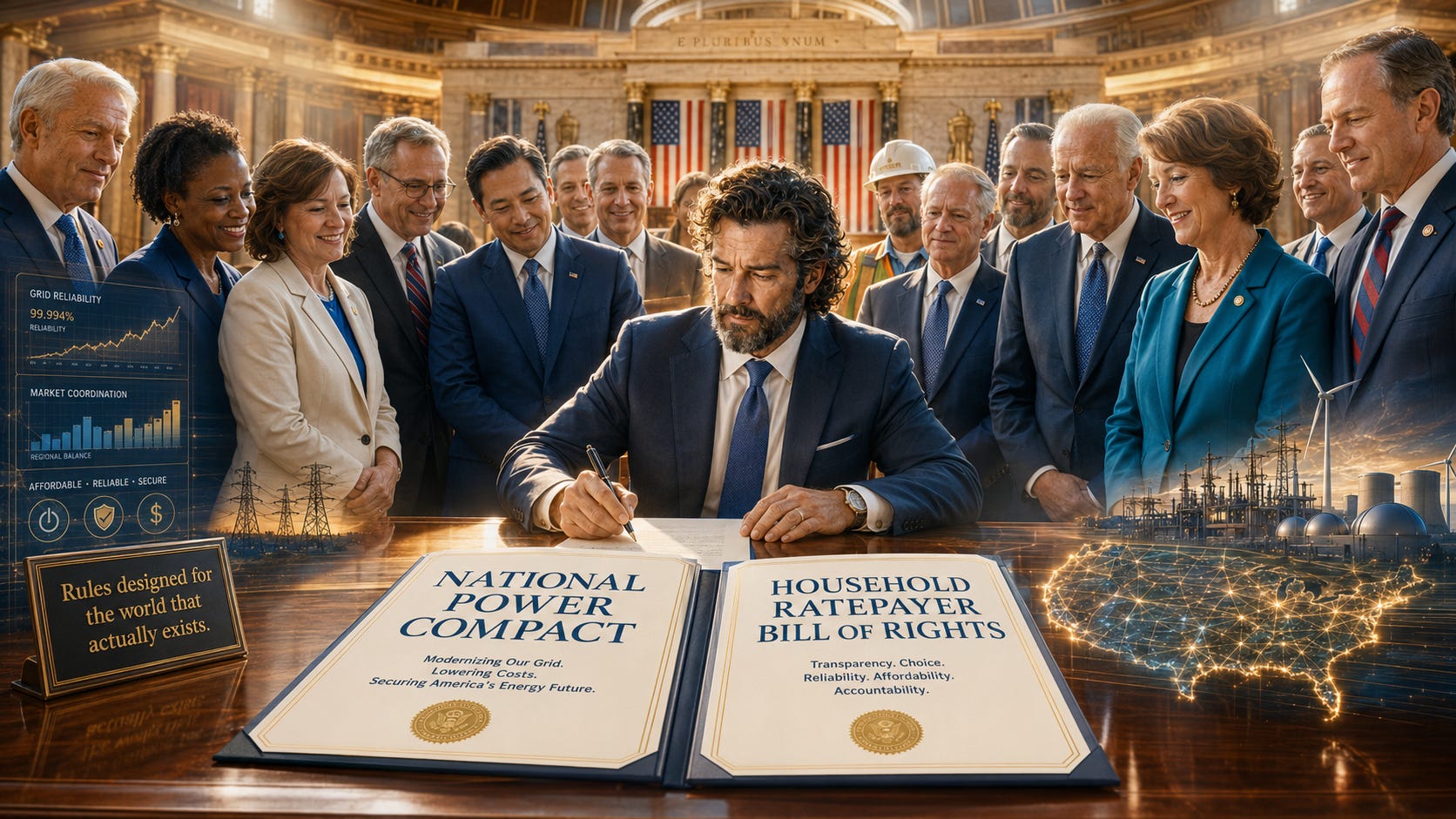
The legislative task can be practical and limited. Congress should establish the National Power Compact and require the biennial National Power Outlook. It should condition selected federal infrastructure, manufacturing, and workforce funds on state and regional participation in conforming plans, while preserving state authority over retail rates and resource choices.
It should direct FERC to establish minimum large-load transparency, readiness, flexibility, and cost-responsibility standards for interstate transmission service, while allowing each region to design the tariff mechanisms that fit its system. It should direct NERC, subject to FERC approval, to maintain a transparent framework for assessing essential reliability attributes and retirement impacts.
It should expand coordinated federal-state permitting agreements; create a statutory pathway for Energy Reuse Zones; and require agencies to recognize existing rights-of-way, interconnections, studies, and industrial infrastructure when evaluating replacement projects. It should fund community participation early enough to shape outcomes, not merely react to them.
It should establish a durable strategic energy manufacturing program with multi-year authorities for transformers, nuclear fuel, grid-control equipment, advanced conductors, turbines, power electronics, critical materials, and other schedule-determining components. And it should align workforce grants with committed regional build plans.
Finally, it should create a Household Ratepayer Bill of Rights for federally jurisdictional and federally supported projects: clear attribution of costs, advance bill-impact disclosure, protection against stranded large-load investments, public auditability, and a prohibition on hiding economic-development subsidies in ordinary utility rates.
No provision requires Washington to choose the winning reactor, turbine, battery, conductor, or data-center design. The compact governs the interfaces: evidence, timing, reliability, cost responsibility, security, and public accountability. That is where the present system is failing.

Rules That Permit Abundance
Energy abundance is not the absence of rules. A country cannot build a safe reactor, a dependable grid, a fair utility system, or a secure fuel supply through improvisation. Abundance depends on rules that protect the public and reach decisions while they still matter.
Good rules identify who decides, by what date, using what evidence, with whose participation, at whose cost, and what happens if the assumptions prove wrong. They do not allow a speculative request to become a public forecast, a private advantage to become a household subsidy, a market label to substitute for physical reliability, or a retirement announcement to substitute for replacement power.
The grid does not need fewer rules. It needs rules designed for the world that actually exists.
Those rules should let America say yes to growth without asking ordinary citizens to absorb every error. They should make growth carry its weight, preserve community participation, reward real grid services, retain useful assets until replacements exist, and rebuild the capacity to manufacture what the system requires.
The next America will not be powered by a slogan. It will be powered by a compact.
Source Notes
The factual context in this essay draws principally from the following current public sources. The National Power Compact, Energy Reuse Zones, the proposed retirement test, the Household Ratepayer Bill of Rights, and the legislative architecture are policy proposals by the author. Forecasts and agency initiatives are planning evidence, not guarantees of future construction or performance.
10. U.S. Department of Energy, Office of Nuclear Energy, Coal-to-Nuclear Transitions, April 2024.
© 2026 Marco Polo | The Independence of Power
No posts
Comments
Nothing yet. Say the first thing.
Sign in to join the conversation.