
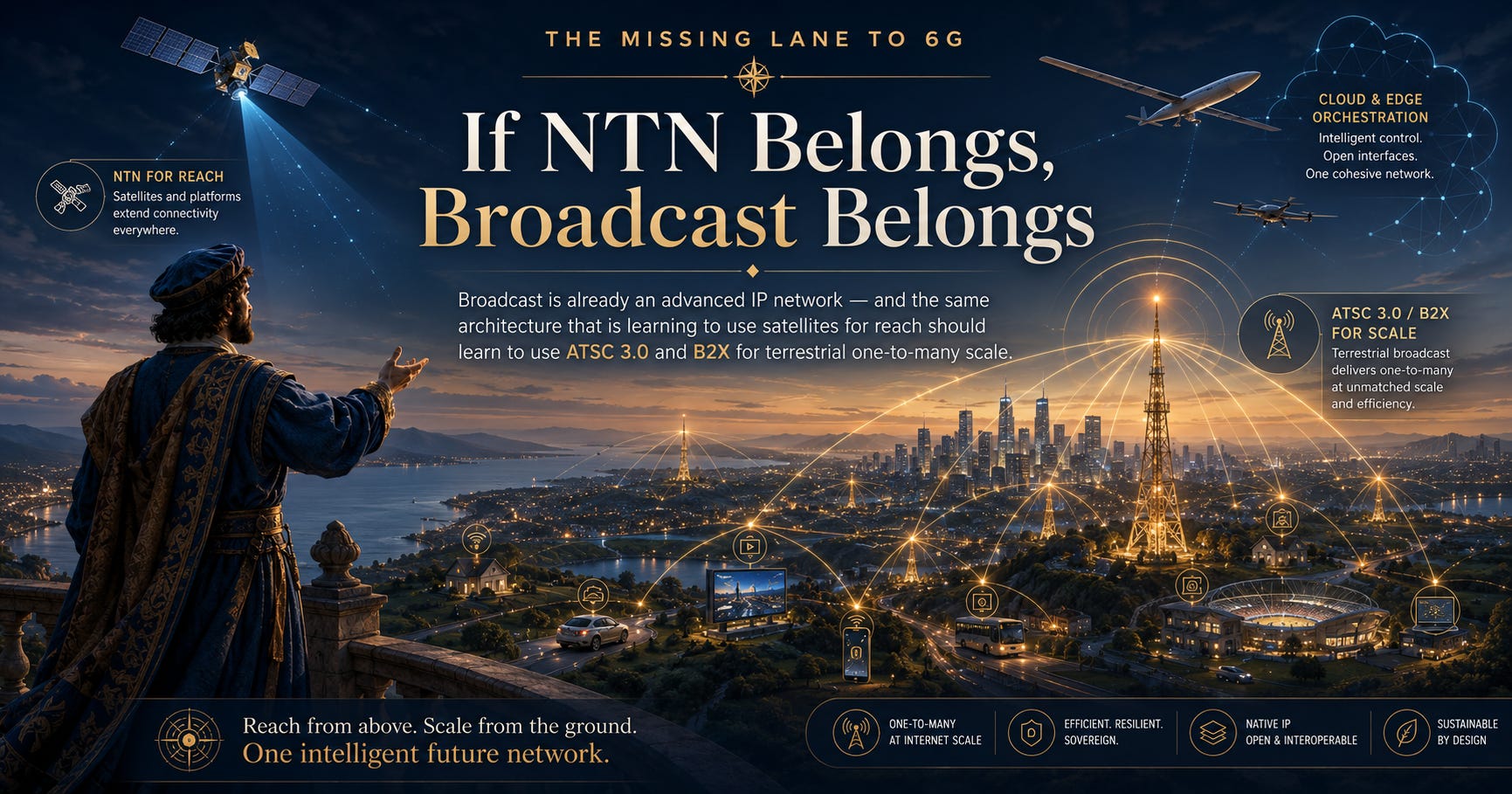
Broadcast is already an advanced IP network — and the same architecture that is learning to use satellites for reach should learn to use ATSC 3.0 and B2X for terrestrial one-to-many scale.
The mobile industry has already made the most important conceptual decision required for the future Internet: no single access network will be best at every job.
Non-Terrestrial Networks (NTN) made that conclusion unavoidable. Satellite Direct-to-Device (D2D) allows an ordinary handset to remain part of a mobile service even when the serving radio system is not the operator’s conventional terrestrial RAN. The engineering, ownership, coverage geometry, delay, mobility, and capacity profile may all be different. Yet the service can still be discovered, authenticated, controlled, and experienced as part of one larger network.
That is more than a coverage achievement. It is an architectural precedent. It tells us that another network can become useful to mobile without first becoming a copy of mobile.
Terrestrial Direct-to-Mobile (D2M) asks the mobile ecosystem to apply the same principle where the need is not remote reach but common scale. When many devices need the same object, the best path may be a high-power broadcast network built to deliver once across a wide area. In the United States and other ATSC markets, that network is no longer an analog television relic. It is ATSC 3.0: an all-IP, configurable OFDM platform whose physical and service layers were designed for resilient one-to-many delivery.
Chapter 3 established an important caution. LTE-based 5G Broadcast has improved through Releases 18 and 19, and it may serve useful dedicated-broadcast applications. But its 3GPP name does not make it the strongest physical layer, a native extension of an operator’s modern RAN interfaces, or the only path by which broadcast can belong in 5G and 6G.
The better question is not which technology carries the most familiar label. It is which bearer performs the burden best—and whether the whole network can select, control, and measure that bearer.
If satellites can become part of the 6G imagination, so can towers.
For most of cellular history, network expansion followed a familiar pattern: add spectrum, add sites, densify the radio layer, expand backhaul, improve compression, deploy more edge capacity, or offload sessions to Wi-Fi. Each response could be rational. Together they created a habit of solving nearly every burden by building more individualized delivery capacity.
NTN breaks that habit. A satellite beam is not simply a taller cell. It brings long propagation paths, moving coverage, constrained link budgets, different handover behavior, external infrastructure owners, and service areas that bear little resemblance to an urban terrestrial grid.
3GPP did not reject the satellite layer because it was physically different. It adapted the architecture because the capability—coverage beyond the practical terrestrial edge—was worth having.
That reasoning should govern the terrestrial side as well. A high-power broadcast tower is not a macrocell with an unusually large antenna. It is a different kind of network asset optimized for a different burden. If physical difference is no longer a reason to exclude satellites, it cannot remain a reason to exclude broadcast.
D2D has made the case for reach. It can extend service over oceans, isolated territory, transportation routes, disaster zones, and places where conventional terrestrial construction is absent, damaged, or uneconomic.
D2M makes the case for scale. Its strongest use is not rescuing one handset beyond the network edge, but serving large populations inside the terrestrial footprint when their demand becomes common. A live event, emergency object, software package, map layer, educational file, AI model component, or popular media segment should not consume a separate radio path merely because millions of receivers happen to want it.
The two ideas are complementary. D2D extends the map. D2M changes the capacity multiplier. One adds a viable path where terrestrial coverage fails. The other preserves terrestrial mobile capacity by moving common demand onto a shared path.
5G Multicast and Broadcast Services (5G MBS) supplies a third tool: multicast that is native to the 5G Core and NR for operator-controlled groups and localized demand. The emerging architecture should not force these capabilities into a contest. It should understand where each performs best.
The outdated mental model of broadcasting is a fixed waveform carrying a fixed television schedule to a fixed receiver. That model does not describe ATSC 3.0.
ATSC 3.0 is organized as a layered system. Its physical layer, link layer, transport and signaling, security, applications, and presentation functions can evolve without requiring the entire system to be rebuilt at once. The payload is IP. The network can carry timed media, non-timed data, applications, signaling, emergency information, files, manifests, software objects, and resources intended for receiver caches.
Television remains an important service. It is no longer the architectural definition of the bearer. An IP object does not become less useful because a broadcast transmitter carried it. The service layer determines what the object means; the RF layer determines how efficiently it reaches many receivers.
That separation is exactly what makes ATSC 3.0 relevant to the future Internet. It allows the same physical infrastructure to support media, public safety, software distribution, connected vehicles, education, edge-cache replenishment, and other common-object services without pretending they are all television channels.
ATSC 3.0 uses OFDM, but the important fact is not the acronym. It is the degree of control available inside the waveform. Physical Layer Pipes can carry services with different combinations of coding, modulation, robustness, and capacity within the same emission. Guard intervals, code rates, constellations, pilot structures, and framing can be selected around the service and deployment.
The system supports single-frequency networks, channel bonding, multiple-input multiple-output modes, and a bootstrap intended to remain a durable entry point as services and waveforms evolve. Long LDPC codes, non-uniform constellations, interleaving, and flexible OFDM parameters give network designers a broad operating space between difficult mobile reception and high-capacity fixed service.
The ETRI-led comparisons discussed in Chapter 3 found material performance advantages for ATSC 3.0 over the evaluated pre-Release-19 5G Broadcast configurations in laboratory, field, and handheld-mobile conditions. Release 19 interleaving improvements deserve fresh direct testing, but they do not erase the distinct coding, constellation, framing, and deployment inheritance of the two systems.
That matters to energy efficiency. Useful bits per hertz determine more than a marketing data rate. They influence required signal strength, transmitter power, site count, coverage margin, receiver duty cycle, and the amount of infrastructure needed to close a service reliably.
LTE-based 5G Broadcast is a real one-to-many physical layer. It can carry IP services in dedicated, receive-only, free-to-air configurations and has gained useful capabilities in Releases 18 and 19. The argument for ATSC 3.0 does not require denying those facts.
The limitation is architectural fit. 5G Broadcast descends from the LTE eMBMS and FeMBMS branch, not from NR-based 5G MBS. Its broadcast chain remains separately engineered from the interfaces through which an operator’s contemporary RAN is scheduled, timed, observed, controlled, and disaggregated.
IP does not solve that interface problem by itself. An MNO does not operate a RAN merely by delivering an IP stream to a transmitter. It needs capacity exposure, admission, timing, user-plane mapping, real-time control, fault reporting, performance measurements, security, device capability awareness, and commercial accountability.
eCPRI and O-RAN open fronthaul illustrate the difference. They define machinery between distributed and radio functions that ordinary IP payload compatibility does not supply. A 3GPP-derived broadcast profile can interoperate at selected service layers while still remaining outside the operator’s day-to-day RAN pipeline.
The choice is therefore not between a ‘cellular’ technology and a ‘non-cellular’ technology. It is between bearer architectures with different physical performance, coverage geometry, device paths, and integration burdens. The familiar name should not substitute for that comparison.
B2X does not ask ATSC 3.0 to masquerade as cellular. It asks broadcast to expose the functions that mobile, cloud, edge, and service platforms need in order to use it.
At the service level, that means common objects can be identified, described, authorized, scheduled, delivered, repaired, measured, and reconciled without requiring an application to understand the mechanics of the broadcast network.
At the network level, B2X is moving toward a more explicit alignment with 3GPP and O-RAN thinking: service discovery, bearer selection, Broadcast Core Network functions, F1/PDCP-style offload paths, disaggregated radio elements, and an OFDMA resource framework in which multicast can be scheduled across time, frequency, service groups, and device classes.
This distinction is important. ATSC 3.0 supplies a high-performing broadcast-native foundation. B2X supplies the translation and control layer that makes its capacity legible to the networks already carrying digital life.
The work is not finished. Candidate standards, architecture papers, demonstrations, device development, and interface proposals are not the same as a mature nationwide commercial ecosystem. But B2X is aimed at the correct seam: the place where a strong broadcast bearer must become selectable and operationally useful without surrendering the physics that make it efficient.
India’s D2M work is important because it begins with the mobile device rather than treating the television receiver as the boundary of broadcast. Testing has included ATSC 3.0-based broadcast radio heads, mobile reception, high-power and low-power configurations, coexistence with cellular service, and ordinary handset behavior while the broadcast path is active.
That is the right systems question. The value of a one-to-many bearer is not proven merely by radiating a waveform. It is proven when devices can discover it, receive common content efficiently, continue using cellular functions, obtain repair or personalization through another path, and present the result as one coherent service.
In brownfield ATSC markets, the near-term opportunity is to make existing ATSC 3.0 infrastructure useful to mobile and cloud platforms through B2X. In a greenfield market, the opportunity reaches further: the broadcast bearer, mobile interfaces, device architecture, and service orchestration can be aligned from the beginning rather than retrofitted after separate ecosystems harden.
The result is not a replacement mobile network. It is a capacity partner. Common payloads move once; authentication, transactions, return traffic, telemetry, recommendations, and other personal functions remain on interactive networks.
Cellular design naturally treats a two-way session as the basic unit of networking. Broadcast begins from a different premise: a common forward path can carry enormous value even when the return path is separate, intermittent, or unnecessary.
That is not a defect. A software image, emergency map, live event, model update, or public-information package may need to reach millions of receivers, while only a small fraction of the associated traffic is personal. Sending the shared payload once and keeping individualized functions on mobile, Wi-Fi, or fixed broadband is often the more rational architecture.
The future Internet will not require every layer to perform every function. Satellite does not replace dense terrestrial service. Wi-Fi does not replace mobility. Fiber does not replace radio. Broadcast does not need to grow an artificial cellular uplink before its wide-area common downlink becomes valuable.
Broadcast’s strongest strategic argument may be the least glamorous: much of the network already exists. Transmitter sites, antennas, spectrum assignments, power systems, operational staffs, monitoring, emergency responsibilities, and broad coverage footprints are not proposals in a laboratory roadmap.
Integration is not free. Devices need compatible receivers and antennas. Chipsets must support the relevant bands and waveforms. Discovery, identity, policy, security, rights, measurement, repair, application signaling, and settlement must work across network boundaries.
But those are integration tasks around an existing wide-area network. They are materially different from building another nationwide layer of individualized capacity solely because the architecture never learned how to invoke the one-to-many asset already standing on the horizon.
This is also an energy argument. Reusing existing infrastructure, avoiding duplicate transmissions, preserving interactive mobile capacity, reducing peak-driven overbuild, and selecting the bearer with the best useful bits per hertz can matter as much as lowering the instantaneous power of a particular radio.
Bringing broadcast into the future network does not require relabeling ATSC 3.0 as NR, putting every transmitter inside a mobile operator core, or forcing a high-power tower to imitate a dense cellular grid. That would erase the difference that creates value.
Interworking means that devices and service platforms can discover the bearer, understand its capabilities, request capacity, apply policy, maintain continuity, verify delivery, obtain repair, and measure the result. It means an application can state what it needs without hard-coding the network that must carry it.
Release 19’s work on interworking between non-3GPP terrestrial broadcast and 5G MBS is an important formal recognition of this direction. It does not complete the ecosystem, but it confirms that the 5G system can treat an external broadcast network as a useful service resource.
The Broadcast Core Network work and B2X architecture carry that idea further. They ask how broadcast can participate in common service orchestration while retaining a data plane, coverage model, and physical layer suited to broadcasting.
NTN taught the mobile ecosystem to accommodate a radio environment that does not resemble the familiar cell. The industry accepted different delays, moving beams, constrained capacity, new timing relationships, and external infrastructure because the reach was valuable.
Broadcast asks for the same openness. Its topology, waveform, and operating model differ because its purpose differs. It is optimized for wide-area one-to-many distribution rather than individualized sessions. That is not an inheritance to be apologized for. It is the capability the larger architecture is missing.
The strongest road to 6G is therefore not a single radio technology extended until it attempts to perform every task. It is an intelligent framework in which cellular unicast carries personal interaction, 5G MBS serves operator-controlled groups, D2D supplies reach and resilience, and ATSC 3.0/B2X supplies terrestrial scale.
The bearer should be rewarded for performing the burden best. The cleanest packet is the one that does not have to be sent a million times—and the best missing lane is the one that can be selected, controlled, and measured as part of the whole network.
Chapter 5 will turn fully to that alignment layer: how B2X makes broadcast legible to 3GPP, cloud, edge, O-RAN, and device ecosystems without forcing broadcast to surrender the one-to-many advantage that makes it useful.
• 5G Americas, “5G-Advanced Overview,” July 2025: Used for the 5G-Advanced framing around NTN, AI/ML, energy efficiency, network automation, and the transition toward 6G.
• 3GPP, “Non-Terrestrial Networks (NTN)”: Used for the formal NTN framework, Release 17 foundations, later enhancements, satellite and airborne access, and the architectural distinction between terrestrial and non-terrestrial radio systems.
• GSMA, “Satellite direct-to-device (D2D)”: Used for current mobile-industry terminology and for the treatment of satellite D2D as a complement to terrestrial mobile coverage.
• 5G-MAG, “NTN & Content Delivery: From Specs to Software,” April 2026: Used for the active convergence of NTN, Direct-to-Device, multicast-broadcast services, media delivery, and open implementation work.
• 3GPP, “Broadcast, multicast technologies”: Used for the evolution from MBMS and eMBMS/FeMBMS to 5G MBS, dynamic point-to-point/point-to-multipoint delivery, and Release 19 interworking with non-3GPP terrestrial broadcast.
• 3GPP, Release 19 Summary, April 2026: Used to confirm Release 19 treatment of interworking between non-3GPP digital terrestrial broadcast networks and 5GS multicast-broadcast services.
• 3GPP Work Item DTTB4MBS: Used for the formal work-item path connecting non-3GPP digital terrestrial broadcast networks with 5G multicast-broadcast services.
• 5G-MAG, “LTE-based 5G Broadcast” standards overview: Used to distinguish LTE-based 5G Broadcast from NR-based 5G MBS and to recognize continuing Release 18 and Release 19 profile improvements.
• Kwon et al., “Comparative Assessment of Physical Layer Performance: ATSC 3.0 vs. 5G Broadcast in Laboratory and Field Tests,” 2025: Used for the comparative laboratory and field assessment across fixed and mobile reception. The chapter treats the work as evidence on the evaluated pre-Release-19 baseline and supports new testing of completed Release 19 implementations.
• Ahn et al., “Evaluation of ATSC 3.0 and 3GPP Rel-17 5G Broadcasting Systems for Mobile Handheld Applications,” 2023: Used for the peer-reviewed physical-layer and network-deployment comparison and the reported advantage of ATSC 3.0 in the evaluated handheld-mobile configurations.
• ATSC A/300, “ATSC 3.0 System”: Used for the layered, all-IP ATSC 3.0 architecture and its hybrid broadcast-broadband service framework.
• ATSC A/321, “System Discovery and Signaling”: Used for the bootstrap as a durable entry point capable of signaling services and future waveform evolution.
• ATSC A/322, “Physical Layer Protocol”: Used for OFDM, Physical Layer Pipes, coding and modulation flexibility, interleaving, guard intervals, single-frequency networks, channel bonding, and MIMO.
• ATSC A/330, “Link-Layer Protocol”: Used for ATSC Link-Layer Protocol carriage of IP packets and efficient, extensible encapsulation between upper-layer services and the RF layer.
• ATSC A/331, “Signaling, Delivery, Synchronization, and Error Protection”: Used for IP-based timed-media and non-timed-data delivery, ROUTE object transport, receiver caching, hybrid delivery, and repair.
• ATSC Candidate Standards directory — B2X System Discovery and Signaling: Used for the emerging B2X discovery framework and OFDMA-oriented operation across broadcast and IMT resources. Candidate-standard status is retained because this work is not yet a final ATSC standard.
• IBC Technical Paper, “ATSC (B2X) Multicast Broadcast Neutral-Host O-RAN System Architecture,” 2025: Used for the proposed B2X OFDMA resource framework, service scheduling, O-RAN alignment, F1/PDCP interworking, dual-connected devices, and neutral-host broadcast RAN architecture.
• CPRI Cooperation, “eCPRI Specification V2.0”: Used to distinguish ordinary IP payload carriage from defined radio-fronthaul functions involving user-plane data, real-time control, timing, delay measurement, and fault indications.
• O-RAN Alliance, Work Group 4 — Open Fronthaul Interfaces: Used for the relationship between distributed and radio units and the importance of open, defined interfaces in a disaggregated RAN.
• Prasar Bharati, “ATSC 3.0 Based D2M Test Results,” November 2025: Used for India’s Direct-to-Mobile terminology and documented ATSC 3.0 broadcast-radio-head, mobile-reception, HPHT/LPLT, and cellular-coexistence testing.
• Landrove et al., “Broadcast/multicast delivery integration in B5G/6G networks,” 2024: Used for the Broadcast Core Network concept and the need for a broadcast-specific data plane and integration architecture rather than simply importing a 5G Core unchanged.
• NGMN Alliance, “A Roadmap to Energy Efficient Networks,” July 2024: Used for traffic-aware energy management, measurement, AI/ML-assisted prediction, carrier and cell shutdown, and the broader need to assess energy savings without degrading service.
No posts
Comments
Nothing yet. Say the first thing.
Sign in to join the conversation.