
America should not answer state-directed energy power by becoming a state-directed economy. It should build the constitutional means by which free people, competitive enterprise, and public purpose can act together at national scale.
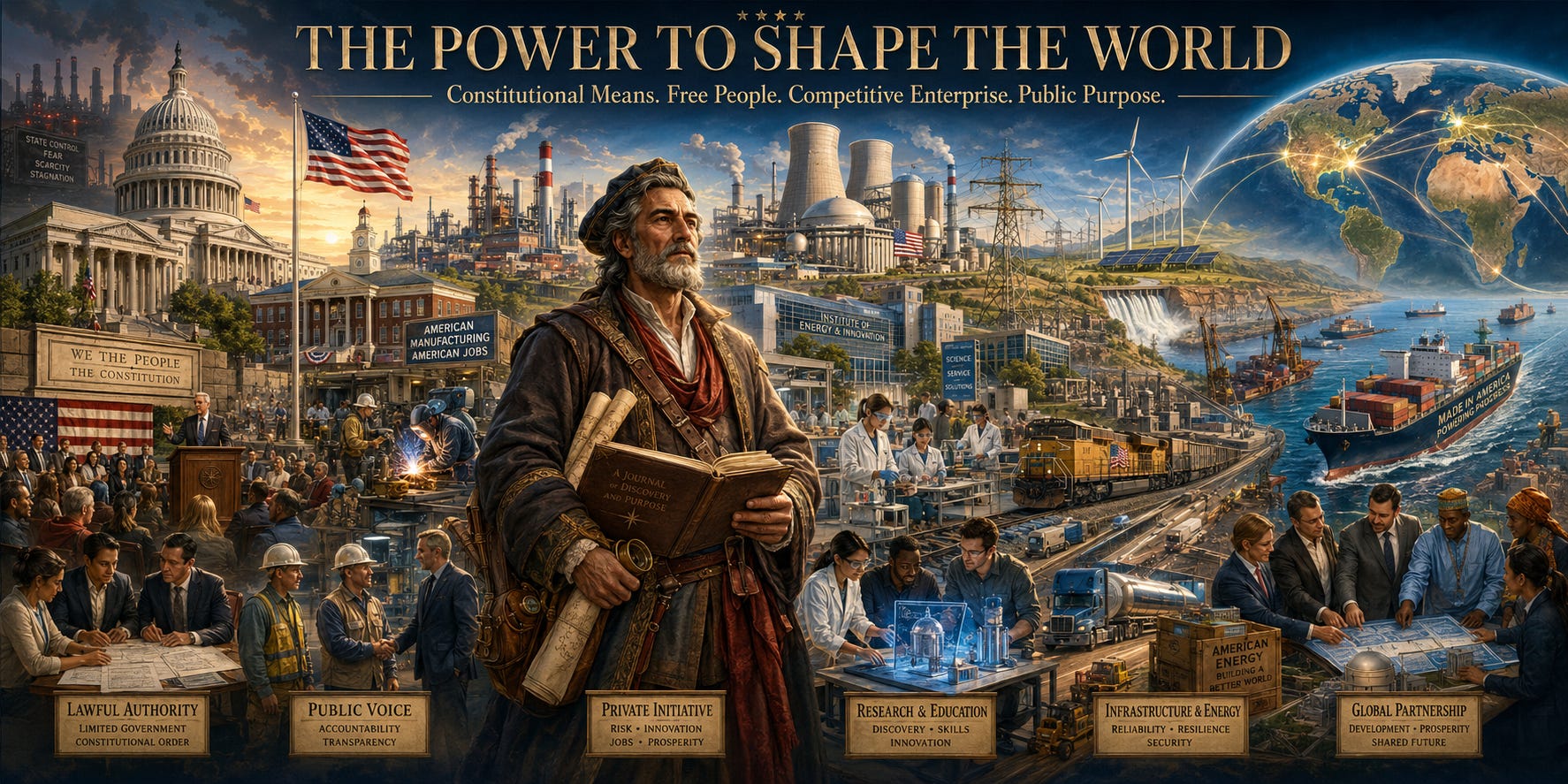
The previous chapter asked what kind of country becomes possible when the United States recovers the power, confidence, and capacity to build. This chapter asks what that recovered capacity would mean beyond America’s shores.
The answer is larger than exports in the ordinary commercial sense. A nation that can design, finance, manufacture, fuel, build, operate, and maintain modern energy systems possesses more than a profitable industry. It possesses a durable form of influence. Power plants shape grids. Grids shape industry. Industry shapes employment, state capacity, trade, technology, and political choice. The country that helps another nation build dependable power may remain present through fuel supply, training, standards, maintenance, financing, regulation, security, and successive generations of equipment.
Russia and China understand this. Their systems allow political leadership, state-owned enterprises, public banks, diplomatic institutions, and industrial policy to move in coordinated formation. That coordination has helped them compete for projects that will shape other nations for decades. But the American answer cannot be to copy the political economy of an authoritarian rival. The United States should not seek a command structure that chooses national champions, suppresses competition, or places enterprise beneath permanent political direction.
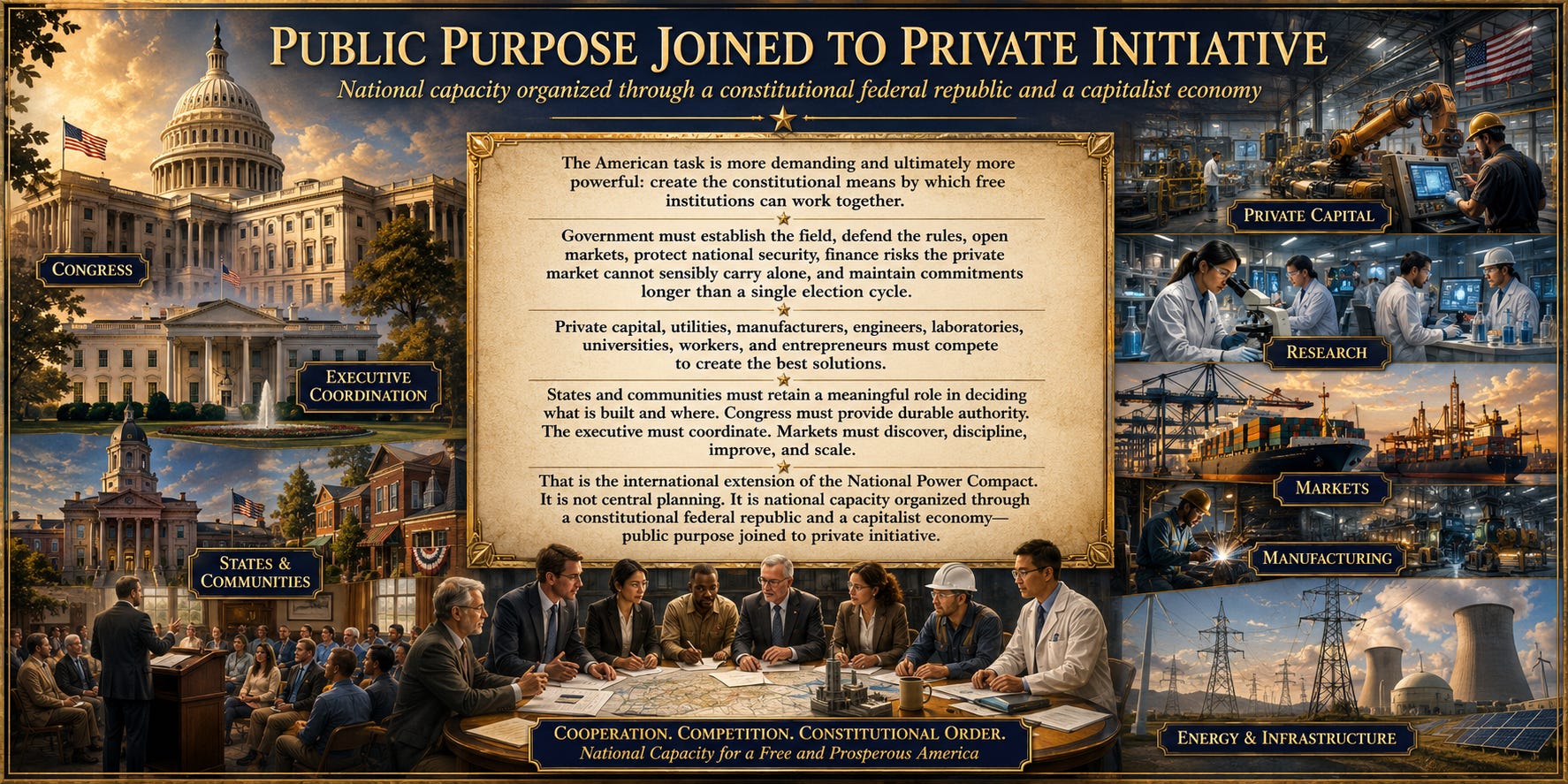
The American task is more demanding and ultimately more powerful: create the constitutional means by which free institutions can work together. Government must establish the field, defend the rules, open markets, protect national security, finance risks the private market cannot sensibly carry alone, and maintain commitments longer than a single election cycle. Private capital, utilities, manufacturers, engineers, laboratories, universities, workers, and entrepreneurs must compete to create the best solutions. States and communities must retain a meaningful role in deciding what is built and where. Congress must provide durable authority. The executive must coordinate. Markets must discover, discipline, improve, and scale.
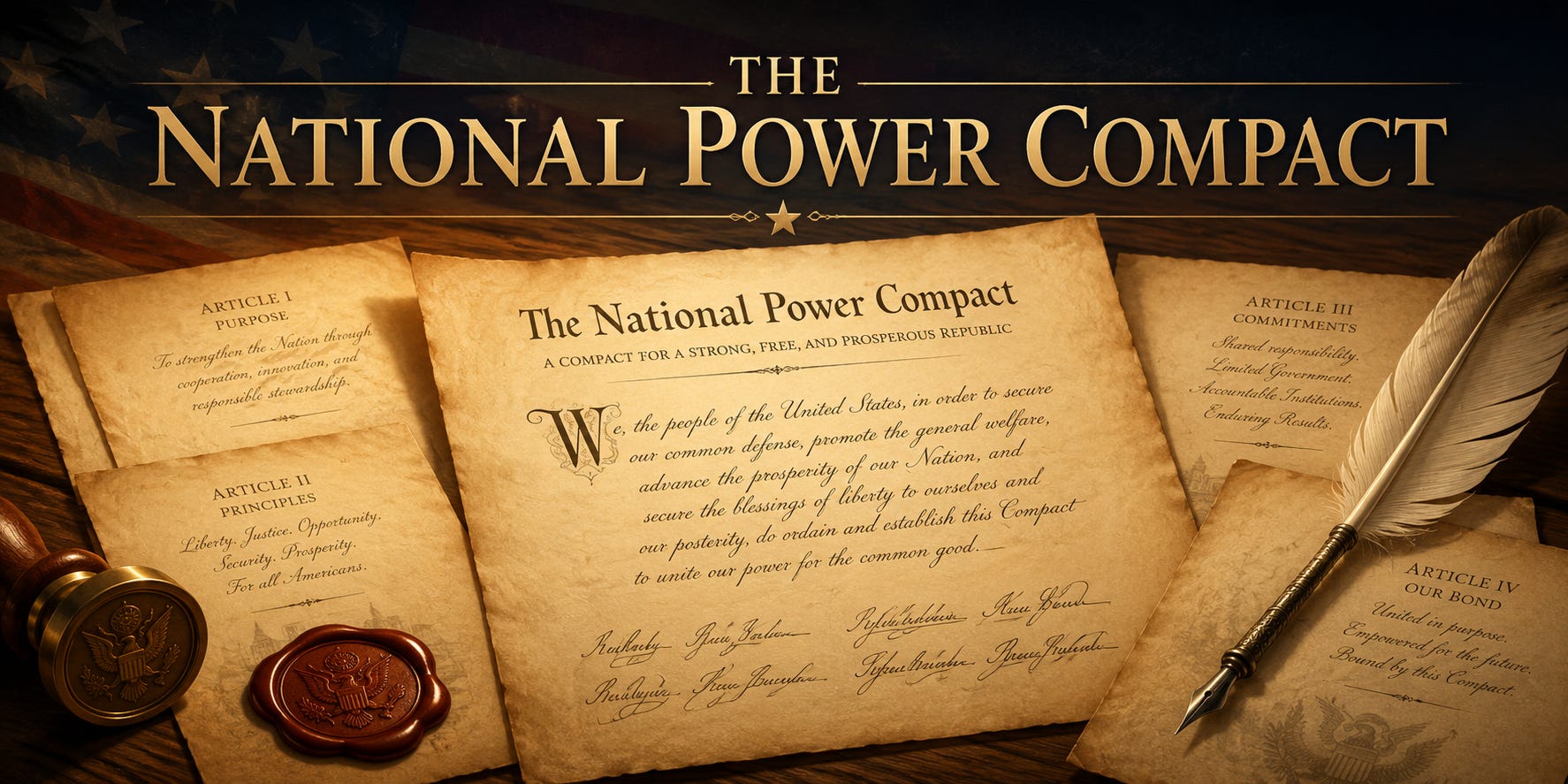
That is the international extension of the National Power Compact. It is not central planning. It is national capacity organized through a constitutional federal republic and a capitalist economy—public purpose joined to private initiative.
The Project Is Larger Than the Plant
A country choosing its first nuclear power project appears to be buying a generating station. In reality, it is choosing a relationship that may last most of a century. The reactor design matters, but so do the construction consortium, the source of debt, the currency of repayment, the fuel supplier, the regulator’s technical model, the operator-training program, the spare-parts system, the cybersecurity framework, the emergency arrangements, and the diplomatic relationship that surrounds them.
The same principle applies, in different degrees, to gas turbines, transmission systems, grid controls, storage, microgrids, communications networks, and industrial energy campuses. Infrastructure does not arrive alone. It carries standards, software, financing practices, legal assumptions, technical habits, supply chains, and professional relationships. When the infrastructure is essential, those relationships become strategic.
The global opportunity is substantial. The Department of Energy describes approximately 300 prospective commercial reactors worldwide over the next fifteen years, representing an estimated market of roughly $1.6 trillion. That figure captures only the reactor opportunity. It does not fully measure associated transmission, fuel-cycle services, construction, industrial heat, desalination, training, digital controls, security, maintenance, and the economic development made possible by the electricity itself.
The question is therefore not whether the world will build. Population growth, industrialization, artificial intelligence, water needs, urbanization, and rising expectations will create pressure for dependable energy. The question is who will help build it, under what rules, with what financing, and with what long-term political consequences.
The Rosatom Model: Coordination as State Power
Rosatom is best understood not simply as a reactor vendor but as an instrument of Russian state capacity. It combines reactor design, engineering, construction, uranium mining, conversion, enrichment, fuel fabrication, training, operations support, and international project development. Russian state financing and government-to-government diplomacy can accompany the technical offer. As of early 2026, Russia continued to build reactors abroad despite sanctions and the economic burdens of war, with at least twenty units under active construction in seven foreign countries according to the Center for Strategic and International Studies.
This model is formidable because it reduces the number of seams visible to the customer. A government considering nuclear power does not have to assemble a reactor company, a fuel provider, a bank, a training institution, and a diplomatic framework from unrelated pieces. Moscow can present the relationship as a package. The package may include attractive credit and decades of fuel and service commitments. It can also create vulnerability: concentrated dependence, opaque terms, political leverage, exposure to sanctions, and a supplier relationship shaped by the strategic interests of the Russian state.
The lesson is not that America requires an American Rosatom. A federal republic with competitive private enterprise should be wary of a state monopoly controlling technology, finance, fuel, construction, and foreign policy. The lesson is that fragmentation has strategic costs. When every federal agency acts on a separate calendar, every company pursues a separate transaction, every authorization is reconsidered from the beginning, and financing arrives after the commercial window has closed, freedom has not produced competition. It has produced disorganization.
The American countermodel must preserve pluralism while creating coherence. Several reactor vendors should be able to compete. Multiple fuel suppliers should emerge. Utilities, engineering firms, manufacturers, investors, unions, universities, and states should be able to form different consortia. Government should not predetermine every winner. But the United States must be able to tell a partner nation, with credibility, that peaceful nuclear cooperation, export authorization, financing, safeguards, fuel, training, and diplomatic support can be assembled on a schedule that matches the project.
Coordination is not the enemy of capitalism. Properly designed, it is the infrastructure that allows capitalism to compete where the rival offer is backed by the full power of a state.
China and the Competition to Build
China presents a related but different challenge. Its one-party system can align national planning, state-owned utilities, reactor companies, banks, manufacturers, construction firms, universities, and provincial authorities behind long deployment sequences. The most important Chinese advantage is not rhetoric. It is repetition. A large domestic build program creates experienced project teams, operating references, supplier depth, standardized production, and an expanding base from which to pursue overseas markets.
The scale behind that export ambition is now unmistakable. As of July 2026, China had 63 operable reactors, 38 under construction, and another 40 in the planned category. Roughly half of the reactors under construction worldwide were in China. Its flagship export design is the Hualong One, or HPR1000. China National Nuclear Corporation reports 41 Hualong One units approved, under construction, or operating worldwide; the May 2026 ThinkChina analysis described 41 units as operating or under construction. Most of that fleet is domestic. That fact does not diminish its strategic value. It means Chinese vendors can approach foreign customers with a design supported by repeat construction, an active supplier base, trained project teams, operating references, and a government prepared to connect technology, financing, training, fuel, and diplomacy.
China’s completed overseas reactor record is narrower than the 41-unit design fleet, but it is concrete and growing. South Asia is the principal current beneficiary: Pakistan has six Chinese-supplied commercial reactors operating at the Chashma and Karachi sites, including two operating Hualong One units at Karachi, while Chashma 5 - a third exported Hualong One - is under construction. That produces a current total of seven Chinese-supplied reactor units at two Pakistani sites, six operating and one being built. Western Europe has benefited through China General Nuclear’s minority investment in the two-unit Hinkley Point C project in the United Kingdom, although those are French-designed EPRs rather than Chinese reactor exports. Central Asia is an emerging field: Kazakhstan has selected Chinese participation for planned follow-on nuclear projects, but those units are not yet under construction. Chinese proposals or cooperation positions have also reached South America and Africa, while Southeast Asia is becoming a major prospective market as Vietnam, Indonesia, the Philippines, Malaysia, Thailand, and Singapore examine nuclear options. Chinese firms have already pursued training, institutional cooperation, and commercial engagement in the region. The distinction matters: Pakistan demonstrates delivery; the other regions demonstrate the reach of the campaign and the markets now being contested.
America should study that industrial logic without importing the political system that commands it. The United States does not need a five-year plan dictating which company will build each reactor. It needs a durable market in which companies can see enough committed demand to invest in factories, tooling, workforce, quality assurance, and fuel capability. It needs regulation that reaches decisions, procurement that rewards repeatability, and financing mechanisms that allow credible projects to move before inflation and delay destroy them.
The distinction is fundamental. Authoritarian systems can order capacity into existence, sometimes quickly and sometimes wastefully. A free-market republic creates capacity by making investment rational. It establishes predictable rules, protects contracts and property, prices the services the system actually needs, coordinates public infrastructure, and allows firms to compete for long-term demand. The National Power Compact was designed to create precisely that environment at home. Domestic competitive ability is therefore the foundation of export strength. A nation cannot become the preferred international supplier of technologies it rarely builds for itself. Customers will ask where the design is operating, whether the supply chain is stable, whether the regulator has repeated experience, whether construction teams have learned from earlier units, whether fuel is assured, and whether the vendor will survive for the life of the plant. The export campaign begins not in an embassy but on an American construction site.
A Valuable Course Correction - but Not Yet a System
The Trump administration has made important changes in direction. The May 2025 nuclear executive orders treated abundant nuclear energy as an economic-security, national-security, industrial, and technological priority. They called for faster reactor testing, reform of licensing, rebuilding of the fuel cycle and industrial base, deployment at federal and defense sites, and a stronger campaign for American nuclear exports.
The export provisions are particularly significant. The administration directed the Department of State to pursue additional peaceful-nuclear-cooperation agreements, called for broader use of federal resources to support commercial civil nuclear projects, and sought faster decisions on technology-transfer authorizations. The domestic orders similarly recognized that export leadership cannot be separated from testing, licensing, fuel, manufacturing, and deployment at home.
These are valuable course corrections because they restore national intent. They tell agencies that nuclear capability is not merely another regulated commercial activity. It is part of the national industrial base and the international position of the United States.
But executive direction is not yet a durable system. Orders can accelerate agencies and signal urgency. They cannot by themselves guarantee multiyear appropriations, create a deep order book, establish sufficient conversion and enrichment capacity, train tens of thousands of workers, make project finance competitive, or assure foreign partners that American policy will remain stable across administrations.
A strategic industry requiring ten-year construction horizons and eighty-year customer relationships cannot be rebuilt on two- and four-year political rhythms. The next step is to translate the current course correction into legislation, institutions, capital structures, and commercial commitments that endure.
A strategic industry requiring ten-year construction horizons and eighty-year customer relationships cannot be rebuilt on two- and four-year political rhythms.
The American Model: Federal Means, Capitalist Execution
The United States already knows how to combine national purpose with private action. The country built canals, railroads, ports, land-grant colleges, electrical systems, research universities, dams, laboratories, highways, communications networks, nuclear plants, and space systems through different mixtures of federal authority, state participation, local consent, private capital, competition, procurement, land grants, credit, research, standards, and long-term contracts.
None of those achievements requires us to pretend that government and markets occupy separate worlds. Government creates law, infrastructure, security, basic research, standards, and durable public commitments. Markets allocate much of the capital, test competing ideas, discipline costs, reward execution, and adapt technology to customers. The constitutional question is not whether government acts. It is whether it acts through lawful, limited, transparent institutions that preserve competition and accountability.
For energy exports, the federal role should be enabling and catalytic. It should negotiate the legal agreements that permit cooperation. It should protect nonproliferation and national-security interests. It should help finance sovereign and political risks that private lenders cannot price alone. It should support early project development, regulatory capacity, workforce training, and fuel assurance. It should coordinate agencies so that companies can receive decisions on commercially relevant timelines. It should maintain diplomatic engagement when projects span decades.
The commercial role should remain commercial. Competing American and allied firms should design, construct, manufacture, insure, operate, and service projects. Investors should bear real risk. Customers should be able to compare technologies and consortia. Poor performers should not receive permanent protection simply because they carry an American flag. Public support should be tied to milestones, transparency, local benefit, security, and credible paths to repayment.
This model does not produce the surface simplicity of a single state corporation. It can produce something stronger: a resilient ecosystem of firms, capital, knowledge, and institutions that does not depend on one political leader or one corporate hierarchy. The federal government supplies continuity and strategic alignment. Capitalism supplies invention, selection, efficiency, and scale.
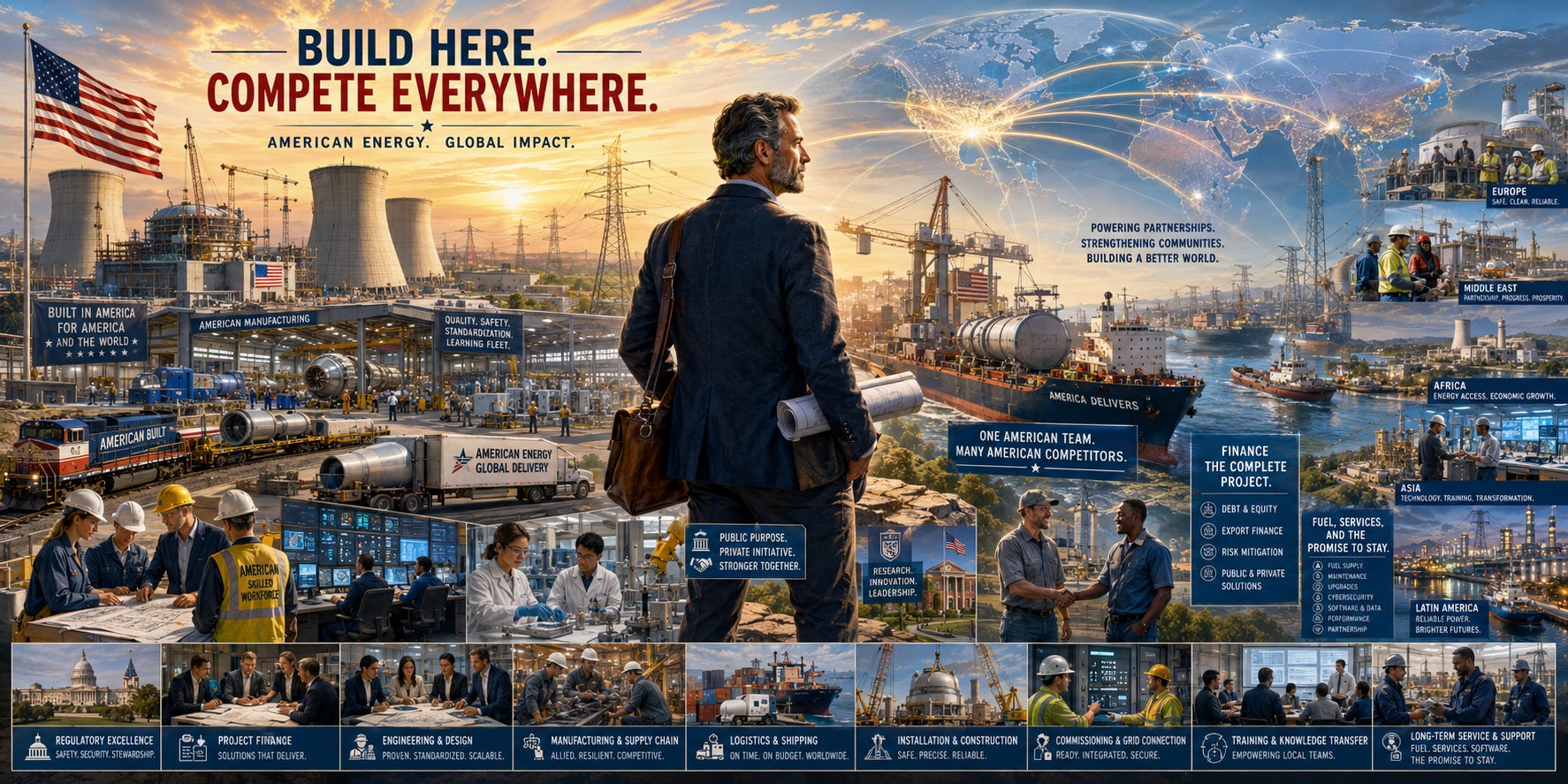
Build Here, Compete Everywhere
The first export policy is successful domestic construction. The United States needs operating reference plants, repeat orders, qualified suppliers, stable fuel, experienced craft labor, predictable regulation, and financial structures that customers can understand. Every domestic unit should be treated as part of a learning fleet rather than a one-time monument.
That does not mean every project must use one design. It means the country should stop resetting the industrial system for every unit. Competing design families can each achieve standardization. Utilities can aggregate orders. Suppliers can manufacture common modules and components. Regulators can reuse completed work. Construction teams can move from site to site. Universities and training programs can align with actual deployment schedules.
Domestic deployment also creates price discovery. American firms cannot promise international customers credible schedules and costs if the nation has not confronted those realities at home. Early projects may require risk-sharing and federal participation because they rebuild capabilities that later projects will use. But the purpose of that support must be to create a functioning market—not permanent dependence on subsidy.
A strong domestic market would also make the United States a better allied partner. American leadership need not mean that every component is made in America or every contract goes to an American firm. Trusted allied supply chains can provide uranium, conversion, enrichment, forgings, turbines, instrumentation, engineering, and finance. Sovereignty is strengthened when interdependence is diversified, transparent, and chosen among reliable partners.
One American Team - Many American Competitors
Foreign customers should not have to navigate the full organizational chart of the United States government before discovering whether an American project is possible. The country needs a standing mechanism that can assemble the federal side of an offer while preserving competition among commercial participants.
The Department of State should lead diplomatic alignment and peaceful-nuclear-cooperation agreements. The Department of Energy should coordinate technical cooperation, fuel strategy, laboratories, and export authorizations. The Nuclear Regulatory Commission and American technical organizations can support independent regulatory capacity abroad without becoming sales arms. The Export-Import Bank, Development Finance Corporation, Trade and Development Agency, and multilateral institutions should provide project preparation, credit, guarantees, and political-risk tools where statutory standards are met. Commerce should advocate for American firms. Congress should supply stable authority, oversight, and funding.
The result should not be a government-selected vendor. It should be a qualified field. For a given opportunity, competing consortia might combine different reactor firms, engineering and construction companies, fuel providers, operators, banks, and local partners. Federal support would follow transparent national-interest and project-readiness criteria. The customer would receive a coherent American offer without losing the benefits of competition.
Call it one American team at the strategic level and many American competitors at the commercial level.
Finance the Complete Project
Nuclear exports are often won or lost through finance before the technology comparison is complete. A reactor project requires large capital commitments, long construction periods, sovereign cooperation, currency management, and confidence that political conditions will remain stable. Private capital can carry much of that burden only after risks have been allocated in forms investors can understand.
The American approach should use public finance carefully but unapologetically. Export credit, loan guarantees, political-risk insurance, project-development grants, milestone-based lending, and partnerships with allied and multilateral institutions are not departures from capitalism when they address risks created by sovereign policy, long project duration, or competition from foreign states. They are tools for creating a market where a market would otherwise be foreclosed by state-backed rivals.
Discipline matters. Financing should require transparent procurement, credible demand, sound site and grid studies, realistic tariffs, competent project governance, safeguards, anti-corruption protections, local workforce plans, and repayment capacity. The United States should offer better institutions, not merely cheaper money.
The objective is not to socialize every commercial loss. It is to ensure that financeable, strategically valuable projects are not lost solely because an authoritarian competitor can place its treasury behind an integrated offer while American agencies debate whether coordination offends market principles.
Fuel, Services, and the Promise to Stay
A reactor export without a credible fuel pathway is incomplete. The United States must rebuild conversion, enrichment, deconversion, fabrication, and advanced-fuel capabilities sufficient for domestic needs and a responsible share of allied and export demand. Fuel assurance should be treated as both an industrial opportunity and a nonproliferation instrument.
The relationship continues after startup. Training, outage support, software, instrumentation, replacement components, cybersecurity, life extension, waste management, safeguards, and eventual decommissioning can provide decades of commercial work. They also create trust. A partner nation should know that the American consortium and the American government will remain engaged when a problem occurs after the ribbon cutting.
This is one area where free enterprise can outperform a monopoly. A competitive service ecosystem can innovate, specialize, and respond across a fleet. But only if the national fuel and industrial base is deep enough to support it. The promise to stay must rest on capacity, not sentiment.
Development Without Dependence
Energy exports inevitably have political effects. Infrastructure creates relationships; essential infrastructure creates durable ones. The United States should acknowledge that reality without turning development into coercion.
The American objective should be to leave the partner more capable than before: able to regulate its system, train its people, operate its plants, maintain safety and security, develop local suppliers, and make future choices from a position of greater strength. Local participation should be real, but it should not become a slogan that forces technically unqualified work into a nuclear project. Capability should be built deliberately through education, apprenticeships, supplier qualification, and staged responsibility.
That model differs from dependency built around a single foreign state, opaque debt, exclusive fuel arrangements, or political conditions hidden inside infrastructure. It also differs from disengagement, in which America lectures countries about governance while offering no practical path to the electricity needed for development.
A free society should be able to make a better offer: dependable power, transparent contracts, high standards, multiple commercial partners, local capability, and sovereign choice. The strategic advantage comes not from controlling the customer but from becoming the partner the customer prefers to keep.
Beyond Nuclear: Export the Architecture of Abundance
Nuclear power is the clearest long-duration example, but the opportunity is broader. Many nations do not need a single technology. They need an energy system: generation, fuel, transmission, distribution, substations, communications, digital controls, storage, demand management, microgrids, water systems, and trained institutions.
The portfolio described in this series can become an export architecture. Large reactors may anchor industrial regions. SMRs may fit smaller grids, retired thermal sites, mines, islands, or energy campuses. Microreactors may serve remote communities and critical facilities. Gas turbines with secure fuel can provide firm capacity and flexibility. Hydropower modernization, geothermal energy, productive renewable resources, storage, advanced conductors, grid-enhancing technologies, underground or high-voltage direct-current corridors, and resilient local systems can be combined according to local conditions.
American communications, computing, cybersecurity, and artificial-intelligence capabilities can help operate those systems more efficiently. Universities and laboratories can support planning, materials, safety, forecasting, and workforce development. Financial institutions can help turn technically sound plans into investable projects.
The future export is not a catalog of machines. It is the capability to help a partner nation move from chronic shortage to dependable abundance while preserving its own sovereignty.
The Compact for American Energy Leadership
Prove it at home. Build and operate repeatable domestic projects so American claims rest on demonstrated performance.
Coordinate without commanding. Use federal authority to align diplomacy, security, licensing, finance, and project support while preserving commercial competition.
Create one strategic team and many commercial competitors. Present a coherent national offer without establishing a permanent state monopoly or protected champion.
Finance the complete project. Combine private capital with disciplined export credit, guarantees, political-risk tools, and allied participation.
Guarantee a credible fuel path. Rebuild domestic and allied conversion, enrichment, fabrication, and service capacity.
Train to independence. Help partner nations develop regulators, operators, engineers, skilled trades, safeguards, and qualified suppliers.
Build transparent partnerships. Require sound governance, accountable contracts, realistic economics, safety, security, and enforceable milestones.
Stay for the life of the system. Treat fuel, service, modernization, cybersecurity, waste, and decommissioning as part of the original promise.
Export the architecture, not only the machine. Integrate generation, grids, resilience, communications, water, industry, and human capability.
Make policy durable. Translate executive direction into legislation, institutions, appropriations, and commercial commitments that survive political cycles.
The Counterbalance of a Free Republic
Russia and China demonstrate that coordinated state power can build and export at scale. America should take that competition seriously. But it should not conclude that freedom is an industrial disadvantage.
Freedom becomes a disadvantage only when it is confused with drift. Federalism becomes a disadvantage only when authority is fragmented without a means of decision. Capitalism becomes a disadvantage only when markets are asked to compete against foreign treasuries without public rules, infrastructure, or strategic support. Democracy becomes a disadvantage only when temporary disagreement prevents durable action.
The National Power Compact offers a different path. It creates a federal means for forecasting, permitting, reliability, supply-chain renewal, consumer protection, and national coordination. Chapter 9 extends that logic outward. The republic establishes the conditions. Companies compete. Investors choose. Workers build. Universities teach. Laboratories discover. States and communities participate. Allies contribute. Customers decide.
This is not weaker than authoritarian coordination. Properly organized, it is more adaptive, more innovative, more accountable, and more durable. It does not require the wisdom of one party or one ruler. It distributes initiative across a nation and then gives that initiative a lawful way to converge on common purposes.
America’s strategic answer is therefore not a government corporation that owns the entire future. It is a republic capable of making the future buildable.
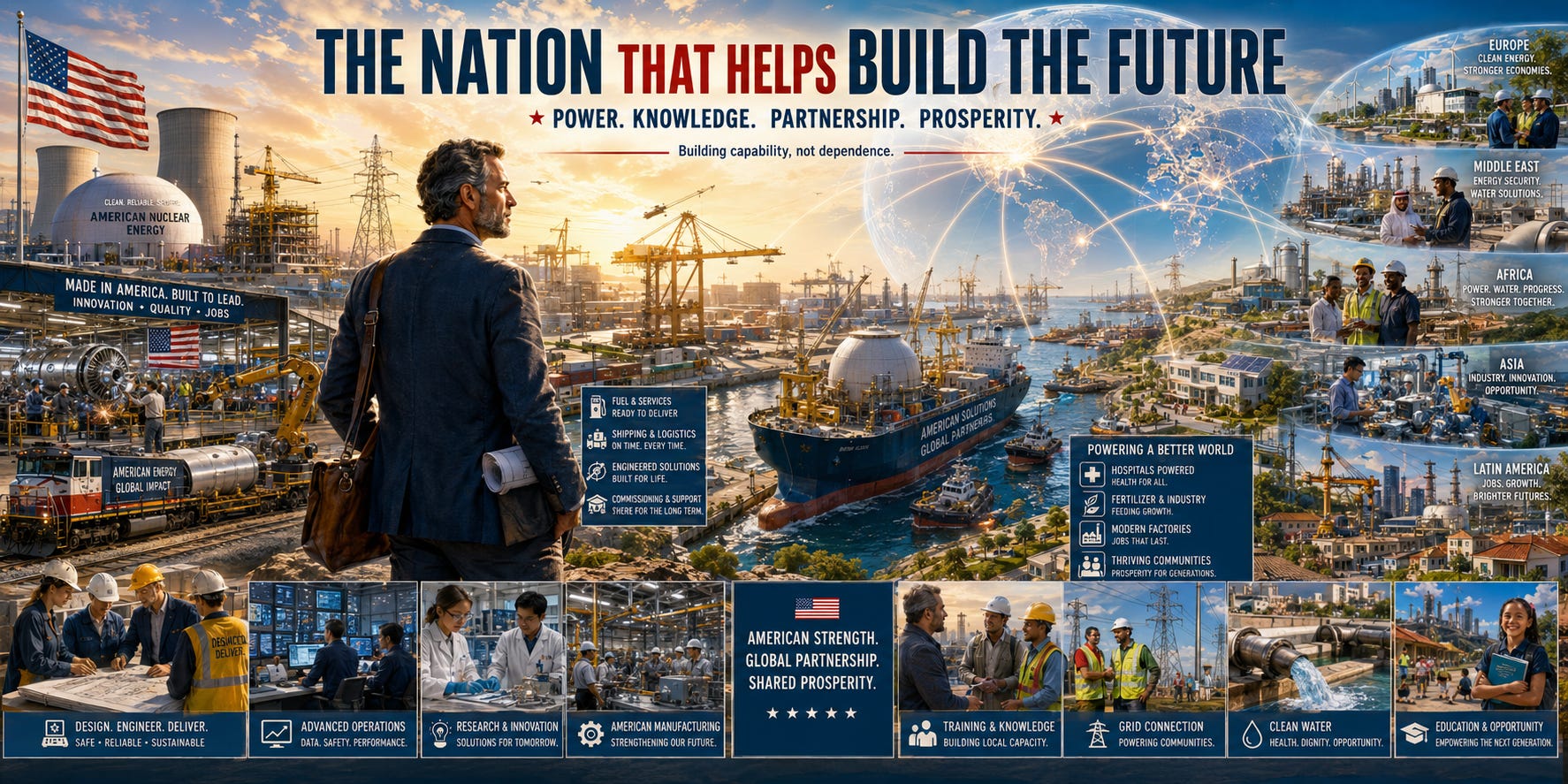
The Nation That Helps Build the Future
The coming global energy buildout will shape the distribution of industry, technology, wealth, and political influence for the remainder of this century. Nations will remember who helped them escape shortage, power their hospitals, manufacture fertilizer, provide clean water, educate their people, and build modern industry. They will also remember the terms under which that help was offered.
America has fallen behind, but decline is not destiny. The country retains extraordinary advantages: deep capital markets, world-leading laboratories and universities, experienced operators, innovative reactor companies, advanced manufacturing, strong allies, a respected safety and nonproliferation tradition, and a political system capable of correcting itself.
The present administration has begun an important course correction. The next obligation is to make that correction durable and larger than any administration. Congress, states, industry, labor, finance, universities, communities, and allies must convert direction into capacity.
An abundant America would gain more than domestic security. It would recover the ability to offer the world something worthy of a free republic: not dependence, not political submission, and not scarcity managed from above, but the tools, power, knowledge, and partnership through which other nations can build greater capability of their own.
America’s next independence will be secured at home. Its larger meaning will be measured by what a confident, competitive, and capable republic helps make possible beyond its shores.
Source Notes
The factual context in this essay draws principally from the following current public sources. The essay distinguishes executive direction from completed industrial capability and uses foreign models as strategic comparisons, not as political models for the United States. Each source note includes one or more live hyperlinks to the referenced material.
1. U.S. Department of Energy, Office of International Nuclear Energy Policy and Cooperation, accessed July 2026. Used for the estimate of approximately 300 prospective commercial reactors worldwide over fifteen years, valued at roughly $1.6 trillion, and for the role of nuclear exports in energy security and economic opportunity.
2. White House, Executive Order 14299, “Deploying Advanced Nuclear Reactor Technologies for National Security,” May 23, 2025. Used for the directives on peaceful-nuclear-cooperation agreements, federal promotion of American nuclear exports, export-authorization timelines, fuel-chain agreements, and use of federal resources to support international projects.
3. White House, Executive Order 14302, “Reinvigorating the Nuclear Industrial Base,” May 23, 2025. Used for the administration’s findings on diminished U.S. deployment, foreign reactor-design dominance, fuel-cycle dependence, and the need to rebuild conversion, enrichment, manufacturing, and deployment capability.
4. White House, Executive Order 14300, “Ordering the Reform of the Nuclear Regulatory Commission,” and Executive Order 14301, “Reforming Nuclear Reactor Testing at the Department of Energy,” May 23, 2025, together with the associated White House fact sheet. Used for the administration’s nuclear licensing, testing, national-security, and domestic-deployment course correction. The essay treats these actions as direction and institutional reform, not as evidence that industrial capacity has already been restored.
5. Center for Strategic and International Studies, Jane Nakano, “The Geopolitics of Russia’s Civil Nuclear Exports Four Years into the War,” March 6, 2026. Used for Rosatom’s continuing international role and the finding that Russia had at least twenty reactor units under active construction in seven foreign countries as of February 2026.
6. World Nuclear Association, “Asia’s Nuclear Energy Growth,” updated July 20, 2026, and “Nuclear Power in China,” updated July 15, 2026. Used for China’s 63 operable reactors, 38 under construction, 40 planned, the concentration of global nuclear construction in Asia and China, the strength of China’s nuclear supply chain, and its policy of exporting nuclear technology. China National Nuclear Corporation, “The Hualong One: China’s Solution for the Global Clean Energy Sector,” used for the official statement that 41 Hualong One units are approved, under construction, or operating worldwide. ThinkChina, Zha Daojiong, “China May Power Southeast Asia’s Nuclear Future,” May 21, 2026, used for the article’s characterization of 41 Hualong One units as operating or under construction and for the discussion of Southeast Asia as a prospective nuclear-growth market. The essay distinguishes the primarily domestic Hualong One fleet from completed exports.
7. World Nuclear Association, Pakistan - World Nuclear Performance Report, and Pakistan - World Nuclear Outlook Report, used for Pakistan’s six operating Chinese-supplied reactors at Chashma and Karachi, the two operating Hualong One units at Karachi, and Chashma 5 under construction, producing a total of seven Chinese-supplied units at two sites in South Asia. UK Government, “Hinkley Point C to Power Six Million UK Homes,” used for CGN’s 33.5 percent stake in the two-unit UK project; World Nuclear Association, “Nuclear Power in China,” used to distinguish operating exports from investments, selected projects, frozen proposals, cancelled projects, and cooperation positions in Central Asia, South America, Africa, and Europe; and World Nuclear News, “CGN to Train ASEAN Nuclear Professionals,” together with the ThinkChina article used for China’s training and commercial engagement in Southeast Asia. The essay treats Southeast Asia as a prospective beneficiary and contested market, not as a region already operating Chinese-built power reactors.
8. U.S. Department of Energy, “Bilateral Cooperation,” “123 Agreements for Peaceful Cooperation,” and NNSA Nuclear Nexus: International Nuclear Safeguards. Used for the role of technical cooperation, safeguards, peaceful-use agreements, laboratory partnerships, export controls, and partner-country institutional development.
9. Export-Import Bank of the United States, “EXIM Support for Nuclear Sector Transactions,” U.S. International Development Finance Corporation program materials, and U.S. Trade and Development Agency, “Project Preparation Assistance,” used for the general functions of export credit, political-risk support, project preparation, and development finance. The essay recommends coordinated use of existing authorities subject to statutory standards; it does not imply automatic eligibility for any project.
10. Nuclear Scaling Initiative / Solestiss, Landscape of U.S. Domestic Advanced Nuclear Energy Supply Chain, March 2026. Used for the conclusion that export credibility depends on domestic order books, fuel capacity, fabrication, machining, welding, inspection, quality assurance, and a qualified workforce.
11. U.S. Department of Energy, “Department of Energy Announces American Nuclear Supply Chain Loans,” June 23, 2026. Used as an example of current efforts to aggregate demand and finance long-lead nuclear equipment. The program is treated as conditional lending, not a grant or completed buildout.
12. Historical framing draws on the National Archives’ account of the Morrill Act, the Library of Congress resources on American railroads and mapping, its historic map of U.S. canals and railroads, and the National Archives’ overview of the Constitution. These sources support the established American use of federal authority, state participation, private capital, land grants, standards, research institutions, and regulated enterprise to build national capability. The essay uses this history to describe an American institutional model, not to claim that every program had identical financing or governance.
No posts
Comments
Nothing yet. Say the first thing.
Sign in to join the conversation.