
Making broadcast legible to telco, cloud, edge, device, AI-RAN, and standards ecosystems — while preserving the independent one-to-many bearer that gives the future network more capacity, more resilience, and more sovereign choice.
The preceding chapters widened the question. The future network is no longer a cellular network with a few auxiliary attachments. It is becoming a network of networks: terrestrial mobile, Wi-Fi, fiber, edge cloud, satellite Direct-to-Device, 5G Multicast and Broadcast Services, and terrestrial broadcast all available for different burdens.
That change creates an opportunity, but also a new problem. A network can have many excellent bearers and still use them badly if the service layer cannot see them, compare them, request them, or measure what they delivered.
B2X — Broadcast to Everything — is the translation layer that closes that gap. It is not a replacement for 5G or 6G. It is not broadcast dressed in cellular terminology. It is the set of interfaces, control functions, discovery mechanisms, service abstractions, device behaviors, and commercial rules that allow ATSC 3.0 and future broadcast/multicast bearers to participate in the same service-orchestration environment as mobile, cloud, edge, and NTN.
The idea has become more concrete. ATSC approved A/391, B2X System Discovery and Signaling, as a Candidate Standard in July 2026. The emerging B2X architecture uses OFDMA, physical resource blocks, O-RAN concepts, and F1/PDCP-style interworking to make a wide-area one-to-many bearer understandable to networks built around 3GPP service logic. The first task is no longer rhetorical alignment. It is interface alignment.
That is why eCPRI matters. It is not the whole answer, but it is a useful starting point because it forces broadcast engineers to think like a modern RAN: where user-plane data enters, where control resides, how timing is maintained, how distributed and radio functions communicate, how faults and performance are reported, and how a bearer becomes operationally visible rather than merely IP-compatible.
The larger leap comes from AI-RAN. Once the network can classify demand, predict commonality, price energy and congestion, recognize device capability, and compare available bearers, B2X stops being a niche broadcast interface. It becomes part of a decision engine asking a much more valuable question: where do these bits fit best?
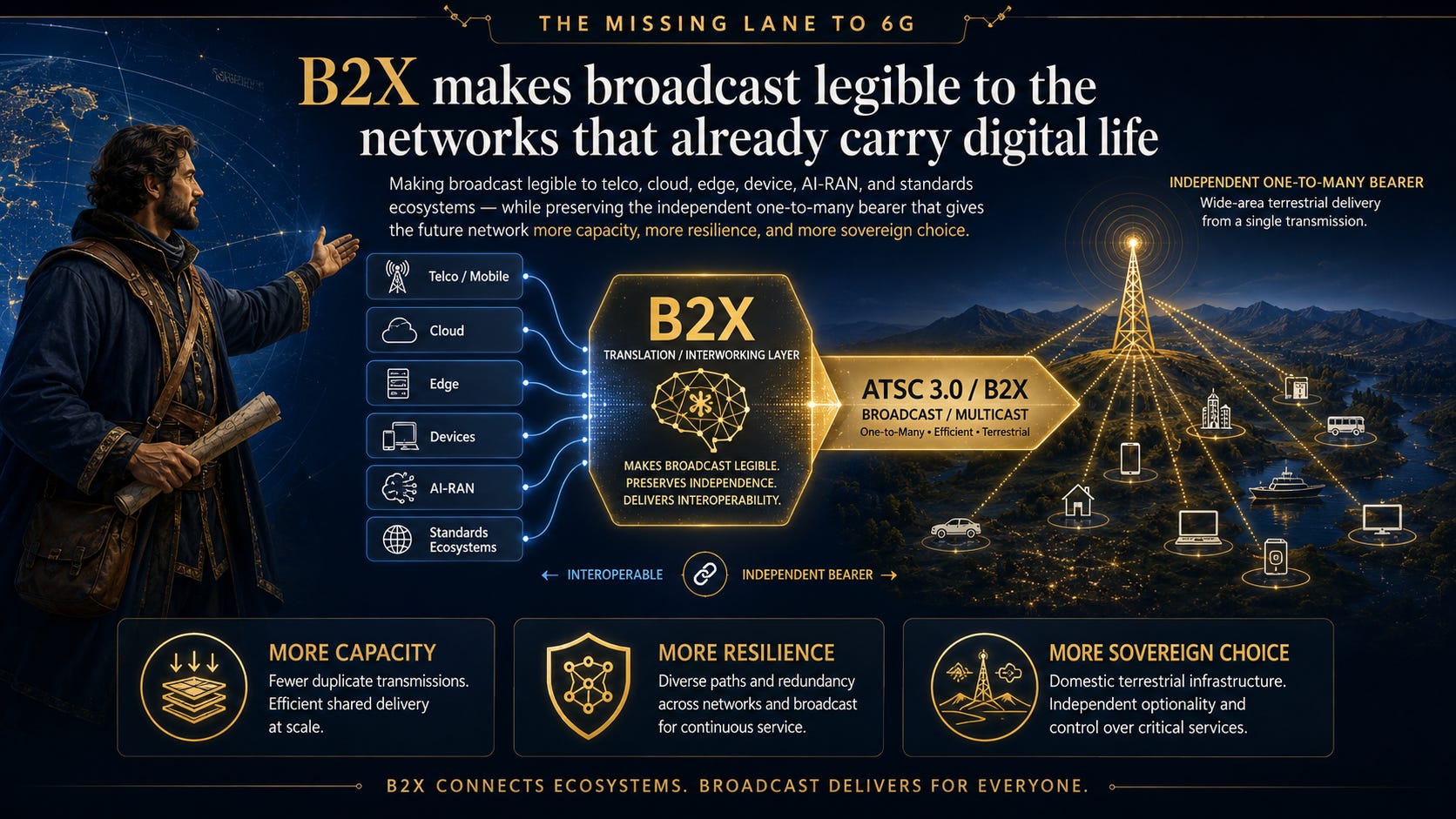
The word translation matters. B2X should not convert broadcast into cellular. It should translate between different network languages while allowing each network to retain the physics and economics that make it useful.
A cloud application thinks in objects, deadlines, geography, security, audience, quality, and cost. A mobile network thinks in sessions, policies, QoS, slices, radio resources, mobility, and subscriber state. A broadcaster thinks in coverage, RF capacity, scheduling, protection, emission, local obligations, and one-to-many reach. The device thinks in availability, battery, entitlement, continuity, and user experience.
B2X has to make those descriptions mutually intelligible. The application should not need to know which transmitter, Physical Layer Pipe, physical resource block, satellite beam, or repair path ultimately carried the object. It should describe the burden. The network should choose the bearer.
That separation is the architectural hinge of the series. The service plane says what must happen. The bearer plane decides how it happens. Translation succeeds when the service can move among bearers without losing identity, policy, security, continuity, measurement, or commercial accountability.
Chapter 3 drew an important distinction: IP is not an interface. Two systems can both carry IP while remaining operationally foreign to one another. The packets may be familiar; the machinery around them may not be.
An MNO needs more than a content feed. It needs defined points for admission, user-plane mapping, timing, real-time control, fault reporting, performance measurement, lifecycle management, and policy. The radio layer has to participate in the operator’s operational model, not simply receive a file from it.
eCPRI is useful because it exposes this hidden layer. Its specification defines transport and control between radio-equipment control and radio equipment, including user-plane information, control and management transport, and synchronization. O-RAN extends the same instinct into open fronthaul, disaggregated radio functions, management, and intelligent control.
B2X work is now aimed directly at this seam. The 2025 IBC architecture describes an O-RAN-aligned neutral-host broadcast RAN, an OFDMA resource grid, physical resource blocks, virtual bandwidth parts, and an F1 interface that can carry 5G/6G PDCP information into the B2X path. A/391 adds the discovery entry point for B2X endpoints across broadcast and IMT bands.
The important point is not that every proposed interface is finished. It is that interface cleanliness has become a design objective. B2X is being built to look less like a special-purpose media system at its boundary and more like capacity that another network can invoke.
The first commercial instinct is to describe B2X as mobile-data offload. That is accurate, but too small. Offload assumes the mobile network already owns the burden and then decides to move some of it elsewhere. The larger opportunity is to decide upstream which bearer should own the burden in the first place.
That changes the addressable market. B2X can serve an MNO trying to protect scarce interactive radio capacity, but it can also serve a CDN deciding how to pre-position a common object, a cloud platform distributing an AI model, an automotive platform moving maps or software, a public-safety authority distributing resilient alerts, an enterprise updating large device fleets, or a national network seeking a second path for essential information.
The buyer is no longer necessarily ‘a broadcaster’s customer.’ The buyer can be any service that has common demand and values wide-area delivery. The product is no longer only spectrum inventory. It is a managed bearer with known reach, performance, cost, security, energy characteristics, and proof of fulfillment.
That is a much larger TAM because the economic unit changes. B2X is not merely selling megabits from a tower. It is selling avoided repetition, preserved mobile capacity, faster fleet completion, lower infrastructure burden, resilience, and a selectable national distribution path.
The timing is unusually favorable because the RAN itself is becoming more intelligent. O-RAN and the AI-RAN Alliance are moving AI from isolated optimization into network architecture: policy, traffic steering, radio resource management, energy optimization, workload placement, and increasingly native AI control.
The decision B2X needs is conceptually simple even if its implementation is not. The network should understand the object, the audience, the geography, the time window, the mobility pattern, the required reliability, receiver capability, spectrum conditions, energy state, cost, and available bearers. It should then choose the path that performs the burden best.
For ten highly interactive users, that may be unicast. For a campus or venue, it may be Wi-Fi or local 5G MBS. Across a terrestrial commonality threshold, it may be ATSC 3.0/B2X. Beyond terrestrial reach, it may be D2D. For some services the answer may be hybrid: broadcast the common payload, use mobile for authorization and interaction, use broadband for repair, and use edge storage to reduce latency.
The value of AI is not merely faster optimization within one radio network. It is network awareness across radio networks. B2X gives that intelligence something it currently lacks: a high-power terrestrial one-to-many bearer that can be selected as easily as another route.
That is the moment when broadcast stops being an adjacent industry and becomes part of the AI-native network’s resource pool.
A service begins by declaring intent. A cloud or mobile application identifies the object, geography, device classes, deadline, security policy, reliability target, cache behavior, and acceptable repair path. It does not specify a tower.
The orchestration layer evaluates demand and available resources. It can compare mobile unicast, Wi-Fi, 5G MBS, D2D, terrestrial broadcast, edge pre-positioning, or a combination. Commonality analysis estimates whether a one-to-many path creates a meaningful spectral, energy, cost, or resilience advantage.
If broadcast is selected, a B2X or Broadcast Core Network function queries capacity across the required footprint. It translates the service request into scheduling, protection, signaling, resource allocation, and transmission requirements across participating facilities.
At the radio boundary, clean interfaces move the user plane and control information into the B2X RAN. At the receiver, the B2X endpoint discovers the waveform, associates the object with the requesting service, validates and caches it, and exposes it to the application. Personalization, entitlement, telemetry, acknowledgments, and repair can remain on the connected path.
The system then closes the loop. Telemetry reports fulfillment and performance. The orchestrator can compare planned versus actual delivery, trigger retransmission or broadband repair, update future bearer decisions, and support settlement.
The user should experience none of this complexity. The application asked for an object. The network chose the best combination of paths. That is what successful translation looks like.
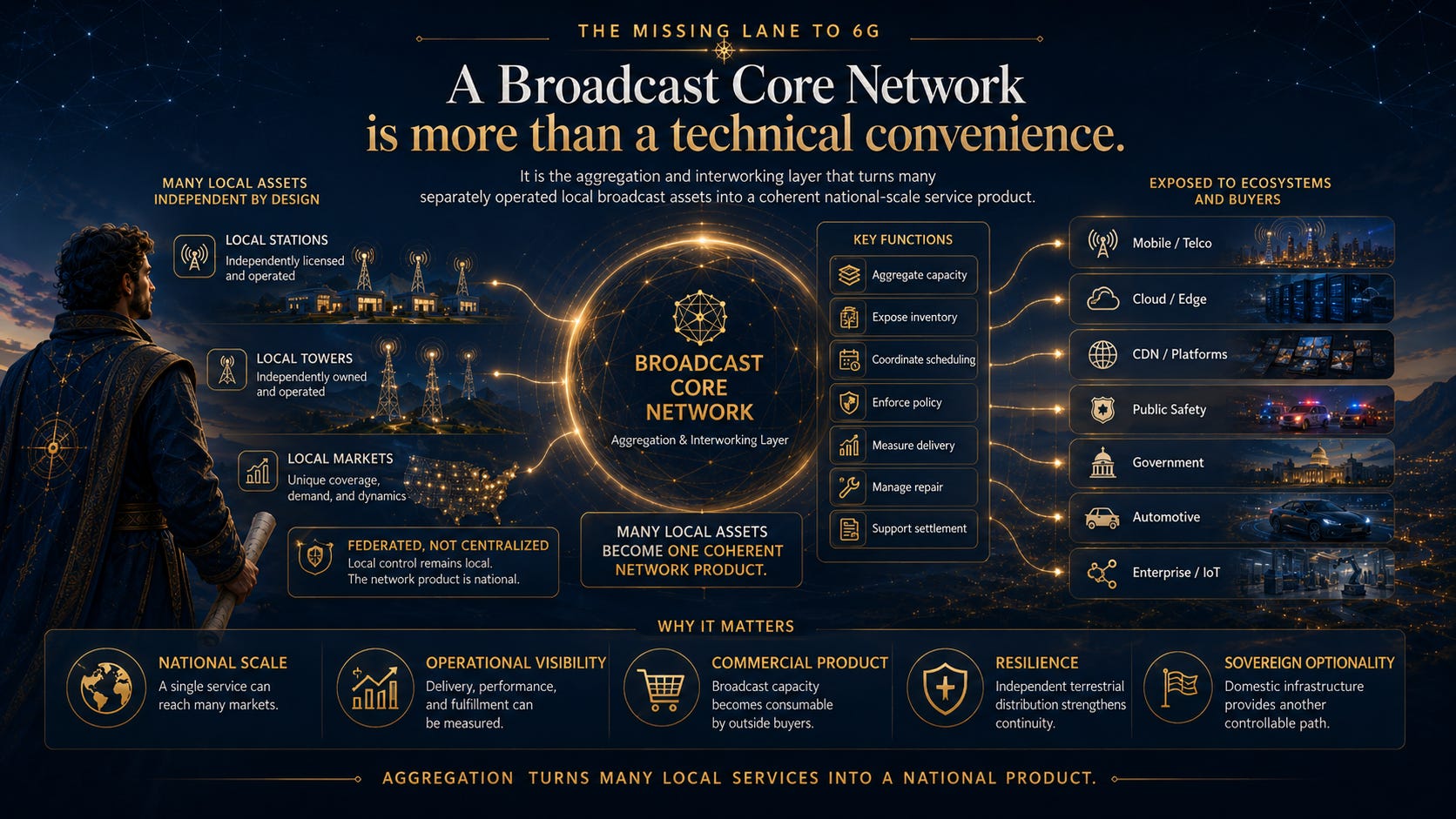
Broadcast has a structural problem that technology alone cannot solve: its capacity is fragmented across many licensees, markets, towers, schedules, and local obligations. A hyperscaler or national MNO cannot reasonably build a separate operational and commercial relationship with every station required for a national footprint.
The Broadcast Core Network concept is therefore more than a technical convenience. It is the aggregation layer that can make independently operated broadcast infrastructure appear as coherent capacity to an external buyer.
That function can expose inventory, assemble geography, coordinate scheduling, enforce policy, collect telemetry, manage repair, and support commercial settlement while allowing stations to remain separately licensed and operated. The network is federated rather than centralized.
ATSC’s current Technology Group 3 explicitly places B2X, BRidge Architecture, Broadcast Core Network, and 5G harmonization in the same work program. ATSC materials also contemplate an interface between a Broadcast Core Network and a 5G Core. That is exactly the direction required if broadcast capacity is to become consumable in the same way cloud and telecom capacity are consumed.
This is where B2X becomes market-making infrastructure. Translation turns an RF asset into a service. Aggregation turns many local services into a national product.
In established ATSC markets, B2X should begin with the network that already exists. Towers, spectrum, transmission systems, operational staffs, local licenses, and ATSC 3.0 coverage are sunk assets. The brownfield objective is not to discard them for a theoretically cleaner architecture. It is to expose them through clean interfaces, core-network functions, device support, and AI-aware orchestration.
That approach has an important economic virtue: it creates a new network product without requiring the MNO to build another national layer of high-power common-object capacity.
Greenfield markets can go further. India remains the clearest example because D2M is being developed alongside 4G/5G, future networks, AI/ML, cloud, edge, cybersecurity, device testing, and national-scale public-interest requirements. There, the opportunity is not simply to bridge a legacy broadcast domain into cellular. It is to design the broadcast bearer, interfaces, devices, and orchestration model as a coordinated communications system from the beginning.
That is where the emerging OFDMA B2X RAN becomes especially significant. A greenfield deployment can preserve high-power one-to-many physics while aligning scheduling, physical resource allocation, fronthaul, service exposure, and device expectations with telco standards from day one.
Brownfield B2X is a bridge. Greenfield B2X can be an architectural foundation.
The NTN era introduces another consideration that is easy to miss when the discussion is framed only around coverage and capacity: control.
Starlink is an extraordinary communications asset. Its Direct-to-Cell network demonstrates how quickly a private satellite platform can add reach, resilience, and new service options to terrestrial operators. Its scale also shows why D2D will be an important part of the future network.
But any critical network dominated by a small number of external infrastructure owners creates a concentration question. The concern is not that satellite service should be rejected, nor is it principally about one individual. It is that routing national communications through infrastructure whose operating policy, upgrade path, geographic availability, and ultimate control may sit outside a nation’s own communications institutions creates a dependency that should be understood rather than ignored.
Recent experience has made that concern concrete. Starlink became indispensable to Ukrainian communications, while disputes over how and where the service could be used demonstrated that a privately controlled connectivity layer can acquire geopolitical importance. SpaceX has disputed aspects of public reporting about particular service restrictions, but the broader lesson does not depend on assigning motive: control of infrastructure can matter as much as performance.
Europe is responding to the same structural issue through a language of technological sovereignty. GOVSATCOM is now operational, and IRIS² (Infrastructure for Resilience, Interconnectivity and Security by Satellite) is explicitly intended to provide secure, resilient satellite communications under European control. The point is not to eliminate commercial providers. It is to avoid making essential communications dependent on a single external path.
Terrestrial broadcasting adds a different kind of sovereign option. Broadcast towers operate inside national territory, under domestic spectrum licenses and regulatory authority, with local operating organizations and established public-interest obligations. That does not make every component domestically manufactured or every operator state-controlled. It does mean the bearer can remain physically and institutionally rooted inside the country it serves.
B2X therefore adds more than efficiency. It gives the future network a domestically controllable terrestrial one-to-many path that can coexist with satellite, cellular, fiber, and cloud. In a resilience architecture, independence of path is itself a feature.
The sovereignty argument needs discipline. A nation that insists every network element be nationally owned would throw away the benefits of global standards, commercial satellite systems, international cloud platforms, and cross-border interoperability.
The better objective is optionality. Critical services should have more than one technically and institutionally independent path. Satellite can remain indispensable for remote reach. Terrestrial mobile can remain indispensable for personal interaction. Cloud platforms can remain indispensable for computing and service creation. Broadcast can provide an independent national distribution layer when common content, emergency conditions, congestion, or policy makes that valuable.
B2X is what allows sovereignty and interoperability to coexist. The bearer can remain independently licensed and operated while its interfaces are open enough to participate in a common service architecture.
That is a more durable definition of resilience than simply adding another technology to the same control domain.
The commercial implication is larger than it first appears. If B2X were only a technical bridge from ATSC 3.0 into one MNO core, the addressable market would largely be mobile offload.
If instead B2X exposes a neutral, measurable, independently operated multicast bearer to many networks, the market includes MNOs, cloud companies, CDNs, vehicle platforms, public-safety systems, government networks, AI platforms, IoT fleets, education systems, software distributors, enterprise networks, and national resilience programs.
A broadcaster can collaborate with all of them without becoming a subsidiary radio layer of any one of them. The same capacity can be offered under different policies, geographies, service levels, and commercial models.
That independence is not friction to be engineered away. It is part of the product. A neutral-host one-to-many network creates competition among bearers, reduces dependence on any single platform, and gives the AI orchestration layer a genuinely different option to choose.
The TAM therefore grows with interoperability. The more easily B2X can be selected, controlled, and measured, the more customers can treat broadcast as infrastructure rather than media.
The danger is that alignment could erase the advantage it is meant to expose. If B2X requires continuous cellular attachment, an individualized state machine for every receiver, or confinement inside one operator’s core, it will recreate the scaling problem under a new name.
The architecture should instead preserve bearer independence, broad-area reception, local broadcast participation, true shared delivery, and the ability to reach devices that are not actively consuming an individualized mobile session.
At the same time, independence cannot mean opacity. B2X capacity must be discoverable. Device capability must be known. Policy must be enforceable. Service requests must map predictably to radio resources. Security must extend across paths. Telemetry must be trustworthy. Fulfillment must be measurable. Settlement must be possible.
This is why the work now under way in ATSC matters. A/391 provides a B2X discovery entry point. The IBC architecture provides an early RAN model. TG3/S44 is explicitly chartered around B2X, BRidge Architecture, and Broadcast Core Network work. 3GPP has already opened the door through Release 19 terrestrial-broadcast interworking. O-RAN and AI-RAN are building the intelligence that can decide when the door should be used.
The standards are not finished. That is not a weakness in the argument; it is the reason the argument matters now. The interfaces are being shaped while 6G architecture is still being imagined.
The earliest B2X idea was straightforward: make ATSC 3.0 understandable to 3GPP. That remains true, but the ambition has grown.
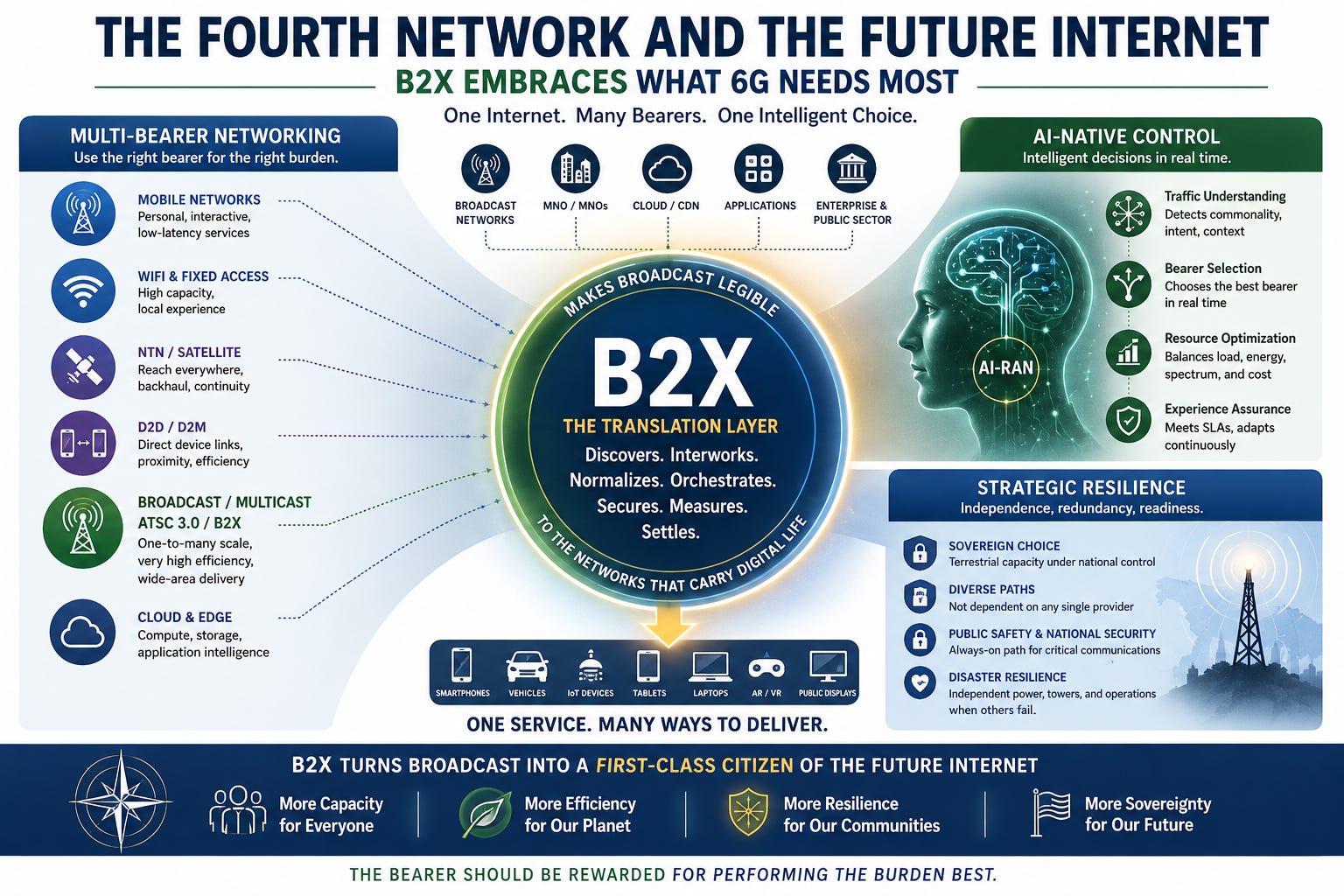
B2X now sits at the intersection of three changes. The first is multi-bearer networking: NTN has normalized the idea that a mobile service can use infrastructure outside the conventional terrestrial RAN. The second is AI-native control: the network is learning to decide where workloads and traffic should run. The third is strategic resilience: governments and operators increasingly value infrastructure diversity, local control, and reduced dependence on a single provider.
Broadcast fits all three. It is another bearer. It is especially efficient for common terrestrial demand. And because its infrastructure is physically distributed, domestically licensed, and independently operated, it adds a form of redundancy that another overlay controlled by the same platform cannot provide.
The road to 6G therefore should not ask whether broadcast is cellular enough to join. It should ask whether the network is intelligent enough to use broadcast when broadcast performs the burden best.
That is the purpose of the translation layer.
B2X makes broadcast legible to the networks that already carry digital life — and gives those networks a new reason to share the load.
• ATSC, “A/391: B2X System Discovery and Signaling,” Candidate Standard, July 9, 2026: Used for the first approved B2X Candidate Standard, the B2X bootstrap entry point, B2X Virtual Frames, B2X Endpoints, and operation across broadcast and IMT bands. Candidate-standard status is retained because the broader B2X system remains under development.
• ATSC, “Standards Update: New Candidate Standard Approved,” July 28, 2026: Used to confirm the July 9 approval of B2X System Discovery and Signaling and ATSC’s description of the action as a major step forward for the B2X system.
• ATSC Technology Group 3: Used for the current scope of TG3/S44 covering B2X, BRidge Architecture, and Broadcast Core Network, and TG3 work on ATSC/5G harmonization and interworking.
• IBC Technical Paper, “ATSC (B2X) Multicast Broadcast Neutral-Host O-RAN System Architecture,” September 2025: Used for the emerging B2X OFDMA architecture, physical resource blocks, virtual bandwidth parts, neutral-host O-RAN model, F1/PDCP interworking, carrier aggregation, and dual-connected endpoint concepts.
• 3GPP, “Broadcast, multicast technologies”: Used for Release 17 5G MBS, dynamic point-to-point/point-to-multipoint behavior, hybrid service delivery, continuing Release 18/19 enhancement work, and the Release 19 interworking direction for non-3GPP terrestrial broadcast.
• 3GPP Work Item DTTB4MBS, “Interworking of Non-3GPP Digital Terrestrial Broadcast Networks with 5GS Multicast Broadcast Services”: Used to distinguish formal 3GPP recognition of external terrestrial broadcast from the additional interface, device, aggregation, orchestration, measurement, and commercial layers required for B2X.
• ATSC, “The Broadcast Standards Association,” May 2025: Used for ATSC’s public framing of 3GPP harmonization, ATSC 3.0 for India as a B2X solution, and a potential interface between the Broadcast Core Network and 5G Core.
• ATSC, “Core Network Technologies Planning Team Formed”: Used for the long-running Broadcast Core Network rationale: aggregation of broadcast towers, datacasting, traffic offload, moving-vehicle services, heterogeneous-network convergence, and new business relationships.
• ATSC, “President’s Memo: FCC Action Accelerates NEXTGEN TV Transition,” November 2025: Used for the B2X convergence framing around mobile data offload, unicast-multicast switching, service continuity, Release 19, 5G-Advanced, and 6G.
• CPRI Cooperation, “eCPRI Specification V2.0”: Used for the role of fronthaul between radio-equipment control and radio equipment, including user-plane transport, control and management, synchronization, and the distinction between IP payload compatibility and operational RAN integration.
• O-RAN ALLIANCE, “O-RAN Native AI Architecture Description”: Used for the framing of native AI as an enabler for 6G and the role of RAN Intelligent Controllers in improving network efficiency and user experience.
• O-RAN ALLIANCE, “Release 5 Completed,” June 8, 2026: Used for the current maturity of O-RAN specifications, AI/ML workflow enhancements across Non-RT and Near-RT RIC functions, and continued emphasis on deployable interfaces for 4G/5G networks.
• O-RAN ALLIANCE, “Potential Energy Savings Features in O-RAN,” January 2025: Used for AI-assisted energy optimization, resource orchestration, and the SMO/Non-RT RIC/Near-RT RIC framework.
• AI-RAN Alliance, “MWC 2026 Momentum,” February 26, 2026: Used for the rapid expansion of AI-RAN work and the distinction among AI-for-RAN, AI-and-RAN orchestration, and AI-on-RAN, including optimization of performance, energy, radio resources, and workload placement.
• AI-RAN Alliance, “AI-Native RAN: From White Papers to Validation,” April 8, 2026: Used for the shift from AI-RAN architectural concepts toward validation, shared infrastructure orchestration, and end-to-end AI-native control.
• Prasar Bharati, “ATSC 3.0 Based D2M Test Results,” November 2025: Used for India’s practical ATSC-based D2M testing, including broadcast radio heads, mobile-device behavior, and coexistence considerations.
• Starlink, “Starlink Mobile”: Used for Starlink’s description of the scale and international reach of its satellite-to-mobile constellation and operator partnerships. The chapter treats this capability as an important future-network layer rather than as a reason to reject satellite connectivity.
• FCC, “Approves Next-Gen Satellite Constellation,” January 9, 2026: Used for the scale of SpaceX’s authorized Gen2 Starlink expansion and the role of the constellation in future broadband and direct-to-cell connectivity.
• Reuters, “Musk ordered shutdown of Starlink satellite service as Ukraine retook territory from Russia,” July 25, 2025: Used as a public example of why control of privately operated critical communications infrastructure can become a sovereignty and resilience issue. SpaceX disputed aspects of the reported episode; the chapter uses it as evidence of structural concentration risk, not as a judgment of motive.
• European Commission, “EU GOVSATCOM: Securing Europe, from ground to space,” February 26, 2026: Used for the explicit European framing of secure connectivity as a sovereignty issue and for GOVSATCOM/IRIS² as communications built and operated under European control.
• European Commission Joint Research Centre, “IRIS² — Europe’s space-based secure connectivity system”: Used for IRIS² as an EU program aimed at secure, resilient connectivity and digital sovereignty.
• European Commission, “Strengthening Europe’s Tech Sovereignty,” June 2026: Used for the broader definition of technological sovereignty as the capacity to control key technologies and infrastructure while reducing reliance on external providers.
• ATSC A/300:2026-04, “ATSC 3.0 System”: Used for ATSC 3.0 as a layered, all-IP, flexible terrestrial system rather than a television-only transport.
• ATSC A/331:2026-04, “Signaling, Delivery, Synchronization, and Error Protection”: Used for service discovery, IP-based media and non-timed data delivery, hybrid broadcast/broadband operation, synchronization, and application-layer repair.
B2X remains an evolving standards and cross-industry program, not a finished universal end-to-end system…yet. I take responsibility for liberties taken and ideas that surround integration of the cited standards, public technical materials, and prior chapters in this series.
No posts
Comments
Nothing yet. Say the first thing.
Sign in to join the conversation.