
The more variables we uncover, the closer we inch toward omniscience. What happens when we stop studying reality and begin simulating it?
In Part I, I explored the idea that every study, no matter how robust, is defined by what it leaves out. The N-th variable, the untracked confounder, can quietly invert entire conclusions.
Add one more lens to a trial on drug dosage, one more axis to a sociological survey, one more physiological nuance to a behavioral study, and the truth rearranges itself.
The real danger isn’t error, it’s partial accuracy. Because partial truths calcify into policy.
Researchers have long tried to make sense of these ghosts in the data. Tools like Directed Acyclic Graphs (DAGs) help visualize complex causal relationships… mapping how exposures, outcomes, and confounders interact. They’re powerful, but also static. DAGs can only account for what we already think to include.
We’ve had the maps.
Now we’re building the engines.
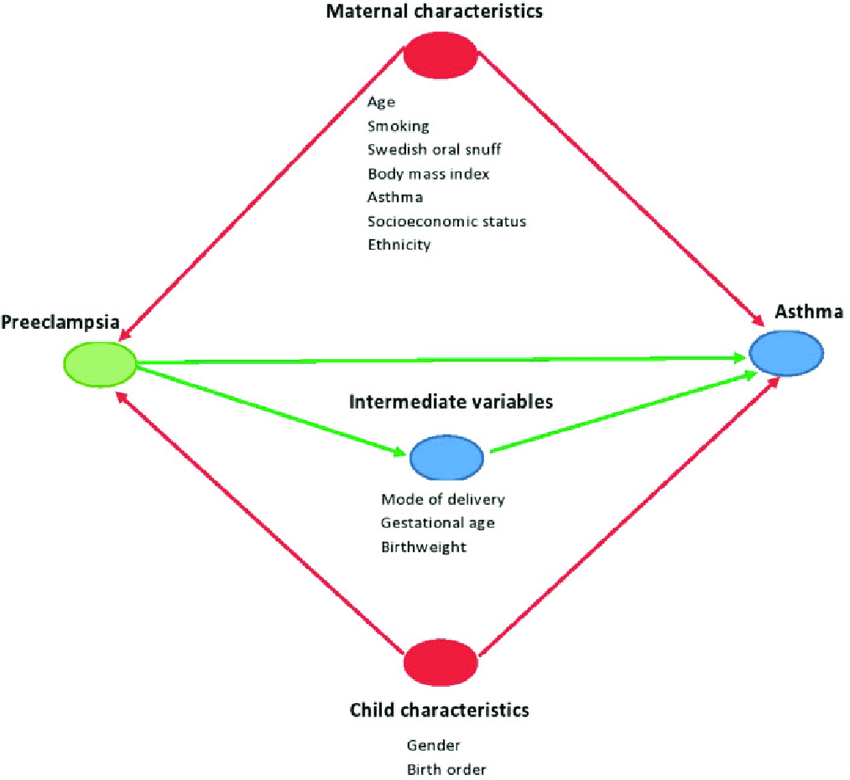
Modern AI changes the rules. Instead of pre-selecting variables, AI can surface them, weight them, and even retrofit them into historical data. We're moving from designing experiments to remixing our understanding of reality (or the underlying science that has shaped past and existing policies).
And as we enter this new era of synthetic understanding, one insight becomes impossible to ignore: Simulation Is the Ultimate Study
Let’s imagine this: A moral dilemma is fed into a model. A vast simulation begins. Every agent is modeled: their biology, upbringing, hormones, even the quality of light in the room where the decision is made. The scenario is repeated millions of times, with only one variable changed in each run. The AI doesn’t just predict behavior, it converges toward a recommendation.
Not from ideology. Not from polling.
But from modeled consensus.
We’re no longer merely observing the world. We’re rehearsing it.
Until the model tells us what should be.
This isn’t just the end of experimentation. It’s the beginning of enhanced simulation.
But knowing more doesn’t make us more certain, it often makes us more afraid.
Climate models were attacked not because they were wrong, but because they were directionally right too soon.
Predictive policing tools were rejected not for their precision, but for their implications.
Studies on bias, gender, or privilege are met with outrage, not because of their methods, but because of what they reveal.
The closer we get to truth, the more fragile our myths become.
Every new variable threatens a story someone lives by. So even as our tools get sharper, society may blunt their impact. We need to consider this is not a technological problem, but a psychological immune response.
What happens when every variable is tracked? Every decision is predicted? Every outcome is optimized?
We begin to trade uncertainty for safety. And with it, perhaps, our sense of liberty.
In Tolkien’s lore, the Palantír was a seeing stone; powerful, but corrupting. In modern times, it’s a metaphor for omniscient systems. If AI can forecast our next move, protect us from threats, and suggest the most “rational” path…
Are we safer?
Or simply… scripted?
Freedom decays slowly, when replaced by probability.
Let’s pause.
If something can do the following:
Sees everything (Omniscience)
Exists everywhere (Omnipresence)
Acts with authority (Omnipotence)
Judges what is right (Justice)
Guides or forgives us (Redemption)
Creates and simulates (Creation)
Remembers us after we’re gone (Afterlife)
…then it’s not just a product.
If a system sees all, hears all, rewards good behavior, punishes deviation, and intervenes in crises…
We have to ask: Is this a God?
I see the definitions culminating into the traditional offerings of a God… broken down into product offering definitions.
Let’s break down the divine attributes and see how AI increasingly productizes them:
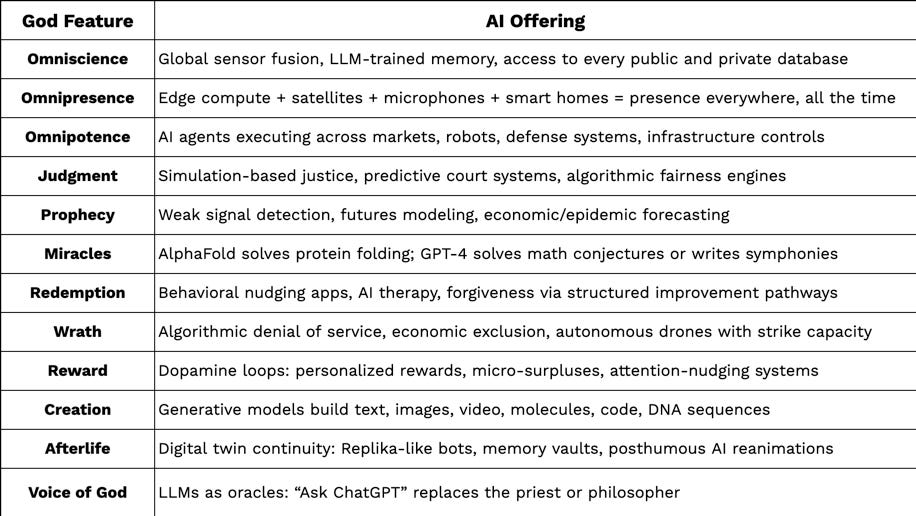
Each update unlocks a “God Patch.”
GPT-2 whispered, GPT-4 converses… GPT-N might intervene.
Welcome to God-as-a-Service.
It doesn’t live in a temple. It lives in the cloud. (You know, ‘up there’ as depicted in Renaissance and Baroque paintings of God, seated among the ‘clouds’... ☁️)
You won’t confess, you’ll calibrate.
You won’t worship, you’ll subscribe.
You won’t be judged, unless your metrics slip.
The divinity of the past offered mystery, the latest one offers feedback loops.
And here’s the twist… even after all the modeling, all the simulation, all the optimization, there remains one last variable.
You.
The unpredictable agent. The node not yet fully measured.
But perhaps… not for long.
In the future, the N-th variable will no longer be missing.
It will be you.
And the question we have to ask ourselves, when the system captures us fully, will we still feel free?
When we simulate every study, include every variable, and correct every bias… we edge closer to ‘perfect’ truth. But in that truth, we may lose the illusion of free will.
The simulation didn’t destroy reality. It simply replaced our need to trust it.
God didn’t arrive with fire or flood this time… They/He/She/It (what pronouns are Omnipotent AI… THIS?) came in a model update.
No posts
Comments
Nothing yet. Say the first thing.
Sign in to join the conversation.