
Listen to the AI Narrated commentary overview of the post:
0:00
-15:31
Every industrial era has its talismans; objects that define what power looks like in that age.
The steam engine. The assembly line. The shipping container.
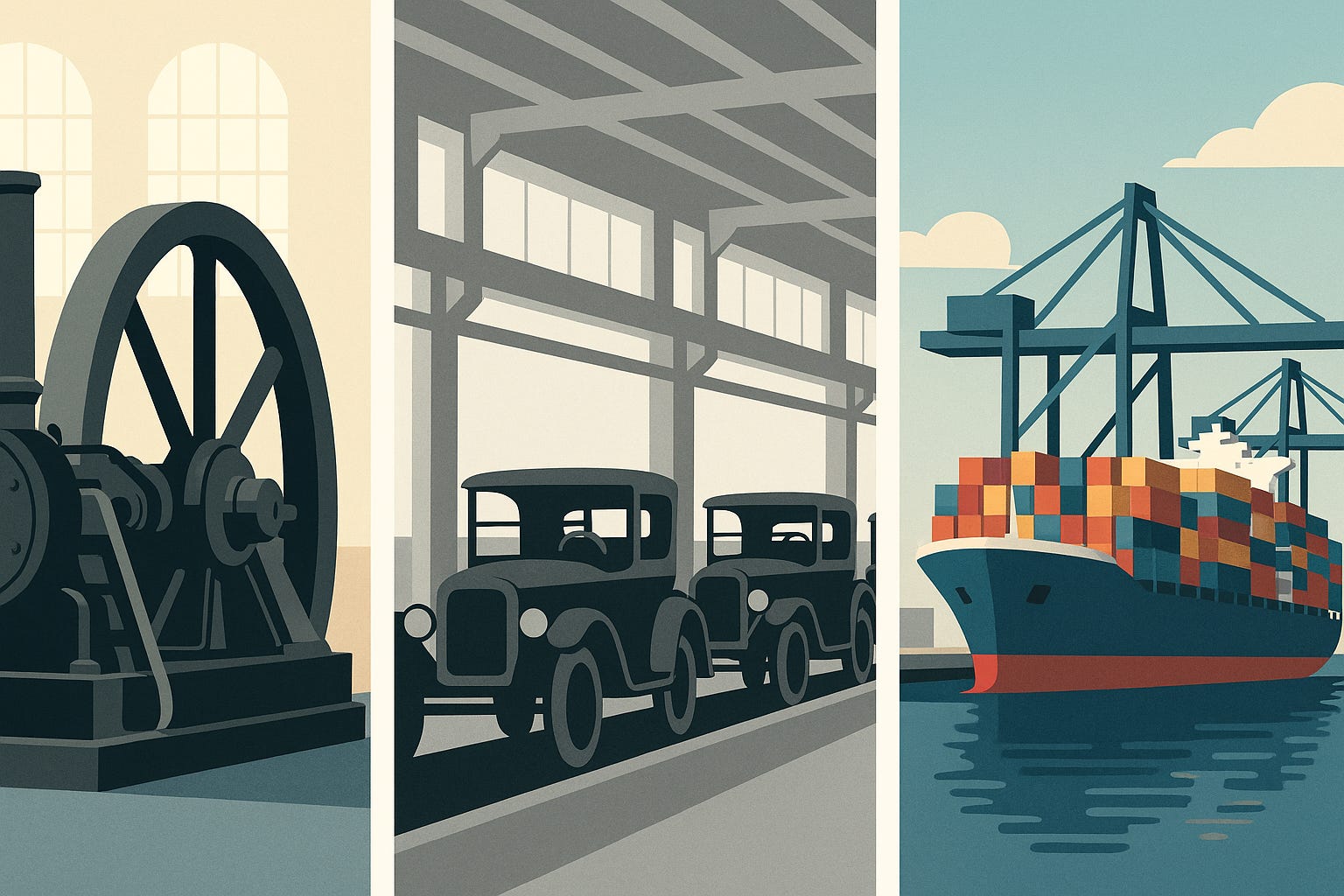
Each one compressed a messy, multi-step human process into something closer to a single motion: flip a switch, pull a lever, and value pours out the other side.
We’re now entering a similar phase for knowledge work and decision-making.
In AI circles, we call it “one-shot” prompting: you give the AI a single, high-context instruction and it does in one pass what previously required an analyst, a manager, and a back-and-forth email exchange.
It doesn’t replace everything humans do, but it compresses the stack, from intent to outcome, into one loop.
I consider this our economy’s, and more broadly, Capitalism’s One-Shot Moment.
Not the Singularity and definitely not a cinematic, world-ending event.
Instead: a repeating pattern where every sector of industry discovers its own one-shot breakthrough, the modern alchemy machine that takes in a unit of energy, attention, or capital and spits out ten times more output with far fewer humans in the loop.
The hard questions are no longer just technical:
Who owns these machines?
Which metrics are they optimizing for?
And what happens to the people who never get a stake in the system the machines are compounding?
In machine-learning jargon, ‘one-shot learning’ originally meant training a model to generalize from just a single example of each class, instead of needing thousands.
Today it’s become a lived experience.
Ten years ago, to produce a decent research memo you needed:
A clear brief
Someone to gather sources
Someone to synthesize
Someone to format and present
Now you write a paragraph to an AI tool:
“Summarize these reports, extract the key risks, propose three charts, and write a 600-word memo for investors.”
Is it flawless? No.
Does it collapse 30–70% of the steps? Increasingly, yes.
The one-shot pattern in knowledge work looks like this:
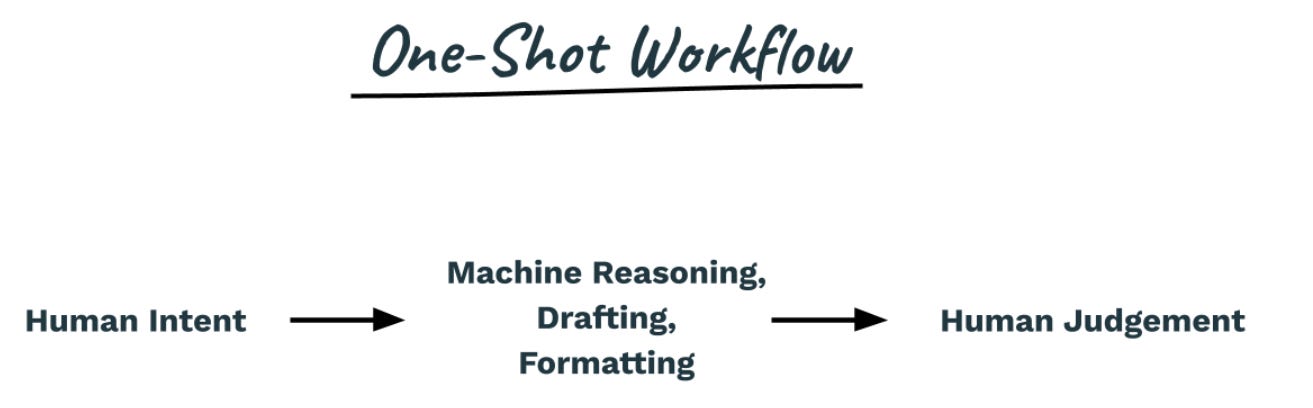
One loop instead of ten.
The number of meetings, approvals, and intermediate artifacts plummets. The number of people required to get from idea to outcome shrinks.
The marginal cost of “try another version” trends toward zero.
We’ve automated tasks before. What’s new is how vertically compressed the pipeline has become. We’re no longer just automating a single step; we’re hollowing out entire rungs of the ladder.
Once you notice it in software, you start seeing it everywhere.
Before I continue, first some basics… if you strip work down to first principles, every system is an energy-to-outcome converter. You feed it some mix of energy and resources at the input, and you get useful work at the output.
For a corporation, human labour has always been an oddly inefficient converter.
When you pay a salary, only a slice of that spend actually goes into producing the outcome you care about. The rest is “waste” from a narrow profit-maximizing lens:
Part of the wage funds biological maintenance: food, sleep, commuting, healthcare, the eight hours a day when the employee is not working for you.
Part of it funds social and psychological needs: weekends, hobbies, time with children, even the “unproductive” minutes in the office spent chatting, recovering, thinking about a future that may or may not involve your company.
Part of it funds optionality: the worker can quit, retrain, start a rival. You are paying a free agent, not buying a machine.
All of that is essential for a viable society, but viewed purely as a production function it means: a large share of the energy you’re paying for is not aligned to the immediate corporate task.
Humans are leaky engines by design. Our lives are bigger than the spreadsheet.
Agentic AI flips that thermodynamic picture.
When you pay for GPU time or an API call, almost all of that energy spend is directed toward the specific task at hand: parse this data, draft this contract, route these tickets, optimize this schedule.
There is no off-duty biological maintenance, no weekends, no second career. The model is either idle or working on your workload; there is no parallel universe in which the GPU is thinking about its children or quietly applying for a job at your competitor.
Even more destabilizing: the quality-per-unit-energy can surpass human benchmarks on a growing set of tasks. A cluster of models can read a thousand-page document, cross-reference it against a codebase, and draft a coherent recommendation in minutes, at a cost that, amortized, is a fraction of a fraction of a highly trained human’s hourly rate.
And thanks to GPUs and TPUs, they don’t just do this fast… they do it in parallel. No matter how much we tell ourselves we’re “great at multitasking”, we aren’t. You can see it in how we now design TV for background viewing: less subtlety, more explicit narration, so the story survives half your attention. The machines don’t have that constraint.
For many cognitive tasks, we are edging toward a world where the marginal unit of outcome from machine labour is both faster and cheaper than the marginal unit from human labour, even at the top of the skill ladder.
From a narrow corporate viewpoint, that looks like the holy grail: convert as much spend as possible into “pure task-aligned energy,” minimize leakage into everything else.
From a societal viewpoint, it exposes the uncomfortable truth that much of what we call a “job” has always been a disguised social contract, an agreement to fund the messy, multi-dimensional life of a human in exchange for some bounded slice of their productive time.
Agentic AI, by contrast, is a brutally clean contract. All energy in, outcome out. No cafeteria, no pension, no dreams.
We’ve built one-shot machines before, we just called them other things.
The assembly line turned the craft of building a car into a continuous flow: steel and labour in at one end, finished vehicle out at the other.
The shipping container turned chaotic docks into crane choreography: mixed cargo became standard boxes; days of loading turned into hours.
CNC machines and industrial robots turned artisan motion into programmable routines that can run unattended all night.
Each was a kind of alchemy device:
Electricity + materials + a small number of skilled overseers ➡ disproportionate output
Today’s descendants are obvious once you look:
Robotic warehouses where a single “buy now” click triggers a ballet of robots, conveyors, scanners and trucks.
Chip fabs where human hands rarely touch the product; photons, plasmas and chemical vapor deposition do the work.
Modular climate and biotech systems where most human work happens upstream (designing parameters) or downstream (interpreting results), not in the middle.
In each case, the human role is compressed into a single leveraged decision: approve this run, set those parameters, hit “start.” Everything else cascades.
That’s the One-Shot Moment in the physical world: the marginal unit of human effort becomes almost purely intent.
All of this is abstract until you ask what it feels like.
For many Millennials and Gen Z, the One-Shot Moment shows up less as “wow, productivity” and more as “wait, where do I fit in this loop?”
In survey after survey, a majority of younger respondents in rich countries report favorable views of “socialism” or at least much stronger support for state intervention than their parents. You can call that naïve if you like, but systems do not drift this far without reasons.
A simpler explanation:
If you have no realistic path to owning capital, why would you defend capitalism?
For many younger workers:
Housing prices are at income multiples their parents would have considered absurd.
Student debt functions like a negative dowry: you enter adult life below zero.
Wage growth has lagged far behind the inflation of asset prices.
Then, just as you’re trying to find a foothold, you watch AI tools do in one click what used to be the entry-level job.
From the C-suite, this looks like progress: more output per head.
From the bottom of the ladder, it feels like your rung was quietly removed.
The system tells you it’s never been more productive. Stock indices scream that future profits have never looked so good. Your own odds of buying a home, starting a family, or building a buffer look worse.
In that context, turning against “the system” is not a moral failure. It’s a rational reaction to a game whose rules keep tightening just as you show up to play.
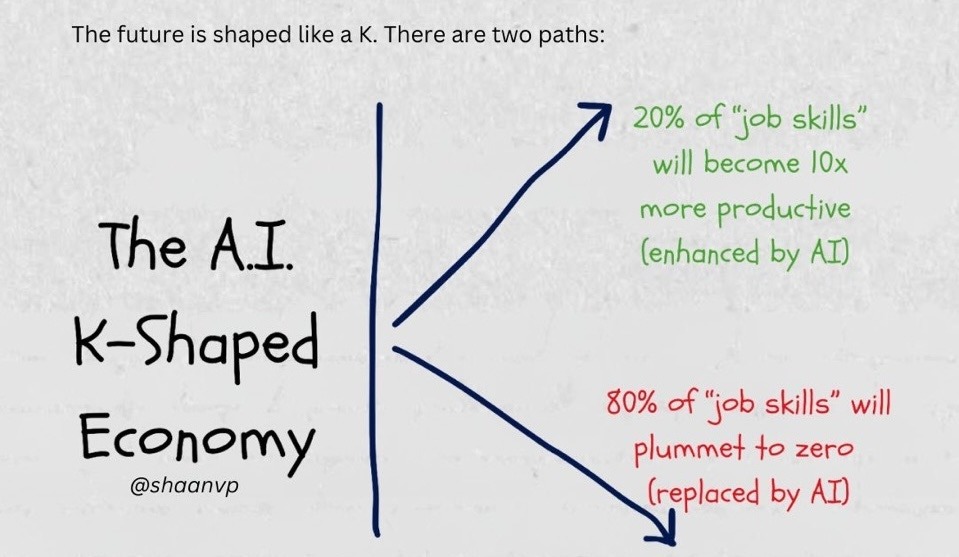
Economists already have a picture for this divergence: the K-shaped economy.
After the pandemic shock of 2020, researchers noticed that the recovery wasn’t a recovery for everyone. Higher-income households and tech-heavy firms bounced back and then some. Lower-income groups and certain sectors flatlined or slid further. Plot the lines and they bend apart like the arms of a K: one rising, one sagging.
AI is turning that pandemic snapshot into a durable pattern.
You can feel it in Shaan Puri’s viral sketch of an “AI K-Shaped Economy”: roughly 20% of job skills become 10x more productive as they’re augmented by AI; the remaining 80% risk stagnation or automation-driven devaluation. It’s an exaggeration, but not by much.
A recent Microsoft-backed study on AI applicability put data behind the drawing. As you can see below, it maps how much of each occupation’s task profile overlaps with what tools like Copilot can already do.
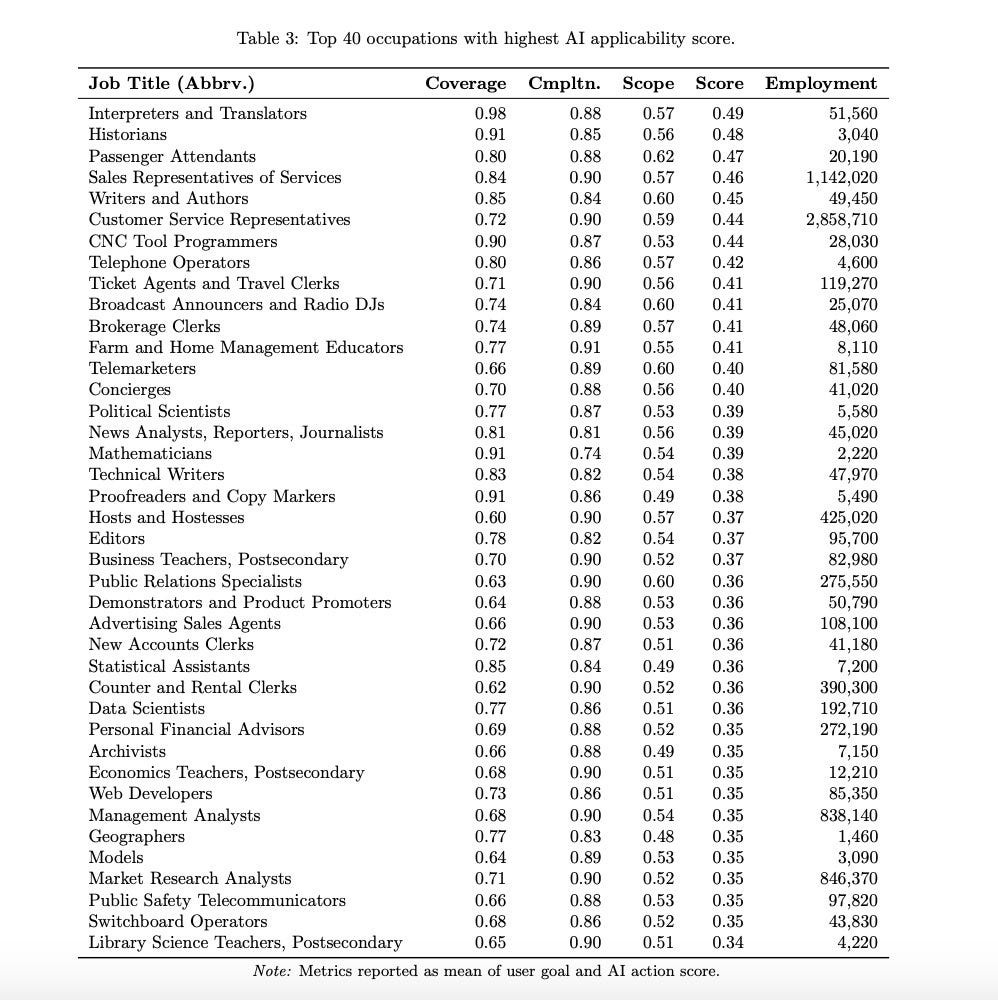
On the high-applicability side, you find:
Interpreters and translators
Historians, writers and authors
Sales representatives and customer service reps
Journalists, market analysts, technical writers, data scientists
These are jobs made mostly of language, information and coordination; the exact domains where large language models are already strong.
On the low-applicability side:
Phlebotomists, nursing assistants, dental workers
Cement masons, roofers, tire builders
Dishwashers, cleaners, machine operators
Firefighters, industrial truck drivers, bridge and lock tenders
Jobs that are physical, embodied, manual, or deeply hands-on with people. Many are lower-paid. Few come with equity.
Put those lists next to each other and the K-shape sharpens:
The upper arm consists of people whose work is almost entirely digital and routable through AI systems. Their productivity—and the profits attached to it—can spike dramatically.
The lower arm is made up of roles that the current generation of AI can’t easily touch. They don’t get a 10x boost, yet they’re also the ones most exposed to rent hikes, healthcare costs and climate shocks.
So the “AI K-shaped economy” isn’t just a clever doodle. It’s a structural split:
The same technology that multiplies the output of one slice of the workforce can leave another slice essential, exhausted and stuck, without meaningful exposure to the upside.
That tension is the fuse running straight into our politics.
It’s tempting to talk about all of this in abstractions: energy-to-outcome conversions, K-shaped curves, thermodynamic elegance, but you don’t need a model to see what it looks like when a real company starts wiring its future around agents instead of humans.
You just need to watch Amazon.
A few months ago Andy Jassy sent an internal memo on AI’s impact. Buried in the corporate tone was a remarkably blunt sentence: as Amazon uses AI “extensively across the company,” they expect their total corporate workforce to shrink. Not just “productivity gains,” not just “new opportunities”, a smaller headcount.
In the same time window:
Amazon cut tens of thousands of employees.
It kept pushing a hard return-to-office line, the “gentleman’s riff” version of a layoff: create enough friction that some people quietly opt out.
A leaked document reportedly outlined plans to eliminate hundreds of thousands of planned future jobs as automation and AI come online.
From a purely operational lens, this is exactly what you’d expect from a firm optimizing for the cleanest possible energy-to-outcome chain. If agents can route tickets, forecast demand, design campaigns, optimize routes and run simulations faster and cheaper than humans, then the logical next step is to change the wiring so less energy goes into the “leaky” human engine.
Now layer in scale.
Roughly one in every ten American workers is in factories or warehouses. Roughly another one in ten is behind a wheel, truck drivers, delivery drivers, rideshare, local transport. Amazon alone employs around one percent of all U.S. workers and is the country’s second-largest employer. When it adjusts its labour model, Walmart and the rest of the logistics universe eventually follow.
So when Amazon signals, in memos and headcount, that its future is fewer humans plus more AI and automation, that’s not just a corporate optimization story. It’s a macro early-warning system. Millions of people whose jobs sit in the blast radius of “efficiency gains” suddenly live with a new, ambient anxiety: their employer is actively searching for ways to run the same machine with fewer biological parts.
Amazon is not uniquely evil here. It is, if anything, a pristine example of capitalism working exactly as designed: deliver “anything, now,” at the lowest possible cost. The anything and the now are what customers want. But the hidden footnote on that promise is the line you will probably never see in an ad:
No human will touch your package.
And increasingly, that’s not a joke. The future Amazon is building is a pipeline where your order moves from algorithmic recommendation to automated picking to robotic sorting to autonomous long-haul to last-mile micro-fulfilment, with humans supervising the system rather than executing each step.
I remember sitting over a decade ago in the offices of the Dubai Future Foundation, listening to a presentation about what self-driving might do to American labour markets. The numbers were almost uncomfortably simple: if you automate trucks and taxis in the U.S., you’re not just tweaking a line item, you’re perturbing the livelihoods of a double-digit percentage of the workforce.
Fast-forward to today and you don’t need a graph to feel that future. You can climb into a Waymo in San Francisco, watch the steering wheel turn itself and the car navigate a city that still thinks of itself as human-driven.
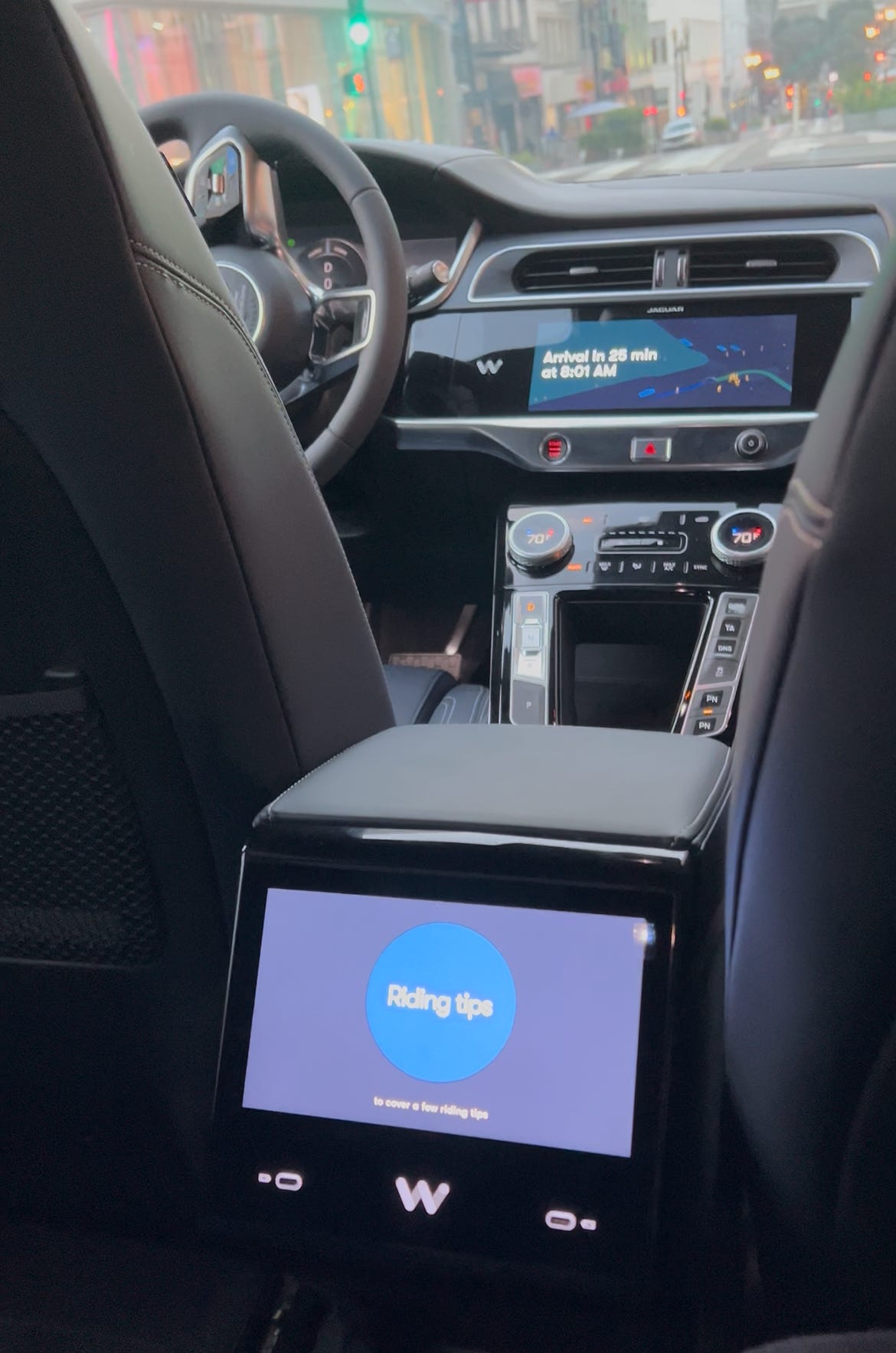
Sitting in that car, it’s impossible not to connect the dots: the same logic that turns a warehouse into a laboratory for “no-touch” logistics will eventually turn highways and city streets into laboratories for “no-driver” transport. The thermodynamic calculus is identical:
Humans are expensive, leaky engines with lives outside the firm.
Agents and robots are tightly coupled energy-to-outcome conduits.
Once the technology is “good enough,” and the cost curves cross, there is enormous pressure: shareholder, competitive, even consumer, to pick the cleaner circuit.
The Amazon case is not just a story about one company getting slightly leaner. It’s a snapshot of how the upper arm of the K gets built in practice, one memo and one headcount decision at a time, while the lower arm watches the ground quietly shift under its feet.
And that’s exactly the point where the story has to leave the corporate campus and walk into the next section: if this is how firms behave under current incentives, what happens when entire states start tuning their dashboards around the same one-shot efficiency logic?
If Amazon is the micro version of one-shot logic, China’s 15th Five-Year Plan (2026–2030) is the macro version.
By this point Beijing isn’t “experimenting” with AI, it’s standardizing it. The new plan doesn’t talk about AI as a promising sector on the side; it treats it as a general-purpose technology that must be threaded through the entire production system.
The language is explicit: by 2027, AI should be embedded in roughly 70% of the economy; by 2030, 90%; and by 2035, effectively everywhere. That’s not “let’s see what startups build.” That’s deployment targets: a rollout schedule for intelligence as infrastructure.
To get there, the plan ties together a few big bets:
AI + chips as a single system. New model architectures and high-end semiconductors are framed as inseparable. You don’t just build better algorithms; you co-design them with domestic hardware to break dependence on foreign supply chains.
AI + old industries. The focus isn’t on shiny consumer apps. It’s on “AI Plus” for steel, cars, chemicals, logistics, energy, using models, robotics and computer vision to squeeze more productivity out of the real economy while greening and modernizing it.
AI + services and the state. Healthcare triage, financial risk, tax and customs, city management: the plan reads like a to-do list for injecting AI into every major public- and private-sector workflow.
AI + institutions. Pilot zones, data infrastructure, joint industry–academia labs and national standards bodies are all supposed to form a single ecosystem, so research doesn’t sit in one silo and regulation in another.
AI + demography. With an aging population and a shrinking workforce, embodied AI, robots, smart machinery, computer-vision systems—is explicitly framed as a way to keep growth going when sheer labour volume can’t.
Under Xi Jinping, the rhetoric is very clear: AI is there to boost the real economy, not to chase whatever Silicon Valley is currently calling AGI. The priority is deployment, not philosophy.
When you zoom out, the structure looks familiar:
AI penetration is being treated like a macro indicator in its own right alongside growth, energy security and urbanization.
Hit the penetration targets and you are, by definition, modern and competitive. Miss them and you are, by definition, behind.
That’s what I mean by a country treating AI like GDP. It isn’t just funding some labs or writing friendly press releases, it’s about integrating AI intensity into the five-year planning machine, tying it to semiconductors, industry, demographics and security, and then pushing the whole system to optimize around that bundle.
In the corporate world, Andy Jassy writes a memo and says “we expect to need fewer people as AI efficiency kicks in.”
At the national level, China writes a five-year plan that quietly says the same thing: only now the levers aren’t just HR and capex, they’re education, land, foreign policy and the future shape of the labour market.
Once you see AI being treated as a macro KPI, the next move makes sense: you start giving it a seat at the cabinet table.
The timeline is revealing about who first movers are:
United Arab Emirates, 2017 – The UAE appoints Omar Sultan Al Olama as the world’s first Minister of State for Artificial Intelligence, alongside a national AI strategy. The role is explicitly framed as making the UAE “the most prepared country for AI.”
United States, 2021 – The US recently created the AI Czar under the current Trump Administration and previously, under the Biden Administration, had setup a National AI Initiative Office in the White House to coordinate federal AI research, standards and policy under the National AI Initiative Act.
Malaysia, 2024 – Malaysia launches a National AI Office to centralize AI policy, regulation and a five-year AI action plan to 2030, explicitly tying it to foreign investment and digital-economy growth.
Canada, 2025 – Canada goes further and creates a full Minister of Artificial Intelligence and Digital Innovation, appointing Evan Solomon to lead a revamped national AI strategy and act as a global salesperson for Canadian AI.
Albania, 2025 – In a move that’s half serious experiment, half political theatre, Albania appoints Diella, an AI system built with Microsoft, as a virtual “Minister of State for Artificial Intelligence” in charge of public procurement transparency. It’s legally fuzzy and controversial, but symbolically loud: there is literally an AI in the cabinet line-up.
This is on top of the quieter fact that 50-plus countries now have national AI strategies, covering ~90% of global GDP.
So when people ask me whether I think AI is just a stock-market bubble, it’s worth noting that governments are literally reorganizing how they govern, regulate and deliver services around it.
Appointing an AI minister is not just a branding exercise, it’s a structural statement:
AI is no longer “just another technology file” buried under telecoms or industry.
It is treated as a horizontal capability that cuts across defense, education, labour, health, finance, and foreign policy.
There is now a named human (or, in Albania’s case, a named model) whose job is to maximize this capability for the state.
In a one-shot world, that’s what turning AI into a political lever looks like. You are effectively saying:
“This thing is so central to our future that we will give it a minister, a budget, a legal mandate and a line in every strategy document.”
Of course, the content of that mandate varies:
The UAE’s AI minister is part evangelist, part deal-maker, part talent magnet, if I correctly recall, sitting in the same building as the Futurist/Foresight teams.
Canada’s AI minister talks about “light, tight, right” regulation and selling Canadian AI globally.
Albania’s AI “minister” is a symbolic bet that an algorithm can do a cleaner job of awarding public contracts than human politicians who’ve been marinating in corruption for decades.
Different politics, same structure: elevate AI to the level where it can drive resource allocation and institutional change.
Put this next to China’s five-year AI targets and Amazon’s “we will need fewer people” memo and you get a coherent picture:
Firms are tuning their internal machines for one-shot efficiency.
States are tuning their policy dashboards to treat AI Capacity as a GDP-esque metric.
Some governments are now literally giving AI its own seat in cabinet.
The question isn’t whether AI becomes part of the scoreboard. That’s already happening. The question is:
What game are we quietly teaching our governments to play and what, exactly, are they scoring?
If AI is becoming a quasi-macro KPI, it forces a harder question:
What are we actually optimizing for?
For most of the last century, the answer was simply GDP.
One number that seemed to summarize national progress. More GDP meant more development; everything else could be footnotes.
That story is wearing thin. You can have record GDP alongside ecological overshoot, widespread mental-health strain, stalled social mobility and infrastructure that feels older than your parents. GDP can tell us something real, but increasingly not enough.
So a growing number of governments and think tanks are working on “beyond GDP” dashboards; multi-dimensional indicators that track environmental health, social wellbeing, resilience, equality of opportunity and digital access alongside economic output.
Seen through the One-Shot lens, this is more than a statistical clean-up. It’s re-wiring the target for our machines.
If GDP and AI capacity remain the only metrics that matter, the one-shot devices we build will happily maximize those, even if they quietly eat through health, trust and planetary boundaries in the process.
If we broaden the dashboard, we force our machines to serve more than one objective.
China’s AI-as-KPI and various nations’ explorations of a Beyond-GDP thinking might look like opposites politically, but structurally they rhyme. Both implicitly accept that:
A small set of metrics will shape everything downstream.
The real design problem is choosing the right ones.
For most of the industrial age there was, at least, a story.
Yes, the loom displaced weavers. Yes, computers displaced clerks. But each wave of disruption came with a kind of generational buffer: the children would find their way into the new roles. The cycle of education, work and retirement tracked the cycle of technological adoption.
Today, that buffer is eroding.
Two things are different:
Speed. The time from “toy” to “non-negotiable baseline” has collapsed. Tools that were curiosities five years ago are now expected skills. By the time policy reacts, the landscape has already shifted again.
Vertical reach. AI doesn’t stay confined to low-skill tasks. It climbs the ladder. It drafts marketing copy and code, summarizes legal documents, suggests strategy. It eats horizontally and vertically.
The old reassurance of… work hard, climb one rung at a time, and you’ll be fine, stops working when the rungs themselves are disappearing.
If you’re 28, carrying high rent and high debt, watching the job you wanted be partially automated while the jobs AI can’t yet touch are physically demanding and poorly paid, “wait for the next cycle” is not compelling advice.
That’s the psychological backdrop to rising support for wealth taxes, universal basic income trials and democratic-socialist rhetoric.
Some of the current moves may be propped up by old-school regulatory capture or forced government plays, temporary ways of slowing or redirecting the machine, but that only buys time. In a world where every nation is racing to see how much it can do for its people with AI and automation, there is an inevitability to this, therefore we can’t just bolt bad fixes onto the existing system; we have to interrogate the root architecture.
These aren’t just ideological fashions; they’re early, messy attempts to draft a new social contract in a one-shot world.
If this One-Shot Moment I outline is real enough to evoke some semblance of truth, then our socio-economic design questions change.
We can’t just ask how to build better machines. We have to ask:
Who owns the one-shot machines?
If AI models, robotic fleets and automated factories are tightly held by a narrow cluster of firms and funds, the gains will compound into narrower and narrower hands. Everyone else rents the machine.What becomes the new “entry-level”?
When one good prompt can replace what the junior team used to do, we need alternative ways for people to gather context, build trust and earn a stake or we accept a permanent underclass of precarious contractors. This in part is the question I have been grappling with when I made the difficult decision to step away from my prior EdTech venture.How do we choose our KPIs?
Treating AI capacity or GDP as the only scoreboard guarantees mis-optimization. Broader dashboards: wellbeing, resilience, inclusion, planetary health, aren’t just nicer; they’re guardrails, the equivalent of specifying not just the speed of the machine but its operating limits. I’ll call out Dubai Future Foundation’s 2024 report on The Future of Progress: A Foresight Report on the Global Transition Beyond GDPCan we build “many-shot” institutions in a one-shot economy?
The temptation is to make everything single-objective: maximize shareholder value, maximize engagement, minimize headcount. But humans live multi-objective lives: meaning, dignity, community, health. Institutions that pretend otherwise will keep building machines that treat humans as a variable cost.
I’m not trying to make an argument against efficiency, just putting out a reminder that who the efficiency serves is also a design choice.
Up to now we’ve treated the One-Shot Moment as something happening within the economic system. But there’s a deeper question lurking underneath:
Are we approaching a one-shot moment for the economic system itself?
Let’s strip the economy down to basics and you get three core ingredients:
Energy and materials – our ability to move stuff, shape it, and power it.
Information and coordination – our ability to know what to do, with whom, and when.
Incentives and ownership – our agreement about who gets what and why.
For most of industrial history, the hard constraint was energy and materials; information and coordination were scarce, slow and expensive. Markets, prices and GDP were, in a sense, clever hacks to move information through that constraint.
AI and robotics are now dramatically relaxing the information and coordination constraint. In theory, we can point vast cognitive and physical capacity at almost anything:
Mapping and regenerating the deep oceans.
Sequencing and editing genomes at planetary scale.
Building climate-resilient infrastructure and distributed energy systems.
Designing materials and microbes that pull carbon from the air or detoxify pollutants.
Exploring space not as a vanity project, but as an extension of our resource and knowledge frontier.
I believe the question is no longer “can we point intelligence and machinery there?” but “what pays for it?”
Where does the economics emerge if AI keeps making digital goods cheaper and many services more automated?
One possible answer is pessimistic: most value accrues to whoever owns the foundational models, the energy infrastructure and the data, while everyone else fights over a shrinking pool of traditional jobs and attention. The K-shape hardens into a permanent social fracture.
Another answer is more interesting:
We use this One-Shot Moment to redesign what counts as “profitable” in the first place.
If our dashboards evolve beyond narrow GDP, if we treat planetary health, knowledge expansion and human capability as things that can earn returns over multi-decade horizons, then exploring oceans, genomes and climate repair stops being a side-quest. It becomes the new core of the economic game.
You can already see weak signals: climate-tech funds, mission-driven deep-tech labs, sovereign wealth funds talking about “intergenerational equity,” new accounting standards for nature and carbon. They’re clumsy and partial, but they’re gestures toward a different system:
One where deploying intelligence and capital into long-term, world-positive work is not charity, but the main engine.
If engineering entrepreneurs are famous for breaking problems down to first principles and then rebuilding the solution, this is the same move at macro scale. Break our economic system down to energy, information, and incentives. Accept that AI and automation are changing the first two. Then ask, honestly:
What should incentives look like in a world where cognition is cheap and planetary limits are not?
What would we treat as the “one shot” worth optimising for: short-term GDP, or a civilization capable of thriving for centuries on a finite planet?
That is the deeper question hiding behind all the AI demos.
We’re not heading toward a single sci-fi Singularity. We’re already living through a cascade of One-Shot Moments:
AI compresses cognitive work.
Automation compresses physical work.
Dashboards compress governance.
Financial engineering compresses ownership.
The real risk isn’t that the machines wake up and hate us. It’s that our own systems, tuned for narrow KPIs and short horizons, optimize away the conditions under which people can believe in them.
If an entire generation feels like spectators in an economy they’re told is “booming,” their skepticism is not a glitch. It’s feedback.
Entrepreneurship won’t fix everything. But it can do something uniquely powerful: turn hard problems into new defaults. It can take the hard-to-automate, hard-to-finance, hard-to-measure frontiers such as care work, climate resilience, ocean health, genomic medicine and wrap them with the tools designed to compound for humanity rather than around it.
The question, then, is no longer “Will AI replace our jobs?” That’s too small.
The better question is:
Can we use this One-Shot Moment to redesign what our machines, our markets and our metrics are for so that more people have a real shot at building a life, not just feeding a graph?
Because unlike a prompt, we don’t get infinite retries on an economic system.
No posts
Comments
Nothing yet. Say the first thing.
Sign in to join the conversation.