
The question “Did the new ways of working movement fail?” has been circulating around my networks lately. It was the subject of a recent podcast conversation between Rodney Evans and Sam Spurlin, and my friend Mark Eddleston has been publishing chapters of his book Why Change Fails on Substack. These are people who, like me, have been working in this field for the last ten to fifteen years. People inspired by movements like Agile, or books like Maverick! by Ricardo Semler or Reinventing Organisations by Frederic Laloux. As Rodney puts it: “We felt like eventually the world would have an awakening and the future of work would be adaptive, progressive organisations. That has not arrived, fifteen years later.” Mark has also been very honest in sharing his dark-night-of-the-soul reflections, observing that the experiments he helped teams to run as a consultant always seemed to show promise but inevitably fizzled out after he had left.
My peers seem to be tapping into something because their posts are generating lots of comments and dialogue with their audiences. I sense this is because people feel seen and less alone thanks to what is being named. There are a lot of good people out there who have been working hard for years trying to create organisations, communities or initiatives that are more decentralised, more human, more purpose-oriented. Some have dealt with heartbreaking failures – a flat organisation that just couldn’t scale or become sustainable, a social impact initiative that couldn’t crack shared power and whose founders burned out, a progressive not-for-profit that got tired of fighting with the bigger economic system. Others are struggling on but continue to bump up against so many challenges that they are perhaps asking themselves: is it worth it? Would it not be easier and less painful to just go back to a 9-5 job in a traditional organisation and work on my passions outside of work?
Rodney, Sam and Mark are clear to state that there is no blame or judgement here. It’s not the fault of people in organisations, working hard to go against the grain and create something new. And it’s not the fault of the consultants or coaches, who are (for the most part) good people trying to make a difference. It’s that the system has been more persistent than perhaps any of us thought. Our current landscape, shaped by factors like AI disruption and geopolitical uncertainty, means we are living in less abundant times. Organisations are less willing to take risks and have fewer resources to throw at governance experiments or external coaches and consultants.
Added to that, could we have been going about transformation the wrong way? Mark argues that we are still trying to apply linear thinking to complex problems. We keep spending time and money on experiments with things like decentralised decision-making or autonomous teams, believing that if we do X, we will get Y. Yet if this were true, surely there would be so many more examples of self-managing organisations? Mark believes that perhaps the self-managing organisation is a rare bird – beautiful, but more dodo than dove. Organisations where new ways of working actually work are the exception, not the norm. Perhaps it’s because of the unique worldview of the founder, or a set of specific circumstances that are impossible to replicate in any other organisation.
I think he’s right to warn us about trying to apply linear thinking or copy-pasting models or practices from other organisations. It’s natural that we look for recipes or blueprints. They give us a false sense of certainty or predictability. But the truth is, these processes take grit and a willingness to go into the unknown. If you are in it for a quick fix or profit gains, it’s probably best not to start at all. Of course we can be inspired by other organisations, but it can be more helpful to take those principles, rather than how they are expressed, and find our own way to evolve structures or processes that make sense for us in our context. Mark’s also right about the important role that founders or CEOs play. It’s rare to find individuals with the magic combination of humility and vision at the top of an organisation. (Though there is valuable development work these people can do – Tom Nixon and the ConsciousU community are doing great work around this.)
My friends are not arguing that we should give up, or that these were bad ideas. Rodney clarifies that she is talking about: “the failure of the movement, not the failure of the moves.” She continues: “I’m still fully allegiant to the ways of working and I am more curious about the ways in which the systems have fought back and those things have not become defaults. Why a new way of working didn’t become the way.”
I’ve had several conversations with Mark over the years, both on Zoom and walking through the countryside in Wales. As I understand it, one of his worries is that enthusiasts or promoters of new ways of working make it sound like a utopia. “Just read this case study or listen to this podcast and set out on your own journey. It’s easy, it’s fun, it’s a better way of working!” And yet he and I both know from experience, it’s not always easy, or fun, and it’s not always the best way of working for every organisation. Self-management isn’t for everyone. He’s also pondered whether it’s a game for privileged people, one that the average worker perhaps doesn’t have the bandwidth or interest to engage with. Researcher Mike Lee shared some research recently in a webinar which shows that many people are more interested in voice rights than decision rights. So perhaps we overestimate people’s appetite for self-management? Though as Mike said, it doesn’t mean we should abandon less hierarchical practices. It’s more that we should be discerning about who we invite into our organisations and how we support people with the right structures, as well as developmental support (for instance through coaching or training).
I agree with a lot of what Mark, Rodney and Sam are pointing to. But I keep coming back to how much this depends on where you're looking from, and how. So here are three things I've been mulling over.
In the past year alone, I’ve been in rooms with organisations practising self-management in Barcelona, Tokyo, Ljubljana, Leverkusen, Eindhoven and Bristol. And some of these are organisations that have been operating in this way for more than a decade. So from where I stand, the movement feels very much alive. But I appreciate that I am in the fairly privileged position of having a bird’s-eye view since I’m involved in many parts of the movement around the world. What’s also cool is I meet people at least once a month who are totally unaware that there even is a global movement – they thought they were just weirdos!
Rodney and Sam are based in the US and Mark is in the UK. These are two places on the map where the new ways of working movement has never quite taken off in my opinion, despite the odd lighthouse case study from time to time. Here in Spain, there are at least a hundred self-managing organisations. Perhaps it’s because of Spain’s lineage of cooperatives, unions and anarchist movements. It’s definitely helped by the successful spread of NER-style companies, a model adapted by Krisos which is now acquiring companies in Spain and transforming them. Across Europe in general, the movement feels strong, with hundreds attending the annual Corporate Rebels global gathering in the past two years, and with Rebel Cells in more than 25 countries. Having visited Estonia and Slovenia in the past two years, I also have a sense that the movement is just getting started in the post-Soviet context. But it’s not just Europe. I’ve interviewed people from decentralised organisations in countries like Uganda, India, Argentina and Japan. In fact, I visited Japan in February and was really touched by how the movement is blossoming there. Globally speaking, it’s not just small and medium companies either – there’s Haier in China with its RenDanHeYi model; global life sciences company Bayer, now two and a half years into its Dynamic Shared Ownership journey; and Dutch home care organisation Buurtzorg continues to be successful with 10,000+ employees and zero managers.
Perhaps the culture of individualism in the US and the UK makes it harder for self-managing organisations to take root. Maybe the external structures are too hostile. I know in the UK, Helen Sanderson and her peers had amazing success with pilots like Wellbeing Teams, which ultimately failed because of the way care is currently commissioned by the NHS. Politically, a lot of people are feeling disenfranchised and there has been interesting research into how practising democracy in our organisations mirrors the way we practise it as citizens. But there is still hope. I know a handful of wonderful decentralised organisations in the US and the UK. And I also get regular emails and call requests from people in these places who feel isolated and lonely in their pursuit of new ways of working and delighted when they discover other fellow travellers.
Finally, it occurs to me that it might be more helpful to look at the movement as less of a linear timeline and more like an ecocycle. As Rodney mentioned in the podcast, some organisations are perhaps in the Scarcity Trap – not willing or able to invest in new experiments. I also see that other organisations may be in the Rigidity Trap – not letting go of ways of working that have outlived their use.
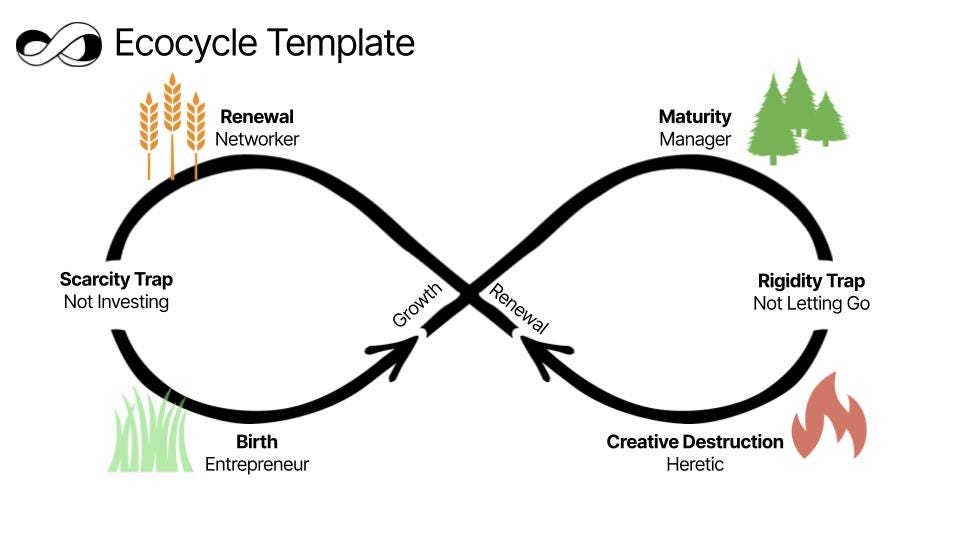
My sense is that the conversations that Mark, Rodney, Sam and others bring to the table are signs that perhaps we are in a phase of Creative Destruction. It’s healthy to notice what has worked as well as what needs to be composted. Let’s take the teal movement, for example, that spun out of Laloux’s book when it was published in 2014. For the ten-year anniversary of Reinventing Organisations, The Teal Team tried to map the teal movement cycle onto a graph (see below). There was definitely a hype phase – Zappos adopting Holacracy, Buffer publicly adopting teal – and then a backslide – Zappos slammed in the press for its ultimatum, Buffer abandoning teal, Medium abandoning Holacracy. During the COVID-19 pandemic, many companies struggled. Although the movement was galvanised by global conferences like Teal Around the World and some teal organisations even flourished during the crisis (like Ian Martin Group), it definitely marked a turning point. People had bigger fish to fry. But with Bayer announcing its Dynamic Shared Ownership ambition in 2024, and communities like the Corporate Rebels growing, could we tentatively say interest is starting to pick up again?
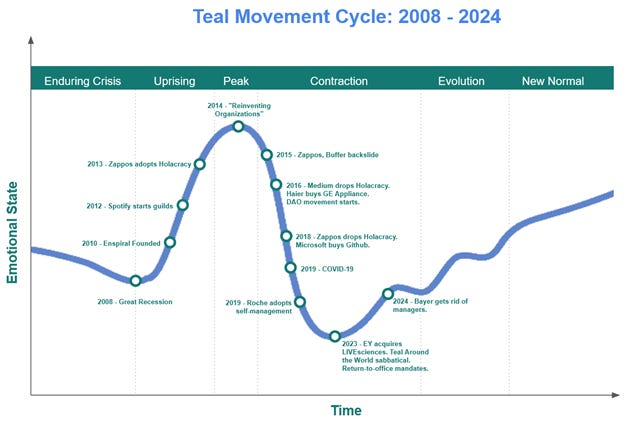
Again, if we think of the movement as less of a line and more of an ecocycle, there are important lessons we can harvest. Some experiments (like Buffer’s) were never given the chance to mature into the next phase of the cycle, with the founders abandoning teal after less than a year. Though, to be fair to them, back then we didn’t have the benefit of more than a decade’s worth of learning about how to apply teal principles for transformation and traps to avoid – learning which Laloux himself has put into more than one hundred videos and now a masterclass. Plus there are now hundreds of examples of organisations practising decentralisation in different countries, sectors and at different scales. As these organisations mature, we are learning things like that it’s OK, and sometimes necessary, to temporarily re-centralise during a crisis, thanks to organisations like Viisi and Vertia, and research by academics like Michael Y. Lee. And we have more understanding of what it really takes to work in this way, and the balance of the structural and inner work that’s needed (see also some of the great research being done by Perttu Salovaara and Veiko Valkiainen).
I try to be aware of when I get stuck myself in the Rigidity Trap. I never want to be dogmatic. Years ago I would have preached that self-management is for everyone and hierarchy is evil. Now I am much more of an advocate for conscious organising. If being structured in a pyramidal hierarchy works for your organisation, your purpose, and your people, great. More power to you. If you feel it’s limiting you, hindering you from achieving your collective aim or harming others and you believe there is greater potential in exploring a more decentralised structure, great. If you need to change course at some point, also fine! And I have learned so much about the importance of how we relate to power and hierarchy. Both concepts are neither good nor bad, and to pretend they don’t exist, even in a decentralised organisation, is hazardous.
To answer the question of whether the movement failed or not depends on what your criteria for success are. I’ve never been under the impression that Radically Decentralised Organisations would end up being the norm. Certainly not in my lifetime. But I’m also reminded of something my colleague and mentor Karin Tenelius told me. She was an early pioneer of self-managing organisations in Sweden back in the nineties, and by the early 2010s was almost ready to give up on the world ever believing that this way of organising was possible. She’d spent a decade writing about her successful transformation cases and talking about them at conferences only to be met with scepticism and sometimes even hostility. And then Laloux’s book came out and sparked a new phase of the movement. Suddenly, she had years of expertise and lived experience that people were interested in. And thus the cycle continues.
When Mark published his blog about self-management being a rare bird, I made a note of a beautiful comment that another friend of mine, Simon Bettighofer from the UN, shared in response:
“In evolution, most new species appear long before the environment fully supports them; their survival depends on patience, persistence, and timing... At the same time, self-management may not even need to dominate or spread widely to have influence. Some species thrive quietly in niches, yet still shape the evolution of the whole ecosystem (like coral reefs that support vast marine diversity despite covering a small fraction of the ocean floor). In the same way, self-management might never become the dominant organisational form, but its traits like trust, distributed authority, and intrinsic motivation could gradually blend into other models, creating more ‘hybrids’ over time. So a next stage might not be pure self-management, but organisations integrating elements of this DNA (shared leadership, participatory decision-making...) within their systems…”
I think what these failure posts offer us is an opportunity to learn from our mistakes – where we tried to install new ways of working like a shiny new app, or killed the experiment too quickly, or didn’t replace centralised structures with clear alternatives, or neglected to design the relational infrastructure to support people with the metaphorical growing pains. We can also learn from the places where the movement is still stuck. What is missing and what is needed for these ways of working to flourish, even when the external circumstances are adverse? What are the prerequisites and how do we know when they are absent?
Ultimately, I am in favour of anything that helps us be more clear-eyed in the choices that we make. It’s why I try to write and podcast about the hazards along the way, and the elements that are worth considering before embarking on a transformation journey. Knowing the risks and the challenges doesn't mean losing faith. If anything, it can instil a stronger commitment to doing this work honestly, pitfalls and all, and sharing what we learn along the way.
So personally, I don't think the movement failed. If we really are in a phase of Creative Destruction, then maybe it's like a forest after a fire – parts of it untouched and still growing, others scorched and unlikely to recover, and some seeds that only open in the heat. What I do know is that we are learning more now than we ever did during the hype phase. Let's see what has grown in another ten years.
Hi, if we haven’t met yet, I’m Lisa Gill. If you liked this post and want more:
No posts
Comments
Nothing yet. Say the first thing.
Sign in to join the conversation.