
This is the moment in the academic year when professors feel all the feelings: grief to lose our dear graduating students, anxiety about all the grading yet to do, and excitement about summer plans. My first job this summer: finish the manuscript for Refugia Church. I’m getting close!
Also: spouse Ron and I shall attempt to undertake various crazy schemes around the yard. I’ll share some schemes in future newsletters. Will we get a water feature built? Stay tuned.

I’m seed starting some native plants this year as well as vegetables. These are teeny-tiny black-eyed Susans that I had to “cold stratify.” Thanks to Rebekah Novak for showing me how to do that. Look, Rebekah! They’re germinating!
Meanwhile, I’m pleased to share with you this recording of my interview with Bishop Marian Budde of the Episcopal Diocese of Washington, DC. Bishop Budde joined us for a Third Act Faith event focusing on our theme this year: interfaith friendships. We have been exploring how interfaith friendships can strengthen our work on climate and democracy. We all came away from the event with a sense of deep refreshment, thanks to the bishop’s wisdom and gentleness. If you would like to read an elegant summary of the evening, visit the Going Deep Newsletter at the Third Act Faith website.
Eesh. Sorry about that ridiculous smirk on my face in this video thumbnail!
Finally, we tried the Refugia beer! With the beaver on the label! Thanks to Speciation Cellars for inventing this craft brew with—as I mentioned before—zero input from me. The verdict: it’s good! It’s a “tart saisson” (translation: farmhouse ale) with hints of cinnamon and plum. I don’t even like beer much, but this was quite good. Here we are enjoying it with some of our Refugia D.Min. cohort.
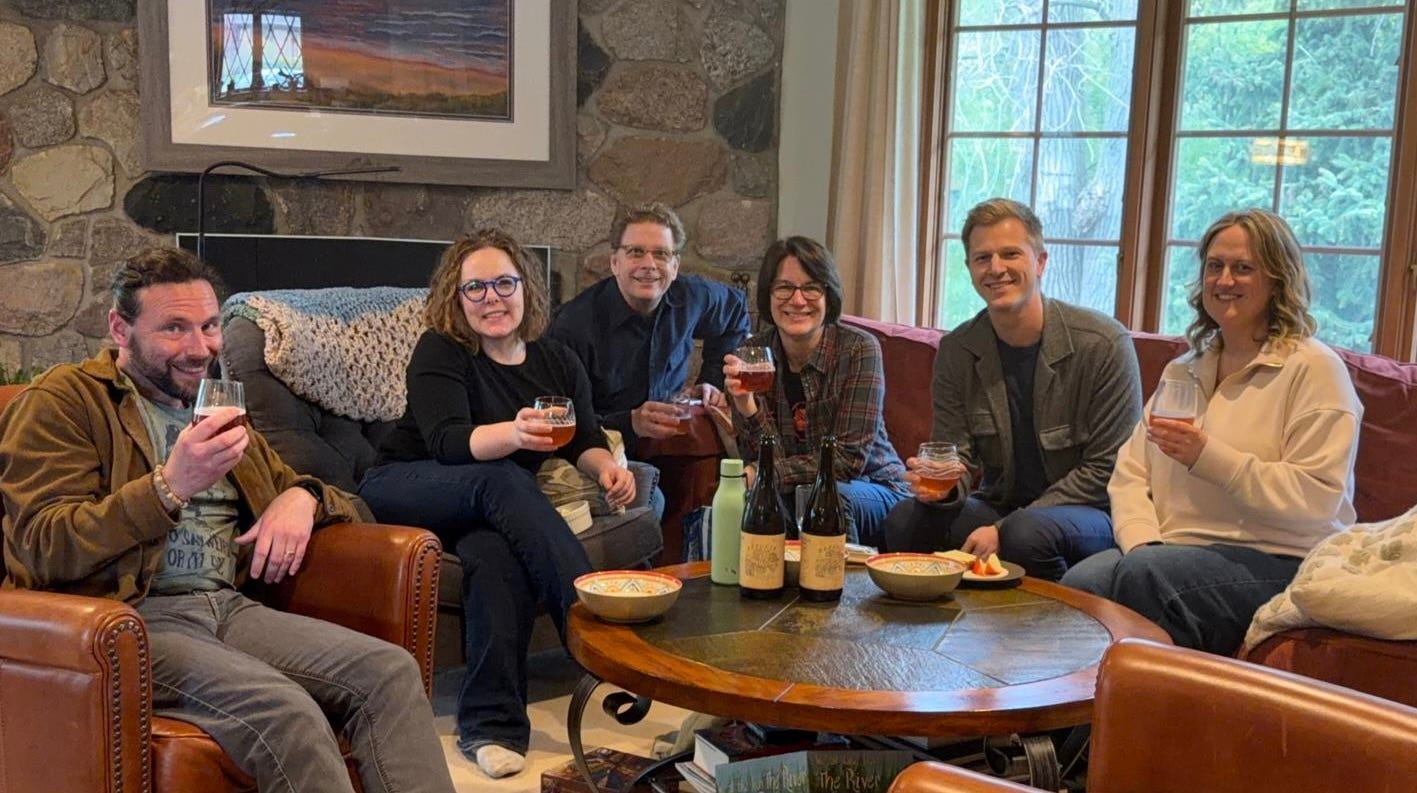
All the reverend doctors (not me, I’m just a doctor): Dave, Betsy, spouse Ron, me, Paul, and Dani, who is receiving her doctoral degree today. Hooray!
It’s been another couple of rough news weeks in the U.S., so I’m going to try to expand our vision to the rest of the globe and see if we can gather strength from some good developments. Let’s begin with the first international conference specifically on “transitioning away” from fossil fuels, held in Colombia last weekend. This conference, as you might recall, came out of the last COP in Brazil, when a number of countries decided they were fed up with COP stalemates and lack of action. The huge COP gatherings leave a lot of the negotiating power in the hands of petrostates, creating a power imbalance that blocks meaningful action.
So 57 countries gathered in Santa Marta, Colombia, (China, Russia, India, and the US were not invited) to discuss practical pathways and create discussion processes that correct some power imbalances. Daisy Dunne for Carbon Brief summarizes:
Against a backdrop of war, a global oil crisis and worsening extreme weather events, ministers and envoys from across the world sat side-by-side in small meeting rooms to have open and frank conversations about the barriers they face in transitioning from fossil fuels to clean energy.
This new format—devised by co-hosts Colombia and the Netherlands—was described as “refreshing”, “highly successful” and “groundbreaking” by countries attending the talks.
They’re going to do it again next year, with Tuvalu and Ireland hosting. Tuvalu is one of those tiny island nations fighting to remain above water, literally.
This year’s event was focused on better process as the point, but they did announce three “workstreams” as outcomes to prepare for next year’s summit.
developing national and regional roadmaps away from fossil fuels
establishing a science panel for global energy transition, including working on financial systems that block transition
addressing fossil-fuel intensive trade.
This work will be done in parallel with COP, not as a rival to COP. From what I can discern, it seems like a much-needed “let’s get stuff done” boost adjacent to the COP structure.
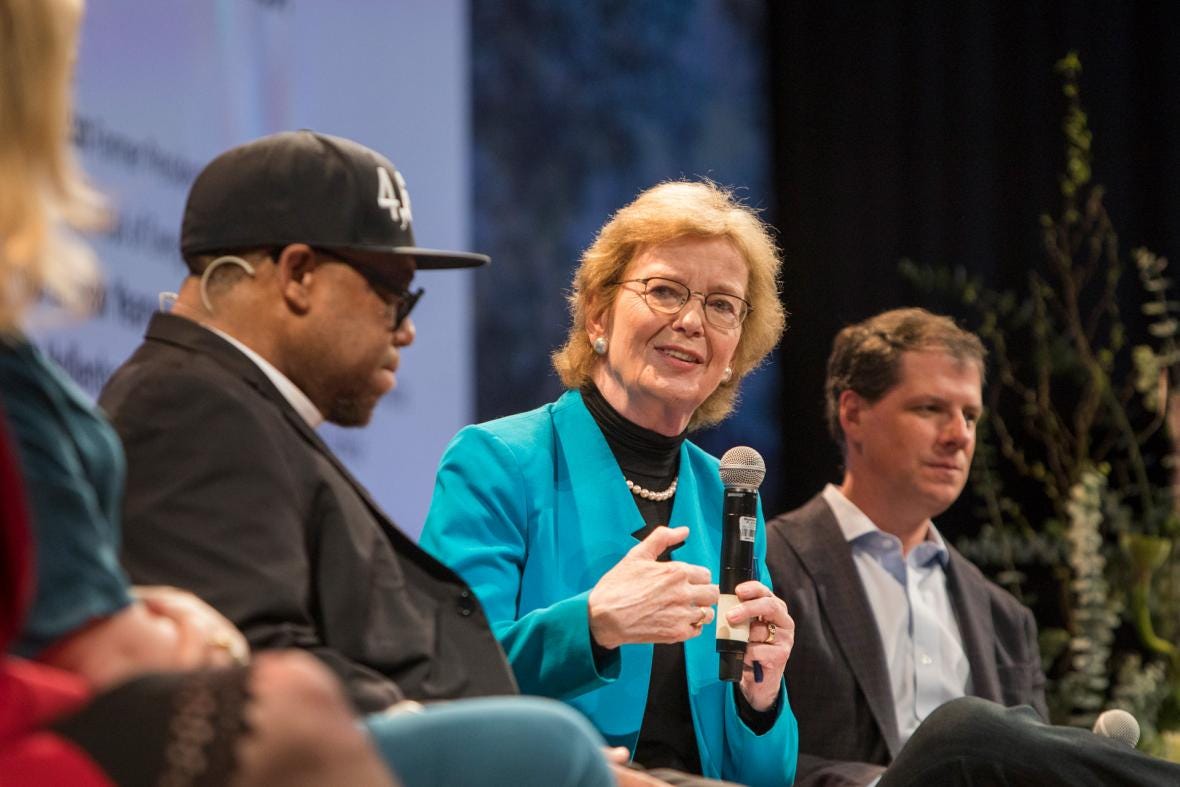
Elder and former president of Ireland, Mary Robinson. Image credit: The Elders/Bob Stender.
The venerable Mary Robinson, former president of Ireland and a member of the global Elders, spoke at a pre-conference webinar and had some pointed things to say about our historical moment (as reported by Bob Berwyn for Inside Climate News):
[Robinson] said the erosion of international law and the global economic impacts caused by the Iran war shows why a just transition into renewables is now “a security imperative.” The second major energy shock in just four years isn’t just a wakeup call, she added, but “a clear signal that our energy systems need urgent structural change.”
Yes, please. I see this Colombia gathering and impressive list of people involved as hugely encouraging developments.
In other cool news, this year’s Goldman Prizes all went to women! These women are climate justice heroes taking on powerful governments and corporations to protect people and the more-than-human world. Liz Kimbrough reports for Mongabay:
Six environmental activists from around the world will be awarded the Goldman Environmental Prize on April 20. Known as the “Green Nobel Prize,” the Goldman Prize honors activists from the six inhabited continental regions. In a historic first, all six winners are women.
This year’s winners fought to protect a rare bat in Nigeria by training community members to prevent wildfires; won a court ruling in South Korea forcing the government to set stronger climate targets; stopped an oil drilling project in the U.K. after a decade of legal battles; pressured a global mining giant to clean up a toxic abandoned mine in Papua New Guinea; blocked the largest proposed open-pit mine in North American history in Alaska; and helped prevent commercial fracking from taking hold in Colombia.
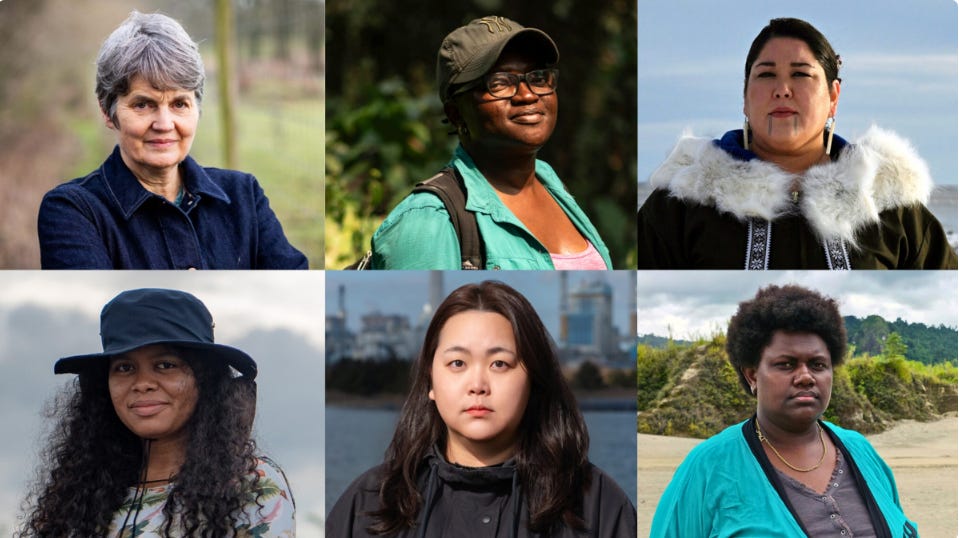
The 2026 Goldman prize winners are Iroro Tanshi from Nigeria, Borim Kim from South Korea, Sarah Finch from the United Kingdom, Theonila Roka Matbob from Papua New Guinea, Alannah Acaq Hurley from the United States, and Yuvelis Morales Blanco from Colombia. Image and caption from Mongabay.
There’s more good news from around the globe coming in our Deeper Dive today, but first let’s look at the wind energy scenario in the US. What are we up against? Maria Gallucci of Canary Media sums up the anti-wind shenanigans the current regime has been trying to pull:
Over the last year, the Trump administration has repeatedly sought to block wind development in U.S. waters by freezing leasing, halting construction on in-progress wind farms, rolling back tax credits, and attempting to rescind key permits. Federal judges have struck down several of those efforts in recent months. Now, the administration is trying a different tactic: paying developers to walk away.
In good news, the “stop-work” orders that stalled five huge offshore wind projects off the coasts of Massachusetts, Long Island, and Virginia, are rescinded, and it looks like the government is giving up on fighting this further in court. Jake Bittle writes for Canary Media:
[Interior Secretary Doug] Burgum had vowed to fight back, but last week, the department quietly let the final deadline for appealing the courts’ decisions lapse. The move means construction of the nation’s first five major wind farms along the eastern seaboard can continue absent a change in the case. When complete, the wind farms will generate enough electricity to power well over 2 million homes.
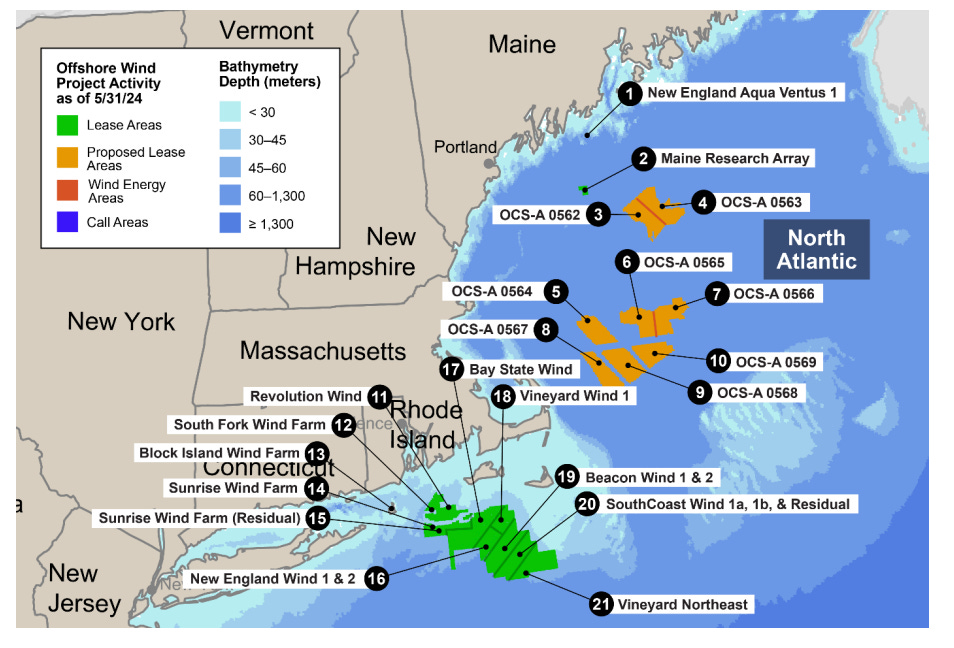
North Atlantic offshore wind projects in the production pipeline as of August 2024. Image credit: Offshore Wind Market Report: 2024 Edition, National Renewable Energy Laboratory, via Stateline.org.
Another court ruling last week shut down some of the Trump team’s permitting delays, tangles, and shenanigans. Brad Plumer reports for the New York Times:
A federal judge on Tuesday blocked the Trump administration from enforcing a series of decisions that wind and solar developers say have throttled hundreds of renewable energy projects across the country.
So that’s good news, too. Now for some bad news: another company is trying to get one of those nice, juicy US government bribes to forfeit their leases for wind developments off the US coast. Remember the $1 billion of taxpayer money being paid to TotalEnergies? Well, Engie wants some, too. There are, of course, legal questions to wrangle. Is it even legal for the US government to do this? More fun stuff to hash out in the courts. Sigh.
But back to good news! (We do seem to undergo news whiplash every day, don’t we?) The top-shelf energy research group Ember released their annual Global Electricity Review for 2026. Friends, the report offers encouraging findings, and the climateratti are all over it. Here’s Ember’s main headline:
Record solar growth meant clean power sources grew fast enough to meet all new electricity demand in 2025, thereby preventing an increase in fossil generation. This was the first year since 2020 without an increase in electricity generation from fossil fuels and only the fifth year without a rise this century.
Right? This is a fantastic milestone. Get ready for some pretty graphs!
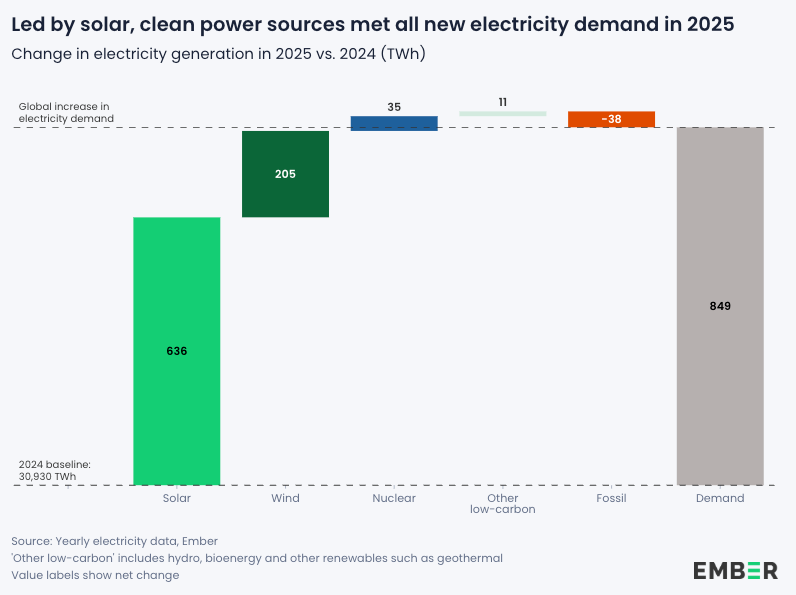
There’s more. This milestone reflects a continued massive upsurge in solar capacity growth—that is, growth in the amount of energy we can generate with solar:
It was only the third time ever that a source increased by more than 500 TWh in generation in a single year. For the fourth year running, solar recorded the largest absolute growth of any electricity source.
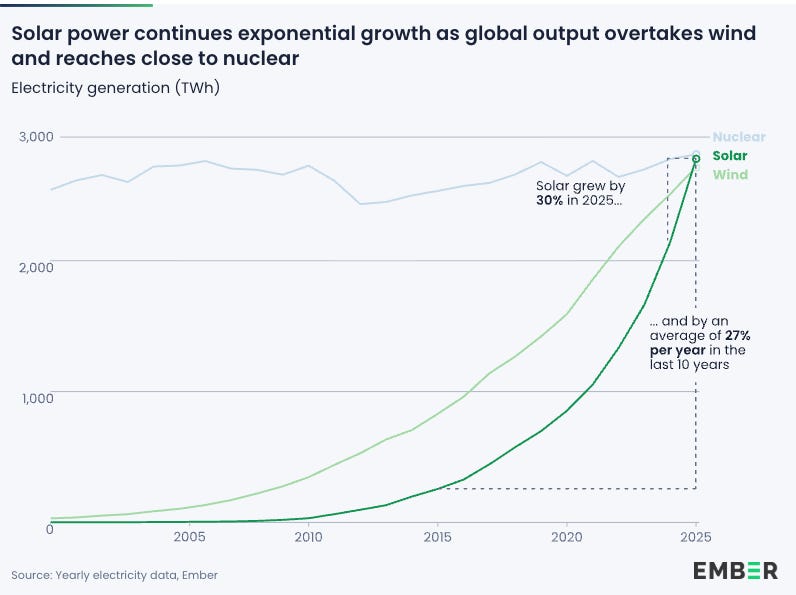
Another pretty graph. See those lovely upward slopes? That’s wind and solar.
But what about China and India, you say? Aren’t they still the bad guys, using all that coal and other fossil fuels? Actually, less and less. They are building out wind and solar at incredible rates, and thus:
This was the first year this century that fossil generation declined simultaneously in both China and India, two of the world’s three largest power sector emitters.
There are so many happy graphs in this report. I’ll offer one more, and then some places to go for more detail. Take a look at this prediction, based on conservative extrapolations:
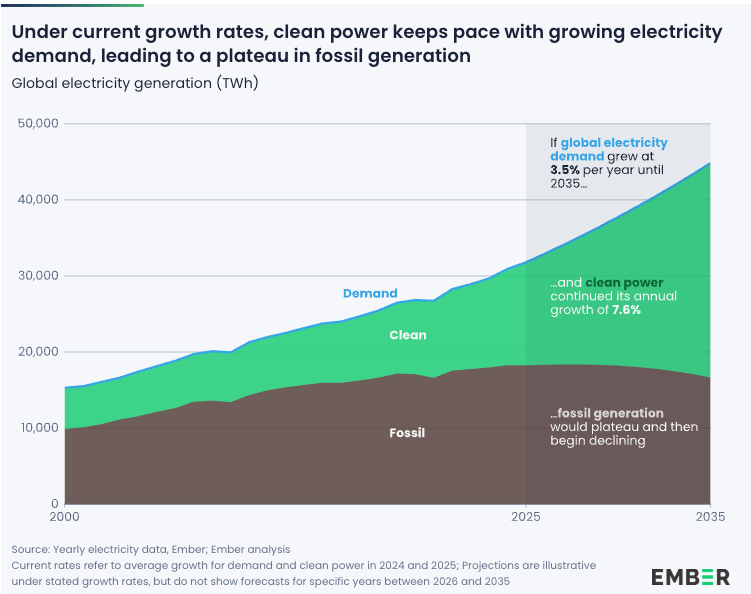
I think… I think we are turning the corner now? Even in the US, we are seeing graphs like this:
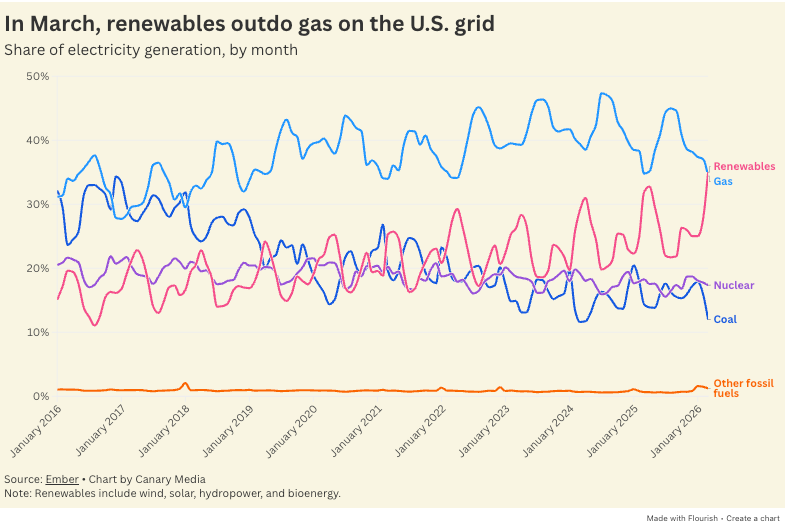
See that little pink line? See where it intersects with the icky blue line? Pink line go up, blue line go down. Image credit: Canary Media.
OK, if you want more, you can find the actual Ember report here. Carbon Brief sums up the highlights in a shorter read, as does The Guardian. If you would rather get into the wonky details while you’re driving or cleaning or otherwise busy with your hands, you can listen to this excellent Volts podcast episode in which host David Roberts interviews the two lead report authors from Ember. Finally, if you like to get your global energy updates while you’re on the treadmill, watch this video from the excellent and entertaining Simon Clark. He walks you through the report with lively commentary.
Today’s sighting features a town in North Carolina that exemplifies what local leadership can achieve in creating the future they want. Enfield, North Carolina, just got a grant for $300,000 to build a shared geothermal system that will heat and cool a whole neighborhood’s worth of buildings. This is a key piece of their visionary master plan. Elizabeth Ouzts reports for Canary Media:
Since late 2023, [Mayor Mondale] Robinson and the team who formed the Enfield nonprofit have been holding town hall meetings to vet and refine their ambitious goals for low-cost energy independence. Their plans include a town-run solar farm, a weatherization hub to help residents access grants for insulating their homes and upgrading appliances, and a revamp of the town’s dilapidated grid, which suffers frequent outages.
The geothermal project, called a thermal energy network, is part of this larger vision. The pilot project would serve an upcoming affordable housing development that Robinson is spearheading, made up of 34 townhomes in southeast Enfield. Eventually, the group hopes to expand the geothermal network to the entire town of some 2,000 — providing a sizable chunk of the community’s energy needs. [some bold original]
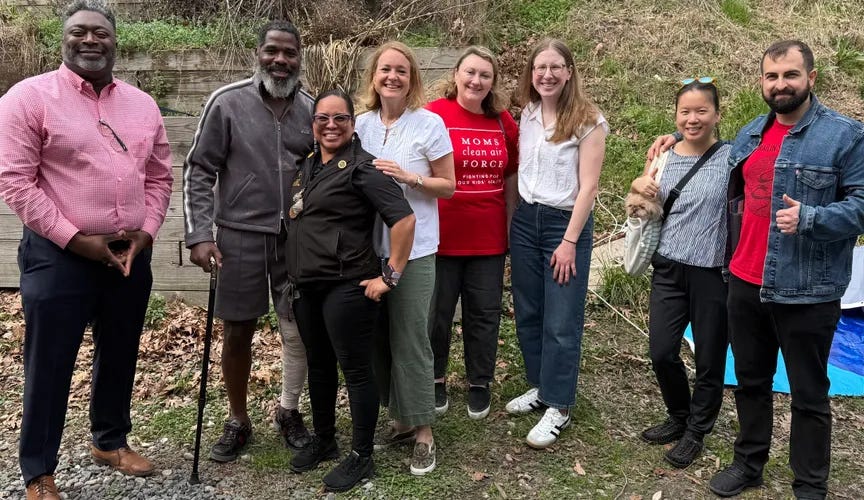
Image and caption from Canary Media. “From left, Willam Munn, Mayor Mondale Robinson, and other members of the team behind Enfield, North Carolina’s clean energy vision (Courtesy of Helen Whiteley, fourth from left).”
The mayor and his team are keenly aware that their work could become a model for dealing with environmental justice issues in their region:
The thermal energy network, he said, could serve “as a model for what’s possible in rural Black spaces, throughout the Black Belt in North Carolina and the South at large.”
The town is working the system, despite the rollbacks on IRA tax credits. They’re going after the geothermal tax credits that survived the purge. Plus they’re getting that $300,000 grant from philanthropic foundation BuildUS. Their plan involves improving water infrastructure and creating local jobs while they’re doing this energy transition. All wins for a small town used to neglected infrastructure, shockingly high energy bills, and power outages.
Enfield is a great example of refugia experimenting: adaptability amid crisis toward a more resilient future, modeling a way forward for others.
Thanks to reader Mavis Moon who sent me a tip on some beaver-related media. This podcast episode of RadioLab, “The Builders,” features our industrious, waddly friends. The podcast is for kids, so it’s pretty… high-energy, let’s say. But it’s fun! And packed with good science about beavers. They even use the term refugia!

One more pleasant photo for you. This is one of many I took while walking the beach at Lake Michigan a couple weeks ago. Enjoy.

I really cannot get enough of sand textures. Is that weird?
I hope you can find deep wells of consolation as well as some sparks of good energy in the weeks ahead. Thanks for reading. Till next time, be well.
Note: As always bold type in quotations is added unless otherwise indicated.
No posts
Comments
Nothing yet. Say the first thing.
Sign in to join the conversation.