
A protest vote is a forgiving thing. It does not ask the politician for a platform. It asks for one quality only, that they are not them, the dreaded political class, and for the last 10 months, Pauline Hanson has successfully portrayed that. Until now.
This week’s National Press Club speech changed that. For the first time, we were given a clear glimpse of what the real world will look like, with the potential of Hanson having some control over government policy.
She told the room she would abolish the SBS: “The SBS will be gone”. She told the room, the country cannot be multicultural, that “we must be monocultural”. She told the room the ABC in the cities would survive only as a subscription service. And asked to account for her own record on wages, she sided with employers, called workers lazy, and demanded they be made easier to sack. These are no longer moods or feelings. They are positions, and positions can be measured against the lives of the people lending her their vote. And they can be held to account by her opponents.
Her lead is built on the softest layer
Start with what her surge is made of, because it is the whole point of her rise to political stardom. One Nation’s vote is not one movement, it is two bolted together. There is an old founding base that came to Hanson on identity, asset-secure, older, living in regions hollowed out by a generation of service decline. That base is hers for a generation and no policy counter will move it. Then there is a newer cohort, the late movers, who arrived after Bondi on grievance, security and the cost of living. They are still mortgaged, sandwich-generation, squeezed and animated by a world that has broke them, emotionally and financially.
Her lead, her stardom, heavily relies on that second, newer, softer layer. The timeline below shows when each group arrived. The base built the floor. The late movers built the lead. And the late movers are renting her support, because the thing that brought them in, economic pain, is precisely the thing Hanson’s own platform makes worse.
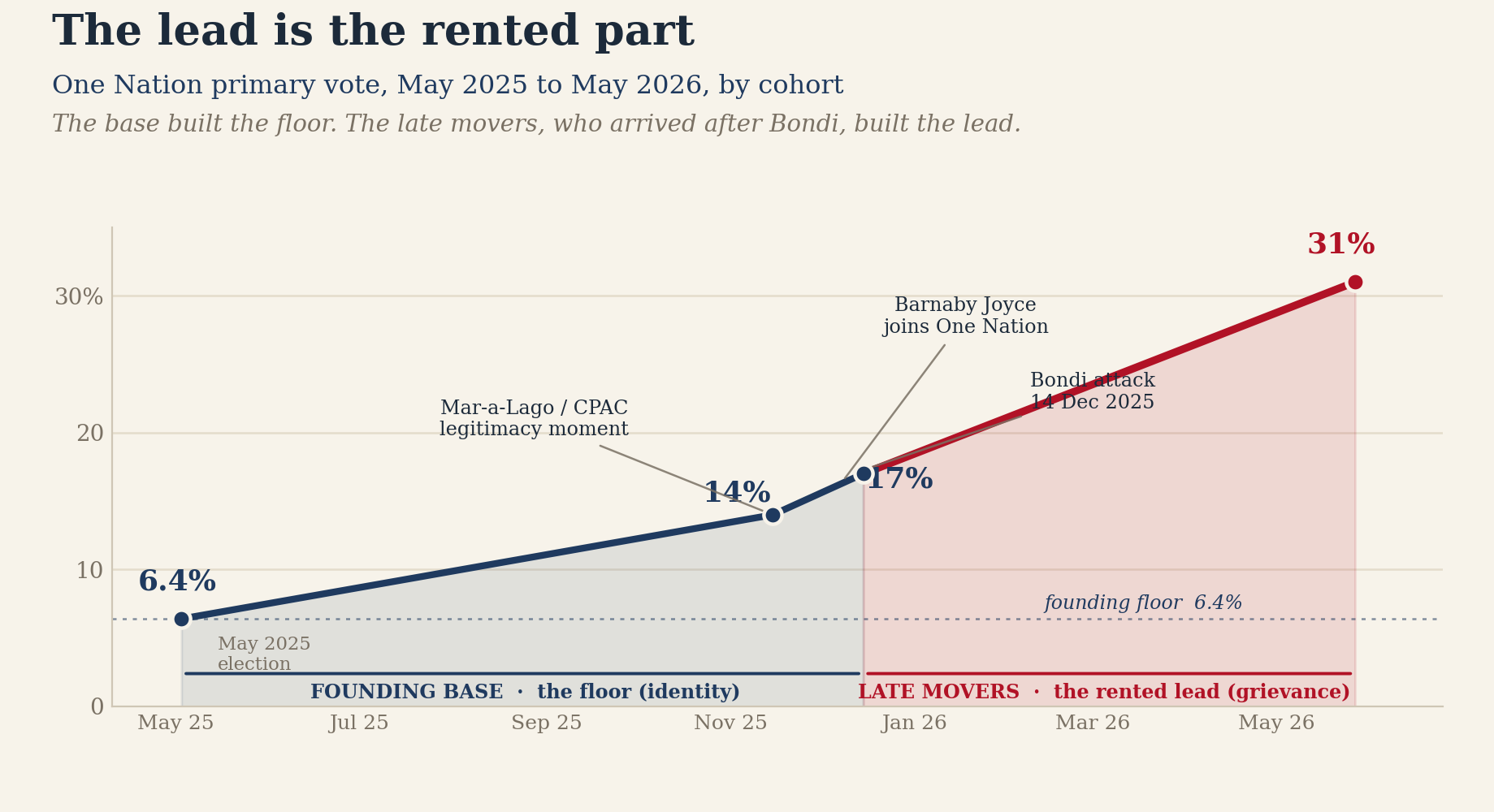
Figure 1. One Nation primary vote, May 2025 to May 2026, annotated by cohort. Readings: 6.4 per cent (May 2025 election), 14 and 17 per cent (Roy Morgan, late 2025), 31 per cent (RedBridge / Accent Research for the Australian Financial Review, May 2026).
The Press Club speech is the first time those late movers, her renters, could read the contract they signed. They may be pleased that it’s actually not real a contract, nor is it a lease.
Industrial relations: the load-bearing crack
Halfway through the address a banner came down in the room accusing her of opposing pay rises for workers. It was treated as a stunt. It was also the single most accurate sentence spoken at the Press Club that day, and Hanson used the question session to prove it. Asked to account for her record, the votes against minimum wage increases, against same job same pay, against the criminalisation of wage theft, she did not retreat. She moved the question from the worker’s side of the ledger to the employer’s, citing a business owner facing higher costs and asking whether business could afford to pay, and then went further.
Pressed on workplace law, she defended making staff easier to sack. You cannot get rid of anyone anymore, she said, and the fault lies with the workers themselves: on their phones, not turning up, in her own word, “lazy”. That is not an offhand aside in a doorstop. It is her considered position, delivered at the National Press Club, and it is consistent with One Nation’s record in the Senate, where the party has repeatedly voted for easier dismissal and against turning casual work permanent. The pay-rise banner did not misrepresent her. It summarised her.
Now line that up against the cohort holding up her lead. The late movers are wage earners. They are mortgaged. Their entire grievance is that the household budget no longer breaks even. And the policy Hanson is offering them is one that makes their job easier to lose and their bargaining position weaker. She is not standing with the wage earner. She is standing with the employer who wants to cut their wages. The “bloke in the corner store” she keeps invoking is the owner, not the worker behind the counter, and the irony here? It’s worker that provided her the lead.
The monoculture misstep
Then the cultural turn. “We must be monocultural” is a clean line for a base that wants one. But look at the map of her own growth. A small but meaningful share of the late surge sits in outer-suburban seats that are among the most diverse in the country, places where a third or more of households speak a language other than English at home. Those voters came to her on rent and groceries. They did not come to be told that the culture they live, preach and build family and community with, is a problem to be dissolved. The moment the grievance vote hears itself described as the thing that must disappear, the grievance detaches from her.
Multicultural Australia is not a slogan, it is an infrastructure: community language schools, ethnic associations, in-language press, the Greek and Italian and Vietnamese and Arabic and Mandarin institutions that have done the hard work of settlement and cohesion for fifty years. When a leader says the nation must be monocultural, she is not describing a mood. She is describing her target. The next two commitments show what the target looks like as a budget line.
“The SBS will be gone”
Hanson justified abolishing the SBS by saying the internet has made it unnecessary. Put the detail behind the sentence. SBS Audio is the most linguistically diverse public broadcaster in the world. It carries news, current affairs and settlement information in 68 languages. It speaks to the nearly five million Australians who speak a language other than English at home. That’s a lot of votes!!. It began in 1975 as two stations, in Sydney and Melbourne, set up to explain Medibank to migrants in their own languages, and it has grown into a network that delivers trusted information in more than sixty tongues to communities that have no other source for it in a form they can fully understand.
Each of those language services is a newsroom and, for a lot of people, a lifeline. It is how an isolated grandmother learns what a government policy means. It is how a newly arrived family is told their rights at work, how to enrol a child in school, where to go in an emergency. “The internet has overtaken it” is not an answer to any of that, because the people these services exist for are often the least equipped to find reliable information in English on a search engine. Abolishing the SBS does not modernise anything. It switches off in-language public information for the exact communities the monoculture line had already put in the frame.
And it takes the World Cup with it
There is a second casualty that reaches well beyond migrant Australia, and it is the one that should worry her strategists most. The SBS is the free-to-air home of the FIFA World Cup. It is where the Socceroos and the Matildas are watched, free, by audiences in the millions. The same network carries the Tour de France and a long list of world sport that ordinary households watch for nothing. Abolish the broadcaster and you do not just lose a channel, you put the most-watched free sport in the country at the mercy of whoever buys the rights next, and in practice that means behind a paywall.
Sit that beside the rest of the package. Hanson’s pitch is that she is the voice of the forgotten viewer in the suburbs and the regions. Yet the concrete effect of her media policy is to take the free World Cup off that viewer and hand it to a subscription service that the big end of town can afford and the household on one income cannot. It is the same instinct as the industrial relations position, she sides with those who can pay or employ.
A subscription ABC says the quiet part
Which brings us to the ABC. Hanson would keep it for the bush and shut it behind a paywall in the cities, where it would “only be a subscription service”. Strip away the grievance about bias and look at the mechanism. Free, universal public broadcasting, available to every household regardless of income, becomes a product you buy. The pensioner in an outer-suburban unit who cannot afford the streaming service, loses the free service. The household already skipping meals, and Hanson spent a long passage of her own speech describing exactly those households, loses it too.
Three times now the same hand shows. Easier sackings. A subscription World Cup. A subscription ABC. In each case the thing that was universal is made available to those who can pay and withdrawn from those who cannot. For a party whose entire brand is the ordinary battler against the elite, it telegraphs, again and again, that when the choice comes she sides with the big end of town, as she did on industrial relations and as her rhetoric against working people keeps confirming.
The exposure the speech did not contain
Everything to this point came out of her own mouth at the Press Club. But the speech is only half her exposure. Two larger vulnerabilities sit outside the transcript, carried into every room she enters, and a disciplined opponent reaches for these first, because they do not depend on the public remembering a single day’s answers. The first surfaces as an absence, her record on violence against women. The second is the one that should frighten her most, the steady Americanisation of the whole project.
The constituency she did not mention
For roughly twenty-four minutes Hanson catalogued the victims of modern Australia: the renter, the pensioner, the young person locked out of housing, the family at the food bank. It was, in places, genuinely affecting. One group never appeared. In a speech about who is being failed, there was not one word for the more than one in four Australian women, 2.7 million of them, who have experienced violence or abuse from a partner.
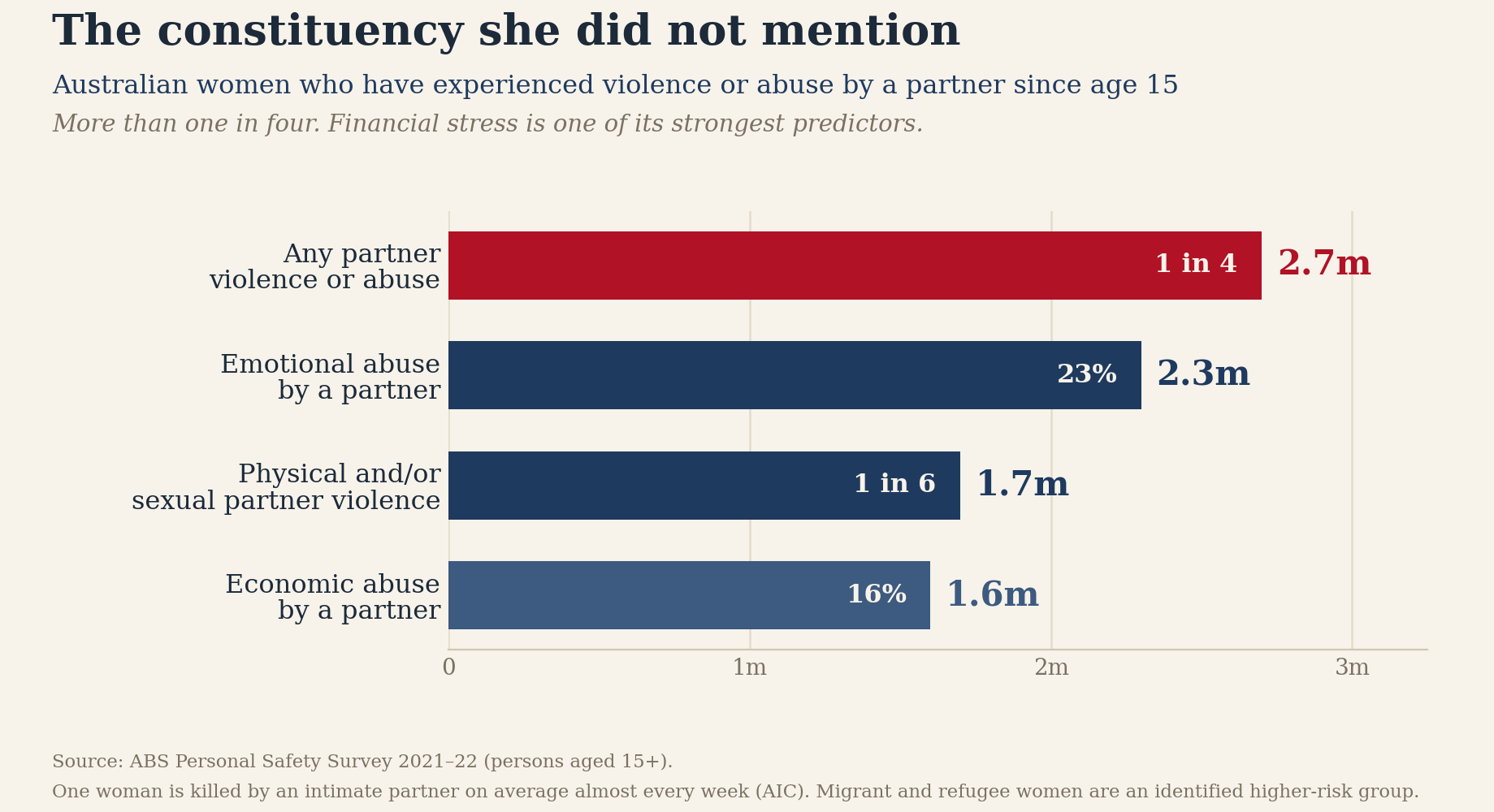
Figure 2. Australian women who have experienced partner violence or abuse since age 15. ABS Personal Safety Survey 2021–22.
In 2019 she told national radio that some of them are, in her words, “nothing but liars” who weaponise abuse claims in the family courts, offered her own son’s custody case as evidence, and referred reporters to men’s rights groups when asked to back the claim up. On the strength of it she was made deputy chair of a parliamentary inquiry into the family law system, by the then Morrison government, an inquiry widely understood to have been driven by her assertion that women routinely fabricate abuse to gain an edge over men. Her party still campaigns on the line that the response to domestic violence is too fixed on women as victims and men as offenders. Her Senate colleague Malcolm Roberts has gone further, suggesting the family court drives men to “lash out in violence”. This is not a leader who forgot to mention the most exposed women. It is one who has already decided to doubt them.
That makes the rest of the platform worse, not merely silent, because it is the same subject. The strongest predictors of a woman’s exposure to partner violence include financial stress and economic dependence, the very conditions an easier-sacking, weaker-wage agenda manufactures. The women most at risk are disproportionately those without their own income, or held in a household by the cost of leaving it. Migrant and refugee women are an identified higher-risk group, and they are the same women who rely on in-language services, including the SBS information she would abolish, to learn that a safe option even exists. One woman in Australia is killed by an intimate partner on average almost every week.
So trace the package through and it does not just overlook the 2.7 million. It doubts them when it speaks, and it raises their exposure when it acts, on three fronts at once: the wage insecurity that traps them, the removal of the in-language lifeline that informs them, and the cultural pressure on the very communities where the higher-risk among them live. The constituency she did not mention is the constituency her platform hits hardest.
America First
The second vulnerability is bigger than any single policy, because it is about what One Nation has become. Over the past year the party has been remade in the image of the American right. It tells voters plainly that if they want Trump’s action and style, One Nation is the Australian version. Late last year Hanson flew on Gina Rinehart’s private jet to speak at CPAC inside Trump’s Mar-a-Lago, the same legitimacy moment that sits on the timeline above, and stayed for the President’s Halloween party. This is not a domestic protest movement adapting to local grievance. It will be argued by her opponents that this is an Australian franchise of an American one.
And the franchise has a problem, because the man at the head of it has spent the past year treating Australia as a target rather than an ally. In January he disparaged the fallen soldiers of America’s allies, prompting the RSL and Australian veterans to condemn what they called a profound insult. He has placed tariffs on Australian steel, aluminium and pharmaceuticals, taxing the exports of a country that runs a trade deficit with the United States and holds a free trade agreement with it, treating a close ally like an adversary. And during this year’s war on Iran he singled Australia out by name, “Australia didn’t help us”, even as Australian personnel were in the theatre, while the crisis he was prosecuting drove up the price at the bowser here. Hanson’s answer to a president who insults Australian veterans and taxes the people who employ Australian workers has been to praise him and to sell his cap.
This is the vulnerability a serious opponent reaches for first, and it is the Coalition, not Labor, that can wield it most cleanly, because it requires no move to the right. The line writes itself. One Nation is no longer an Australian party with Australian concerns, it is the local outlet of a foreign movement, loyal to a president who has insulted our veterans, taxed our exports and dismissed us by name. That framing does what an argument about economics cannot. It places Hanson outside the Australian mainstream, not by moving to her right but by exposing her foreignness, and it hands the late movers, who came on rent and groceries and never signed up for a foreign war, the fuel prices it brought, or a culture war besides, a clean reason to leave. Better still for her opponents, the whole Coalition can prosecute it, because nothing in it divides their party room.
Why the late surge is the one that gets nailed
Put the two figures side by side and the strategy writes itself. The founding base is insulated. It is older, asset-secure, identity-bound. Easier sackings do not frighten a retiree who owns the house outright. A subscription ABC is an irritation, not a wound. The monoculture line is the whole point of their vote. None of this platform costs the base anything, and some of it thrills them.
The late surge is the opposite. It is mortgaged and wage-dependent, so the industrial relations position lands directly on it. It is concentrated in diverse, outer-suburban seats, so the monoculture line and the SBS cut land on it. It is the cost-stressed cohort where, statistically, the risk of family violence is most concentrated, so the silence on women, and the imported war on their choices, land on it too. Hanson has built her lead on the one layer of her coalition that her own program punishes. That is the real world the Press Club revealed, and it is not the unstoppable march the polls suggest. It is a lead resting on people she has now, on the record, told exactly where they stand with her.
The campaign that beats One Nation does not argue with the grievance. The grievance is real, and these voters have had it validated by results nobody can wave away. It does something narrower and far more lethal. It makes Hanson legible. It takes the positions she finally surrendered at the Press Club, the sackings, the paywalls, the silence, and it holds them up against the lives of the late movers until the feeling and her platform no longer match.
Comments
Nothing yet. Say the first thing.
Sign in to join the conversation.