
For many years, and particularly over the past six years, the predominant characteristic of programs related to inclusion or so-called DEI has been to operate on a paradigm of distinguishing one group identity from another, flattening many into binaries positioned as opposites.
It hasn’t been helpful. In fact, it has fueled division, emboldened bad-faith actors, and amplified silliness from the mouths of “influencers” who have captured the narrative of inclusion.
Those who considered themselves anti-DEI had never practiced any sort of organizational development beyond what they might have been required to do for compliance reasons when working for larger U.S. corporations. That didn’t stop them from taking an authoritative tone about what they perceived DEI to be. In the process, they collapsed anything related to it into a frame that met their objectives, be they attention, political expedience, or, for the most fervent anti-DEI actors, well-paying jobs.
In a system, there are parts and wholes. The relationship between those parts determines much of what transpires within that system. That is also contingent on the perspectives held by actors in the system and the distinctions they draw among those parts.
Interdependence exists whether we want it to or not. It creates the possibility for both collective opportunity and systemic failure. Which of those outcomes one gets depends on the diversity in the system, the rules of interaction and engagement, and how feedback is processed.
Donella Meadows said, “We can’t impose our will on a system. We can listen to what the system tells us, and discover how its properties and our values can work together to bring forth something much better than could ever be produced by our will alone.”
This is the nature of interdependence. Genuine transformation cannot be imposed on a system. It has to emerge from within it. Listening, discovering our respective properties and values, can work together for something much greater than a solo opinion, action, or individual aspiration can generate.
During the global pandemic and right after the death of George Floyd, the opportunity to address the ever-lurking vestiges of race and racism led to marches around the world. What came out of those marches was not a transformative way of talking, listening, and learning about race and its inevitable consequences and how we can make a shift. Rather, what emerged was a power vacuum that a few actors, mostly in good faith but not necessarily with deep discernment or wisdom about likely tradeoffs, began to fill.
The conundrum deepened as those who gravitated toward that vacuum, driven by a desire to be a voice for the voiceless and a stand against oppressive systems, failed to stop and consider their vision and who needed to be part of it. Many were animated by a quote from Frederick Douglass: “Power concedes nothing without a demand. It never did, and it never will.”
Share Reconstructing Inclusion
What wasn’t repeated, and likely wasn’t read by most using that quote to stir emotion, was the entirety of the August 3, 1857, speech. Perhaps one of the greatest speeches from one of the greatest human beings in world history, it was about the necessity of struggle. Written at a time when abolition efforts were accelerating among European countries (eight years before the passage of the 13th Amendment to the U.S. Constitution), particularly the British Empire, which had enslaved millions across the world, it told the story of the men and women, freemen and enslaved, privileged by the color of their skin and disadvantaged by it, who worked in solidarity toward the end of chattel slavery. He did not hold back on what that would take. The sacrifice, the inevitable struggle, the necessity of a conviction that might result in unrecoverable loss.
Douglass, naming those who had put everything on the line, said:
“Hence, my friends, every mother who, like Margaret Garner, plunges a knife into the bosom of her infant to save it from the hell of our Christian slavery, should be held and honored as a benefactress. Every fugitive from slavery who, like the noble William Thomas at Wilkes Barre, prefers to perish in a river made red by his own blood to submission to the hell hounds who were hunting and shooting him should be esteemed as a glorious martyr, worthy to be held in grateful memory by our people. The fugitive Horace, at Mechanicsburg, Ohio, the other day, who taught the slave catchers from Kentucky that it was safer to arrest white men than to arrest him, did a most excellent service to our cause. Parker and his noble band of fifteen at Christiana, who defended themselves from the kidnappers with prayers and pistols, are entitled to the honor of making the first successful resistance to the Fugitive Slave Bill.”
To read that passage now is to be stopped cold by the depth of what those people carried. The literal soul-in-the-game of those he names is beyond comprehension for most of us. It is a weight that should accompany any invocation of Douglass’ words.
What is also striking is that both those who support and those who oppose so-called DEI could find meaning in that speech. Douglass evokes Lajos Kossuth, who led the Hungarian Revolution of 1848 against the Austrian Empire. He references the grit of the Turks, who were knocked down repeatedly across 350 years of war with Russia, and kept rising. He invokes Daniel O’Connell, whose nonviolent mass mobilization and moral force efforts led to the Catholic Relief Act of 1829. The speech is clearly framed for the greater good of humanity.
And the passage that most needed to lead the anti-racism discourse of 2020 was not the kind of quote that ends up on signs or in social media posts. I wish it had been so. My belief is that it would have produced a more productive and unified way forward in addressing inequity. If the narrative about transcending our incomplete understanding of race and racism could have started with reading that speech in its entirety, we would be further along. Together.
Had the excerpt below served as the rallying cry, contextualized to the current day, the result would not have been contention, political bad faith, and a reinforcement of division. It would have set us up to address the inequalities now emerging through AI and the companies profiting from it, companies largely indifferent to who gets displaced in the process.
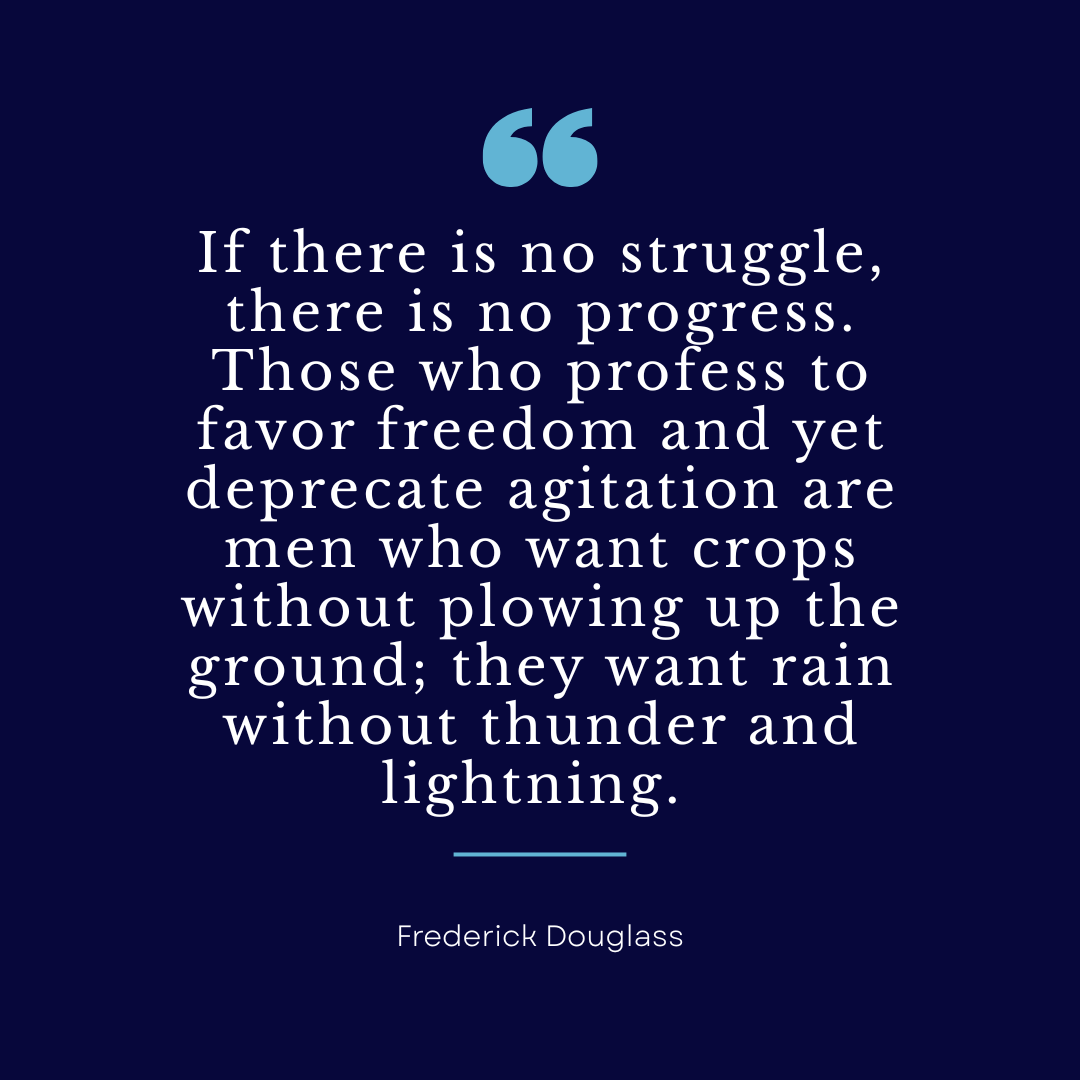
The passage that needed to lead said:
“If there is no struggle, there is no progress. Those who profess to favor freedom and yet deprecate agitation are men who want crops without plowing up the ground; they want rain without thunder and lightning. They want the ocean without the awful roar of its many waters. This struggle may be a moral one, or it may be a physical one, and it may be both moral and physical, but it must be a struggle.”
Here is the conundrum: the very work that both pro- and anti-DEI actors argue over must be practiced in an interdependent way to have any meaningful impact. There is no version of this that works any other way.
If the impact of so-called DEI was little more than legal risk mitigation, personal or political gain, with little to no genuine improvement in the lives of people, their communities, and the organizations they work within, then whatever persists from it will produce net negative results. There is no other probable outcome.
Whether anti-DEI or pro-DEI, interdependence is at play. Both sides are operating without recognizing that planetary existence, let alone inclusion, is a “We” thing. Not a both-sides thing. Something closer to a spherical reality, one where you cannot locate a “side” no matter where you stand.
We draw lines in our heads. In reality, the lines don’t exist. Fred Falker, who has joined me on the Reconstructing Inclusion podcast and will return for another episode, holds the philosophy that we are not divided by our differences; we are separated by distance. Using the nine-dot puzzle as a metaphor, he illustrates in his TEDx talk how our perceived limitations most often exist only in our minds.
Anti-DEI and Pro-DEI, and perhaps a third category of the simply indifferent, are caught in what Dr. King called an inescapable network of mutuality:
“Injustice anywhere is a threat to justice everywhere. We are caught in an inescapable network of mutuality, tied in a single garment of destiny. Whatever affects one directly affects all indirectly. Never again can we afford to live with the narrow, provincial ‘outside agitator’ idea. Anyone who lives inside the United States [or on the planet for that matter] can never be considered an outsider anywhere within its bounds.”
So-called DEI, as it was commonly understood and practiced from 2020 onward, was destined for its current state. The framing was too narrow, the coalition too thin, and the resistance to perspectives outside a particular anti-racist discourse left little room for the kind of broad engagement that transformation actually requires. Now, as the rhetoric of recent years faces mounting scrutiny, including more consistently from DEI advocates (other than me), there is a genuine opportunity to reframe.
It won’t come through legal mandates or training programs alone. It will require us to reckon with a conundrum co-created by all of us, rooted in the failure to acknowledge that our collective mental models have produced the current state of our organizations and institutions. The only way to transform those models is together.
Together doesn’t mean agreement. It doesn’t mean shared ideology. It means that people on every side of this issue become willing to recognize that the sides themselves are an illusion. An incomplete perception of human reality and the complexity of the systems we all inhabit.
We are constantly reinventing our perception of the system and nudging it in directions we rarely fully understand. The more we recognize how our perspectives are entangled with the perceptions of those we call other, the more we open ourselves to being influenced by them. That opening is where possibility lives. It is the move from clinging to a fragment of reality toward embracing the whole of it, with all the messiness that entails. To do that consistently and with intention is, I consider, the pathway to being the change we seek. A pathway to transformation that can endure the tests of these times.
Comments
Nothing yet. Say the first thing.
Sign in to join the conversation.