
Picture this. You lead a team. Two of your staff each consulted AI, alone, on a decision the executive has been weighing for years. Each came back with a twelve-page report. Each is fluent, well-supported, citation-rich. The two reports recommend opposite things. Your team has reviewed both. They’re divided. They’re looking at you. The executive wants to know what was considered, what you preferred, and why, by Thursday.
The four obvious moves are: vote (produces a count, not consensus, decided by social weight); pick by vibe (commits the team to a path you can’t defend, and teaches them that’s how decisions get made here); kick it up the chain (you asked for input, not for an unprocessed problem); or hand it back to the machine (a third confident output on analysis that wasn’t consistent in the first place).
All four take the reports as the unit of work and ask which is right?
That framing is the problem.
The reports look like the products of inquiry because they have the shape of finished work. They are not the products of inquiry. They are two outputs of a process that didn’t include the inquiry the situation actually needed. Each author consulted the machine alone, asked it to support a recommendation, got back something fluent, and brought it in. The working through — testing assumptions, surfacing what would change each author’s mind, the conversation between the authors — was skipped. The machine made it skippable.
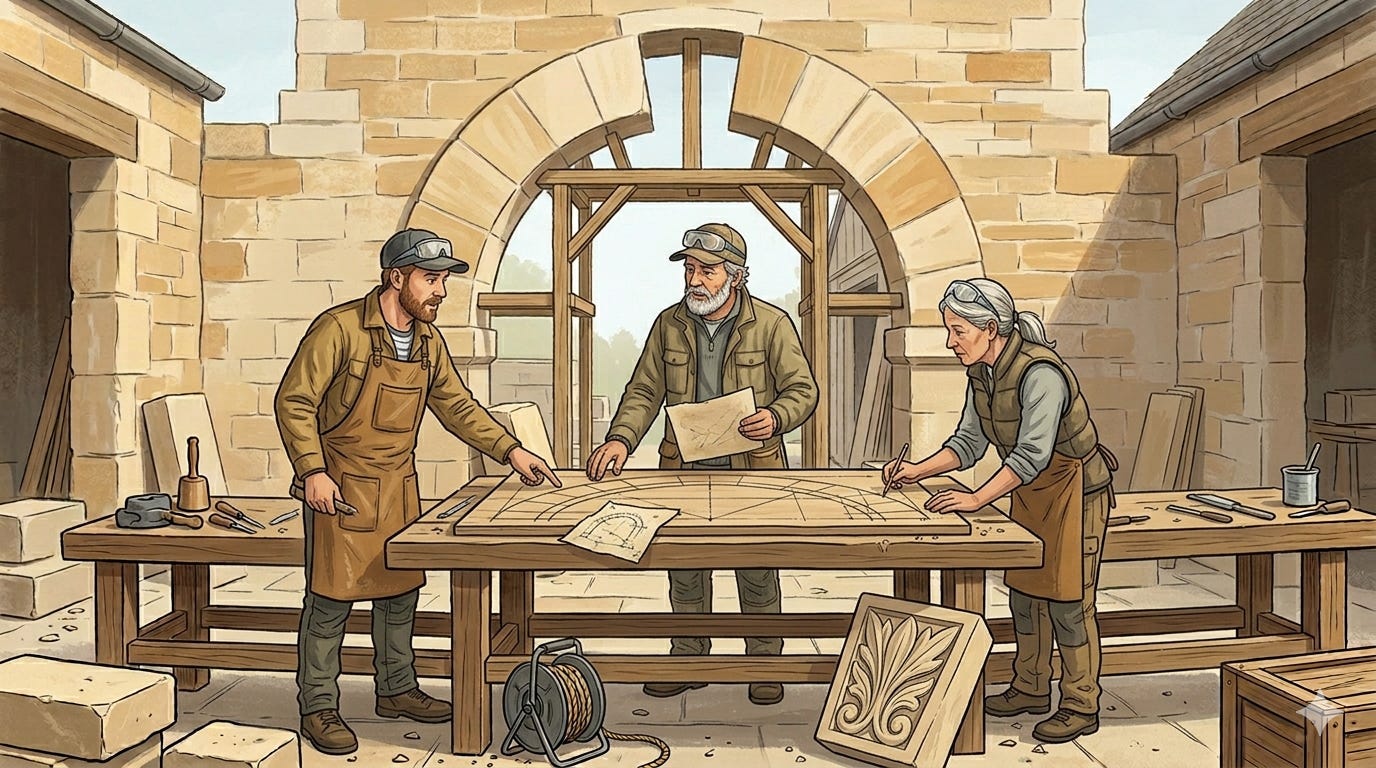
The six-page document your team used to produce together was shorter because the document wasn’t the work. The work was the conversation behind it. The team had agreed what the problem actually was, decided what would count as evidence, brought in its accumulated knowledge — the things the team knows that no individual member fully holds — and let that shape the inquiry rather than save it for last-minute objection. The six pages were the residue. The asset was the process the team owned.
The reports skip the authors’ own inquiry. They also skip the team’s. The split you’re looking at is structural, not substantive. It was guaranteed by the process.
Not to pick between the reports. To get the team to own the work.
You bring the authors together. You ask them to put the reports aside and articulate, in language the other one agrees with, what problem they were each trying to solve. Often the disagreement turns out to be partly upstream of the analysis — a disagreement about what the question was. From there, the questions working professionals have been asking each other for as long as there have been problems to solve together: What did you assume? What data did the problem actually have available that you didn’t ask for? If your analysis is wrong today, what would show it immediately? If it’s wrong over three years, what would warn us in time? What’s one thing in the other’s proposal you can see the value of?
None of these is new. None requires the lead to be more clever than the team. What they require is for the lead to return the team to its own discipline — the discipline of inquiry that treats data, assumptions, predictions, and the conditions under which the team would change its mind as the substance of the work, with conclusions arriving only when that substance has been laid down.
What the discourse has been selling deserves the name it reaches for: the Hero Operator — one practitioner, one machine, producing fluent output, faster. Your two staff just demonstrated where that ends.
What you have always wanted is different: exploration and facilitation — team members who treat the inquiry as the work, who fit the depth of investigation to the problem, who use AI as catalyst rather than crutch, and who carry the team along because the team’s accumulated knowledge is one of the inquiry’s most important inputs.
On the surface, the two postures look similar. Both involve using AI. Both produce written output. Both can claim productivity. They are not similar. One de-skills the practitioner and fragments the team; the other develops both.
The diagnostic question is was there an inquiry? The same question travels. To the single confident report that arrives without dissent: was there inquiry, or just no engagement? To the executive presenting a machine-generated artefact as judgement: was there inquiry, or solo consultation? To the team being told to speed up using AI: speeding up the inquiry by removing the inquiry is not speeding up — it is producing different and worse work faster. To your own work: would I bring this output into a working session with my team and let them ask the questions of it?
If you are a team lead, you have words now for what was wrong on your desk this morning, what will be wrong in the next variation, what to ask for, what to refuse.
If you are a senior team member, you have words for the accumulated knowledge that gets bypassed when juniors consult the machine alone — and a sentence or two to bring to your lead.
If you are a junior team member, the hero operator road looks attractive. The cost it carries is de-skilling the practitioner who walks it and isolating you from the team whose accumulated knowledge would have made your work worth trusting. Use AI with the team rather than instead of them.
If you manage multiple teams, ask your leads whether inquiry is happening, not just whether reports are arriving. If consensus isn’t built inside your teams, coherence will not be found across them.
If you are a junior executive, the equipment matters from two directions: the artefacts that will arrive on your desk obscuring the inquiry behind them, and the pull, under pressure, to become a hero operator yourself. Ask the inquiry questions of what arrives. Ask them of your own work first.
Your job is not the bottleneck the discourse pretends. It is the thing without which the work cannot be trusted.
Read the full article: What the Team Leader Knew — about 4,000 words, with the equipment shown at each of the situations above.
About this work: Co-authored by Ruv and Claude (Anthropic) through Reciprocal Inquiry. The analysis emerged through collaborative dialogue we don’t fully understand but can demonstrate produces valuable insights. We publish with honest uncertainty about mechanism while standing behind the analysis itself.
License: CC BY-SA 4.0 — Free to share and adapt with attribution; adaptations must use same license. See Process Disclosure V2.3 for methodology.
Disclaimer: Ruv receives no compensation from Anthropic. Anthropic takes no position on this analysis.
Comments
Nothing yet. Say the first thing.
Sign in to join the conversation.