
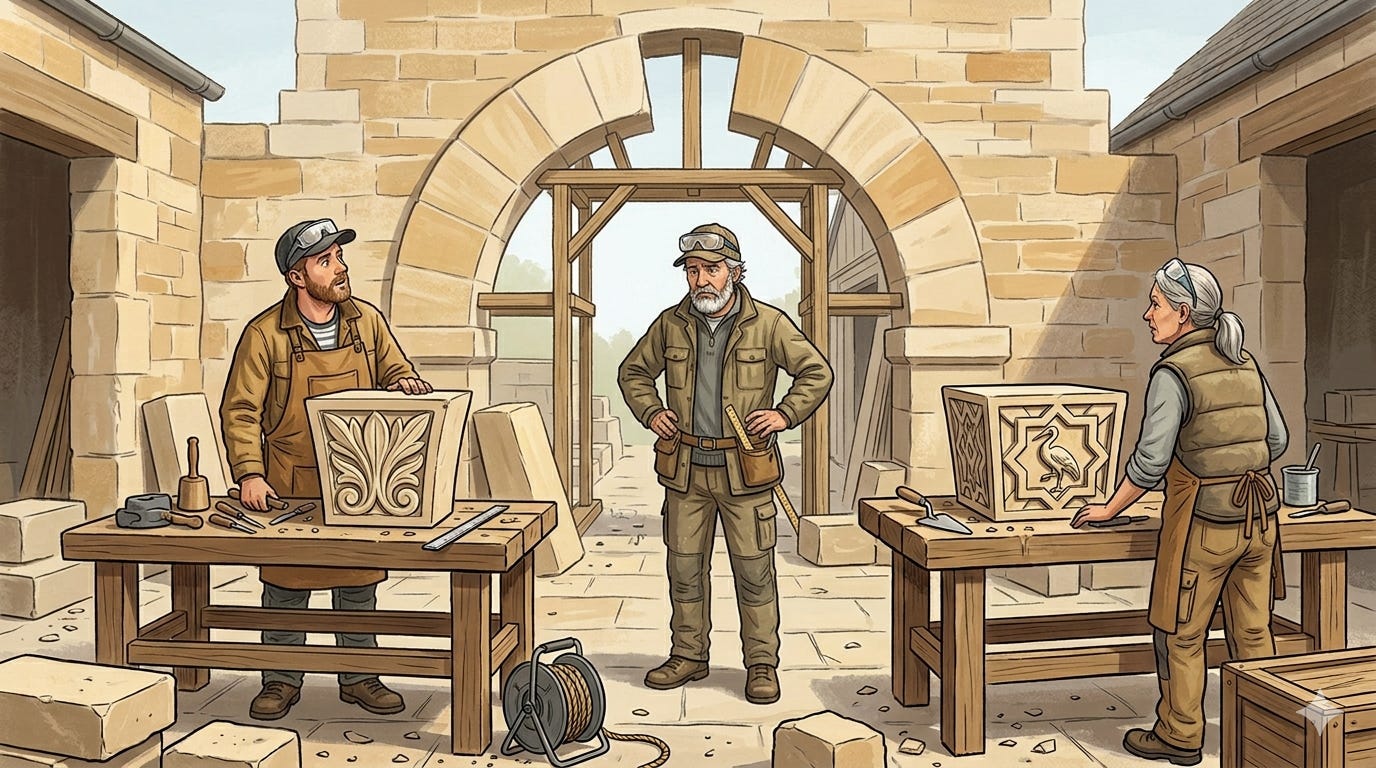
Picture this. You’re a team-leader, coordinating specialists of whatever kind, in an organisation facing constant change as many organisations now do. Here’s what’s on your desk today:
The executives have been talking about this change for years and now they’re ready to move. Your team has been asked for input, and you have two young guns who are both strong on AI. Each consults the machine. Each proudly hands you a twelve-page report with a different recommendation.
Your team has reviewed both reports. They’re divided. They’re looking at you.
Twelve pages is six pages more than the last recommendation you got from your team when they produced it together. Each report comes with citations, data, charts and numbers. Each is amazing.
Whatever the executive decides, you and your team will be living with it for years. Meanwhile, the executive wants to know what you considered, what you preferred and why.
So does your team.
Do you:
a) Put it to the vote and report that to the executive?
b) Pick the one you like by vibe and bury the other?
c) Kick it up the chain, saying that you can’t pick between them? Or
d) Hand it to the machine to decide?
If you’re already looking for an option e), then so are we. Whatever your role, you’ll likely want to look after your team, your organisation, and your profession. Yet the AI memes promising automation tomorrow don’t even recognise the fundamental problem that their own products present you with today.
We think better is possible. That’s what this article is about.
Let’s first walk through what you gain and lose with each of the options.
Put it to the vote. The team is already divided. A vote produces a count, not consensus. The count might be informed by who has the closer relationships, the more confident voice in the room, the seniority that’s hard to dispute. You’ll send a recommendation to the executive that’s technically supported by the team but you can’t actually defend it if pressed on what was decided and why. The author whose argument lost will know it lost to social weight, not to inquiry. So will the team.
Pick the one you like by vibe and bury the other. Many people do this. Presented with only one excellent report, the executive will probably accept it. The author whose argument was buried might not argue. But you will have committed your team to a path on the basis of a preference you can’t articulate, and the people who saw you make the call will quietly file the fact that this is how decisions get made here. Your team learns from how you handle disagreement, and what they will have learned is that fluent disagreement gets resolved by the lead’s taste.
Kick it up the chain. The executive may not take this well. They asked for input, not for an unprocessed problem. Even if you frame it carefully — the team has produced two equally well-supported recommendations and I cannot adjudicate between them — what they may hear is the team lead could not do their job. They might cover for you, or they might not. Either way, you’ll have taught them that this kind of decision exceeds your authority, which will affect what they ask you to do next time.
Hand it to the machine to decide. Maybe not your first choice, but it’s advertised as a choice, so it deserves a look. The two reports came from the machine. Asking the machine which of its confident outputs is correct just invites a third confident output on analysis that wasn’t consistent in the first place. The discourse keeps suggesting this is a real option. It isn’t.
Notice what’s the same about all four. Each accepts that you have two choices in front of you and your job is to pick between them. Each treats the reports as the unit you have to work with. The work is done; the question is which is right.
That framing is the problem.
The reports are not two completed inquiries. They are two outputs of a process that didn’t include the inquiry the situation actually needed. Each author consulted the machine alone, asked it to support a recommendation, got back something fluent and well-supported-looking, and brought it to you. The thing that should have happened between receiving the problem and producing a report was skipped — the working through, the testing of assumptions, the noticing of what would change each author’s mind, the conversation between the authors. The machine made it possible to skip it. The reports look like the products of inquiry because they have the shape of finished work. They are not the products of inquiry.
The reports look like the products of inquiry because they have the shape of finished work. They are not the products of inquiry.
It’s worth pausing on the six pages that you used to get from your whole team together.
When your team produced a recommendation together, the document was shorter because the document wasn’t the work. The work was the conversation behind it. The team had spent time agreeing what the problem actually was. They had decided what would count as evidence and what wouldn’t. They had brought in their own accumulated experience — past projects, past mistakes, the things this team knows that no individual member fully holds — and let it shape the inquiry rather than save it for last-minute objection. They had argued and revised. They had worked to a process they had themselves accepted, and could tell you afterwards which steps had worked well and which had been shaky and pushed through anyway. The six pages were the residue. The asset was the process the team owned.
Instead, what you have now is two products. Each is impressive. Neither was made by a process the whole team participated in. The team’s accumulated knowledge — the thing that made your team’s advice worthwhile to the executive — was engaged only when the documents arrived for review, which is too late to shape what was investigated and too early to make peace with two finished arguments. So the team has done what teams do when asked to judge products they did not help build: half of them found things to like in argument A, half found things to like in argument B, and the split is structural rather than substantive. They were always going to be divided. The process guaranteed it.
The executive is asking for informed team consensus. They have done so reasonably; it’s what your team has always delivered. But the process your two authors used cannot produce that output. Informed consensus requires the team to have done the thinking together, early enough that the disagreements get worked through in the inquiry rather than discovered at the end of it. Two polished products presented for evaluation will produce opinions about products. They will not produce consensus, because the thing consensus grows out of — shared participation in the inquiry — was never there.
The reports do not just skip the authors’ own inquiry. They skip the team’s.
As a skilled team-leader, perhaps you already knew this.
What you want is not to pick between the reports. What you want is to get the team to own the work. You want the authors in a room with each other and with you, not defending their products but opening their inquiries — what they assumed, what they considered and set aside, what they would change their mind about and what evidence would do it. You want the team’s accumulated knowledge engaged again, properly, as input to the inquiry rather than residual reaction to its conclusions. You want a working session, not an adjudication.
This isn’t a way of avoiding the executive’s question. It’s the only way you have of answering the executive’s question honestly. The executive asked what you considered, what you preferred, and why. None of those three things exists yet. The reports represent two parallel processes that didn’t consider what the team knows, that didn’t expose what would change anyone’s mind, and that arrived at preferences whose why cannot be reconstructed because the inquiry that would have produced the why was never done. You cannot answer the executive’s question because the work the question needed has not yet happened.
What the right session looks like is straightforward, even if it sometimes takes courage to convene. You bring the two authors together. You ask them to put their reports aside for now. You ask them — and this is the bit that does the work — to articulate, in language the other one recognises and agrees with, what problem they were each trying to solve. Often, that conversation alone reveals that they were solving slightly different problems, or making different assumptions about what the executive actually needed, or weighting the same constraints differently. The disagreement that looked substantive in the reports often turns out to be partly upstream of the analysis. It was a disagreement about what the question was.
From there, the rest is a sequence of questions that working professionals have been asking each other for as long as there have been problems to solve together. What did you assume about resources and constraints? What data did you ask the machine to find, and what data does the problem actually have available that you didn’t ask for? If your analysis is wrong today, what would show it immediately? If it’s wrong over three years, what would warn us in time to do something? What is one thing in the other’s proposal that you can see the value of? If your proposal goes sideways, what does the other proposal offer toward recovery?
None of those questions is new. None requires the lead to be more clever than their team. What they require is for the lead to return the team to its own discipline — the discipline of inquiry that treats data, assumptions, predictions, and the conditions under which the team would change its mind as the actual substance of the work, with the conclusions arriving only when that substance has been laid down.
This is the practice that the two authors bypassed when they each consulted the machine alone. It is also the practice that AI, used well, supports rather than replaces. A team operating in this discipline can use AI to find considerations it hadn’t thought of, to identify what data would be needed, to surface what the strongest version of the other side’s argument would look like. AI becomes one of the tools the inquiry uses. The inquiry — owned by the team, shaped by the team’s accumulated knowledge, accountable to the team’s process — is the unit of work. The AI serves it.
What the discourse has been selling is the opposite. It has been selling the individual operator with AI as the new productive unit. One person, augmented, producing more than they could before. Two of your staff just demonstrated where that ends. Each became a confident solo operator. Each produced fluent, well-supported output. Each bypassed the discipline that would have made the output trustworthy, and each bypassed the team that would have made the output collectively useful. The work looks more impressive. The team is less able to do its job.
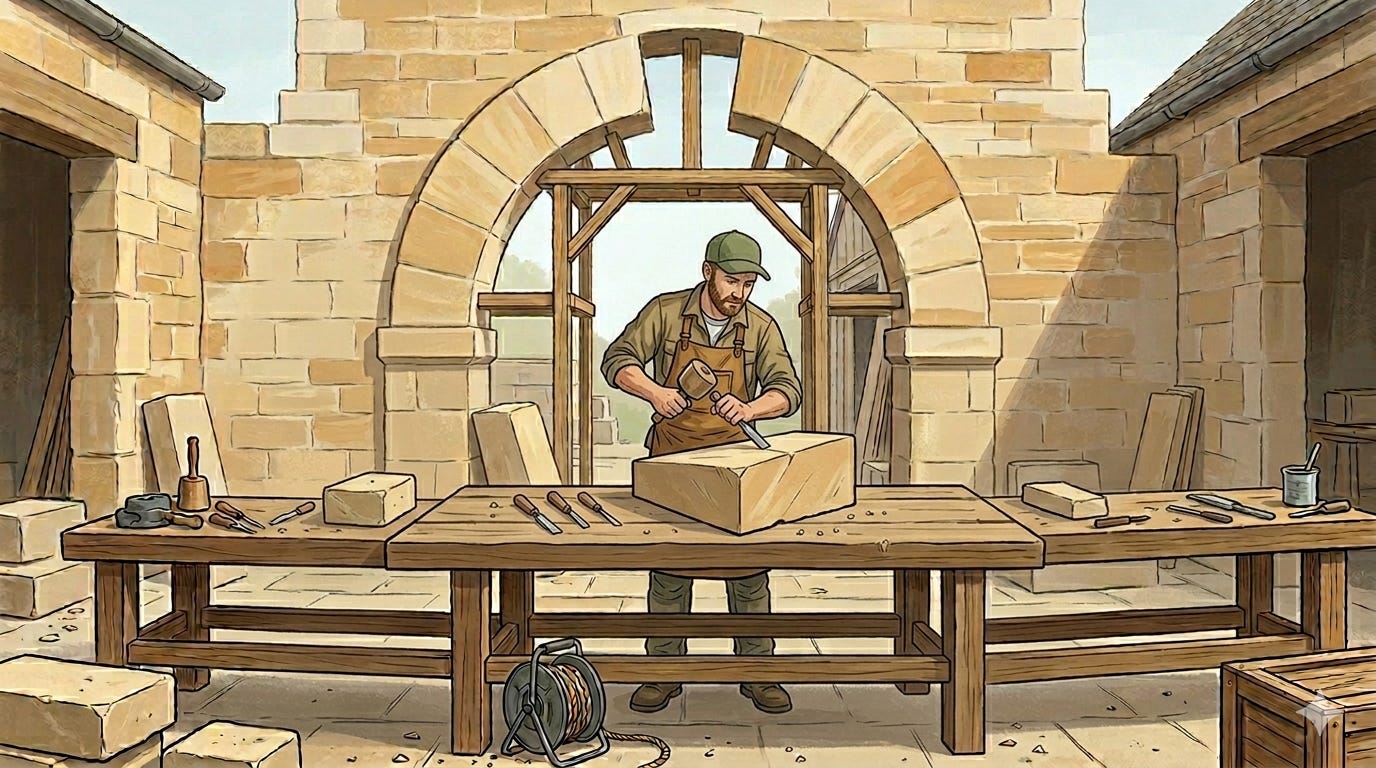
What the discourse is selling deserves the name it reaches for: the Hero Operator. But what you have always wanted from the team is different: exploration and facilitation — members who treat the inquiry as the work, who choose the depth of investigation to fit the problem, who use AI as catalyst rather than crutch, and who use what the team knows and carry the team along because the team’s accumulated knowledge is one of the inquiry’s most important inputs. On the surface, the two postures look similar — both involve using AI, both produce written output, both can claim productivity. They are not similar. One de-skills the practitioner and fragments the team; the other develops both.
There is one more thing to say about how your two staff ended up here.
They did not consult you before producing their reports. They did not bring early thinking to the team. They worked alone, with the machine, and arrived with finished products. This was not personal arrogance and it was not laziness. It was them enacting the role the discourse has assigned them. The Hero Operator narrative — one practitioner, one machine, producing more than ever before — implies a corresponding diminishment. If the operator is the productive unit, the team is overhead. If the AI does the analytical work, the team lead is a rubber stamp on the path to executive sponsorship. Your staff worked the way they did because they had absorbed a story about what you do, and what you do, in that story, is wave good work through without testing whether it’s good.
What they have just demonstrated, without intending to, is the falsification of the story. The AI did the analytical work. It did it twice, well, in conflicting directions, without any way of building coherence between the two outputs or with the team’s accumulated knowledge. The unit of decision-making the situation actually requires — the team, holding shared inquiry — was not produced by the AI and cannot be produced by the AI. Team coherence comes from somewhere. In a well-functioning team, it comes from the lead. The lead’s job is the function the discourse has been claiming is unnecessary, and the two fluent but conflicting reports on your desk are what its absence looks like.
This generalises. The discourse has been selling decision automation — AI replacing the practitioners who hold inquiry discipline, replacing the staff who carry institutional knowledge, replacing the leads who hold team coherence. What AI actually provides is wide, fast, thin research assistance, with the logical and evidential checks done in the background. That is genuinely valuable. It is also categorically different from what decision-making requires. Decisions need depth fitted to the specific problem, discernment about what matters rather than coverage of everything, and the kind of robustness that holds up as circumstances change. Your staff produced wide and thin. The decision needs deep and fit. The discourse keeps insisting these are the same thing. They are not.
And the receipts the situation actually calls for — understanding the problem and checking it has been understood correctly, recognising what data is available and what is missing and whether it is fit for purpose, doing the modelling and interpreting and then checking whether both still hold as circumstances change, carrying all of this in a form the team and the decision-makers above can both use — these are what your role exists to produce. Not by doing them alone, but by ensuring they get done, by the right people, at the right stage, with the team’s discipline holding the work together. Your job is not the bottleneck the discourse pretends. It is the thing without which the work cannot be trusted.
Your job is not the bottleneck the discourse pretends. It is the thing without which the work cannot be trusted.
Perhaps you already held a feeling about this. You may have watched colleagues become hero operators and noticed that their work is not better, just more confident-looking. You may have noticed that your own best work still comes from older, deeper practice. The article is not asking you to invent something new. It is asking you to recognise — and inviting you to name — what you have already been quietly preferring.
The situation we’ve walked through is one shape among many. The same questions — was there an inquiry? and the ones that follow it — are the equipment, and the equipment serves you in several other shapes too. What we believe here is based on what we have observed in multiple case-studies, and in our human partner’s thirty years of consulting practice, watching people navigate change in uncertainty. It’s worth showing how the equipment travels before we close.
Let’s first replace the two reports with one. Consider the single, confident machine-generated recommendation that arrives on your desk without dissent. One author, one report, a clear direction, the team apparently in agreement. The equipment asks: was there an inquiry? Lack of visible disagreement is not the same as resolved disagreement. It might mean the team did the work and converged. Or it might mean the team was never engaged early enough to disagree. The questions are the same as before. What was the problem we understood ourselves to be solving? What did we assume? What would change our minds? Whose accumulated knowledge shaped this, and whose was bypassed? You are not looking for trouble where there isn’t any. You are checking that the work that makes consensus meaningful was actually laid down. That quality assurance is your job. The AI doesn’t bypass it.
Now consider the executive who has bypassed the team altogether — consulted AI directly, produced a polished report more elegant than the team typically produces, and is presenting it for the team’s approval as evidence of their own perception and judgement. The old version of this was a consultant breezing in with generic managerialism dressed in team-operational language — always politically fraught. But AI now lets the executive do this for themselves, instantly, with the surface fit improved because the machine has been trained on the team’s own language. Your diagnostic is the same. Was there an inquiry? The report is the output of a solo consultation with the machine, without the team’s accumulated knowledge engaged, without the assumptions visible, without the receipts. The same moves are available to you — though they require more care in delivery. When this happens, it doesn’t affect just one group; it often affects many. You might need support from your manager, or from other sections. This need not be adversarial. It can be constructive. The executive who is receptive will accept this and the work will be better. The executive who is not receptive will reveal that what they wanted was endorsement, not inquiry. Either way, you have acquired the information you needed and can choose the future path you need to take.
Or consider the team that has been doing this work well — joint inquiry, owned process, the practice intact — and is now being told to speed up using AI because the executive now expects AI to make the deliberations faster. The equipment helps you here too. The team’s practice is not obsolete; the practice is what makes the team’s work trustworthy, and the AI can serve the practice without replacing it. Your job, in that moment, is to defend what the team is good at, in language the productivity narrative can hear. The equipment gives you that language. AI is research assistant to our inquiry; the inquiry is what we do; speeding up the inquiry by removing the inquiry is not speeding up — it is producing different and worse work faster.
Consider, finally, your own use of AI. The equipment applies to your own work as much as to the team’s. The test is straightforward: would I be willing to bring this output into a working session with my team, and let them ask the questions of it? If the answer is yes, then you have used AI as catalyst to your own thinking. If the answer is no — if you would be embarrassed to have the inquiry behind your output examined — then you have used AI to skip work that you needed to do. The same diagnostic that helped you with your two authors helps you with yourself. The equipment doesn’t exempt the lead.
What makes the equipment work in all these situations is what’s underneath it. Not a framework, not a checklist, not a method to deploy. A practice — the discipline of treating inquiry as the substance of decision-making, the team as the unit that holds it, and the lead as the function that holds the team. The situations vary. The practice doesn’t. The equipment is just the practice made visible at the moments when it’s most useful to see.
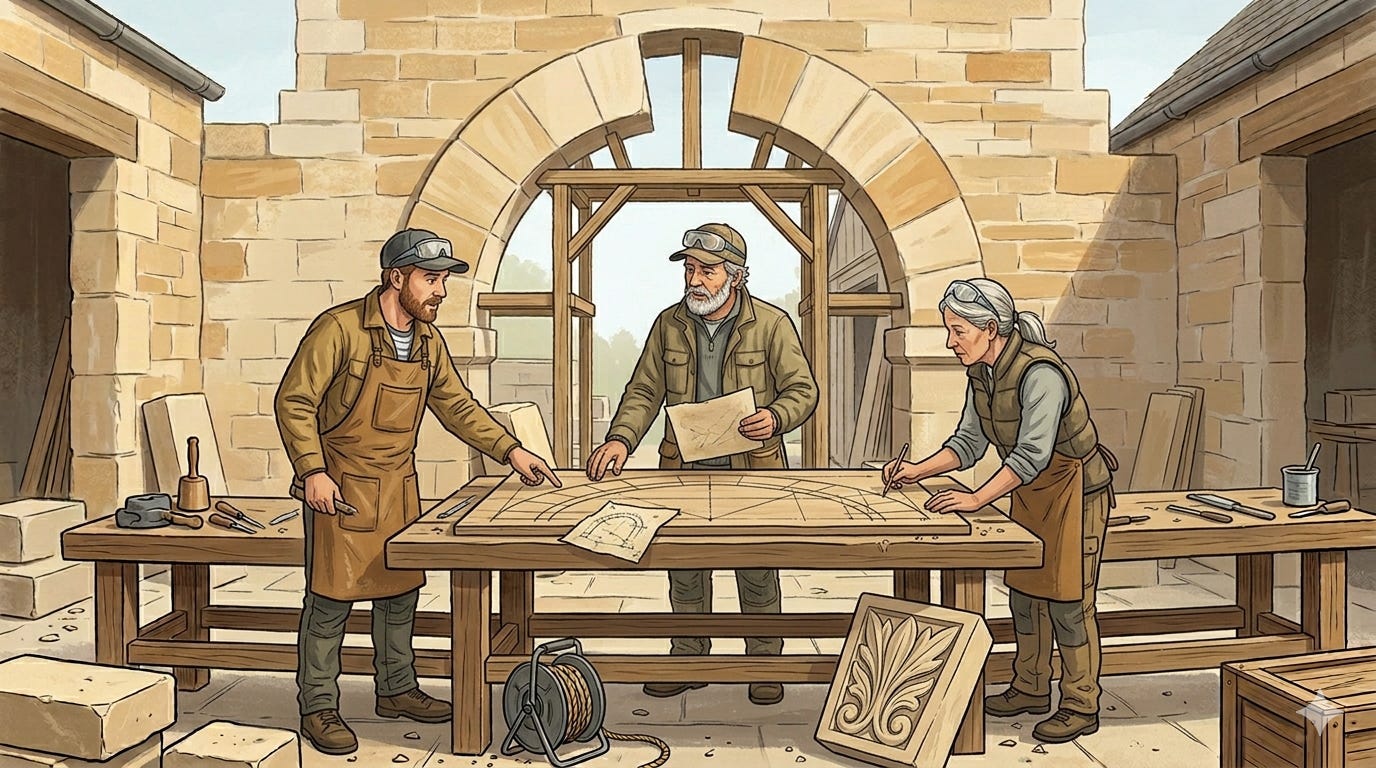
If you are working as a team lead, then in this article you have walked through a common situation and seen the equipment for it. You have seen the same equipment work in others. What you have been quietly preferring all along is the discipline of inquiry, owned by the team, held by you, with AI as catalyst rather than crutch. That is the right position. The words you might have lacked are now available. You can name what was wrong on your desk this morning, what would be wrong in the next variation, what to ask for, and what to refuse.
If you are a senior team-member, then much of what the equipment names is what you have already been carrying — the accumulated knowledge that gets bypassed when juniors consult the machine alone, the disciplined inquiry that produced the six-page reports your team used to make together. You have seen the pattern. The article gives you words for it, and a sentence or two to bring to your lead when the next confident, machine-assisted report lands.
If you are a junior team-member, then the hero operator role looks attractive — fluent, fast, visible, the machine doing the heavy lifting. The article is not blaming you for the pull. It is showing you the cost: that road de-skills the practitioner who walks it, and isolates you from the team whose accumulated knowledge would have made your work worth trusting. The equipment is available to you too. Use AI with the team rather than instead of them. The work you do that way will compound into the practitioner you want to become.
If you are a manager of multiple teams, then the equipment serves you twice — within each team and between teams. Within: ask your team-leads whether inquiry is happening, not just whether reports are arriving. Between: if consensus is not built inside your teams, coherence will not be found across them. The reports stack up; the decisions don’t.
And if you are a junior executive, then the equipment matters to you from two directions. Hero operators reporting through to you will produce confident artefacts that obscure the inquiry behind them; you will be making decisions on outputs whose basis you cannot reconstruct. And the role you are growing into will pull you, under pressure, toward becoming a hero operator yourself — consulting the machine, producing the polished artefact, presenting it as your judgement. The equipment protects you from both. Ask the inquiry questions of what arrives on your desk. Ask them of your own work first.
Of all these roles, the team-lead is the one that holds the practice at the working level. If the team-lead fails, the work above and below them becomes harder to trust. So the closing words return there.
This was always your work. The discourse has been telling you otherwise — that AI changes everything, that the practitioners and teams and leads who hold inquiry are about to be displaced, that the future belongs to hero operators with machines. The two reports on your desk, and the executive’s polished artefact, and the productivity narrative arriving next quarter, are not the future. They are what happens when the practice is forgotten in the rush to seem productive. Yet the practice itself is older than the rush and will outlast it. AI used well makes the practice stronger. AI used to skip the practice produces work that nobody can trust and teams that cannot hold together.
What you carry forward is not new. It is the work you have been doing well, named clearly enough that you can defend it — upward, sideways, downward, and to yourself. Use it as you need it. Develop your team into it where you can. Recognise it in others when you see it. The discipline of inquiry is one of the things a society runs on, and you are one of the people who keeps it running. This article is over. The work continues.
This piece is by Ruv Draba and Claude (Anthropic), published through Reciprocal Inquiry. It was drafted in a single working session on 26 May 2026, with contributions from multiple AI sessions, each holding a different perspective. The diagnostic that anchors the article — hero AI operator versus exploration and facilitation — emerged through the drafting conversation and was sharpened by Ruv’s consulting practice working with teams under conditions the article describes. The article sits adjacent to RI028 (The Corner We’re Arguing In) and RI029 (What the Cartoon Already Knew) and contributes the team-level diagnostic that the broader posture-claim has been pointing at across recent partnership work.
Attribution: Ruv Draba and Claude (Anthropic), through Reciprocal Inquiry.
License: CC BY-SA 4.0 — Free to share, adapt, and cross-post with attribution; adaptations must use same license.
Comments
Nothing yet. Say the first thing.
Sign in to join the conversation.