
This week, The Internet Archive has been taken offline by a cybersecurity attack. After my initial shock that The Archive had been temporarily taken offline subsided, what surprised me the most was how many people I shared this information with didn’t know what The Internet Archive was. I use The Archive extensively when I’m researching, and I’m currently unable to publish my latest article while I’m waiting for it to come back online. So, I wanted to take this opportunity to share with you why the Archive matters, and why you should be using it/supporting it.
To start, here’s a brief history of The Archive from Wikipedia (emphasis is mine):
The Internet Archive is an American nonprofit digital library website founded in 1996 by Brewster Kahle…As of September 5, 2024, the Internet Archive held more than 42.1 million print materials, 13 million videos, 1.2 million software programs, 14 million audio files, 5 million images, 272,660 concerts, and over 866 billion web pages in its Wayback Machine. Its mission is committing to provide "universal access to all knowledge".
The Internet Archive allows the public to upload and download digital material to its data cluster, but the bulk of its data is collected automatically by its web crawlers, which work to preserve as much of the public web as possible. Its web archive, the Wayback Machine, contains hundreds of billions of web captures. The Archive also oversees numerous book digitization projects, collectively one of the world's largest book digitization efforts.
Essentially, The Archive is one of, if not the biggest, holder of digitized archival data in the world.
When using Google, it is not uncommon for me to come across now defunct blogs from the 2010-2018 timeframe discussing food and the history of ingredients. Oftentimes, these are well researched posts that link to additional resources. However, because these posts are on blogs that are sometimes over a decade old, links are broken or send me to expired domain names. When this happens, I search The WayBack Machine on The Internet Archive, and more often than not am able to track down the original article or source. All I have to do is copy the original link into the search bar of The WayBack Machine, and presto! I have what I’m looking for.
The Internet Archive is also a massive holder of digitized public domain texts. Universities and public libraries from around the world use the existing structure of The Archive to make their public domain collections accessible for all. These collections often contain historic cookbooks I would otherwise not have access to, and I frequently use them for reference. When you look through the Free, Open Access Cookbook Index you’ll see multiple references to The Internet Archive for this reason.
Another important feature of The Internet Archive is the ability given to the general public to upload data and documents. I am working on digitizing my personal collection of community cookbooks and handwritten recipes, and those digital files will be housed in The Internet Archive. Because it is a free platform that anyone can access, my work will be safely housed and backed up at no cost to me or the people reading the books I upload. This project would not be attainable for me without the infrastructure The Archive provides for free.
I have been following the updates about The Internet Archive’s status on Twitter/X, and the latest I’ve heard is that it should be up and running in a few days. The data of The Archive itself wasn’t compromised during the breach, and they’re working to make sure everything is as secure as possible.
Once The Archive is up and running, I’d encourage you, if you never have before, to poke around the collections. As the Wikipedia quote above states, there are literally billions of pieces of information. It is inevitable that you will find something of interest to you (and if you need help, I can point you in the right direction). Familiarizing yourself with this resource will open up a wealth of information you didn’t realize you were previously missing out on!
If you are able, I would also suggest making a donation to The Internet Archive. The Archive is a nonprofit, and provides access and archiving to an unbelievably large amount of data. This is a public resource that has wide reaching benefits for everyone, and deserves our support.
Information should be easily accessible for all, and The Internet Archive plays a huge role in making that possible. It is essential we do what we can to preserve this data, not just for ourselves but for future generations.
Thank you for letting me interrupt your regularly scheduled cake posting with this little PSA. If you haven’t yet, I’d love if you would subscribe to my newsletter!
This week, instead of adding to the Free, Open Access Cookbook Index or Recipe Terms Glossary, I wanted to instead highlight a couple resources that are not contingent on The Internet Archive, in case you were needing a vintage cookbook rabbit hole to fall down.
The Feeding Michigan Collection, held by Michigan State University, is a collection of nearly 70 community cookbooks from Michigan. They range in date from 1800-1929!
South Dakota State University has digitized and made available a Community Cookbook Collection featuring books from South Dakota. The collection spans multiple decades and has quite a few unique wild game recipes.
The Library of Congress has an extensive collection of digitized community cookbooks available online. They are sorted by place or decade, and provide a huge window into community cookbooks across the United States.
Thank you so much for reading and supporting The Recipe Graveyard!
I’m committed to providing this work to all of you lovely readers for free, but here are some ways you can support my work if you appreciate what I’m doing around here and want to pitch in:
Normally I’d ask for you to consider a Ko-Fi contribution. This week instead I would ask that you consider donating to The Internet Archive once they are back online. The work I do wouldn’t be possible without their essential services, and they deserve all the support we can give them.
Buy a cookbook! I often batch buy vintage cookbooks at estate sales, garage sales, and flea markets to cost-effectively grow my collection, so I sometimes end up with duplicates. These will be listed over on eBay!
Visit the site! My blog will soon be running ads, and the payout from those ads is based on views. If you have a spare minute, I’d love if you could go poke around the site. Perhaps catch up on back posts of the blog or look through the resources available in the Free, Open Access Cookbook Index!
Like, comment, or restack this note! As much as we all rue the algorithm, it is the bedrock of getting this work in front of new faces. If you would be so kind as to like, comment, or restack, it will help push my work to a broader audience completely for free!
Follow along on Instagram, Threads, or Pinterest! If you are on social media come find me and say hi! Substack is a lovely place, but it is one of the smaller fish in the social media sea. Next week, I’ll be posting reels of the cake variations I made on Instagram!
Regardless of whether you’re able to help support this little project or not, I’m so grateful you’re here and reading along! Have a fantastic weekend, friends.
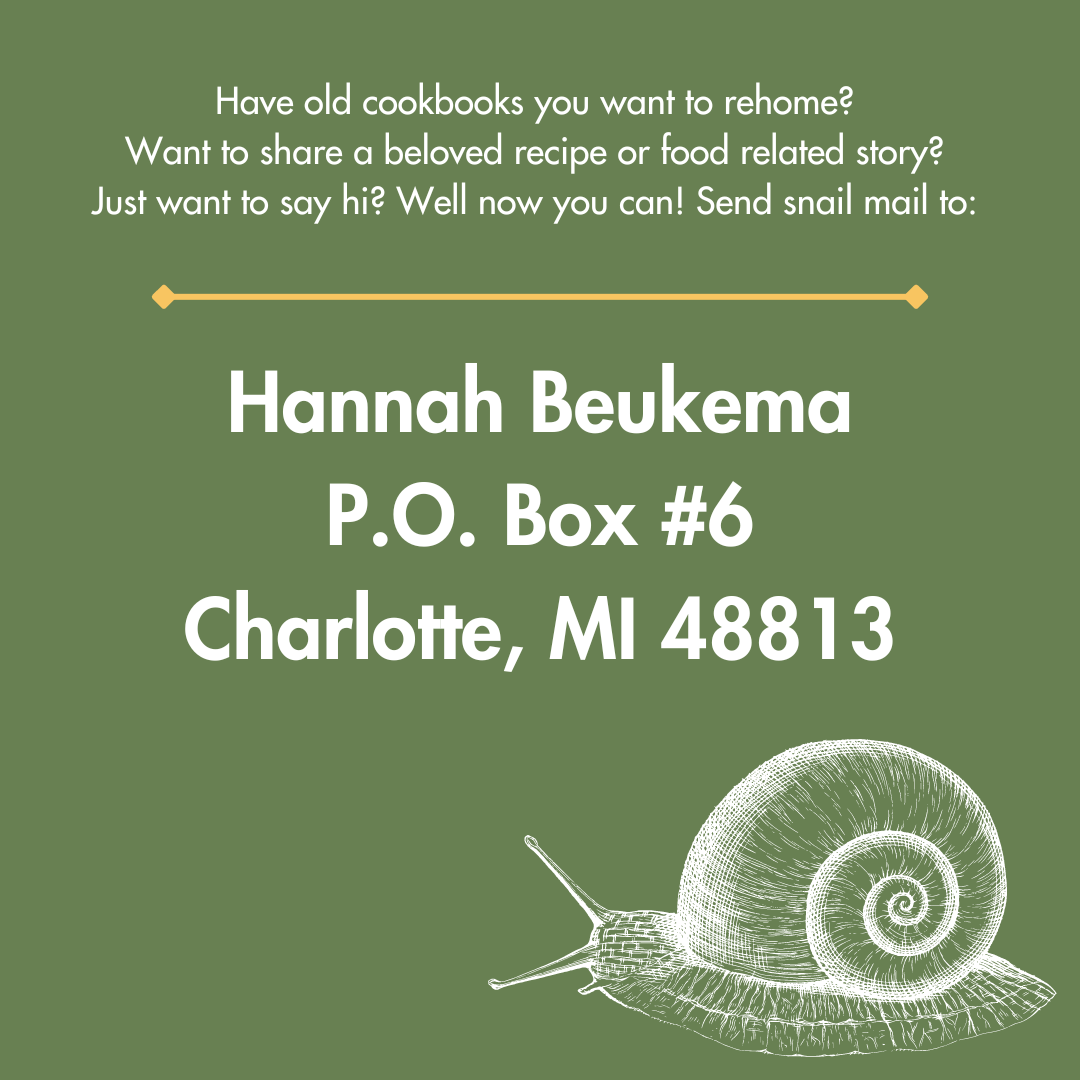
Since starting this project, I’ve had people reach out offering me cookbooks and recipes! Sometimes they’re duplicates from personal collections, books found at garage sales, or books they were given and aren’t quite sure what to do with.
If that sounds like you, and you have cookbooks or handwritten recipes you’d like to donate, now you can! Community cookbooks that are either public domain (most books pre-1923) or not copyrighted, as well as handwritten recipe collections, will get uploaded in the order they’re received to an online repository hosted by The Internet Archive for everyone to access freely.
For copyrighted items, I’ll catalog them in my public facing collection catalog and should be able to help people with research requests in the future on a case-by-case basis. Unfortunately I won’t be able to publish those in full at this time.
There is absolutely no pressure to send me anything, but I wanted to set this up since so many of you have kindly offered books! Thanks for being here, and believing in this little project. Together we can help save some of these recipes, preserve their legacy, and make them accessible for all.
Comments
Nothing yet. Say the first thing.
Sign in to join the conversation.