
Folks using screen readers and anyone who prefers to listen — there’s an audio player bar just below this paragraph, with a play button on the far right. Please let me know if you have any trouble with it.
0:00
-18:33
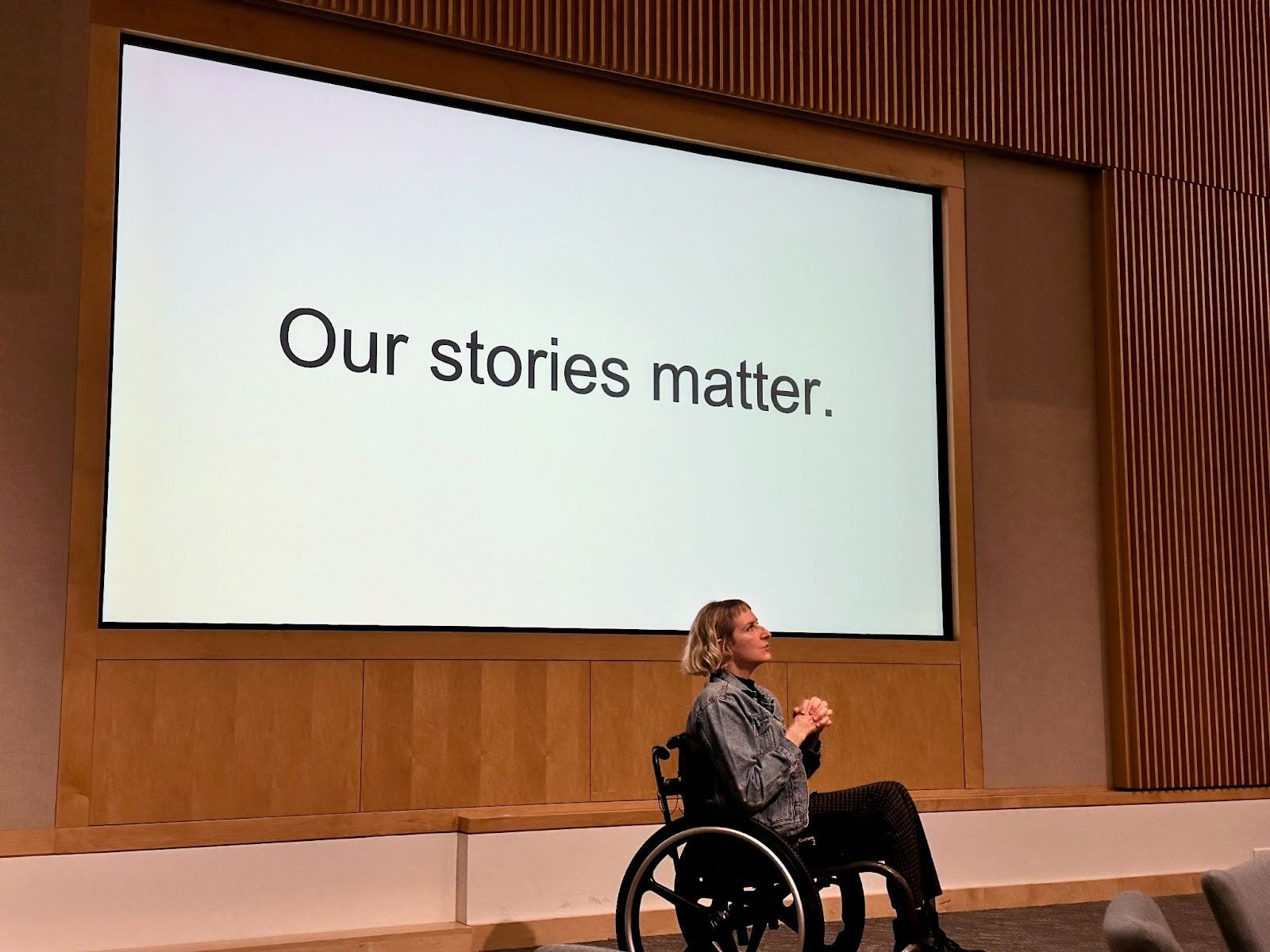
In March, I spoke at an event I can’t stop thinking about. The Platte County Board of Services is an organization in Kansas City that supports folks with intellectual and developmental disabilities, and they invited me to participate in a day they called “Share Your Story.” They invited a whole host of people – folks with disabilities, people who work with them, family members, community stakeholders – all sorts of people! – many of whom occupy more than one of these roles at a time. The event was designed to welcome everyone while centering the voices of disabled people, and my job was to kick off the day with some reflection on the power of personal storytelling before everyone in the room was invited into an afternoon of sharing and listening. Hello and welcome to my DREAM LIFE.
In my experience, this is a unique way to run things. I’ve noticed that when people gather to talk about disability, 1) there is often an emphasis on resources, practical advice, funding, budgets, and legislation (I do understand why), and 2) disabled people themselves aren’t always in the room, let alone handed the microphone. As the executive director, Martha Jaynes, shared, part of her drive for organizing this event was noticing that the higher up she gets in her work, the less and less she hears the voices of the very people they seek to support. But in this case, the planners wanted to focus on personal storytelling AND share the microphone with many disabled people.
I think a day like “Share Your Story” may be rare because – culturally, collectively – we struggle to see the concrete value of both. People with disabilities are often treated more like children or problems to solve, ignore, or tolerate and less like valuable citizens with important insights into this place. (This can be especially true for folks who have — or are perceived to have — intellectual/developmental disabilities.) And maybe it’s because it’s tricky to wrangle the act of personal storytelling into data you can put into a graph? It doesn’t translate easily into that default dollars-saved/dollars-earned carrot we’re supposed to be chasing. And also – maybe – it’s because a lot of people take self-expression, self-narration for granted?
I’ll never ever forget the writing workshop I ran several years ago. I kicked things off by inviting participants to jot down the assumptions or default stories people imagine onto them. This felt like an easy assignment to me. I mean, off the top of my head – She needs my help! She can’t be a mother! She’s gonna fall! She’s so brave! Her husband is a saint! She wishes she could get up out of that wheelchair and run free with the birds! I could be in the middle of making an angel food cake and someone could shout “STOP WHAT YOU’RE DOING YOU HAVE ONE MINUTE TO FILL THIS PAPER WITH ASSUMPTIONS PEOPLE MAKE ABOUT YOU!” And not to brag, but I could fill that page in 30 seconds. Easy assignment, is what I’m saying.
But two dudes squinted back at me – “Uhh, what do you mean? The ‘stories people imagine onto us’?”
“Like if you were in a line at the airport or met someone at a party, what would be a few things people might assume about you without even knowing you?”
They stared at me blankly. “I have no idea,” one guy said. “How would I know that?”
To be fair, I myself had never met either of these guys before this moment. I don’t know their histories or stories. What I do know is that they looked and moved like maybe Dylan O’Brien and Tom Holland would play them in the movie versions of their lives. And I think it’s possible that changes the kinds and range of story lines people project onto you? Maybe it creates a wider set of permissions for the stories you imagine for yourself? And maybe, if that’s the world you live in, it’s easy not to notice storytelling at all? Either way, I clocked the way the assignment I expected to be easy was not easy for everyone. And honestly, the idea of moving through the world without the need for spiky armor to fend off the stories people project onto me felt as foreign as imagining life with access to an invisibility cloak. Like what would I even do with that delicious power??
But then, last week I was part of a Bellevue Literary Review panel discussion on personal narrative and writing the body with Meghan O’Rourke and Porochista Khakpour (by the way, thank you to everyone who came!! it meant a ton to me to feel your presence there!). I listened to both writers reflect on the difficulty of finding narrative when your body is ill in ways that the medical world dismisses – how disorienting it can be when you’re story is erased by experts and your own brain is foggy. I thought – how different (and also strangely similar) for outsiders to tell you your story isn’t real and for outsiders tell you what your story is before you say a word. In other words, there is more than one way to lose the threads of your own experience and invisibility isn’t necessarily a foolproof superpower.
What I’m saying is – if Maslow’s hierarchy of needs was called Taussig’s hierarchy of needs, ⅔ of my chart would circle back to storytelling, and not everyone sees it that way. The power of storytelling and the right of self-authorship (in whatever form that takes – doesn’t have to be through language), is not, in fact, obvious to everyone. Which is why I can’t stop trying to rewrite this one moment from our “Share Your Story” day.
Soon after I arrived (and minutes after accidentally dumping my entire water bottle into my backpack – sorry, this is not the moment I’m still trying to rewrite, I just feel compelled to tell you I did that. I pulled my dripping laptop out of my bag and promptly made a puddle on the tiled floor in the exact spot attendants were lining up to pick up little tote bags holding signed copies of my book, wheeee! Okay, moving on.) Soon after I arrived, a lovely man from the local news station wanted to ask me a few questions about the event and how my story fit into the day. We talked about my own process of losing and learning and relearning to tell my story for myself and what I hoped to offer the group. Finally, he asked – “And what do you find that means to people? Being able to tell their own stories for themselves?” I paused, then sputtered.
To be clear, I’m glad he asked the question – it’s a good one. It’s the kind of question I’d like to be able to answer easily and well, even if someone demanded the answer from me while I was in the middle of baking an angel food cake. And also, it threw me in the same way I felt jarred by the guys in my workshop who couldn’t come up with any assumptions people might make about them. A reminder that not everyone already understands the act of self-narration as essential as food, water, shelter, love!
And it’s because of that – because I was handed this little moment to fill the gap and explain what I see from here – that I keep rewriting my response in my head, coming up with a list of answers I wish I would’ve given instead of my fumbling grab for words like “autonomy” and “agency” and “holding the reins of your life” and what what what exactly am I trying to say? If ever I’m confronted with a recording of whatever I spouted to that reporter, I will have no other choice but to plug my ears and scream Spice Girl lyrics.
But every other part of the day – how do I explain it? I’m still struggling to find the words. It was as it should be and so rarely is. After my keynote bit, small groups gathered at round tables where facilitators with disabilities shared prompts – What was a time you felt free? What is an obstacle you’ve faced? Pull up a picture on your phone and tell us the story of it. Our assignment was simple – everyone who felt comfortable would share a brief story with their table and everyone else would listen. Then Martha led the group in two bigger conversations – What was that like? What did we notice in our stories? And What do we do now? After taking in these stories, what are our declarations for the future we want to move toward? Folks walked around with microphones they brought to anyone who raised their hand.
One thing I know and adore about disabled people is that our bodies and brains don’t always follow the expected path. A straight line can spool in front of us, and we will zig and zag and wander our way into a different trail. And so, as the microphone floated through the room, something organic and maybe unexpected pushed its way through.
It sounded like responses that weren’t always answering the question asked, or monologues that jumped from idea to idea like sprightly springtime grasshoppers, like a voice communicating through AAC technology, like someone signing to an interpreter who translated into the microphone and signed back, like words sometimes difficult to decipher and also rendering story, voice, perspective. It looked like bursts of disruption that flowed easily through the room like slippery fish fins flipping above the surface before wiggling back into the stream – this is how we flow – we are wide and stretchy and wriggling with life. It felt like we can spill our entire water bottle into our backpack, destroying everything from our laptop to a new pack of gum, and then get on a stage to tell stories from our guts because every one of us is just a regular, glorious, organically grown celestial blip tethered to the spinning earth.
And as I took it all in, I was moved to witness a bigger story that went to that deep place beyond language. A story that I’m not sure would completely translate if you looked at the bare transcript itself, but a story I felt in my body – my chest, my gut, my cheeks. As the microphone moved from person to person – so many among us used to being excluded from the room or held up as a shiny token – as everyone took up space and propelled their perspective into a room full of attentive bodies, I felt a story of rare and brawny dignity in the air. A little glimpse at the world as it could be – flexible, open, curious. And that world felt so much more possible to me in the presence of this group. Like – we could do more of this together. Like – we are a part of something bigger than ourselves. Like – how do I so easily lose track of how powerful we are together?
I often say I don’t think the work of disability inclusion is about letting disabled people in the door and then holding the status quo – it’s allowing the inclusion of disability to inspire a revision to the whole script. The way we run an event, the stories and voices we amplify, the rules for who gets to hold the microphone, to what end, and for how long, the goals we set (e.g. what if instead of efficiency or bottom lines, the aim was surprise rabbit trails and moments where someone feels less alone?). When disability is meaningfully included, we learn which parameters are arbitrary, and we’re invited to reimagine, again and again, another way. That is what the day felt like to me.
The next time someone asks me what it means for people to tell their own stories for themselves, I want to be ready. Maybe I’ll say – being invited to tell your own story – through your words, your swaying, pacing, stemming, dancing body, your collage or zine, the way you fling your voice or stretch or scrunch your face – reminds you that you’re real. You’re alive.
Or maybe it connects you to your body – you’re here. You’re a part of this place. You’re a valuable participant.
Or maybe it connects you to a bigger story. Your expression of self is a part of our whole. Your story helps me understand my story, helps us build out our collective map. Throw up your flair! This is what I notice from here – what do you notice from there? How will we ever figure out what’s going on out here without all of our flairs illuminating the entire topography?

CHEWY QUESTIONS – If you want to continue to think through the ideas here, these questions are for you – please feel free to explore this in your personal writing, to talk about it with your people, or to join the conversation on Substack.
What is your experience with self-narration? Has it been a struggle? Or flowed through you freely? Does it come out of you in words or another way?
Help me answer the question – what does it mean to people to be able to assert their own stories for themselves? What do you think?
ALSO SOME COOL THINGS TO CHECK OUT –
Sitting Pretty is going to the theater! Isn’t that wild?? If you are in South Florida on April 9th or 10th, What if Works will bring THE NEXT CHAPTER “Sitting Pretty” to the Westchester Cultural Arts Center stage. This group believes that the arts are a powerful tool for social change, and I’m honored they chose to re-animate my words (verbatim!) through three talented actors (all wheelchair users) and a whole multi-media theater experience. If you are able to go, I would love to hear about your experience! I’m low-key devastated I won’t be there, but I’ve been getting a lot of peeks from a distance, and the creative collaboration of this crew is blowing my mind. Here’s the place to go for more details and to purchase tickets.
A friend of mine, Barry Lee, just illustrated a picture book! Barry is one of my All Time Hands Down favorite artists, so I couldn’t wait to read When I Grow Up I Want to Be A Chair. As soon as I did, I was struck by how different it felt from most of the other books I’ve read in this genre. What is it? There’s a playfulness, nuance, unique kind of whimsy in the story Ryan Rae Harbuck wrote that maybe picture books about disability aren’t always granted permission to explore?

The cover of a bright and vibrant picture book against a purple background. The top features a kid sitting in a wheelchair with her arms up. Her wheels are decorated with flower covers. Behind her are stars and hearts and sparkles in front of a purple background along with a house and tree. She's sitting on top of a green hill, which features the white words against green "When I Grow Up I Want to Be a Chair." There are two flowers with little yellow noses in each bottom corner and a cute little bee. I can feel the energy of two disabled creatives running through this book; it radiates a picture of disability that feels alive to me. As these pages show us, disability can be joyful and confusing and lonely and empowering, sometimes all at the same time. It can be difficult for outsiders to understand the ways a disability might both entirely define us and not at all define us, and I think it’s only the people who understand that complexity in their own bodies who can translate it into a story a kid could get. The story Ryan tells is surprising and rewarding in a way readers might not see coming, and I’m obsessed with Barry’s vibrant, whimsical illustrations. The book comes out April 7th. Here’s a link to it if you wanna check it out!
Two essays I’ve read recently that stopped time. I think I held my breath through both – they flutter alive in bold resistance to the rush of tidy, default illness narratives.
In “What’s Left?,” Courtney Martin records the impossible both/and of her long goodbye to her dad through his slow fade from dementia. “My dad’s disease has forced me to learn a new way,” she writes, “to give up so many things that soothe me: timelines, control, specialness, language. I have had to learn to live alongside this pain, to visit the possibility of not being known by my own father every single week, to find pleasure and joy and friendship and beauty in the visits, anyway.”
In “Not New – And That’s Okay,” Josie George resists culture that “pushes for constant novelty. It doesn’t want old. It doesn’t want repetition, or to wait, or have to make do with what it already has. It doesn’t want to sink deeper, it wants to move on. Stay still? Boring, boring. Give me the new! Our great master dopamine demands new, and it wants it soon, sooner than that.” Instead, as she describes her quiet life shaped by chronic illness, she calls our attention to the value of repetition, sameness, sinking deeper, saying it again and again, just like the starlings.

Thank you, as always, for being here.
XO
Rebekah
No posts
Comments
Nothing yet. Say the first thing.
Sign in to join the conversation.