
Folks using screen readers and anyone who prefers to listen — there’s an audio player bar just below this paragraph, with a play button on the far right. Please let me know if you have any trouble with it.
0:00
-14:30
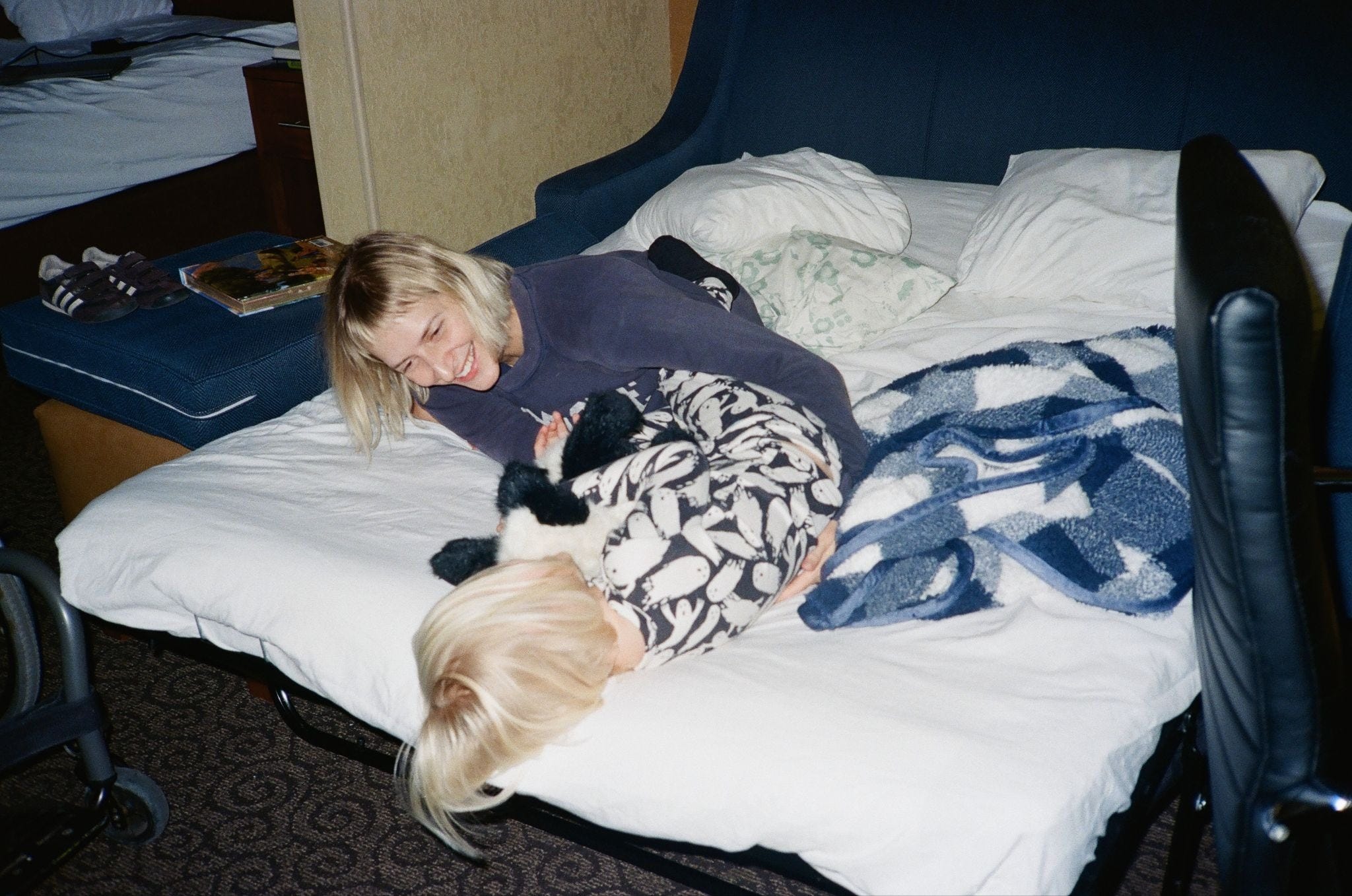
It was only last night, after five years of having me as a mom, that my son finally said, “I wonder why you can’t walk.” He’s heard his peers ask similar questions a bazillion times, but never have I ever heard him express a whiff of curiosity about my legs. Nestled together, warm in his bed, I noted this. He took a beat, then said, “Can we read now?”
“Wait, didn’t you want to know why I can’t walk?” I said, realizing I was actually excited to share this part of my story with him.
“Maaaybe,” he said, cautiously, probably trying to calculate his own interest against just how long this might take. He was really excited to read Mr. Putter and Tabby*, and, as you might imagine, I have been known to go on.
“Usually when the kids at your school ask me about it, I don’t really feel like talking about it. But we’re close, and it’s something I’d like to share with you,” I said. He allowed us to proceed.
You might think that I would know exactly how I wanted to unfold this conversation with him. What notes I wanted to hit or what I hoped he’d understand by the end. I did not.
Without a plan, I found myself hopping between personal stories – a sick baby, a toddler who starts dragging one leg, a kid who feels free in her new wheelchair – and mini-science lessons. Using the railing on his bed as a stand-in spine, we talked about what parts of the spinal cord communicate with what parts of the body. I showed him how I can wiggle one foot, but not the other. Eventually, he returned to his original plea. “Can we pleeeeeeaaase read now???”
We read, then snuggled until he fell asleep, and as I hoisted myself out of his bed, I was laughing. What an anticlimactic conversation! How perfectly humdrum!
I couldn’t tell you exactly what I expected before I knew him, but I know that, at every turn so far, I’ve been surprised by the ways my son has responded to my disability, my wheelchair. Of course it will continue to evolve and shift as he gets older, but so far, he is consistently DISINTERESTED. His mom is just his mom is just his mom. Of course.
You would be forgiven if you assumed his easy acceptance of my disability means he’s also accepted all expressions of disability like some kind of diversity sage who just “gets it,” unlike the rest of us regular people who have to be taught these things. I will never forget our visit to the farmers market when he was two. He saw someone using a motorized wheelchair, pulled out his pointer finger, and loudly shouted “What happened????” I stared at him. Umm, what happened, indeed! Was a motorized wheelchair different enough from mine that he was so thrown? We’ll never know. But clearly – having a parent who uses a wheelchair does not automatically make a kid easily accept every kind of difference he notices. While he and I do have a good frame of reference when talking about the ways it’s easy for people to make assumptions when we encounter something unfamiliar, we still have to have those conversations.
It’s also quite common to assume that the kids of disabled parents will grow up to be good little helpers. Either through parentification – they will, it’s often assumed, take on caretaker roles that are too heavy for their young ages – or because their parents’ disabilities will obviously teach them empathy for others. Since I’ve been writing about disability and parenting, I can’t tell you how many people have told me that my disability will teach my son to be compassionate. *Cue Rebekah prickling*
Last week, we had dinner at our friends’ house (two nondisabled parents), and their four-year-old daughter was very eager to play hostess. She kept walking around the table scooping sweet potato stew and little bits of salad onto all of our plates, and I remember thinking – If my son did something like this, people would confidently assume he learned to be a little caretaker because he has a disabled parent.
I mean, listen. My son is actual magic. His laugh is like if the sun and the ocean made a baby called delight. He invites the whole world into play, and if you’re new around here, you’re invited the same as if you’d been here all along. His brain is a whirling universe full of mazes and creatures and rhymes you’ve only met in your dreams. He’s forever mid-breakdance on a trampoline. His love is feral and bursts out of him in surprise attacks that literally knock me over or tender nuzzles as fleeting and cherished and trusting as a butterfly landing on your shoulder.

But compassionate? A good little helper? I mean, they’re just not the first words I’d pick to describe him. When we approach a door, my kid will not run to open it for me. In fact, he’d rather sit in my lap and use his powerful legs to kick it open while I push us through – objectively harder for me and more exciting for both of us. Most days after school he’s happy to pile my lap with everything that needs carting into the house. When I say, “Hey, can you help me carry some of this inside?” he doesn’t hesitate to decline with good cheer. “My arms are already full,” he says, glancing down at the single lovie tucked under one arm while I juggle a tote bag, two water bottles, a purse, an empty tupperware container, and his unwieldy coat. We hope we can model what it looks like to care for each other – to help a mama out, kid! Like so many other families, we’re working on it.
Our brains create meaning by drawing lines between point A and point B – because this, then that. And when disability is part of an ecosystem, it almost feels like there’s a mandate or irresistible urge or desperate need to speculate, predict, and definitively decide what role it plays in relation to everything else. We start drawing connecting lines where maybe they don’t exist at all. Like the mother-in-law of a friend of mine who assumed that when her grandbabies were slower learning to walk, it had to be because their mom used a wheelchair. (*cough, cough* For what it’s worth and to add one more data point to the map, my baby was an obnoxiously early walker.) But I’m not above it. When my son was a baby who never stopped crying, my brain could not get past the idea that it had to be because I couldn’t pace and bounce him around the house. The “if this, then that” formula was thirsty for dimension.
Or, in our singular focus on the link between point A and point B, we accidentally ignore C through Z. I will never forget the first time I took the enneagram test. I was equal parts mortified and furious reading about the type 4’s tendency to feel like an outsider who doesn’t belong. EXCUSE ME, but feeling like a little alien bobbing around in outer space is because of the toxic combination of DISABILITY + ABLEISM = THE END. I would say that this is a chicken or egg situation. Like maybe my experience of disability in the world MADE me an enneagram 4 who feels like an outsider. Except what do I do about all of the people I know who also grew up disabled and don’t feel like little aliens from outer space? Perhaps there’s room for more layers inside the story.
Being my son’s mom is pulling my attention to a wider map full of sideways paths. I’m sure growing up beside a wheelchair will shape how he sees the world in some ways, but I don’t know that either of us will ever be able to decipher the precise tentacle-reach of that shape. (What does it do to a brain, for example, to grow up kicking open doors from your mom’s lap??? Mostly something cool, I think, but what?!) And also, the more days we live side-by-side, the more tangled and cluttered our maps become. In my one-day, hypothetical fantasy, when he sits down in front of me with his list of things that shaped him the most, I expect it will surprise me.
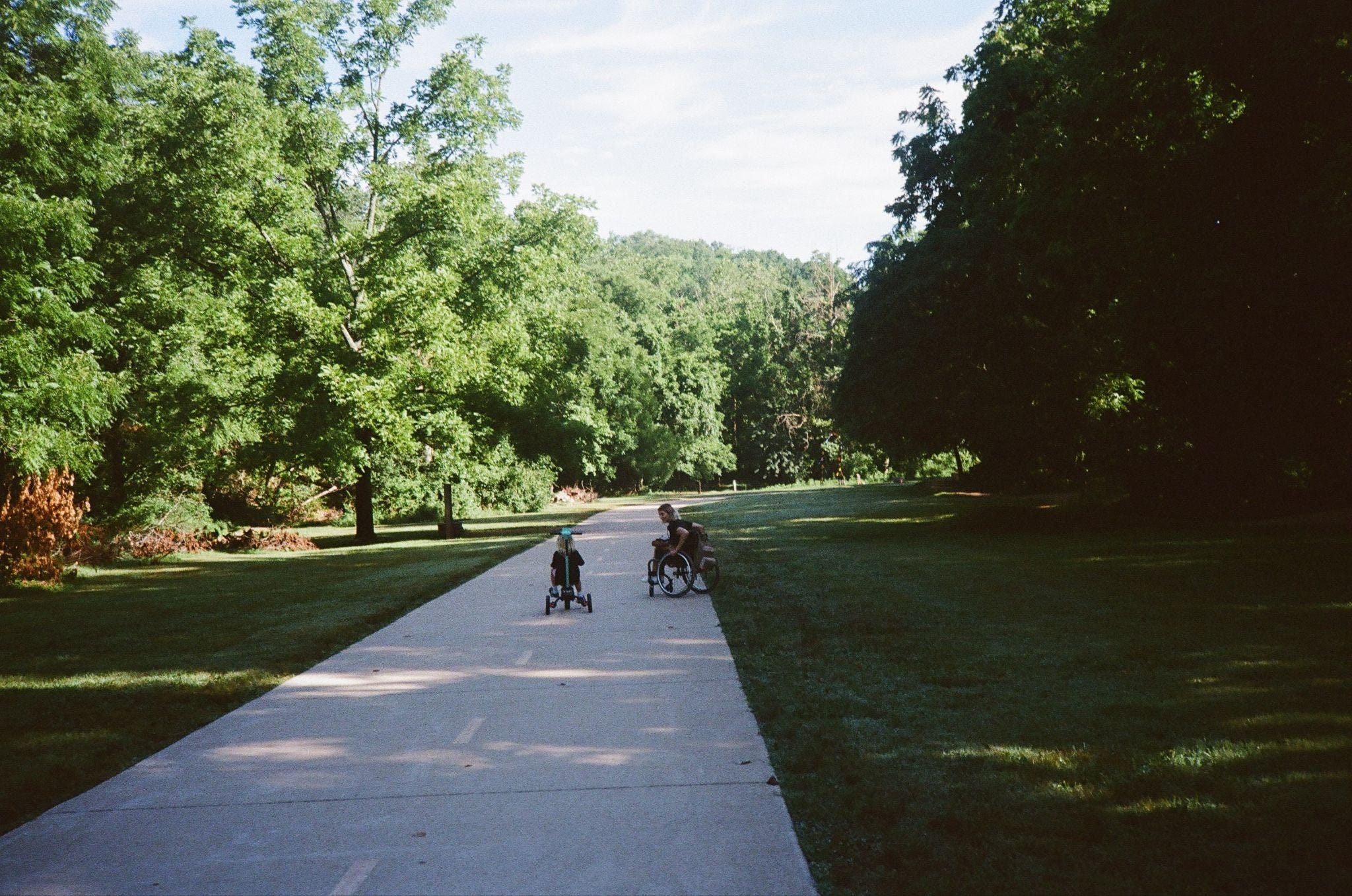
After my rambling disability storytelling/science lesson, but before we read our Mr Putter and Tabby book, I asked my son, “What do you think I should say when kids ask me why I can’t walk?” He sighed, bored to his bones with this conversation. “Just say – it’s a really long story.” And oh my god, if he isn’t spot on.
A Few Other Things!
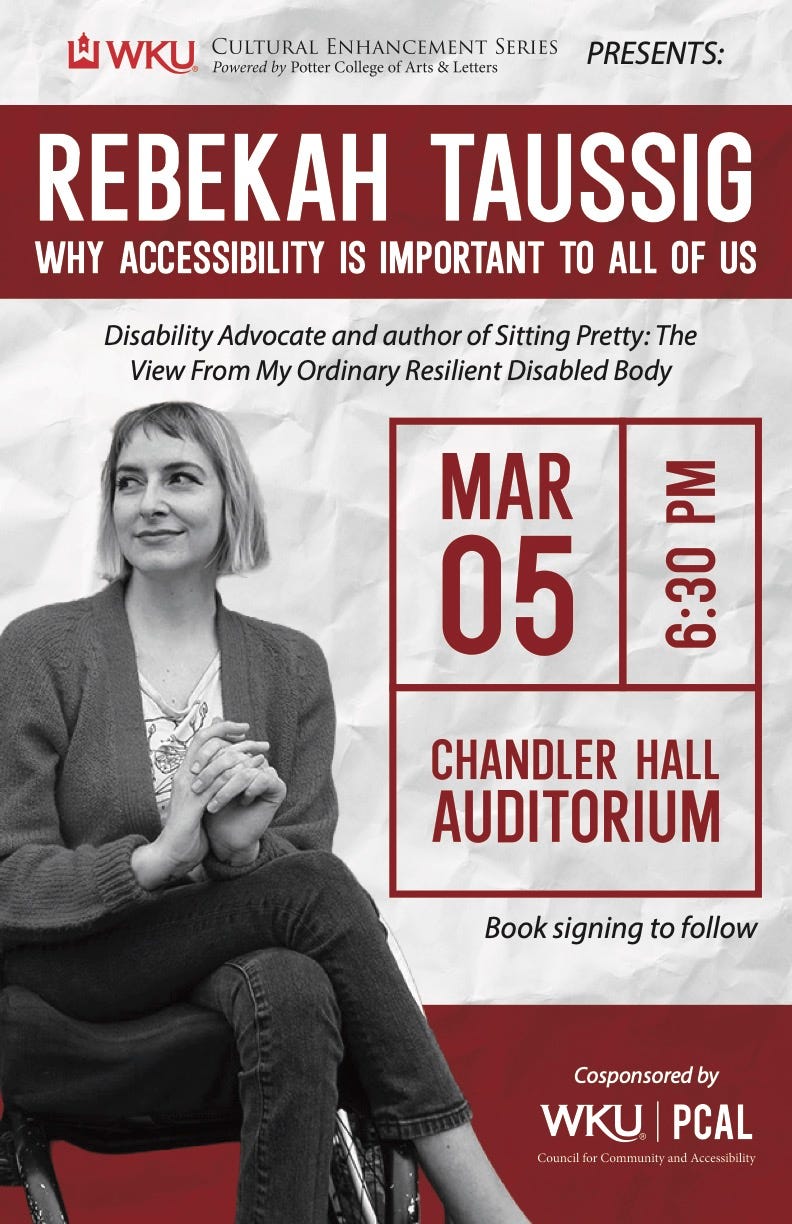
I'm looking forward to meeting with the folks at Western Kentucky University on March 5th (details included on the graphic below)! If you're in the area, the event is free and open to the public, and I'd love to see you!
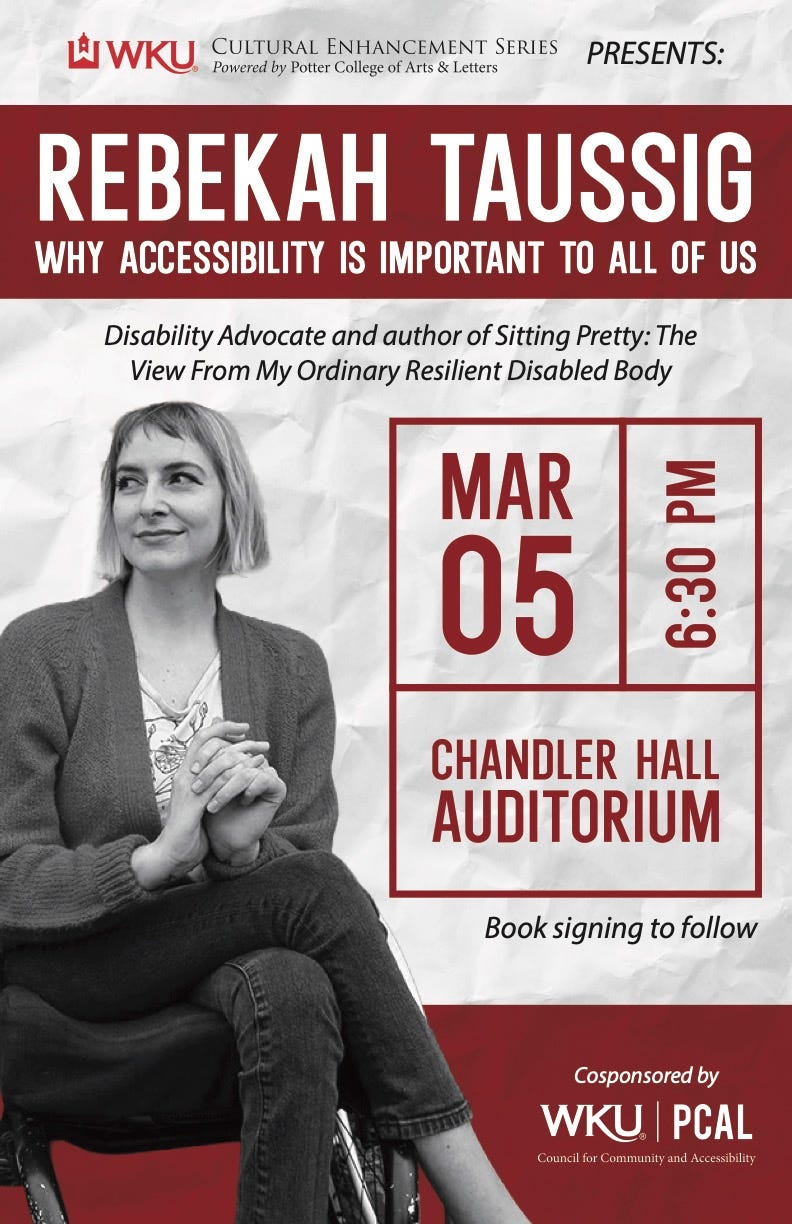
A flyer announcing an event at Western Kentucky University, the text reads “Cultural Enhancement Series Presents: REBEKAH TAUSSIG — WHY ACCESSIBILITY IS IMPORTANT TO ALL OF US — Disability Advocate and author of Sitting Pretty: The View From My Ordinary Resilient Disabled Body — March 5th, 6:30pm, Chandler Hall Auditorium — Book signing to follow.” Next to the text a black-and-white photo of Rebekah sitting in her wheelchair. I am thrilled to be joining three other panelists on March 26th, 6-7pm CT for a virtual conversation on “Writing the Body” as part of Bellevue Literary Review’s series “Conversations on Creative Writing in Healthcare.” If you also find yourself pulled to reflect on what it means to move through medical spaces as a disabled/sick body, RSVP here! (And even if you can’t attend live, an RSVP means they will send you a recording of the event afterward. Yay!)
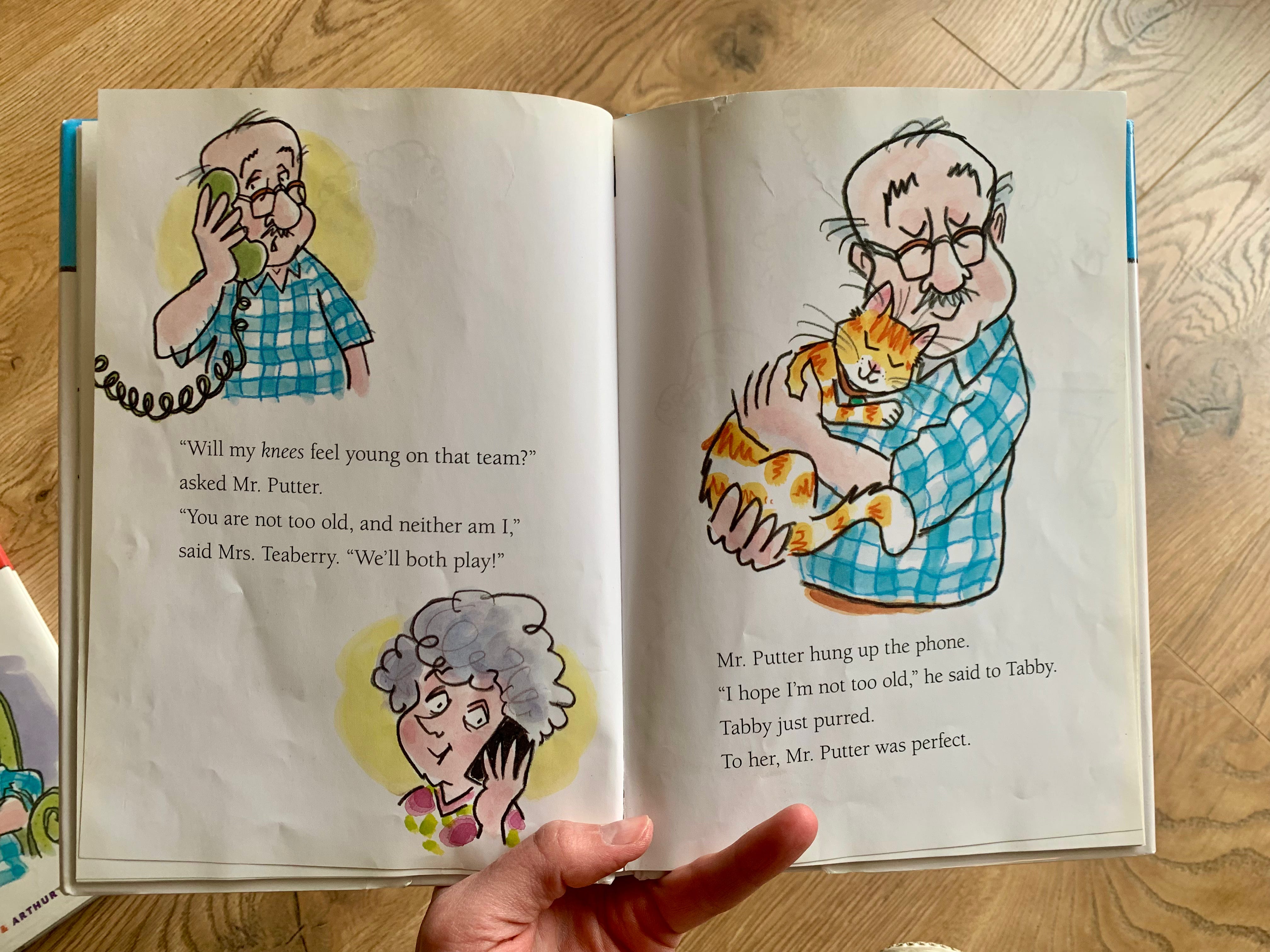
And finally, I’ve been dying to tell you about Mr Putter and Tabby. Otto and I have been reading these books for the last few weeks, and I am OBSESSED (all-caps not optional). It was just in last month’s Substack that I was telling you how I longed for better stories about aging, and then the universe brought me Mr. Putter and his fine cat, Tabby. These books hit that impossible sweet spot of grabbing a 5-year old’s attention and making his 40-year-old mom want to cry with contentment and deep knowing. Mr. Putter’s body is old — we’re not pretending otherwise — he can’t do the things he did when he was younger. When he’s sick, he misses his mom spoiling him with minty tea and adventure books. He remembers having the energy to sled down a hill at full speed. And also, he and Tabby live the coziest life without apology or regret. They make muffins, take lots of naps, and watch the snow fall through the window. They live next door to their best friends, Mrs Teaberry and her good dog, Zeke. Sometimes these neighbors take care of each other (like when Mrs Teaberry hurts her foot, or when Mr Putter gets a cold). Sometimes they go on adventures — Mrs Teaberry likes to dance and go rollerskating, and sometimes Mr Putter is up for it — but there’s no wrong way or right way to do it. I consistently find myself struck by the simple capacity to relish what was and is — at the same time! Bottomline: if you want to feel hugged by a book, I recommend you find a Mr Putter and Tabby near you.

CHEWY QUESTIONS – If you want to continue to think through the ideas here, these questions are for you – please feel free to explore this in your personal writing, to talk about it with your people, or to join the conversation on Substack.
Are there any “because this, then that” narratives you hold tight? What do these narratives give you? Do you find yourself curious about what might show up if you opened the map a crack?
Are there identities/lenses you find yourself looking through more often than others? Or ones you tend to ignore/minimize? Like I’m so quick to look through the lens of disability, but I sometimes forget how much my experience of disability is also shaped by growing up in the Midwest. I don’t notice until I’m in a room full of east coasters, and then, oops! I notice. But I’m curious — if we were to write a list — keyboard/pencil/voice-to-text app recording for 5 minutes straight — what identities/lenses might we eventually jot down that would take us awhile to even notice?
Thank you, as always, for being here.
xo
Rebekah
No posts
Comments
Nothing yet. Say the first thing.
Sign in to join the conversation.