
Folks using screen readers and anyone who prefers to listen — there’s an audio player bar just below this paragraph, with a play button on the far right. Please let me know if you have any trouble with it.
0:00
-17:15
It was during a recent Q&A when someone asked me a question that pressed so precisely on my heartbeat that I completely fumbled it. No, that’s not exactly what I mean to say. I didn’t “fumble” it. I just cared so much about the question that I was inevitably disappointed by the depths left unexplored in my answer. This is not an uncommon feeling for me after a Q&A. I’m often left with one question I keep thinking about days after, wondering as I fall asleep or in the shower – what do I wish I’d said instead?
The question went something like this – What advice do you have for two disabled parents as they set out on this journey with their new baby.
And immediately – HEART SPLIT OPEN, ON THE FLOOR, WE ARE NOT OKAY, WHERE IS THE FIRST AID KIT. Sitting there in front of my computer screen, people zooming in from around the globe, actual make-up on my face (a rarer and rarer occasion these days), I am transported to a planet of doubt and fear and grief and a depth of fatigue that lives in the parts of the ocean submarines have yet to access.
There’s a recording of this Q&A. You might’ve seen it. I cannot bring myself to rewatch/relisten to anything that I record, let alone a moment like this one, but I remember my first response was to acknowledge the ocean waves of feelings the question brought up in me. The second thing I remember pointing to was the importance of connecting with other disabled parents.
In my earliest days of parenthood, I remember feeling shocked – by how hard my internalized ableism kicked in, by how alone I felt in the experience, by how hard and how much one baby could cry. Also shocked by how fundamentally different, categorically separate I felt from nondisabled parents. How ragey I felt when I sensed anyone ignoring or glossing over that gaping separateness. Our experiences were not the same. We might both feel self-doubt, but when strangers observed us showing up for pediatrician appointments or to the playground with our babies in tow, one of us would probably and by default be trusted while the other would not. (Hint: take a peek at some of the disproportionate numbers of disabled parents who lose custody of their kids or check out which states have laws that allow disabled parents to lose custody of their kids based solely on disability, no proof of abuse or neglect necessary. Or don’t take a peek. It’s very distressing information.) For me, being able to process with other disabled parents felt practically, psychologically, and emotionally vital. So this was the response I offered the question asker. Connect with other disabled parents.
As we moved on to the next question in the Q&A, something about that answer niggled me. Maybe it felt too simple for the sprawling collection of deep wounds I accumulated during the early months (years? years) of parenting. When I felt like the worst kind of imposter, when I felt the skeptical eyes of strangers, when I learned about the ways the law discriminates against disabled parents, when family members scooped my baby away from me in attempts to help – what did I need to hear? What lesson do I wish I could have absorbed into my body sooner?
Maybe something like this –
You are not a normal mother. You don’t look or move or function or THINK like a normal mother. PRAISE FUCKING BE.
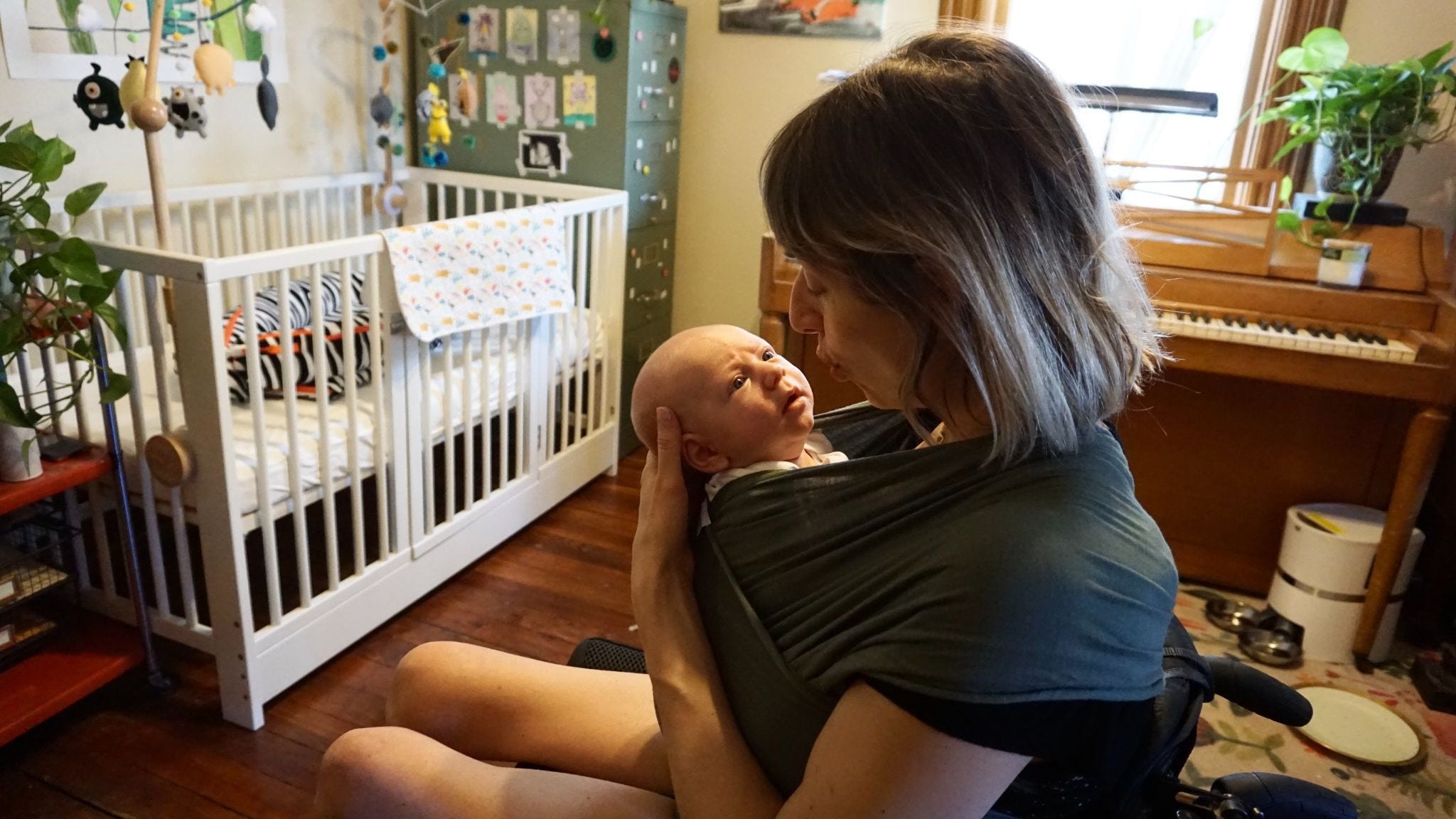
The absolute don’t-test-me truth is that normal mothers are a little bit of an illusion. But illusions can be powerful – there is certainly safety, affirmation, and reward in appearing to match an ideal. And there are plenty of people who are capable of chasing after illusions – of working really, really, really hard to get as close as possible to the image of that towering statue called Mother.
But YOU – my spectacular butterbean – cannot chase after that illusion. You are incapable of fitting into the mold from the word go.
And somehow, you have equated that mismatch to insufficiency – automatic failure. You mixed up “normal” mother with REAL mother, LEGIT mother, CAPABLE mother. You are running on the instinct that the only way you and your kid will make it through this is if you distance yourself from disability more than ever – more than you did when you were a teenager asking someone to whisk your wheelchair out of your prom pictures, working so so hard to pretend like inaccessible buses and bathrooms and trips to the beach didn’t cost you anything, declining to identify with any of those disabled people, crushing your body and heart to match the image of normal, average, typical, everyone else.
Let me give you a picture.
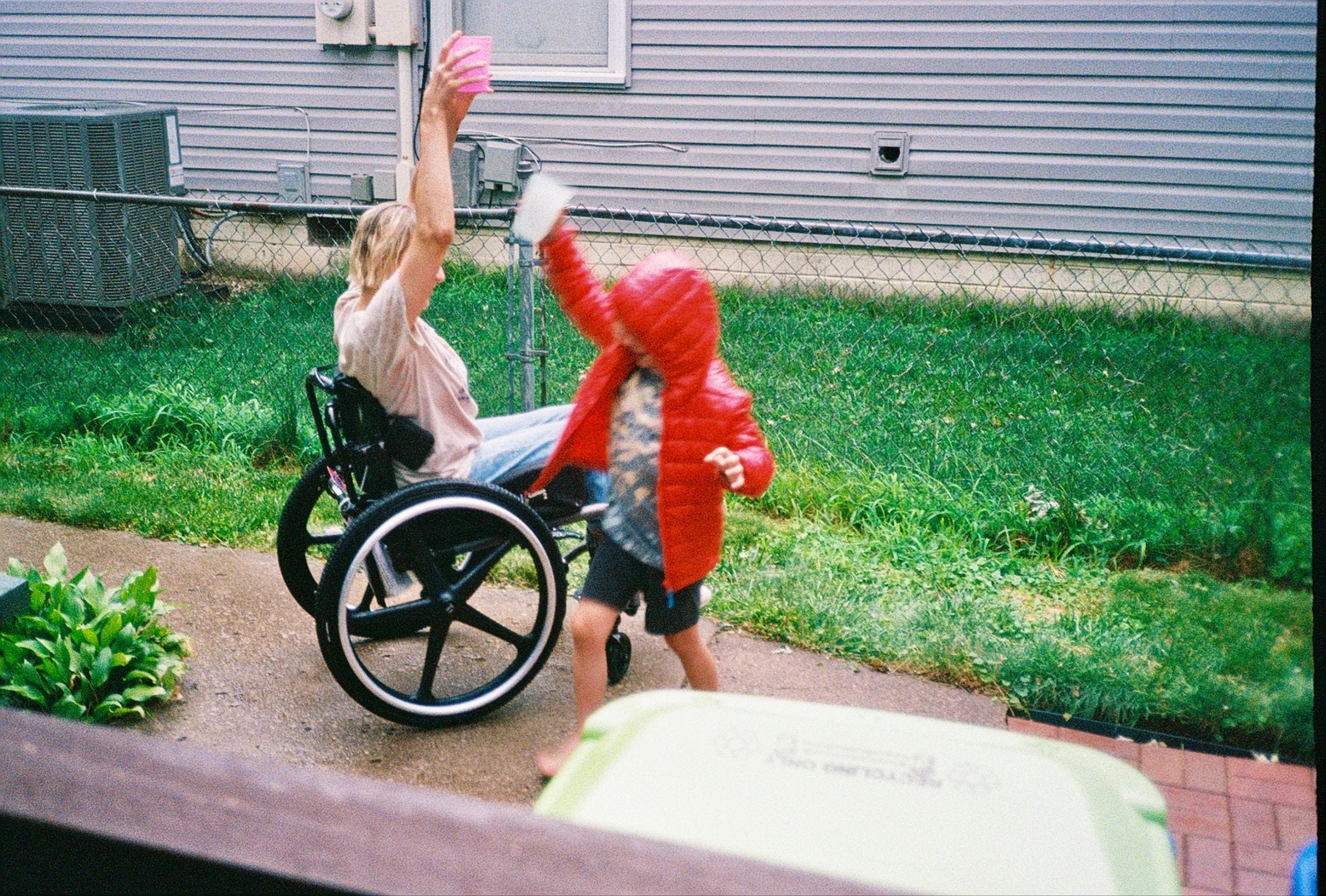
When your son is two, he will start going to daycare. Day after day, you will show up to the building alongside a line of parents whose bodies’ look and move and operate similarly to each other and not at all to you. You will roll down the hall toward the room where your son is waiting, and as he exits that building with you, the gap that was noticeable, even ordinary, on the way in will feel threatening on the way out. It’s one thing to be seen as Other when you’re alone. It’s a different game when he’s attached to you. And he Will Not play the game. He will not hold your hand, he will want to hide in the bush next to the parking lot while he waits for you to seek him, he will run in the opposite direction of the car and toward the baby bunny, the trail of ants, the bright red leaf. And your body will erupt in a panic to match. Not for the sake of a prom picture that looks like the other prom pictures, but to prove that you are a legitimate parent, you’ve got this, your son is safe with you. And to prove that legitimacy, competence, and safety, you will feel your bones grinding, your heart pounding, your head exploding with the urgency to do it like the rest of them – keep their pace, follow their direct routes, captain the ship with very little input from your sole passenger. Actually — maybe even a little bit better? Faster? Crisper? And every single day, you will fail at this. You will move slower, your path will deviate and loop, your son will protest, and you will be the very last car to drive out of the parking lot. You will be frustrated. You will both cry. And you will try this again and again and again. Every single day, you will panic over the gap between your family and typical.
This makes sense. You’re not foolish. There are real stakes here.
And also. The tight fist of that fear will diminish your capacity to assess the shifting level of risk. Until something deeper than fear begins to push its way to the surface.
I don’t even know how to tell you where the crack will start. Maybe it’s in the very moments that feel most like failure – when you will be too tired to try again. When you just give up. Yeah, okay, sure. Forget the car. Forget home. We’re playing hide and seek. Yeah, I do see that trail of ants – wow, look at how busy, how organized! And I can’t believe I was just going to roll by that baby bunny. Everybody stop! Nobody breathe! Just watch.

You’ll start dragging less and playing more, and the shift will start to feel easier. Maybe the older, sturdier, and more mobile your son becomes? Or maybe it’s how you’ll recognize that genuine safety increases when you’re working together. Some families will rush for a real reason – they have another kid to pick up or are trying to make it to an appointment or a shop before it closes, but you? You will rarely be in an actual rush. It will take you a surprisingly long time to realize that.
Slowly, oh so slowly, you will start to know, in your body, that your disability is one of the greatest tools you have to offer to this sprawling, unwieldy parenting project. It is the relentless prompt to bring you back into creative collaboration and connection with this miraculous, complicated human you’re in charge of for the next three breaths.
Whenever you feel the disability prompt, LEAN IN, BABY. Slow down. Take the zigzag path. Don’t try to skip across or gloss over or turn away from the crack; run your finger over its roughest edge until you hear what it’s trying to tell you. Like — connection over control! Creativity over default! Listening over demanding! There are no rules — just you, me, here, now, blank page, let’s go. Rely on those scrappy, adaptable, flexible, ready-to-pivot muscles you acquired through a lifetime in this disabled body. You’ve already survived decades of patience bootcamp – you’ve had to ask for help again and again – your body knows how to do this – let it. Every single human is operating within a web of limitations and assets – you, your son, your sturdy-fragile partner. Don’t crush what is possible for the arbitrary, faulty project of matching. Typical is not better. Not even close.
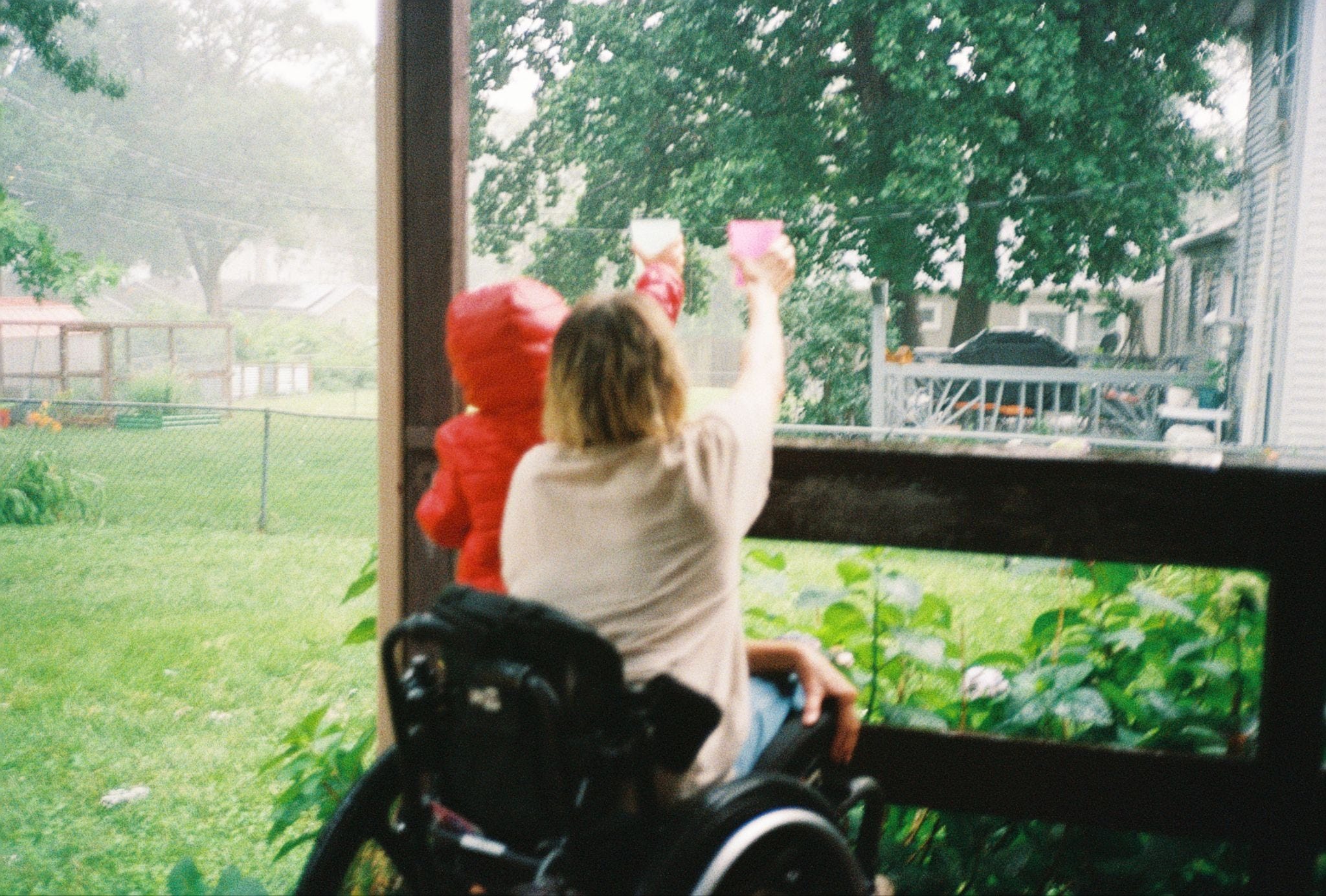
There’s a very real part of me that wishes that hard-earned insight could’ve been absorbed in tiny-purple-capsule form. I wish I could’ve known it in my body from the beginning. I wish I could take a hit whenever I need a quick return to that deep knowing. But I don’t think that’s how it works. I’m not even sure how much I could have absorbed these exact words had I read them in my peak panic during daycare pick up.
But these were some of the things swirling in my mind in the hours and days after I logged off of that virtual Q&A when the new disabled parents asked me for advice.
And in a great twist, I was actually given a second chance. The couple that asked the question in the Q&A actually reached out to me after the event, and despite our mutually busy schedules, we managed to huddle up for an hour over zoom to talk more about parenting and disability. And almost immediately, I noticed something unexpected.
They were very different kinds of people and parents than me. Even though their baby was only a few months old, they didn’t seem plagued by the self doubt that plagued my early parenting. They didn’t seem crushed by not matching. In fact, they didn’t seem to equate the difficulty of navigating the world as disabled parents with personal insufficiency at all. One might say they easily accepted that they weren’t “normal” parents (or they actually were very normal parents, depending on how you look at it). They’d already moved on to the fruitful path of figuring out – without shame, anguish, or guilt – the setup that would work the best for the three of them.
I sat with this surprise for weeks after we chatted. Especially in light of the advice I’d actually given on the official Q&A – connect with other disabled parents. In retrospect, I think I see the value and limitation of that advice with a sharper clarity than I did when I gave it. On the one hand, I wonder what a time-traveling relief it would have been for early-parenting-days me to meet with these exact parents in their early days of parenting – to see their assurance, to witness the precise brand of questions they were asking, to watch them point to inaccessibility as the problem. And also, had this time-slip conversation taken place, I don’t know how much I would have related to them. Despite the fact that we were all disabled parents, we did not actually experience the first few months of parenting in the same way.
As I say often, we are not a monolith. The path is not rigid. The experience of disability takes infinite shapes. And that seems worth our attention, too. When I was a new parent, I was so sure nondisabled parents couldn’t possibly understand my experience and disabled parents necessarily would. What feels truer now is just how hard it can be to understand ourselves, let alone any other person. It makes me want to keep both hands open, always – one for the ways we are the same, one for the ways we are different. How can we override the human brain’s impulse to assume, categorize, and draw boxes around each other? I suppose that question could be a sort of sideways piece of advice for parents and not parents alike.
A Couple of Other Things –
This week I posted a little signing off episode for the podcast I’ve been co-hosting with my friend Caitlin Metz for the last year. To mark the moment, I created a sort of kind of blackout poem from the transcripts of some of my favorite episodes. If you’ve been around here for a bit, you know I love a good blackout poem – like the ones I made from old medical charts (featured in this Substack essay last year). The whole episode is less than 15 minutes long, and if you’re in the mood for a both/and poem that looks the hard bits and the beautiful bits in the face, it’s here whenever you need it.
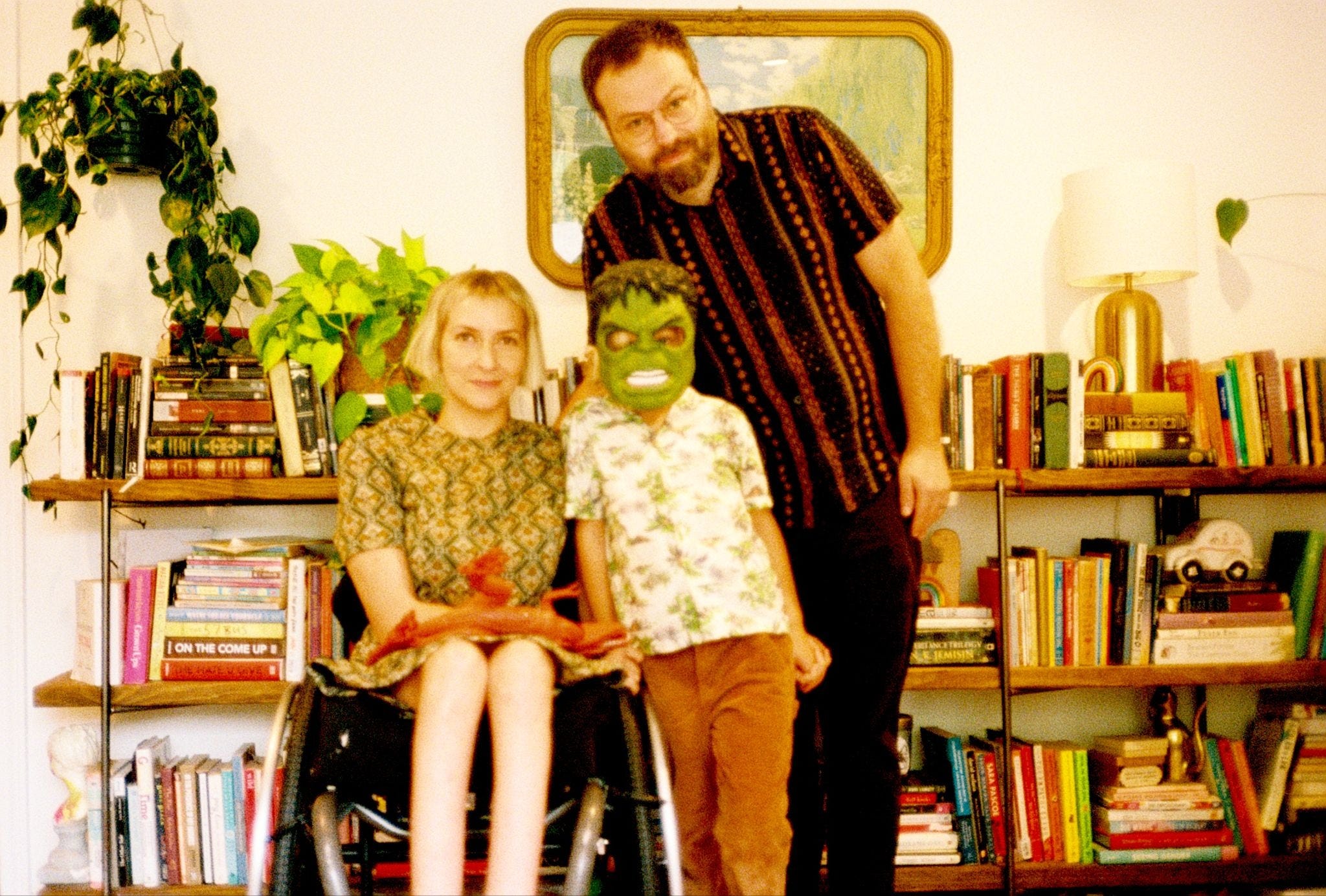
HAPPY HALLOWEEEEEN!!! The three of us are dressing up as pink axolotls this year. What about you? If you’re looking for an original tune to make the day feel festive, here’s a song Micah and I wrote for Otto when he was two and first falling in love with the spooky season.

CHEWY QUESTIONS – If you want to continue to think through the ideas here, these questions are for you – please feel free to explore this in your personal writing, to talk about it with your people, or to join the conversation on Substack.
What is it you wish a younger version of yourself could’ve understood earlier and through their guts? Do you think you had to learn it by going through it? Or do you think the right words at the right time would’ve made a big difference?
Have you ever been surprised to find a deep connection with someone when you weren’t expecting it? Or have you felt a disconnect where you expected quick understanding?
Thank you, as always, for being here.
xo
Rebekah
No posts
Comments
Nothing yet. Say the first thing.
Sign in to join the conversation.