
“Resistance aims to kill. Its target is the epicenter of our being: our genius, our soul.” — Steven Pressfield, The War of Art
“There are no bad parts, only parts needing healing. Even the destructive parts are trying to protect you.” — Richard C. Schwartz, No Bad Parts
I’ve been thinking about norms that impact how we lead, work, and connect since my recent Unburdened Leader conversation with Nilofer Merchant about her new book, Our Best Work: Break Free from the 24 Invisible Norms That Limit Us.
I see many accepted norms in how we approach discomfort and vulnerability in my work, especially when it comes to resistance.
And Steven Pressfield’s book, The War of Art, is one of those books I see people return to again and again when they want to better understand their resistance.
In it, Pressfield spoke to the many universal struggles of resistance, self-doubt, and procrastination, all of which often show up when someone is creating or doing something meaningful and high-stakes.
This book led to an albeit reductive takeaway for many that’s now a norm for responding to resistance: kill it at all costs, or it will keep your gifts from getting out into the world, including your best work.
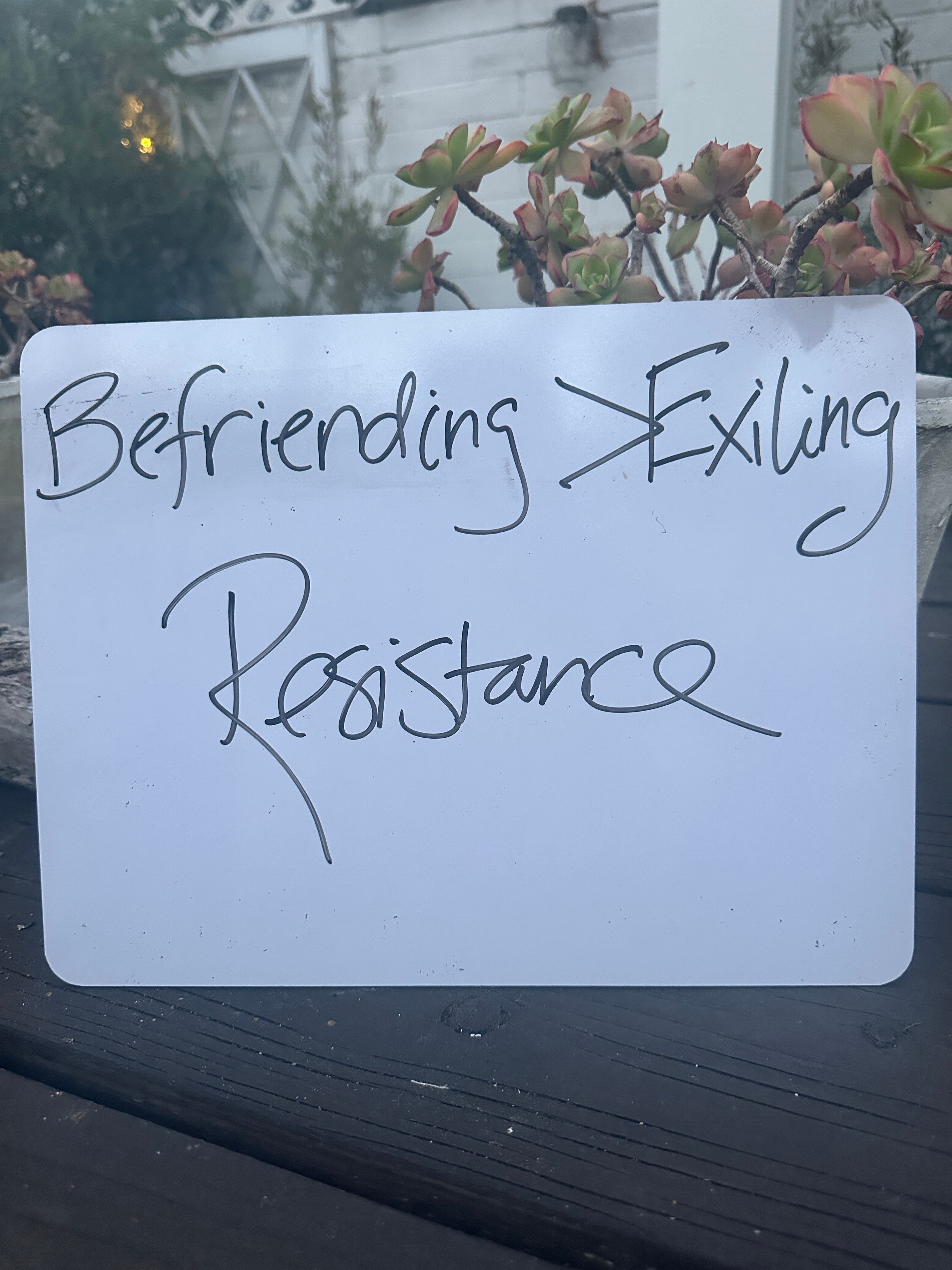
While I totally get the desire to exile resistance, I always found this approach to resistance disconcerting as it clashes with my trauma-informed training.
Here’s what my trauma-informed training taught me: powering over, cutting out, or exiling any part of someone’s story or any part showing up in the room perpetuates trauma.
The framework I’m certified in and consult in for my clinical and leadership work, Internal Family Systems, flips this script entirely: every protective part in us that shows up is trying to help us, even resistance.
Moving towards resistance rather than against it is countercultural…and it works.
And when I initially encouraged people to see resistance instead as an altruistic, protective force rather than their enemy, people would look at me like I had two heads.
While I don’t get that pushback as much these days now that approaches like IFS are more known, when I name resistance as a protective force to befriend and learn from, it still stirs the desire to shut it down and get rid of it.
Exiling is exactly what it sounds like. We take the parts of us that feel inconvenient, unacceptable, or painful and stuff or push them away. But here’s the thing: they don’t go away and instead weigh us down and create more internal angst. And that internal angst directly fuels how we show up in all the spaces we live and lead.
And when you do something that stirs vulnerability, you will likely experience some form of resistance that messes with your clarity and momentum.
We see the impact leaders have who want to kill resistance within themselves and within those they lead. It does not bode well for anyone on a team who has to exile parts of themselves for fear of rejection or alienation.
What sets you apart in how you lead yourself and others is how you relate to resistance and its BFF’s: procrastination, self-doubt, insecurities, and avoidance.
Instead of killing your resistance, get curious about what it’s trying to protect.
Instead of power-overing anything or anyone who activates resistance, you lead by powering-with.
Because the hubris of blowing through resistance rarely sustains and often does harm.
We learn early what we need to exile to fit in.
And that early learning, whether it happened in your families, at school, in your first jobs, travels with us into every room we walk into as leaders.
The leaders I work with often have done significant personal healing work. And when they step into a bigger role that has more visibility and complexity, they start feeling things they thought they had already worked through.
I call these ‘echoes’ of burdens that operate like muscle memory when fears show up. And they come to me asking: ‘What is wrong with me? Why am I backsliding?’
And my answer is always the same: Nothing is wrong with you. You are doing something new, and new is vulnerable. And feeling vulnerable always sucks. It’s data, not a moral judgement on your abilities.
Our bodies and inner systems do not forget what they need to do to protect, even if it means throwing up resistance in the face of vulnerability’s discomfort.
The nervous system carries the memory of what it felt like to be in those earlier situations where others minimized your needs and saw your doubt as weakness.
And when the conditions of a new situation activate those muscle memories, the body responds. Not because the healing didn’t happen. Because you are doing something that matters. And the parts of you that learned to protect you in those earlier moments are doing their job.
This is not a personal failing. This is biology. And it needs tending, not exiling
What if the thing you have been trying to defeat is actually trying to protect you? And what if what’s standing between you and the leader you know you are isn’t the enemy, but the source of your greatest wisdom?
What I teach and imperfectly practice is simple to understand but harder to do when resistance shows up. Instead of going to war with resistance, I get curious about it and ask it what it’s protecting.
I listen and ask if this part needs anything from me. Because that part of you that’s resisting? It has information you need.
And the leaders who learn to access that information lead differently. They make better decisions and stay more present. And they build teams that actually trust them.
Our relationship with resistance is what will set us apart. Not whether we feel it, but how we relate to it and stay present with ourselves and the people around us, even when everything in us wants to push through, shut down, or disappear.
That is not weakness or inefficiency.
This is the ongoing work of leaders humans today.
This piece is a companion to my conversation with Nilofer Merchant on The Unburdened Leader podcast — where we went deep on the norms that keep us from doing our best work and what it actually takes to build something different. Listen wherever you get your podcasts or find it at rebeccaching.com.
What came up for you reading this? Where have you been exiling resistance — in yourself or in others? How does rethinking your approach to resistance land with you? Hit reply and let me know, or leave a comment on Substack.
Comments
Nothing yet. Say the first thing.
Sign in to join the conversation.