
A fragment of rainbow suddenly appeared, rising up from the trees right in front of me, its colorful swath disappearing into the dark clouds above. I gasped. And then, suddenly, in the distance on the opposite horizon, another fragment of rainbow, this one even brighter, spouted up from earth into the clouds, with golden sunlight drenching the trees around me.
I was literally bursting with awe, and the need to share this with the world. But the Jerusalem park pathway I was on was empty.
Suddenly the clouds broke wide open and there was a complete rainbow sweeping all the way across the sky. The two fragments I had seen were actually either end of one perfect arc.
Just then I noticed a woman concentrating on picking olives from the grove there, her back to this glorious phenomenon.
“Look, look!” I called out to her, pointing to the rainbow, breathless for others to see this. She looked up at me, puzzled, and I pointed again, saying, “it’s a huge rainbow!” Seeing it, her mouth and eyes popped opened wide, and we burst into laughter at the sheer unexpected beauty of it.
In broken Hebrew with an Arabic accent she asked me to repeat the word in Hebrew.
“Keshet,” I told her.
“Qaws qazah,” she said, “in Arabic it’s qaws qazah.”
We both repeated the phrases to ourselves, feeling out the new sounds; then smiled and parted ways, me heading back home, her back to her olives.
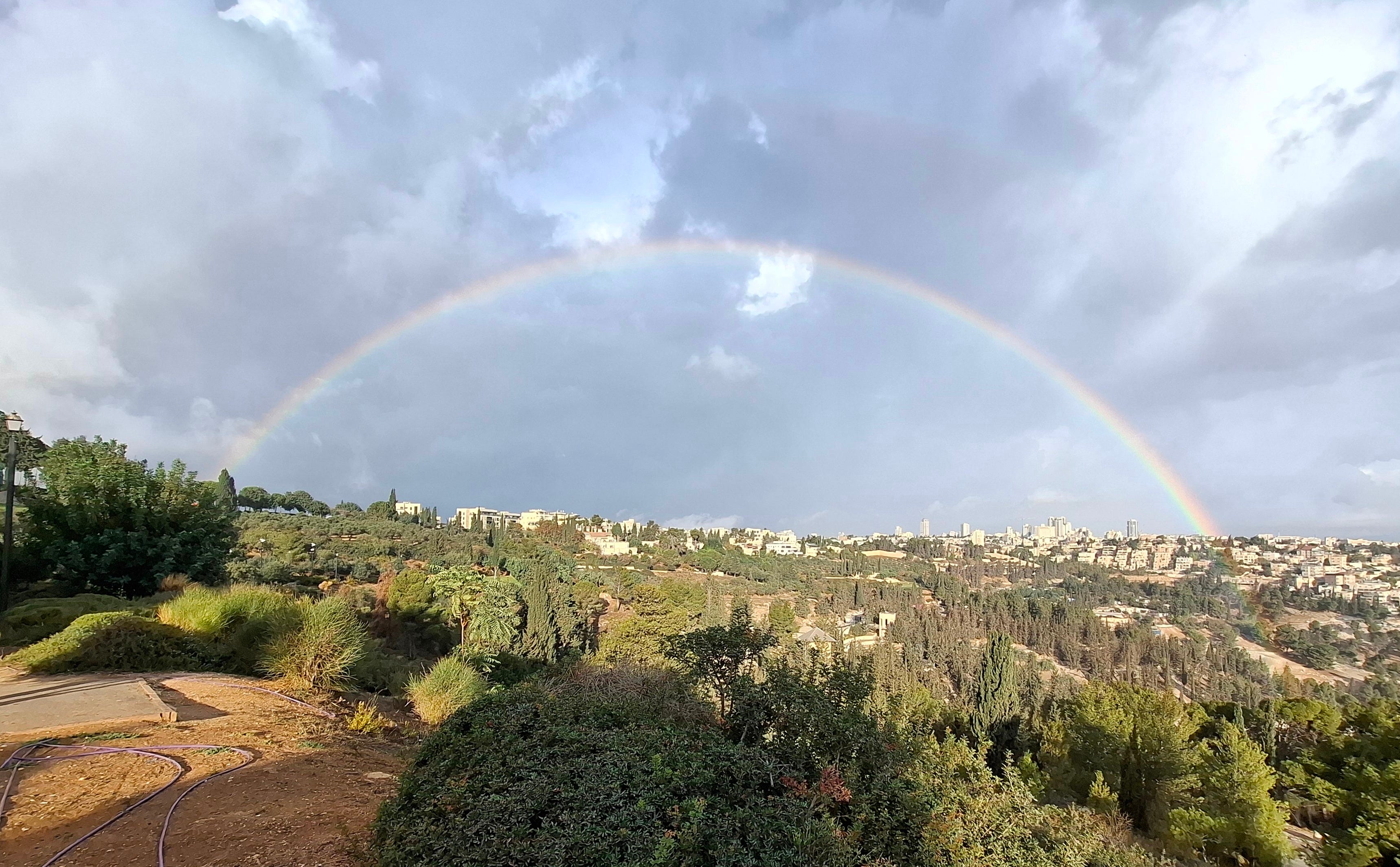
When I got home my daughter admired my photos of the rainbow and said she had just been reading about the story of Noah and the Ark, and how the rainbow is a symbol of God’s promise to Noah to never send such a flood again.
I went back to re-read the text, and how, after the flood is over, God establishes a covenant with Noah and his descendants, and even with every living creature: no flood will again destroy the earth, nor all living creatures. The rainbow, God explains, will serve as a symbol of this covenant, and a reminder of this commitment. [Genesis 9:8-17].
I wondered what Islam might have to say about rainbows. A quick google search showed that there is indeed a hadith that “The rainbow is security for the people of the earth that they will not be drowned.” This was also grounded in the story of Noah and God’s promise. A little reminder of our shared origins, and our intertwined present.
I couldn’t help but feel the sharp contrast between the small moment I’d just had in the park over a rainbow with the Palestinian woman who had been picking olives, and the evolving phenomenon of settler violence against Palestinian civilians in the West Bank, which has captured significant media attention in Israel over the last few weeks, triggered especially by the recent large-scale arson attack targeting industrial and agricultural areas, as well as IDF soldiers. Generally, the most frequent targets are farmers tending to their olive groves or herds, but also mosques, cars, homes, businesses. These are not security operations. They are explicit attacks on civilians.
Often referred to as settler violence, including in mainstream Israeli and Jewish media, it is often attributed to radical right-wing activists in the movement to establish illegal outpost settlements in the West Bank, also generally adherents of ultra-nationalist and religious ideology, and of Meir Kahane. But that only provides a partial picture.
This type of ultra-nationalist violence has been an ongoing issue for years. Though there have been some efforts to curb it by state and security officials, such violence goes largely unchecked. Since the war, the rate of incidents has gone up dramatically: some eight incidents per day over the last month or so, resulting in many being hurt and extensive damage. Under far-right National Security Minister Itamar Ben Gvir there has been a dramatic decline in investigations: a drop of 73 percent, and when there are investigations, few are indicted and even fewer convicted. This is not surprising given Ben Gvir’s explicit views and his history as a defense lawyer for such cases.
Unfortunately, over the years that this problem has expanded, attempts to address the issue, or even to draw broad public attention to it, have often been stymied. This is due to both far-right delegitimization campaigns, and public discomfort around examining something which feels critical of Israel and supportive of Palestinians.
But the escalation of the past few weeks has been sufficiently extreme as to catalyze both mainstream media attention and condemnation from security and political figures. President Trump’s administration expressed concern as well, specifically that settler violence risks undermining the efforts to fully bring the Gaza war to an end.
Condemnations are a start. Now effective actions to prohibit, prevent and prosecute this phenomenon are essential.
I know that for some it is tempting to turn away from this issue, whether out of discomfort, indifference, belief that it’s a fringe issue, or frustration for how such issues may be used to delegitimize Israel.
But closing our eyes to this issue is a mistake, for a wide range of reasons. First and foremost, these violent acts target and harm innocent people. The violence, and failure to curb it, conveys a message that Israel, and Israelis, condone harming Palestinians indiscriminately; this helps bolster those who promote terrorism against Israeli civilians. It is undermining Israeli rule of law, ethics and norms. Perpetrators are often teens with troubled personal backgrounds, and it seems that some are also taking advantage of this to advance their extreme political and ideological agenda.
At a more macro level, IDF Chief of Staff Eyal Zamir expressed concerns that this ultra-nationalist violence risks inciting a conflagration in the West Bank as well as undermining security efforts in other key areas such as Gaza, Lebanon and Syria. It also risks undermining opportunities for what could be significant regional alignments.
The role of the army is complicated, even implicated. While IDF soldiers are sometimes targets, as they were in some of the recent events, there are many incidents where soldiers fail to prevent such violence, and even participate in it. Chief of the IDF Central Command, Maj. Gen. Avi Bluth, who commands troops in the West Bank, came out with a clear denunciation of this; the next day settlers responded by torching a mosque in a Palestinian village, leaving graffitied messages condemning Bluth. In a citizens’ army, where service is compulsory, this is a matter concerning all Israelis.
At this point, we can’t say we didn’t know of the issues or their costs, nor that these are the actions of a marginal fringe, or just a few wild weeds. Failure to act effectively and consistently, allows this sort of ultra-nationalist violence to both represent us and steer us in ways that are disastrous for both Palestinians and Israelis.
Fortunately, these recent events seem to be triggering more widespread attention and response. There have been more stories in mainstream media. I was struck by a recent lengthy interview of the head of the Yesha Council on Galgalatz, the army radio station, in which the interviewers – who made it clear that they are not opposed per se to the settlements – were insistent on clear answers about concrete steps being taken. Some Gush Etzion residents are speaking out about the issue. The head of the Shin Bet has advocated going beyond bans to the use of electronic monitoring bracelets for known violent settlers. And the army, Shin Bet and police seem to be working together to identify a range of measures to address the issue.
This current flurry of attention and activity needs to go beyond appearance and rhetoric to sustained efforts achieving real results. It’s hard to see this particular government coalition being willing to truly pursue these efforts. But whether you are concerned for Israelis or Palestinians, on this matter our wellbeing is clearly intertwined. This situation is making all of us worse off.
It’s worth remembering the promise the rainbow symbolizes. There is a Jewish blessing we are supposed to say when we see rainbows.
בָּרוּךְ אַתָּה ה’ אֶלוֹהֵינוּ מֶלֶךְ הָעוֹלָם זוֹכֵר הַבְּרִית וְנֶאֱמָן בִּבְרִיתוֹ וְקַיָם בְּמַאֲמָרוֹ
Blessed are You, Lord our God, King of the universe, who remembers the covenant, and is faithful to His covenant, and keeps His promise.
It’s not just God who’s responsible for preventing disasters. This one is on us.
This piece appeared on my blog in Times of Israel on Novemer 25, 2025.
No posts
Comments
Nothing yet. Say the first thing.
Sign in to join the conversation.