
On Thursday I was invited to speak at the South West Paediatric Mental Health Network Conference — a room full of paediatricians, psychiatrists, and mental health practitioners. Highly motivated professionals with deep knowledge of mental health.
And much of what they wanted to talk to me about was neurodiversity.
It says something about where the gaps really are. These are the professionals the system points to when a child is struggling — and yet neurodiversity, something we know has a profound effect on a child’s mental health, whether it’s supported, unsupported, diagnosed, or missed entirely, isn’t something their training had equipped them to feel confident in.
I enjoyed the day - there were some fascinating and illuminating speakers on Child Trafficking, The Dark Web, local CAMHS provisions, Trauma pathways and a lived experience conversation with an amazing young adult who had struggled significantly with their mental health and come out the other side. However, it left me with some thoughts…
From my perspective as an educator, parent coach and content creator, my reach goes to place that most don’t see. And the DMs I get, tell the story just as much as the children I teach every day.
Childhood, as we’ve built it, runs through one institution. If you’re a child, you go to school. That’s not a small thing — school is where most children spend most of their waking lives, where friendships form, where identity takes shape, where a sense of belonging or not-belonging gets decided, day after day, for years.
So what happens when school doesn’t work for you? And — the question we ask far less often — why doesn’t it work?
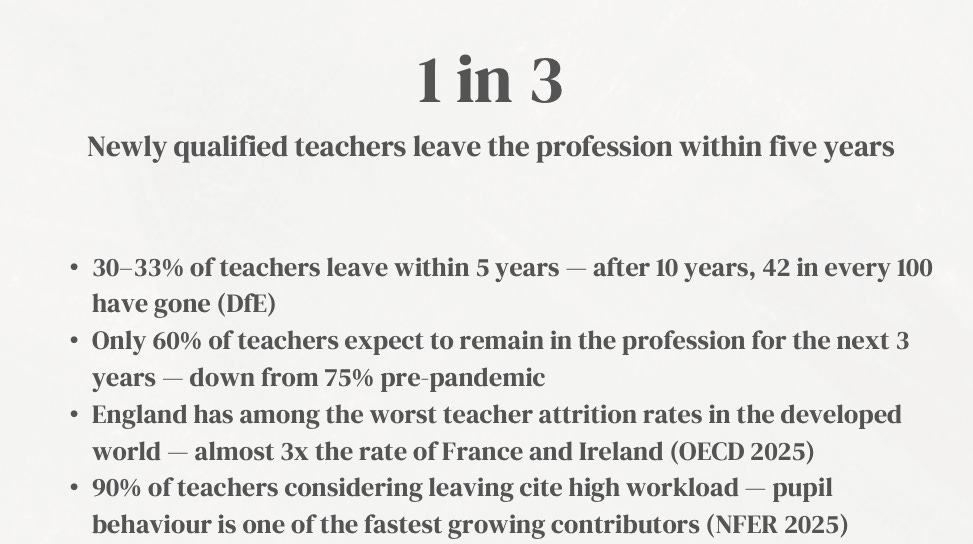
Part of my talk was a run of statistics — children’s mental health, neurodivergent mental health, school exclusions, attendance, CAMHS waiting lists. Some of this was familiar territory for the room. A lot of it, particularly around neurodivergent children, clearly wasn’t. Put together, the picture is bleak.One in three newly qualified teachers leave the profession within five years. Over three times the attrition rate of France or Ireland. Only 60% of teachers now expect to still be in the job in three years — down from 75% pre-pandemic. Pupil behaviour is one of the fastest-growing reasons cited for leaving.
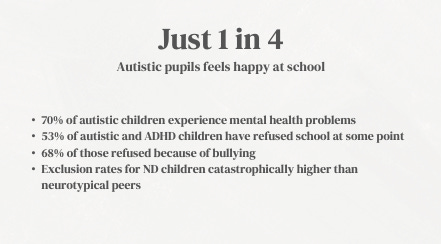
Just one in four autistic pupils feels happy at school. 70% of autistic children experience mental health problems. 53% of autistic and ADHD children have refused school at some point — 68% of those because of bullying. Exclusion rates for neurodivergent children are catastrophically higher than their neuro-average peers.
And the clinicians who are supposed to catch what school can’t? CAMHS waiting lists are now so long that by the time a child is seen, the crisis that triggered the referral may be a year old — and the consultant doing the assessment may see that child once, never again, with no visibility into the environment that produced the crisis in the first place.
Three different statistics. Three different parts of the system. But notice what they have in common: every one of them describes the system failing the adults too — teachers leaving, clinicians unable to reach the children who need them, CAMHS buckling under demand it can’t meet.
And yet when the system around a child collapses like this, the burden doesn’t land on the system. It lands on the child.
The teacher leaves — the child loses the relationship, and starts again with someone new, who doesn’t yet know them. The CAMHS appointment doesn’t come for eighteen months — the child carries the unmet need, alone, for eighteen months. The school can’t cope with how a child presents — the child gets excluded, or refuses to attend, and that becomes the thing written in their file. Not “the system around this child was buckling.” Them.
Every adult in this picture is doing their best inside a system that’s failing them. And every time that system fails, it’s the child who absorbs the impact — in their attendance record, their exclusion record, their mental health, their sense of who they are.
Take that first statistic again — a third of newly qualified teachers gone within five years. Now hold it next to what we know about what struggling children actually need: an adult who’s still there next term, and the term after, who notices the gradually before it becomes the all at once. That kind of relationship takes years to build. A school that can’t keep a third of its newly qualified staff cannot offer it — not because anyone doesn’t care, but because the relationship simply isn’t there long enough to form. Every departure takes it with them. The next teacher starts from zero, with a class of thirty, or — in secondary — a revolving door of thirty-odd children, six times a day, five days a week.
You can’t have relationship-first teaching and high-turnover schools. You can only have one. And right now, the child is the one paying for which one we’ve ended up with.
Here’s the question Thursday left me with.
A child’s mental health doesn’t live in a clinic appointment, or in a classroom, or at home. It lives across all three — and right now, those three points don’t talk to each other.
Home sees the meltdown after school, the refusal on Sunday night, the child who is a different person behind their own front door than the one the school describes. School sees two very different things, depending on the child: the mask — held together for six hours, then falling apart somewhere the school never sees — or the explosion, the child who can't hold it together at all, and ends up punished for the very thing the environment provoked. Professionals see neither, in any sustained way — they see a snapshot, once, often months or years after the pattern began, with no access to what home or school could have told them from the start.
Each point holds a piece of the truth. None of them holds the whole of it. And nobody is positioned, trained, resourced, or given the time to connect the three.
So the meltdown gets treated as a parenting problem. The mask gets mistaken for coping. The explosion gets written up as a behaviour issue. The snapshot in clinic gets read without the context that would make sense of it. Three stories, three records, three versions of the same child — and not one of them looking at the whole picture, because the system was never built to let them.
The canaries keep falling. We keep being surprised. Wrong question, again: it’s not what’s wrong with this child — it’s why did we build a system where home, school, and professionals were never connected in the first place?
Willow is an AI parenting companion built on my methodology, designed specifically for neurodivergent families and to help them navigate the gaps that this piece describes. You can find out more at squarepegkids.com.
Rebecca Briggs is a specialist teacher and parent coach with 35 years’ experience working with neurodivergent children and families. She is the founder of Willow, an AI parenting companion for neurodivergent families, and is currently writing her second book on the systemic failures behind the childhood mental health crisis. The Willow Schools pilot launches in September 2026. Rebecca spoke at the South West Paediatric Mental Health Network Conference in June 2026.
If this resonated, drop WILLOW in the comments and I’ll send you more information.
Rewired publishes every Friday at 9am UK time.
*Pictures in this piece are extracts from my talk to the SWPMHN Conference on 11th June 26, Bath, UK.
No posts
Comments
Nothing yet. Say the first thing.
Sign in to join the conversation.