

Our triumphalist president Don Trump—“So! Much! Winning!”—lost two wars last week: A big one against Iran, and a much smaller one against algae.
Let’s start with the big one. This past Wednesday at the Palace of Versailles—famed as a symbol of royal excess and bad diplomacy—Trump signed a memorandum of understanding ending his stupid war with Iran. Trump is pitching it as a victory. In truth, it’s more like an escape hatch, a way for Trump to extricate himself from one of the biggest foreign policy blunders in American history.
Trump started this war by assassinating Iran’s leaders and destroying much of the country’s military on the assumption that Iran’s new leadership would acquiesce to Trump’s demands out of an urgent instinct for self-preservation. Instead, Iran made the most obvious move possible: It grabbed the world by the Strait of Hormuz and demanded that Trump back down.
What Iran did was actually right out of Trump’s playbook. Trump likes to force his opponents to accept his awful demands by threatening worse if they defy him. This often works because Trump is basically a voluminous septic tank overflowing with money and shamelessness. He lets his opponents know he is willing to pay any price, suffer any humiliation, and destroy anything they love to get his way, implying they had better take the bad deal rather than resist and become party to a worse one.
Trump, however, backed Iran’s leadership into a corner, so they felt they had nothing more to lose. Iran also sensed there were two lines Trump wasn’t willing to cross: A new ground war in the Middle East and permanently higher gas prices. So Iran seized the Strait of Hormuz and essentially told Trump he could reopen it by either accepting their terms (the bad option) or sending US tanks along with thousands of body bags to Tehran (the worse option). The author of The Art of the Deal chose the bad option.
As I mentioned earlier, Iran closing down the Strait of Hormuz, a 24-mile-wide channel of water through which 25% of the world’s oil supply and 20% of the world’s natural gas supply flows, was a move so obvious even noob war gamers would grasp its significance. And anyone who’s been paying attention to the war in Ukraine should be aware of the menace posed by cheaply-produced drones. It’s clear Trump didn’t account for any of that before launching his war. Nor apparently did Trump reflect for even a minute on why his predecessors chose not to do the easy thing and just bomb Iran into submission. He just assumed they were weak of will. He never considered that Iran may have advantages of their own to leverage, or that the fallout of the war may reverberate around the world in (not-so-)unexpected ways.
So what did this war accomplish? Not regime change: Iran’s new supreme leader is the son of the old supreme leader. If any regime change has happened, it’s probably been the entrenchment of Iran’s military leadership. Only time will tell if a military junta is preferrable to the old theocracy. Furthermore, not only did the war not liberate the Iranian people, but it’s left them worse off than before. Iran had repressed domestic uprisings earlier this year; now any kind of internal dissent seems unimaginable.
Trump did not get Iran to end its nuclear program, which he had supposedly destroyed last year with air strikes. Trump and Iran have only instead agreed to continue discussions about the future of the program. The reality, however, is that the US has lost most of its leverage when it comes to negotiating with Iran over its nuclear ambitions. If Iran walks away from the negotiating table, what is Trump going to do, bomb them? It’s now clear Trump no longer desires to do that. And if Trump did resume strikes, Iran could simply reclose the Strait of Hormuz in retaliation. Ironically, now that Iran maintains a chokehold over Hormuz, they may no longer desire a nuke. Controlling a massive portion of the world’s oil supply probably grants them more leverage than a nuclear weapons program or even an actual nuclear weapon (which they knew they could never use anyway) could have ever provided. (Also, if Iran’s nuclear weapons program is no longer a national priority, why did Trump set up a $300 billion fund to encourage them to dismantle it?)
In other words, Iran comes out of this war in a strengthened geopolitical position. Iran is supposed to allow free transit through the Strait of Hormuz for the next 60 days, but all bets are off after that. (UPDATE: Iran announced yesterday they reclosed the Strait since Israel was not abiding by the ceasefire agreement. That puts Trump in quite the jam: The only way he can deliver on his end of the deal is to convince a country he has no control over to stop fighting.) Two months from now, Iran can turn the Strait into a toll booth, with rates determined by what they want and whether or not the world is acquiescing to their demands. If the world doesn’t play along, Iran can close it once again. The oil-rich nations of the Persian Gulf, who have long viewed Iran as a rival and the US as an ally, may conclude it makes more sense to align their politics with the new gatekeeper rather than the old policeman. A year ago, Iran would not have dared to close the Strait of Hormuz. They had no idea how the US would have responded. Now they’re emboldened to do that knowing the US Navy isn’t coming to stop them.
It is true Iran’s military and economy have been decimated by the war. We also don’t know what the long-term consequences of the war will be; perhaps new pipelines will reroute oil to ports beyond the Persian Gulf, or maybe uncertainty surrounding oil supplies will finally spur nations to hasten the transition to green energy sources. But right now, it’s hard to say Trump won this war. Despite taking an enormous punch, Iran was not only able to drive the terms of Trump’s surrender but reasserted its place as a major geopolitical player on the world stage. On the other hand, Trump flexed his might only to end up negotiating his way back to a deal that is not only short of the pre-war status quo but worse than the Obama-era deal Trump derided and tore up. Trump was convinced he could win by playing the strong guy. Instead, he lost. Our saving grace is that Trump—perhaps because he was bored, chastened, fearful of the political consequences, or eager to turn his attention to Cuba—didn’t double-down on his folly and put boots on the ground, but that doesn’t excuse the folly to begin with.
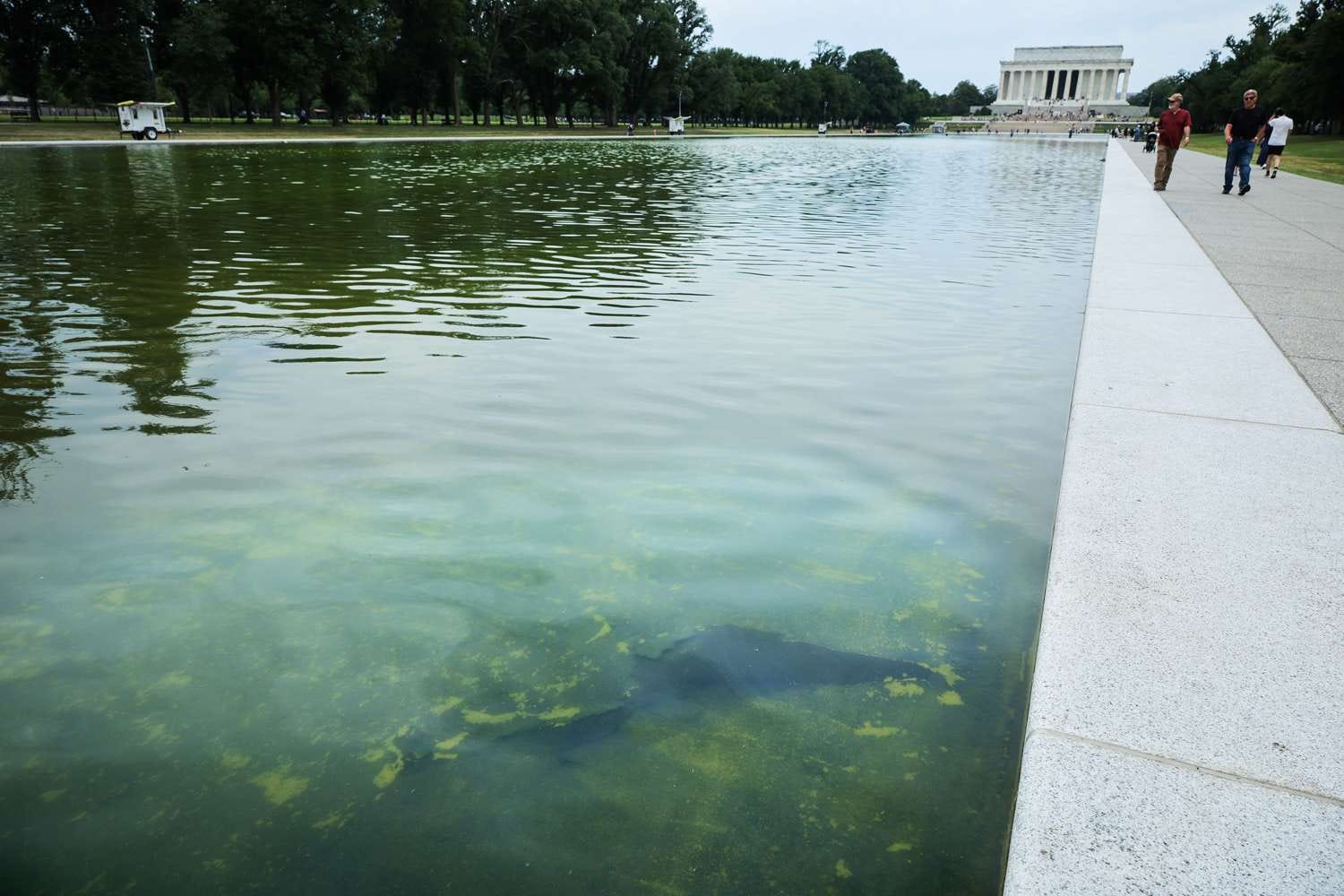
Trump’s surrender to Iran played out last week alongside another war he has been waging (and also losing) in DC against algae. Back in April, Trump decided he needed to renovate the Reflecting Pool between the Lincoln Memorial and the Washington Monument. Admittedly, the 100-year-old pool is difficult to maintain: It has sunk by a foot, its filtration and water treatment system is flawed, the basin and pipes annually leak over ten times the pool’s 6.5-million-gallon capacity, and algae blooms frequently turn the pool green. As Trump is quick to point out, renovations undertaken during the Obama administration did not solve these problems. However, as the owner of multiple country clubs, Trump decided he was just the guy we the people needed to fix a faulty pool.
Trump originally said the project would only cost $2 million. Expenses eventually ballooned to roughly $14 million. The government bypassed the typical competitive bidding process and hired a contractor for $1.7 million to oversee the project. The contractor also happens to be a Trump donor, a Mar-a-Lago neighbor, and someone who pled guilty to conspiring to bribe a member of Congress in 2001. Trump put his personal touch on the project by having the contractors cover the bottom of the pool with a coating colored “American flag blue.” The work was completed pretty quickly for a project of this magnitude, and the Reflecting Pool was refilled a couple weeks ago and in plenty of time for the nation’s semiquincentennial. Did the paint job make a visible difference? Reportedly, not much.
But then the algae reappeared, turning the pool’s water green. This was not necessarily surprising, since Trump did not fix the underlying filtration issue (that work will supposedly begin later this year) and new blooms often occur in recently refilled pools. It probably did not help, however, that the bottom of the pool had been painted dark blue, as darker colors absorb more sunlight, which increases the temperature of the water and makes the shallow, unshaded pool a more hospitable environment for algae. Workers combatted the bloom by adding hydrogen peroxide to the water, but that only switched one type of algae out for another. On Thursday, however, a new problem literally rose to the surface: The pool’s blue coating began peeling away. (Hydrogen peroxide is a paint stripper, so that may be the culprit.) Visitors to the Mall could be seen pulling scraps of paint out of the muck as souvenirs. The Reflecting Pool is now a brew of slimy green algae and American flag blue paint rinds. (UPDATE: Trump stated last night that vandals had so damaged the pool that it would now need to be drained. There is no evidence to support Trump’s accusation unless you consider painting the bottom of the pool an act of vandalism. If that’s the case, we definitely know who the true vandal is.)
During his second term, Trump has made it a personal priority to oversee a makeover of Washington DC, which is weird for a guy with so much else on his plate. He’s turned the White House into a tacky, gilded palace, paved over the Rose Garden, added two large flag poles to the grounds, renovated the Lincoln bedroom’s bathroom, and demolished the entire East Wing to make room for a colossal $600 million ballroom. (Trump initially said private donors would pay the ballroom’s $400 million price tag; now taxpayers are expected to foot half the bill.) Just beyond the White House, Trump intends to paint the gray granite of the Eisenhower Executive Office Building white and has closed Lafayette Square for renovations. (Trump is afraid protestors will pry bricks out of the square’s walkways and use them as projectiles, so he wants new sidewalks paved with granite.) Huge 1984-style banners bearing Trump’s face hang from federal office buildings throughout the District. At the entrance to Arlington National Cemetery, he plans to build a gigantic arch that would dwarf the Lincoln Memorial, and he wants to construct a Garden of American Heroes along the Potomac to honor such luminaries as circus performer Annie Oakley and game show host Alex Trebek. In a move that would have been equivalent to Trump painting his name onto the Washington Monument and rebranding it the “Trump-Washington Monument,” Trump slapped his name onto the Kennedy Center—the nation’s official memorial to John Kennedy—took over the Center’s operations, and then moved to close it down. A federal judge recently ordered him to remove his name from the Center’s façade, which he did, but Kennedy’s name remains concealed behind scaffolding covered in tarp. (Trump’s doing that either because he’s petty or because his stunt damaged the building’s exterior.)
I don’t know why Trump is so obsessed with these vanity projects. Perhaps he is used to living in the lap of luxury and finds the federal government’s accommodations lacking. Or maybe he is envious of the royal splendor he has encountered during visits to foreign capitals and feels the United States’ more plainspoken architecture and décor—a reflection of our democratic heritage—is unfitting for such a powerful nation and its president. As a politician more attuned to culture than policy, it probably makes sense Trump is more interested in projects that stir emotions rather than those that materially improve people’s lives. I suspect a big part of what Trump is doing is tied to his self-image as a supremely successful real estate developer with “exquisite” taste who wants to share his gifts with America, no matter how tacky that taste may be. He also probably wants to leave as many monuments to himself scattered across Washington DC as possible.
Yet what Don Trump’s adventures in both Iran and the Reflecting Pool reveal most about the man is his toxic understanding of power. Trump thinks power is just about imposing his will on others and holds nothing in reserve. That, he believes, was the weakness of his predecessors. But Trump confuses might with invincibility, wields power carelessly and recklessly, is oblivious to his own limitations, always forgets there are forces beyond his control, and never accounts for the advantages his opponents could potentially leverage against him. That’s how forces both large (a Middle Eastern nation) and small (microscopic Scenedesmus algae) humiliated him last week, and why Trump ends up ruining everything he touches. You could say it’s the stuff of tragedy, but Trump’s far too pathetic for that.
Trump is dangerous because he is willing to use the powers of the president instrumentally and illegally (neither his war with Iran nor his renovation of the Reflecting Pool received proper authorization.) But his failures last week revealed he is fundamentally a weak and tiny president, someone who can get neither the big nor little things right. He’s full of bluster and bombast. He’s really good at wrecking stuff. He’s terrible, though, when it comes to getting results. That hardly makes him a powerful man. Thankfully, after the week Trump just had, the nation is finally beginning to realize that.
Thanks for reading Reason to Believe! This post is public so feel free to share it.
Comments
Nothing yet. Say the first thing.
Sign in to join the conversation.