
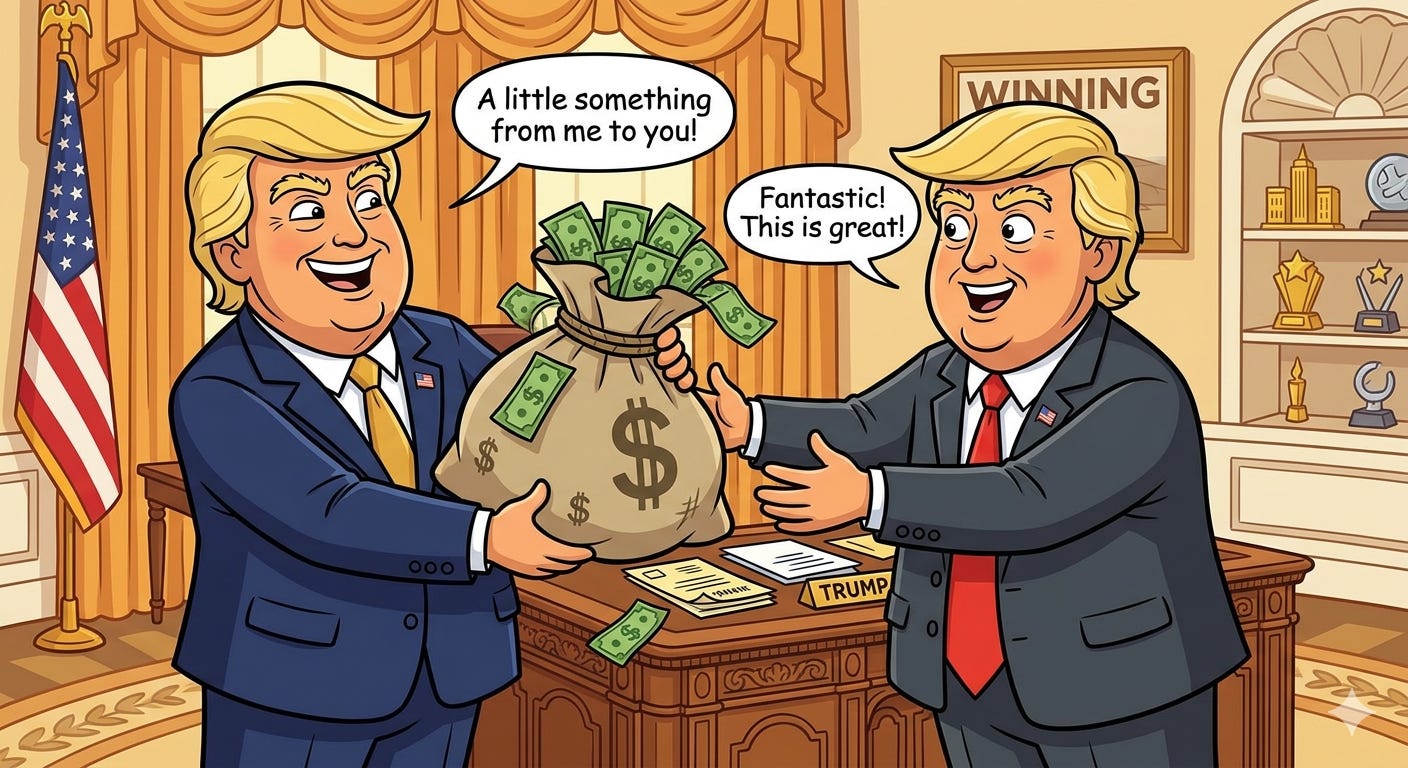
Strangely, one of the most glossed-over aspects of Don Trump’s reign as president is its corruption. I argued in 2017 that Trump would become the most corrupt president in American history as soon as he took office due to his refusal to divest ownership of the Trump hotel on Pennsylvania Avenue in downtown DC, which he could use to launder the money of literal lobbyists. By the time he was reinaugurated eight years later, Trump had turbocharged his grift through the sale of stock in his social media company and meme coin, which enabled anonymous investors to enrich the president by overinflating its value. Nearly everything the administration does—from withholding funds to Ukraine to holding up media company mergers—stinks of a quid pro quo. The corruption is so great it is as though Watergate is happening on a daily basis.
Yet for the most part, the broader American public has been unmoved by these scandals. There are many reasons for this. The first is the moral corruption of the Republican Party, which has lacked the collective heft and guts to rebuke this president. Another is that despite the American people’s professed disgust for corruption, it turns out combatting it is just not as big a priority as issues that have a more direct effect on public life, like the economy, war, and public health (issues that at one time or another have actually tanked Trump’s approval rating.)
Third, when it comes to matters of corruption, the American people are very susceptible to “whataboutisms,” or defensive arguments that flip accusations back onto accusers. This has always been a go-to move for Trump; recall how he drew attention to Bill Clinton’s sex scandals following the release of the Access Hollywood tape in 2016. It certainly helped that a whiff of scandal trailed opponents like “Crooked Hillary” and “Crooked Joe,” but the ethically-compromised Trump was also determined to amplify the idea that politics itself is so inherently corrupt that it was only fair people should allow him to be as dirty as his adversaries. (There is no place for the “when they go low, we go high” standard in Trumpworld.) A decisive segment of the American people, inclined to believe the worst about politics and that their only choice was between two evils (without taking the time to actually assess and gauge “evil”) were willing to define deviancy down in Trump’s case.
Finally, Trump benefits from Mr. Burns Syndrome, aka “Three Stooges Syndrome.” This is a reference to an eleventh-season episode of The Simpsons in which Mr. Burns is diagnosed as “the sickest man in the United States,” afflicted by “everything.” When Mr. Burns says that sounds like “bad news,” his doctor counters that his ailments actually cancel one another out. To demonstrate, Burns’ doctor produces a small door and a handful of novelty germs; as he shoves the germs through the door, they all get stuck inside the frame, with none able to break through to sicken the millionaire:
Mr. Burns concludes this condition leaves him “indestructible.” And that’s how it is with Trump, too: A man afflicted by so many scandals that none on their own are able to weaken the man.
This past week, however, one may have finally broken through.
Last Monday, Don Trump essentially ordered the Justice Department to settle a $10 billion lawsuit he had brought against the IRS for $1.776 billion. Trump filed that lawsuit against the IRS this past January, alleging the agency was responsible for leaking his tax returns to the press back in 2019-2020. That set up a bizarre situation in which Citizen Trump was basically suing President Trump; as one of those Trumps stated after filing the lawsuit, “I am supposed to work out a settlement with myself.”
Acting Attorney General Todd Blanche—who as recently as 2024 was working as Don Trump’s personal attorney—announced the details of that settlement last week. It includes that $1.776 billion taxpayer-financed payout, which is structured as a slush fund Trump can use to compensate those who “suffered weaponization and lawfare” at the hands of the government. What that means is Trump—who essentially controls the board responsible for disbursing the money—intends to use that fund to reward people the government investigated, prosecuted, and in many cases imprisoned for committing crimes on Trump’s behalf.
The most notable of these individuals are the over 1,500 people who assaulted police officers, entered the Capitol Building through shattered windows, and disrupted an official act of Congress during the January 6 insurrection. (Remember, Trump has pardoned all those individuals.) But given Trump’s loosey-goosey relationship to the rules and his conviction that any criticism of either him or his political movement is unfair, the recipients could also include anyone Trump believes has been victimized by his political opponents. While the settlement prohibits Trump and his boys from receiving any of the fund’s money, it’s easy to imagine Trump stashing his winnings away in something like a “dark money” 501(c)(4) and accessing the cash that way.
Perhaps most ominously, though, a $1.8 billion Trump-controlled slush fund sends an unambiguous message to people who may commit crimes on Trump’s behalf in the future. Trump has already shown his willingness to pardon Trump-aligned criminals; now he can point to a huge pot of money he can use to generously reward them for their efforts.
(By the way, it’s worth putting that nearly $1.8 billion into perspective. Neither Trump [$500 million] nor Joe Biden/Kamala Harris [$1.2 billion] spent anywhere close to that amount of money during the 2024 presidential campaign. [Don’t think $1.2 billion is in the same range as $1.8 billion; Biden/Harris would have needed to increase their fundraising by a little less than 50% to match it.] When it comes to the United States’ $7.5 trillion budget, $1.8 billion is just a drop in the bucket, but $1.8 billion can still buy a lot, including annual funding for the Federal Trade Commission [$384 million], the Peace Corps [$487 million], the Smithsonian Institution [$1.1 billion], TRIO programs [$1.2 billion], and the National Weather Service [$1.4 billion]. Put another way, Trump can fund a lot of crime with $1.8 billion. I seriously doubt DOGE will be on the lookout for “waste, fraud, and abuse” in this case, either.)
The other outrageous part of Trump’s settlement is a page-long addendum Blanche posted on Tuesday declaring the United States is “FOREVER BARRED and PRECLUDED from prosecuting or pursuing” Trump, his sons Don Jr. and Eric, and their businesses for financial crimes. There’s some debate about what this addendum actually amounts to, but one thing is clear: Trump and his family are no longer on the hook for what could have been a costly $100 million IRS audit. In fact, any financial crimes they committed prior to last week—including ones we may not yet be aware of—are no longer justiciable. Whatever they may have done, they’re off, scot-free.
The scope of this addendum is uncertain, perhaps intentionally so. It is unclear if Trump’s protections extend beyond strictly financial crimes, if the order prohibits agencies other than the IRS from investigating Trump, and if it prohibits the government from investigating future crimes Trump may commit. Regardless, it’s fair to assume Trump will push these ostensible limits beyond their breaking points. What Trump appears to have done, however, is issue himself and his family something like a pardon. As you may recall, the Supreme Court in Trump v. United States (2024) has already granted Trump extensive immunity for official acts undertaken as president, with “official” defined in very broad terms. That ruling did not cover civil crimes, though. With this settlement, Trump takes it upon himself to address that loophole. It also sets up the likelihood that Trump will pardon himself, his family, and his associates as one of his final acts in office.
Thankfully, there’s already some pushback against Trump’s scheme. Lawyers have argued the creation of Trump’s $1.8 billion slush fund is an appropriation, and the Constitution only grants Congress the power to appropriate money. Trump, however, appears to be leaning on a congressionally-approved Judgment Fund that authorizes the president to pay judgments and settlements in lawsuits filed against the federal government to legitimize his actions, although Trump’s use of that fund stretches its intent.
Democrats are obviously outraged, but so, too, are some congressional Republicans, who scuttled a vote on a reconciliation bill last week following a tense meeting with Blanche. Senate Republicans, nervous about Trump’s plummeting poll numbers amid an unpopular war and rising gas and grocery prices, were already dreading a vote to fund Trump’s ballroom vanity project. They’re also upset Trump has made it his mission to oust incumbent Republican legislators he considers insufficiently loyal. Asking them to bless a $1.8 billion taxpayer-funded slush fund may finally be a bridge too far.
Yet no one would be surprised if Republicans caved to Trump yet again. Furthermore, no one would be surprised if Trump went ahead with his scam even if Congress told him no, and if that happened, no one would be surprised if this Supreme Court—which rarely intervenes to limit the power of a Republican executive—took the president’s side in the dispute. I can already imagine the majority’s opinion: The president, acting through the attorney general, is this nation’s chief law enforcement officer; as the nation’s chief law enforcement officer, only the president has the power to make decisions in cases in which the United States is a litigant; and those decisions are ultimately political decisions, meaning it ultimately falls to voters to pass judgment on the wisdom of those decisions. (I wouldn’t be shocked to see the Court sneak something into the decision about the president’s constitutionally-legitimate power to pardon himself as well.)
Democrats should be preparing now for the likelihood this case ends up before the Supreme Court. It’s not just that they have an ethical obligation to stand up to Trump’s corruption; it’s that they can also use the case to put the judicial reasoning and legitimacy of the Court’s conservative majority on the line.
It’s not hard for Americans to grasp what’s wrong here: Trump has ordered the government to give him 1.776 billion hard-earned taxpayer dollars so he can lavish it on his friends. It’s a clear act of self-dealing. It’s also a slush fund that can be used to finance political crime, which is made all the more apparent by who the slush fund is intended to benefit. When fused to presidential immunity and the president’s pardon power, it creates a serious “Ladder Problem,” which I defined two weeks ago in my article about gerrymandering as a circumstance in which someone who wins power uses his power to prevent others from contesting his power (like someone who climbs up a ladder and then pulls the ladder up behind him so others can’t use it.) A president who can use government funds to pay people to commit political crimes and then pardon those individuals (all while possessing immunity himself) is practically unassailable.
Yet the Constitution does not explicitly prohibit any of this. When it comes to the pardon power, one could even argue it permits it! And I worry this Supreme Court, in either its naïveté, obtuseness, or own base corruption, will allow it.
Which is why Democrats need to draw a line in the sand right now when it comes to this case. They need to declare that this scheme on its face is unconstitutional. Not only does it short circuit our system of separated powers, but it also offends the basic notions of justice and the rule of law that the Constitution is premised upon. The Constitution is designed to serve the people; it’s not a contrivance that allows the president to enrich himself and his cronies. It is supposed to grant the government legitimacy and integrity, not undermine it. It is a system that authorizes the use of power but does not intend for that power to destroy the system it creates; in other words, the Constitution is not the seed of its own destruction. These ideas are inherent to the very idea of constitutional government. A Court that let’s Trump get away with his scam by refusing to stand up for these basic principles is not a legitimate political institution and ought to be treated as such.
James Madison wrote in Federalist 51, “In framing a government which is to be administered by men over men, the great difficulty lies in this: you must first enable the government to control the governed; and in the next place oblige it to control itself.” This is why we have a separation of powers: If one branch abuses its power, another can put that branch back in its place. When the president sues himself and then settles the case by awarding himself a $1.8 billion slush fund, the Supreme Court has an obligation to say that’s crooked as hell. If they can’t bring themselves to do that, then they should know We the People will finally know with certainty that they’re as crooked as the president and kick them to the curb.
Thanks for reading Reason to Believe! This post is public so feel free to share it.
Comments
Nothing yet. Say the first thing.
Sign in to join the conversation.