
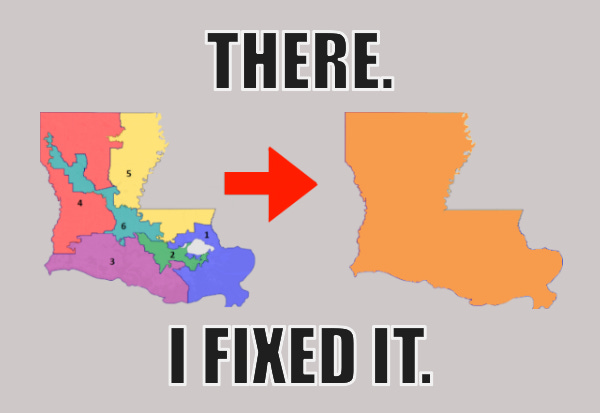
Last week, I wrote about Louisiana v. Callais, a recent Supreme Court case about the constitutionality of majority-minority districts and race-based gerrymandering. In accordance with the Voting Rights Act (VRA), Louisiana drew two Black-majority congressional districts. This meant one-third of Louisiana’s congressional districts would in all likelihood be represented by a Black representative in a state that is one-third Black.
In Callais, the Court’s conservative majority declared Louisiana’s map unconstitutional. The Court said state mapmakers could not take race into account when drawing congressional districts. Louisiana’s Republican-led legislature will now likely redraw the state’s congressional map so there are no Black-majority districts at all. This will pass muster with the Court because Louisiana’s mapmakers won’t publicly announce they are drawing six White-majority districts. Still, the new map will effectively be more racially gerrymandered than the old map, which had the virtue of mirroring the state’s racial demographics.
The Court’s ruling in Callais has set off a furious new round of gerrymandering, as Southern states are now busy slicing VRA-mandated Black-majority districts to pieces. This means the South will soon be plastered with White-majority districts drawn by mapmakers who have perhaps not publicly but by all appearances secretly taken race into account.1
There is a powerful rejoinder to my argument that needs to be addressed. It concerns correlation. Defenders of Louisiana’s new map (the map that will likely eliminate both Black-majority districts) could argue that by redrawing the map, they’re not redistricting Blacks out of power. Instead, they’re redistricting Democrats out of power. It just so happens that in Louisiana, Blacks make up about two-thirds of the Democratic Party. Therefore, a partisan gerrymander that favors Republicans will inevitably disadvantage Black candidates because the categories of “Black” and “Democratic” are correlated with one another. It could be said then that Republican state legislators are not using their redistricting power to target Blacks but rather Democrats, and that’s constitutionally permissible because partisan gerrymanders are constitutional.2
This is a difficult charge to counter. Louisiana’s mapmakers could simply look at partisan affiliation without ever considering race and end up creating a map that coincidentally strips Black voters of the opportunity to elect their favored congressional candidates. Absent a public declaration of racist intent,3 all the evidence would point to a partisan motivation even if the effect appears to be a racial gerrymander favoring White voters.
I argued last week why I think it’s important to take effect into account when evaluating the validity of congressional maps, so I won’t rehash those arguments here. Instead, I want to briefly focus on this issue of correlation, and only briefly, because I think it exposes a more fundamental problem.
My issue with the correlation argument is that it doesn’t account for why the Black vote is correlated with the Democratic vote. As I mentioned in my last article, nearly 9 out of every 10 Black voters votes Democratic in presidential elections. That’s due in part to their support for the Democratic Party’s economic agenda, but it’s also because the Democratic Party (while not perfect in this regard) has backed civil and voting rights legislation and made diversity and inclusion a party priority. On the other hand, for the past sixty years, the Republican Party has alienated Black voters by exploiting White racial grievances for partisan gain. That’s why the Black vote is so strongly correlated with the Democratic Party.
If the Voting Rights Act was designed to protect the civil rights of Black voters by creating Black-majority districts; and if those Black voters still feel the need to prioritize the defense of their civil rights; and if those Black voters overwhelmingly believe the candidates who do the best job defending their civil rights are Democrats; and if those Black voters therefore vote in large numbers for the politicians most likely to defend their civil rights…well, I’d say that sounds like the Voting Rights Act doing exactly what it was meant to do even if it “just so happens” Democrats end up benefitting politically from that. That also means it ought to be acknowledged that “Black” isn’t simply correlated with “Democrat” but with “civil rights” as well, meaning Black representation isn’t the only thing “coincidentally” lost when Republicans design partisan gerrymanders that favor Republican voters. It may sound better to say Louisiana’s Republican-led legislature is simply targeting “Democrats” with their gerrymandering—after all, lots of states of both the red and blue variety engage in partisan gerrymandering—but in Louisiana, “Democrat” is also a racially-loaded term.4
But if we take a step back from all this, there’s probably another issue that’s bothering a lot of you: If racial gerrymanders are unconstitutional, why aren’t partisan gerrymanders as well? If mapmakers can’t take race into account when drawing congressional districts, why can they take party into account? Why can they basically rig the outcomes of elections (and, in many ways, the balance of power in Congress) by giving one party or the other huge and in some cases insurmountable advantages in districts throughout the country?
There are a couple reasons why partisan gerrymandering has not been declared unconstitutional. To start with, racial gerrymanders discriminate on the basis of race, a practice forbidden by the Equal Protection Clause of the 14th Amendment. The Supreme Court applies the strictest level of scrutiny to claims involving racial discrimination. The Court has never treated claims of partisan discrimination with the same level of scrutiny, and for good reason: When parties win elections, they win a mandate to pursue partisan goals, so requiring parties and/or political coalitions to behave as non-partisan when they govern defeats the whole point of elections and organizational politics.
Secondly, it’s very difficult to adjudicate partisan gerrymandering. You’ve probably seen an illustration like this before on social media:
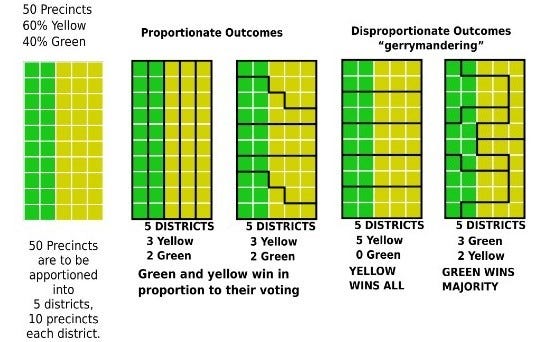
The question here is what is the fairest way to divide this green-and-yellow area into five equally-sized districts. As the illustration shows, there really isn’t one. The first division creates five, non-compact districts that may reflect the area’s political divisions but is also rigged to guarantee a certain political outcome in each district. The second division is perhaps the fairest in that its districts are more compact and likely to generate outcomes that are proportional to the area’s political divisions. But one also has to admit it is intentionally designed to generate likely outcomes, meaning the results of elections in those districts are still more likely to be (pre)determined by mapmakers rather than by voters. Furthermore, it wouldn’t take more than a few slight adjustments to turn this apparently reasonable map into a very biased map masquerading as a reasonable map. The third division appears to be the most reasonable—five relatively compact districts of the same shape and size—but unfairly delivers 100% of the area’s seats to the party that commands the support of only 60% of the area’s citizens. The fourth division is the most unfair as it is designed to give the area’s minority party the most seats.
As this example shows, it is very hard for a judge to determine if a map is fair because there is no set of principles that can consistently be used to make that judgment. “Compactness” can lead mapmakers to pack too many voters from one party into one district, diluting that party’s power throughout the rest of the state. “Proportionality” may lead to bizarrely designed districts full of voters who share little in common with one another; it may also calcify districts, making it harder for changes in public opinion to register in electoral results. “Competitiveness” may be an impossible standard to meet in places with a heavy partisan lean or, if somehow implemented, may not reflect the state’s true political divide. Meanwhile, “impartiality” may generate a result that is so out of touch with the state’s partisan makeup that it generates results that appear like a partisan gerrymander; in these cases, it would have been better for mapmakers to have been more intentional in their design.
The bottom line is this: Some judges fear intervening in gerrymandering cases because they worry their decisions will effectively end up picking electoral winners and losers. This is what Chief Justice John Roberts wrote in Rucho v. Common Cause (2019), the most recent major partisan gerrymandering case:
Excessive partisanship in districting leads to results that reasonably seem unjust. But the fact that such gerrymandering is “incompatible with democratic principles” (Arizona State Legislature, 576 U. S.) does not mean that the solution lies with the federal judiciary. We conclude that partisan gerrymandering claims present political questions beyond the reach of the federal courts. Federal judges have no license to reallocate political power between the two major political parties, with no plausible grant of authority in the Constitution, and no legal standards to limit and direct their decisions. “[J]udicial action must be governed by standard, by rule,” and must be “principled, rational, and based upon reasoned distinctions” found in the Constitution or laws (Vieth, 541 U. S., at 278). Judicial review of partisan gerrymandering does not meet those basic requirements.
In other words, even though partisan gerrymandering is unjust and undemocratic, the Court does not have a good way to settle such cases, so it won’t even try. As frustrating as that may be, perhaps that’s for the best, since a judicial rule governing gerrymandering could make the problem worse.
Rucho is flawed for three major reasons, however. First, it does not address what I call the “Ladder Problem,” which results when a party wins political power and then uses its power to rig the political game in its favor. (I call it the Ladder Problem because it’s like someone using a ladder to ascend to a higher level and then pulling it up behind them to keep others from also accessing that level.) Democracies cannot endure if they do not have ways to address the Ladder Problem. Gerrymandering is a Ladder Problem since the party that wins the right to draw districts can potentially draw themselves into power in perpetuity. No democratic theory supports that idea, and our Constitution certainly shouldn’t either; in fact, the Equal Protection Clause, according to Reynolds v. Sims (1964), “guarantees the opportunity for equal participation by all voters in [legislative elections],” which can’t happen when state legislatures marginalize voters by diluting their votes across congressional districts.
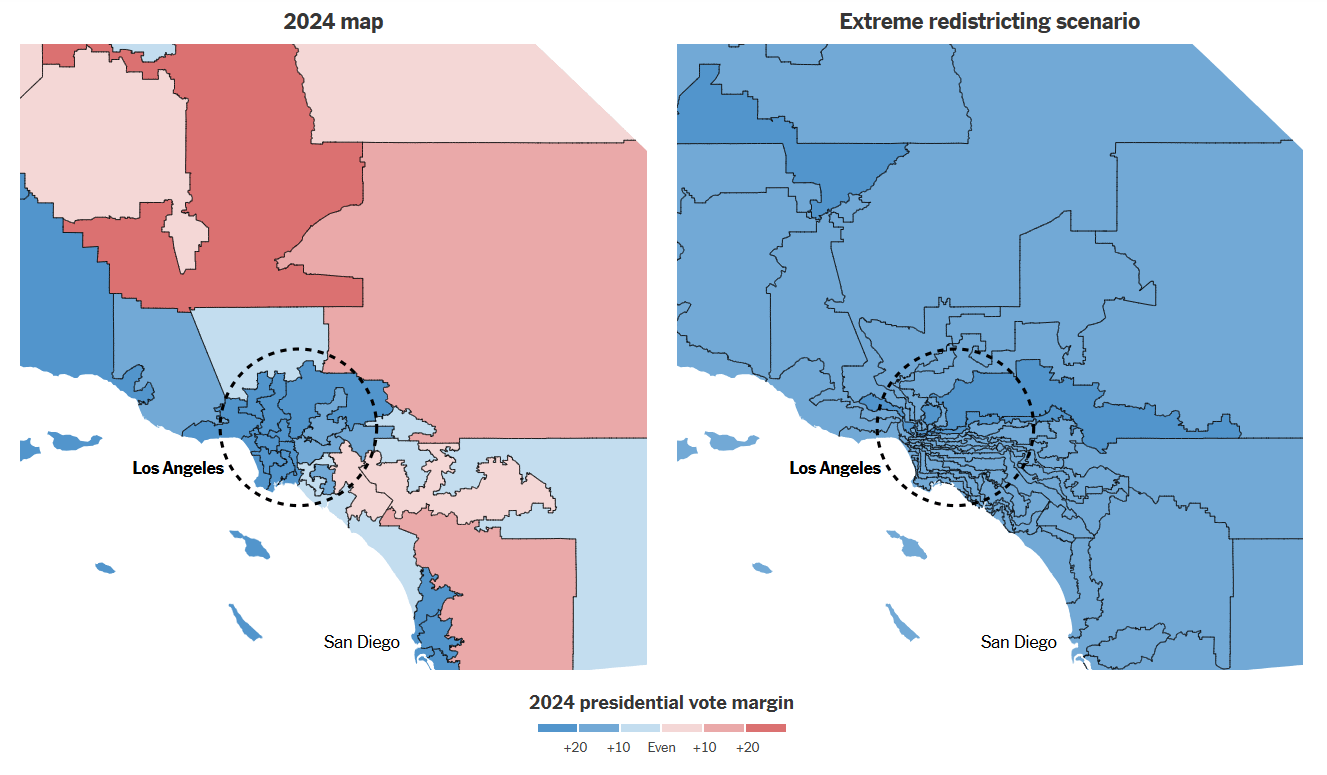
Second, Rucho argues it does not want to interfere in gerrymandering cases because the states are actively seeking solutions to the problem. But as 2026’s gerrymandering wars have revealed, the states are no longer (if they ever really were) trying to tamp down the problem of gerrymandering but are instead pushing it to its extreme, enabled as they are by computerized mapmaking programs that can shuffle neighbors into different districts based on their partisan affiliations. California, for instance, is preparing a map that could turn the Los Angeles area into a bowl of spaghetti with noodle-shaped districts wiggling off into Republican-leaning rural areas in an effort to deliver each of the state’s 52 congressional seats to Democrats:
Third, Rucho acknowledges partisan gerrymandering is unjust and undemocratic and does nothing about that. Yes, I wrote earlier that perhaps that’s the best we can hope for, but we should expect more than helplessness from a Court that is supposed to uphold justice and defend democracy. Furthermore, this problem is reaching a tipping point. The Court has indicated before that if partisan gerrymandering becomes too much of a problem, it might feel compelled to intervene. That time is now. It can no longer sit on its hands.
So let me help. The problem here isn’t strictly gerrymandering. It’s bigger than that. The problem is actually woven into the practice of redistricting itself. The Court can’t figure out what to do about gerrymandering because they have yet to acknowledge how constitutionally problematic the act of drawing congressional districts is.
So here’s what the Court needs to do: Declare congressional districts unconstitutional.
The Constitution makes no mention of congressional districts. It only states, “Representatives…shall be apportioned among the several States which may be included within this Union, according to their respective Numbers….” It does not say those representatives need to be divided into districts. State legislatures have historically divided their states into districts, but they haven’t always done so. As recently as seventy years ago, a few states elected some members or all of their congressional delegations at-large, although this eventually came to be seen as a way for Southern states to potentially avoid creating a district that may be a Black-minority district. Districts became mandatory only as recently as 1967 with passage of the Uniform Congressional District Act, which required every member of Congress be elected from a single-member district. This suggests we should not regard districts as set in constitutional stone but rather as a mechanism Congress has settled on to select members of the House.
Because the Uniform Congressional District Act is a law rather than a constitutional provision, it can be struck down by the Supreme Court.5 On what grounds could it do that? By declaring the act of drawing congressional districts a violation of the Equal Protection Clause and the “one person, one vote” rule, since there is no fair and principled way for mapmakers to draw districts without either enhancing or diminishing the electoral value of one person’s vote relative to another’s. Voters should be heard in elections; they should not be corralled by elected officials in ways that pad majorities or dilute their power. It is impossible for mapmakers to draw districts without doing this. Even non-partisan redistricting committees make judgments about district shapes, the relative competitiveness of districts, and the partisan balance between districts that have the potential to mis-represent the people and enhance or diminish the value of an individual’s vote.
The basic problem isn’t all the shenanigans politicians pull when designing districts; the basic problem is the use of districts. The act of drawing politically-significant lines on a map—a task that can be performed in an infinite number of ways in every state—is inherently problematic because a single voter’s power can change dramatically depending on which of those infinite scenarios becomes codified into law.
So what mechanism for selecting members of Congress would replace districts? States should instead be required to hold a statewide vote to determine the makeup of that state’s congressional delegation. Seats in Congress would be assigned based on the proportion of votes each party won in the election. Each party would be responsible for selecting the individuals who would occupy those seats. Each party would also divide the state into districts based on the number of seats that party won so that a sense of local representation would not be lost.
Here’s how that might look in Louisiana. During the spring or summer, the parties would hold a convention to determine their slate of six nominees for Congress. Perhaps in choosing the slate, the parties aim for geographical diversity, or maybe they choose instead to keep the wings of their parties happy and focus instead on ideological diversity, or maybe they try to ensure the slate reflects the demographic diversity of their party or state. Each party’s slate would spend the fall campaigning for office. On Election Day, voters would go to the polls to vote for their preferred party. If those results in Louisiana resemble the results from the 2024 presidential election, that would mean Republicans would win 60% of the state’s seats while Democrats would win 38% of the state’s seats. Since Louisiana has six congressional districts, that means Republicans would win three seats and Democrats would win two seats; based on the remainder of the vote (about 10% for Republicans, about 5% for Democrats) Republicans would win the final seat, bringing their total to four seats. Republicans would divide the state into four districts and assign one member to each district, while Democrats would divide the state into two districts and assign one member to each.
By using this method to elect members of Congress, each Louisianan would be represented in Washington. Each Louisianan could claim to be represented by a member of his or her party. Louisiana’s congressional delegation would reflect the state’s partisan composition. No Louisianan could claim their vote was wasted.
Under this plan, gerrymandering would be rendered a thing of the past. Representatives would no longer choose their voters; voters would choose their representatives. These ridiculous gerrymandering wars would end. There also would be no need for racial gerrymandering, as the preferences of Black voters would be fully accounted for. We would no longer need to argue about intent and effect. The correlation problem would no longer matter. Gerrymandering’s Ladder Problem would be solved.
This plan could also weaken the two-party system, as third parties would only need to win a significant proportion of the vote rather than the most votes to earn a congressional seat. (States—particularly large states—would probably need to set a minimum percentage of votes parties would need to win to qualify for a congressional seat in order to prevent off-the-wall fourth parties from claiming seats. States would also probably need to adopt ranked-choice voting.) At the same time, this plan could also rebuild the grassroots capabilities of the parties, since it would become critical for parties and candidates to rally local party members during both the primary and the general elections.
If I had my druthers, I’d go a step further and enact this plan, which I wrote about last year. I think it does a better job preserving local representation while reflecting the views of the national electorate. It preserves districts, but in a way that makes gerrymandering meaningless.
But I’d be onboard with the plan I laid out in this week’s article as well. It would do a much better job re-presenting the people in Washington than the current system and would not require the constitutional overhaul my preferred system would require. It’s also a plan—no districts, proportional representation—the Supreme Court could implement almost entirely on its own, leaving some (not necessarily insignificant) details to the states and parties to sort out.
The Roberts Court has said it has no idea how to adjudicate what it acknowledges is the unjust and undemocratic practice of partisan gerrymandering. There is a way forward, though. They just have to think outside the lines.
Thanks for reading Reason to Believe! This post is public so feel free to share it.
The Supreme Court’s ruling in Callais also makes it impossible to remedy a racial gerrymander that discriminates against Black voters. Let’s say Louisiana’s mapmakers were caught on camera saying they intended to draw congressional districts that discriminated against Black voters. A remedy that attempted to correct for that problem by intentionally drawing districts that empowered Black voters wouldn’t pass constitutional muster with the Supreme Court, since that map would also be a racial gerrymander. Instead, the state’s lawmakers could hire mapmakers and tell them (wink, wink) not to take race into account. No one would be surprised if the new modified and *unbiased* maps generated roughly the same results as the old racially-biased maps, and those new maps would be allowed to stand simply because the new mapmakers weren’t caught announcing their racist intentions on camera.
One could further argue the Voting Rights Act unfairly gives Democrats an advantage in the race for control of Congress, since they do not need to draw Republican-majority districts in states they control while Republicans are often required to draw Democratic-majority seats in states they control. For example, the Democratic-led legislatures in Massachusetts, Maryland, and Illinois do not need to set aside Republican-majority seats the way Republican-led legislatures in the South must set aside Democratic-majority seats to comply with the Voting Rights Act. One could argue the Voting Rights Act consequently becomes a sort of Trojan horse used to win Democrats seats in the House.
Even if a racist intent was annoucned, does anyone really trust this Court to follow-through on this anti-racist principle anyway? Remember Don Trump’s anti-Muslim travel ban from back in 2017? That ban targeted a number of majority-Muslim nations. After Trump was sued for issuing a discriminatory order, he added a few non-Muslim nations to the ban to try to un-ring the bell. Trump’s animus toward Muslims was also well-known, since he routinely disparaged Muslims on the campaign trail in 2016. Yet the Court’s conservative majority let the ban stand, arguing the president simply needed a plausible reason for issuing the ban regardless his past comments; in this case, all Trump had to say was “national security” for them to sweep all his Islamophobic comments under the rug. In her dissent, Justice Sotomayor pointed out how oblivious that reasoning was, writing that the Court “leaves undisturbed a policy first advertised openly and unequivocally as a ‘total and complete shutdown of Muslims entering the United States’ because the policy now masquerades behind a façade of national-security concerns.” She also pointed out the Court’s hypocrisy, since it had earlier allowed a cake decorator to discriminate against gay customers because the state of Colorado had brought up his conservative Christian religious background when finding him guilty of violating the state’s anti-discrimination laws. The majority opinion even stated the Court likely would have ruled against the cake decorator had Colorado’s officials not made those remarks, indicating the state wasn’t wrong on the substance. And let’s not forgot Justice Brett Kavanaugh’s recent concurrence in Noem v. Vasquez Perdomo, in which he stated federal immigration officers could use ethnicity as a factor to justify stopping and temporarily detaining an individual; such stops are now known as “Kavanaugh Stops.” When it comes to the Roberts Court, discrimination is fine so long as the discriminator shares their political leanings, but it’s bad when it targets their political friends.
It’s worth taking a moment here to reflect on what it means exactly for Republicans to end up disenfranchising Black voters via partisan gerrymandering, which Americans dislike but have resigned themselves to accept as a part of American politics. Partisan gerrymandering provides Republicans with a shield—“We’re not targeting Blacks, we’re favoring Republicans”—but it’s actually more like a sleight of hand. What they’re actually saying is, “Set aside your concerns regarding civil rights, just let us play politics.” Now I’m not one to put down politics, but it is rather astonishing to see someone elevate politics above civil rights, which are rights that secure people’s ability to participate in politics. Someone who tries to sideline civil rights probably thinks they can’t win the political game when everyone exercises their civil rights. I suspect no one understands this better than Chief Justice John Roberts, who has spent his entire career—as far back as when he worked for President Reagan’s Department of Justice—attempting to dismantle the Voting Rights Act. Roberts would have us believe he is acting on principle, that any kind of discrimination—both anti-Black and reverse—violates the Constitution. I don’t buy it. I think Roberts knew in the early 1980s that the Voting Rights Act stood in the way of Republicans’ pursuit of power, so he sought to destroy it. That’s an interesting choice. He could have decided as a matter of principle to leave the Voting Rights Act alone and instead work to change the Republican Party so it became more competitive in a post-Civil Rights Movement America. He didn’t do that, though. Instead, Roberts sought to change the law. Why? I doubt it was because Roberts himself harbored animus against those the law benefitted. Instead, I’d guess Roberts concluded that even if the Republican Party fully embraced the Voting Rights Act, his party would still struggle to build a durable electoral majority atop its conservative policy agenda. So the protections afforded primarily Democratic Black voters via the Voting Rights Act had to go. That episode is so telling to me. Even as far back as the early 1980s, Republicans like John Roberts were making that deal with the devil. They knew they couldn’t win on the merits, and that for the GOP to win, it needed to ally itself with resentful White voters and demolish civil rights protections. He finally made it happen.
As for whether the federal government can intervene in the redistricting process, the Constitution states the “Times, Places and Manner of holding Elections for Senators and Representatives, shall be prescribed in each State by the Legislature thereof [and] Congress may at any time by Law make or alter such Regulations.” That means states alone do not control the congressional election process. Furthermore, in Baker v. Carr (1962), the Court ruled federal courts had the power via the Equal Protection Clause to review redistricting cases.
Comments
Nothing yet. Say the first thing.
Sign in to join the conversation.