
The company I work for has a long-standing rule against using acronyms, and for good reason. Acronyms often obscure meaning, sometimes deliberately. Employees will avoid admitting they don’t understand an acronym—readers to avoid looking uninformed, and writers because they’re simply repeating what they’ve seen others say.
I once read an internal email at Palantir that was meant to update the government business on a series of product initiatives. It was so egregiously littered with acronyms that I gave up reading. I replied privately to the author to politely demand that they publish a glossary for acronyms (they politely demurred).
If you’ve been on the receiving end of non-transparent language like a barrage of acronyms, you know how demotivating it is to try and decipher any of it. It makes you feel like you’re uninformed, and you’re reticent to participate because you can’t judge the merits of what you can’t understand.
Many industries have this, whether it’s acronyms or buzzwords or just terms that no one can define. The financial industry develops tons of complicated investment vehicles hidden behind innocuous wording. The mass purchase and obscurity of one such vehicle, the subprime mortgage, led to the 2008 financial crisis.
Lawrence Fields: “You read [the subprime mortgage contracts]? No one reads them. Only the lawyers who put them together read them.”
Michael Burry: “I don’t think even they know what they’ve made.”- The Big Short (2015) (video clip)
The national security community, however, elevates obscurity through acronyms to a true art form. Nearly every program and agency office has an acronym. How does a Department of Defense leader decide what needs improvement in their organization? The DOTMLPF-P framework, of course. Which is part of the JCIDS framework.
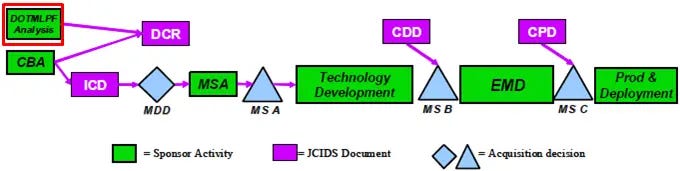
But acronyms aren’t to blame. In fact, they can be quite useful. The Department of Defense (DoD) in particular has a lot of things to give names to. It is the largest employer on the planet, with roughly 2.8 million people allocated across hundreds of offices and thousands of programs. Acronyms make it simpler to talk about these entities by giving them a memorable moniker–assuming you understand the acronym. Once you’re “in the know,” they actually become quite comfortable and enjoyable.
For those that work in an acronym-fueled culture, you’ll know that being understood and trusted within that culture often means speaking the language. Any sales team knows they need to speak in a way their customer understands. At Palantir, speaking about customers in codenames (you can see an old leaked list here) combined with product names like Quiver and Highbury meant you could talk about them in public with co-workers and it’d sound like gibberish to everyone else. “There’s a Delta deploying Quiver to Zorro? What??” That sentence makes sense to me. There’s real utility in coded language.
That’s why deciding not to use acronyms in DoD conversations is like deciding that you won’t write Javascript as a web developer. We understand that Javascript is suboptimal, but for better or for worse, virtually every webpage in the world runs on it.
The real issue arises when we stop understanding the entity behind the acronym, and that’s why rules to avoid acronyms entirely are created. Take DIU ETV. This is an acronym for the Defense Innovation Unit’s Enterprise Test Vehicle program. What could something as generic as “Enterprise Test Vehicle” possibly mean? Well, here’s a DoD spokesperson to explain:
The Enterprise Test Vehicle (ETV) will serve as a research and development platform for the USAF to explore open system architecture and modularity concepts…The intent is to certify the ETV for use and have it as a rapid, affordable option for program offices to test out new capabilities at the subsystem level without having to [recertify] it for flight test. The ETV will be used to integrate … COTS subsystems to prove the integration and affordability of the system concept.
You’re probably still confused. The issue isn’t ETV, it’s that ETV is defined with a slew of buzzwords followed by even more unnecessary acronyms, like USAF (the Air Force) and COTS (commercial products). Even worse, it’s missing the point. What makes ETV theoretically valuable is that certification of systems in defense is an extraordinarily arduous process, and not all that scientific sometimes. The threat of having to certify can outright kill interest in trying new approaches, or you’d have to find a loophole. So to rephrase, ETV is about building a cheap, flying “thing” where you could attach a radar or bomb or new software, and then not have to painfully recertify in order to test it. As the title of that article points out, it looks to be somewhere between an unmanned aircraft and a missile, and a cool thing about the program is that shows how the lines between the two have really started to blur.
But you wouldn’t have guessed all of that from reading DoD language about ETV.

Another case in point is the DoD’s new unclassified counter-drone strategy. Published in December 2024 and amplified by multiple defense media outlets (DefenseScoop, DefenseNews), it is a prime example of “cotton candy language” - many words that melt into no substance. It might sound harsh, so I encourage you to read it. It’s a two-page fact sheet that genuinely says nothing.
It’s tempting to laugh this off as bureaucratic silliness, but it matters. Being able to destroy drone threats is one of the greatest dilemmas facing the US military today. We are actively expending multi-million dollar missiles on $10,000 drones in order to protect $2,000,000,000 Navy ships and other commercial vessels in the Red Sea today. If said Navy ship expends most of its missiles, which is now relatively cheap to induce for the Houthis, the ship has limited ability to protect itself or other vessels. Since 90% of traded goods are shipped by sea, disruption of commercial shipping would have catastrophic economic impact.
So this fact sheet is the DoD’s announcement that we, as a nation, have come up with an innovative strategy to counter these cheap drone attacks. And this is the entire “Strategic Approach”, verbatim:
The Department is mitigating the potential negative effects of unmanned systems on U.S. forces, assets, and installations – at home and abroad. A critical portion of our efforts, particularly in the near-term, comes from improving our defenses, with an emphasis on detection as well as active and passive defenses. The Department will ensure our forces and priority installations have protection. To stay ahead of advances in unmanned systems – and their growing prevalence – the Department will prepare for more advanced challenges, pacing our future capabilities to more stressing cases (e.g., larger numbers of increasingly capable and autonomous systems). Over the mid- and long-term, the Department will also develop and design our future force to reduce their vulnerability and increase their resilience to these threats. Taken together, these approaches will allow the Department to maintain our advances and our ability to fight and win our Nation’s wars, if called upon.
There’s no strategy. The sum of that paragraph is “we’re going to do something.” If the real strategy is all classified, then the DoD should save its breath and skip the fact sheet. But I don’t think a meaningful counter-drone strategy can plausibly be all classified, because the threat is widespread and built on technology I can buy off Amazon and assemble via YouTube. And industry knows that there’s no silver bullet to detecting and destroying these small aircraft.
So there’s no strategy. Isn’t that concerning? This fact sheet is a thin wall of text, which could have been generated by ChatGPT, to disguise that fact.
This should be concerning. If this came from a public company, you’d know its days were numbered.
Silicon Valley provides a useful comparison. It too has developed its own ambiguous terminology–like startup names and product names. What’s a Google? What does a company called Applied Intuition do? Like acronyms, these are memorable references to entities, onto which ideas and emotions can be grafted.
But the difference between these companies and the DoD is that they care a great deal about telling you, in a language you understand, what they are and what they stand for. Customers need to know why you’re differentiated and helpful if they’re going to buy your product. Startups are inherently risky, and they retain employees by ingraining and then proving out a narrative about why they will succeed when most companies don’t. Any successful company craves feedback when their communication is off.
Similarly, fast-paced, high-growth companies internally depend on precise communication. Each worker is responsible for producing convincing ideas and articulating them in a way that resonates with their coworkers. Communicating complex concepts requires understanding them, and to understand a complex concept takes time and effort. When we don’t want to commit the effort, we look for shortcuts in the vague language-land of buzzwords.
Software culture will eat DoD. But it will take time.
One of the ways we’ll notice progress is in how the language changes as the urgency to reform DoD increases in pitch. Senator Roger Wicker (R-MS), the incoming head of the Senate Armed Services Committee, just published a proposal on reforming the defense acquisition process, meaning how the DoD buys things. One thing that stands out is how Wicker’s language is simpler, filled with historical examples, and provides an actionable plan. He points to specific clauses of regulation to cut and contracting pathways to promote. And it’s just 24 pages. In contrast, to use one of Wicker’s examples:
By 1980, the C-17 specification consisted of more than 13,000 pages and 35,000 drawings. Contractor responses came in boxes delivered by the truckload.
How our organizations talk and how they act reflect each other. Simplicity forces clarity for the author as much as the listener. Since the language is a symptom of organizational culture, there are a few Reasonable policies that can drive towards a more transparent and effective DoD culture.
First, we must clamp down on paper-based deliverables. Wicker noted that in the 1970s, half of all defense R&D funding was spent on paper documentation. That’s ridiculous, and it almost certainly has increased. At its worst, documentation is used to prove that work happened, even when that “work” was just writing the document. We need to limit the ability for government program managers and contractors to hide outcomes behind reports that will never be read.
Second, we should evaluate vendors by what they build, not what they claim they can build. With AI now churning out polished, indistinguishable proposals at scale, the current process rewards those who write the best pitch—not those who deliver results. Instead of rewarding the most convincing words, DoD should prioritize products that actually work, delivered on time and on budget. The product should speak for itself, not hide behind a wall of text.
If the government needs to develop a complex system, it should ask vendors to demonstrate real, iterative prototypes. Companies can fund this at risk if they know there’s a clear strategy to deploy and fund it into production on the other end. Companies sell to each other in this way all the time, with venture capital often lending the upfront investment.
Third, Congress should require the DoD to tie its strategy documents to measurable metrics. After slashing language like, “The Department of Defense must meet the urgency of today’s threats and tomorrow’s challenges,” strategies should insert specific actions with timelines. Then they should be revisited on a schedule. The strategy’s authors can host live Q&A sessions for Congressional leaders and industry to ask the tough questions, but also pitch ideas. And the author(s) must be held accountable when metrics aren’t hit.
Ultimately, clarity in language drives clarity in purpose—and purpose drives results. A culture that tolerates vague, empty words is one that tolerates confusion, waste, and stagnation. But a culture that insists on plain, actionable communication is one that can move quickly and adapt. Don’t blame the acronym, they can be there to help.
Leaders in DoD must gain a deeper awareness of where these acronyms and esoteric terminology are being used to hide a lack of strategy, and then address those gaps. Examining how Silicon Valley companies communicate and measure outcomes is a living blueprint that motivated DoD leaders can learn from and adjust towards. Leaders can change their tone, how they talk, and their teams will follow.
Because in a world of fast-evolving threats, the cost of low-bandwidth communication isn’t just inefficiency—it’s falling behind. The stakes are too high to tolerate it any longer.
No posts
Comments
Nothing yet. Say the first thing.
Sign in to join the conversation.