
Every June I promise myself I’m going to celebrate Black Music Month properly—and every June life tries to sing lead. 2026 was supposed to be different, but Juneteenth sprinted past, the BET Awards are around the corner, and my internal DJ is still spinning records that raised me.
Music isn’t background noise. It’s documentation—a living record of love, grief, resistance, and pure‑out joy for a people who’ve carried more than their share of dissonance.
“For every situation in my life, there’s a song.”
If I could sing, I’d be on stage. If I could play, it’d be sax or piano. Instead, I write—and I curate the soundtracks that raised us.
The Intruders – “I’ll Always Love My Mama”
Anthem of every Black child who knew exactly where to be on Mother’s Day.The Dells – “Give Your Baby a Standing Ovation”
Proof that applause belongs at home first.Billy Paul – “Me and Mrs. Jones”
Infidelity or honesty, depending on who’s narrating.Marvin Gaye & Tammi Terrell – “If This World Were Mine”
Love so wide it still stretches.Etta James – “Trust in Me”
Non‑gospel lyrics, full gospel ache.Four Tops – “Still Water (Love)”
The grief song that understood loss before we did.
The through‑line is love.
Not comfort. Not safety. Not a life free of terror — because that was not the life. We are talking about a people who survived the Middle Passage, sharecropping, sundown towns, lynchings, and a legal system that looked the other way. Violence was not occasional. It was structural. It was intentional.
And we were living rent‑free in other folks’ minds the whole time — consuming their fear, their hatred, their obsession — and we still sang love you could actually feel. Not in spite of the pain. Through it.
That’s not a music story. That’s a survival story. That’s the miracle.
Black people moved north and took their music with them — and wherever they landed, a sound was born from that place, that community, that specific pain and joy of that city.
Between 1916 and 1970 more than six million Black southerners boarded trains and back‑road caravans, taking hymns, field hollers, and juke‑joint blues with them. Each stop on the journey stamped a new return address on the music:
Motown — Detroit. Berry Gordy’s factory‑timed polish turned assembly‑line soul into crossover pop because he wanted Black music piping into white living rooms.
Philly Sound — Philadelphia. Gamble & Huff layered strings over rhythm, building civic‑rights optimism you could dance to.
Stax — Memphis. Raw church grit, Black and white musicians recording together before the city could share a lunch counter.
Chicago Blues → Soul. Delta guitar plugged into Chicago current, electrifying Muddy Waters and handing rock & roll its swagger.
The sound followed the people. The Great Migration wasn’t just demographic — it was cultural infrastructure under construction in real time. Every city that received Black southerners got a new sound within a generation.
The Lobby That Made It Happen
In 1978 broadcaster Dyana Williams, producer Kenny Gamble, and industry executive Ed Wright formed the Black Music Association (BMA) to prove that Black music was an economic engine, not a niche. They wanted federal recognition that matched the billions Black artists were already generating.
Why President Jimmy Carter Said Yes
In 1979, President Jimmy Carter — Georgia peanut farmer, gospel-raised, R&B-schooled — became the first sitting president to say out loud that Black music deserved a month. Dyana Williams, Kenny Gamble, and Ed Wright pitched a Rose Garden celebration. His staff green-lit it in weeks.
Let’s be clear: there were optics involved. A Southern president needed Black America to see him seeing them. But here’s what’s also true — he showed up. The music played. And June has never been the same.
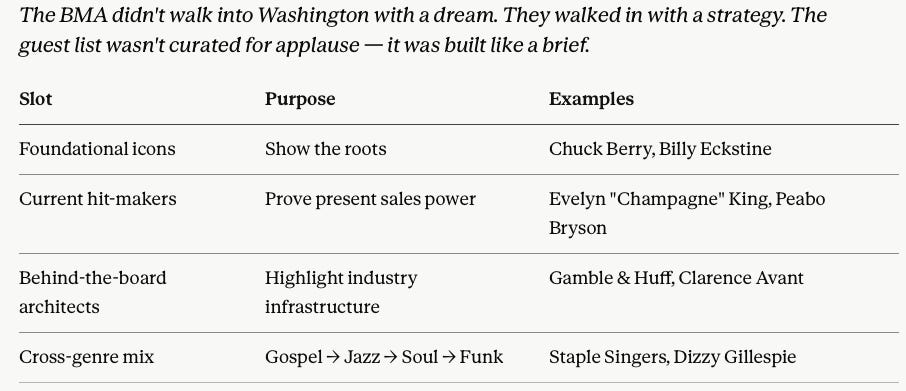
The Curated Guest List (7 June 1979)
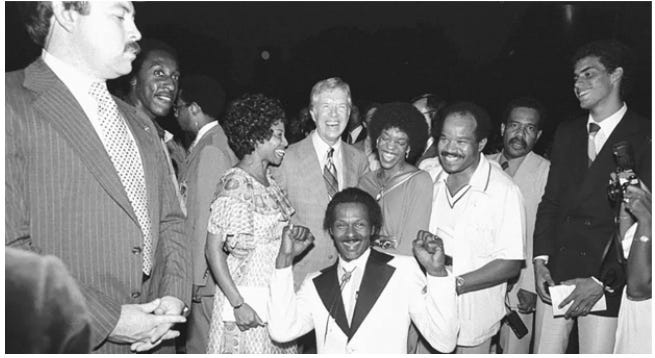
Rose Garden, June 7, 1979 — Chuck Berry, President Jimmy Carter, and a room full of proof that Black music was never marginal. It was national memory.
flcourier.com
Carter proclaimed Black Music Month on the lawn, framing the music as “an irreplaceable part of the national heritage.”
Making It “Official‑Official”
2000 — President Bill Clinton—our resident sax‑to‑the‑core president—signed the African‑American Music Appreciation Month decree, likely humming Stevie while he inked it.
2016‑Present — Each administration issues its own proclamation, sometimes remembering to include the full name.
When the Grammys kept mis-pronouncing our names—or ignoring us altogether—we built our own stage. The BET Awards are the family reunion with cameras: legends get their flowers, newcomers get their first standing-O, and the cypher reminds everybody the pen is still alive. It’s the night where a Prince guitar solo can hijack prime time and a Kanye mic-grab feels less like a stunt and more like generations of side-eye toward gatekeepers who never learned the rhythm.
Not a coincidence that BMM shares the month with freedom’s second‑announcement. Freedom needs a soundtrack, and we provided one.
What’s your soundtrack moment?
The song you played until everybody in the house knew it.
The song that carries a vivid memory.
The record that broke your heart open.
The beat that made you believe you could out‑dance the rent.
Drop it in the comments—or meet me in the Liner Notes room inside The House of Misfits Network, where we’ll spin the full playlist.
The soundtrack is never just the song. It’s where you were, who you were with, and what you survived long enough to remember.
No posts
Comments
Nothing yet. Say the first thing.
Sign in to join the conversation.