
Nolan Wells went away with friends.
They came back.
He did not.
That is the part I cannot get past.
Not because I have decided what happened on Horn Island. I have not. I was not there. I do not know whether Nolan Xavier Wells drowned accidentally, whether someone harmed him, whether something reckless happened that people are now afraid to admit, or whether the complete truth sits somewhere none of us has considered.
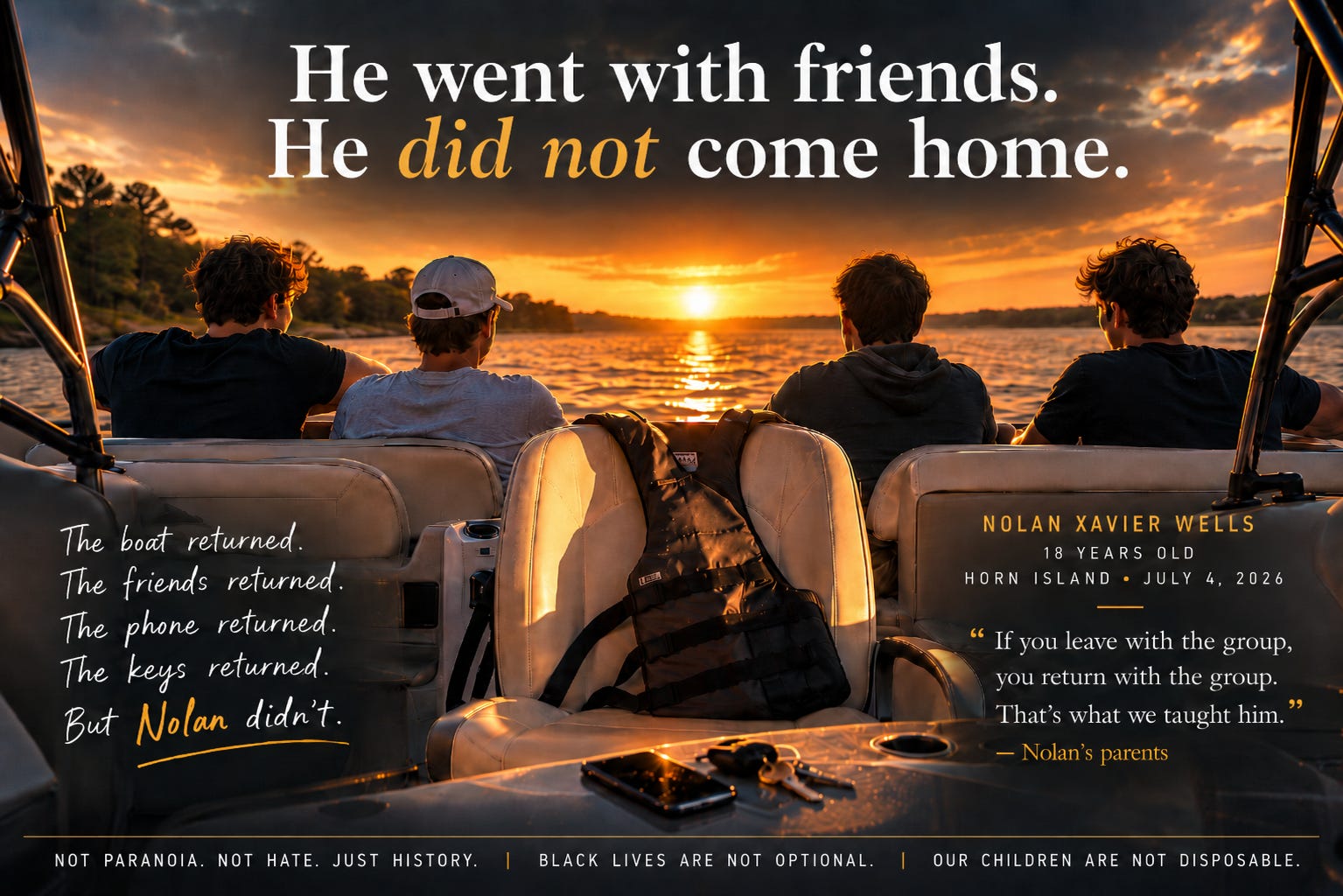
But I know what came back.
The friends came back.
His phone came back.
His keys came back.
And Nolan did not.
He was 18 years old, a college student and football player. On July 4, he traveled by boat to Horn Island off the Mississippi coast. His body was found two days later. His parents have said they cannot accept the claim that he simply chose to remain behind without the people he came with, without his phone, and without his keys. They had taught him something many Black parents teach their children: if you leave with the group, you return with the group.
The authorities have said that they have not found immediate evidence of foul play. An investigation remains open. Autopsy findings and toxicology results are still pending, and Nolan’s family has sought an independent autopsy and further examination of his phone. Their attorney, Benjamin Crump, has raised questions about conflicting accounts, missing digital information, and a video in which Nolan is reportedly heard demanding the return of his phone.
Those are the known facts.
What I am writing about is what happens in the space between those facts.
I am writing about the speed with which people begin protecting everyone except the dead Black child.
The friends need attorneys.
Their families need privacy.
The authorities need patience.
The public must avoid speculation.
Everyone deserves the benefit of the doubt.
Everyone, apparently, except the mother standing without her son.
She is expected to accept uncertainty politely. She is expected to wait while other people manage reputations, consult counsel, coordinate statements, and decide what she is entitled to know about the final hours of the child she raised.
And when Black people look at the scene and say, Something about this does not sit right, we are accused of making it about race.
As though race was not already in the room.
As though Mississippi has no history.
As though the optics of one Black young man leaving with white friends and never returning should produce no particular alarm in a country where Black families have repeatedly been told that what they saw was not what they saw, what they feared was irrational, and what happened to their child was unfortunate but unremarkable.
The question is not whether we can prove the worst. The question is why our demand to know is treated as though it is worse than what happened.
When I first heard Nolan’s story, I thought someone had reposted the story of a vibrant young man I had the pleasure of knowing.
That is how closely the two collided in my mind.
This young man was someone I actually knew. He had attended Georgetown Preparatory School in Maryland. The Black students who boarded there had found one another, as Black students often do inside predominantly white institutions. They created their own circle inside the larger one. They became friends. They grew up. They moved into adulthood, careers, relationships, and the ordinary distance that life creates.
He was in his early 30s when he went on a boating excursion with friends. He was a Black man in the group of white friends. He was preparing to get married.
And he died.
I remember receiving that phone call telling me that He was gone. There had been other people on the boating trip. He could swim. Yet somehow, in the presence of a group of people, he ended up dead.
I need to be precise here: I am not suggesting that anything nefarious occurred or that anyone caused or intended his death. I do not know what happened, and I cannot manufacture facts that I do not possess.
But that does not erase the question that remained.
How can a person be surrounded by people and still disappear from their protection?
How can a group of people return from an experience and one person not return—and no explanation ever seems large enough to fill the place where he stood?
For years, I carried this young man’s death as a private confusion. Nolan’s death brought it back as something else.
A warning.
Not the crude warning that Black people must never have white friends. That is too simple, and simplicity would let everyone avoid the actual problem.
The warning is that proximity is not necessarily protection.
Integration is not necessarily intimacy.
An invitation is not necessarily inclusion.
You can attend their schools, join their teams, enter their homes, ride on their boats, pose in their photographs, laugh at their jokes, become useful to their institutions, and still discover—sometimes in the most irreversible way—that your life does not carry the same emergency when something goes wrong.
That is the terror beneath the conversation.
We are not merely asking whether Nolan’s friends liked him.
They probably did.
We are asking whether they understood themselves to be responsible for his safe return.
We are asking whether his absence produced immediate panic.
We are asking who noticed first.
Who asked where he was?
Who turned the boat around?
Who called his mother?
Who searched for him?
Who decided it was acceptable to leave with his belongings but without him?
And when the stories did not align, who was given the presumption of innocence—and who was left to explain why his own death seemed suspicious?
These questions are not accusations.
They are what care sounds like after care has failed.
There is a phrase people use now: “unalived.”
I understand why the word emerged. Social-media platforms suppress certain language. People learned to evade algorithms by creating softer words for brutal realities.
But Nolan was not “unalived.”
He died.
A mother lost her son.
A body was recovered from the water.
A life that contained muscle, appetite, laughter, plans, arguments, private jokes, family rituals, ambition, and possibility stopped.
“Unalived” is an algorithmic word. It belongs to platforms trying to sanitize death so advertisements can continue running uninterrupted.
It is not large enough for a mother.
And perhaps that is part of the broader sickness: we continually invent language that creates distance between ourselves and what has actually happened.
Tamir Rice did not die in an abstract “officer-involved shooting.” He was 12 years old, playing with a toy pellet gun in a public park, when police arrived and shot him within seconds.
Trayvon Martin was not a symbol before he was killed. He was a 17-year-old walking back from a store.
Emmett Till was not history when his mother received his body. He was her child.
Mamie Till-Mobley insisted that the world see what had been done to her son because America’s preferred method has always been to separate the dead Black body from the life that inhabited it.
Hide the body.
Question the character.
Control the language.
Reduce the urgency.
Call the mother emotional.
Call the community divisive.
Call the questions irresponsible.
Then wait for the public to become interested in something else.
I am not saying that Nolan Wells is Emmett Till. Historical comparisons require care, and the circumstances are not identical.
I am saying that I recognize the ritual.
A Black mother is asked to grieve before she has been told what she is grieving.
She is offered a body without a complete account of how that body came to be there.
And when Black people refuse to move directly from recovery to burial, from questions to acceptance, from outrage to decorum, our refusal becomes the problem.
A dead Black child does not become less alive simply because the people who returned without him would prefer not to discuss how he disappeared.
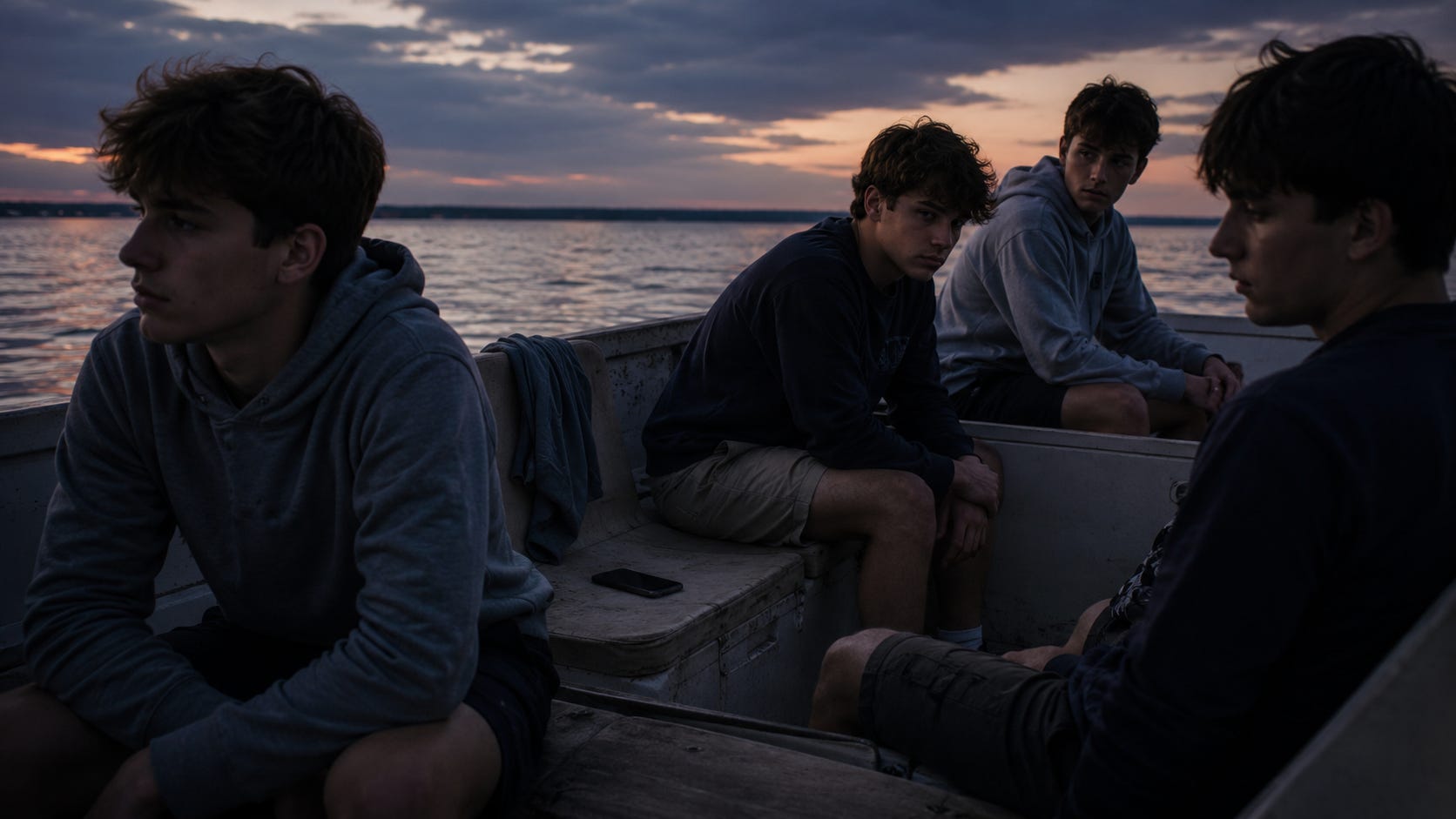
That is what enrages people when we speak about the racial optics.
We interrupt the clean version.
We refuse to agree that because no crime has yet been proven, nothing disturbing occurred.
We refuse the idea that an absence of immediate evidence is the same as an abundance of truth.
We refuse to treat white discomfort as more sacred than Black grief.
And we refuse the compulsory disclaimer.
I am not going to interrupt every sentence to reassure white readers that I do not mean every individual white person in America.
I am discussing an ideology. A pattern. A social arrangement in which whiteness receives institutional credibility before it earns it, while Blackness must prove its innocence, its vulnerability, its humanity, and sometimes even the fact that it has been harmed.
That arrangement does not require every white person to be consciously malicious.
It only requires enough people to protect the arrangement.
Some protect it by remaining silent.
Some by hiring lawyers before offering clarity.
Some by describing questions as attacks.
Some by insisting that race cannot be mentioned until racism has been proven beyond all possible doubt.
Some by rewriting history because the original version makes them uncomfortable.
Some by demanding civility from the wounded while showing no urgency toward the wound.
This political moment did not invent that impulse.
It released it.
It gave old contempt a louder vocabulary. It taught people that cruelty could be renamed honesty, that resentment could masquerade as patriotism, and that the historical record could be revised whenever the truth injured the self-image of the country.
But death does not erase life.
Changing the language does not alter what happened.
Silencing the questions does not create an answer.
And refusing to look at racial power does not make racial power disappear.
Nolan lived before he became a headline.
A vibrant young black man lived before he became a phone call I could not make sense of.
Tamir lived before the patrol car entered the park.
Trayvon lived before a stranger decided that his presence required surveillance.
They were here.
They occupied space.
They belonged to people.
They were expected home.
That last sentence is the one I keep returning to.
They were expected home.
Not as statements.
Not as cautionary tales.
Not as evidence in someone else’s argument.
Home.
I am no longer willing to treat a Black family’s questions as dangerous while treating everybody else’s silence as reasonable.
I do not know precisely what happened to Nolan Wells. His family does not yet know either. That is the point.
A mother should not need a nationally known civil-rights attorney, celebrities funding an independent autopsy, a press conference, and a public campaign simply to establish that the unexplained death of her child deserves a complete explanation.
The friends may have legal rights.
The authorities may need time.
The investigation must follow evidence rather than public speculation.
All of that can be true.
And this can also be true:
You do not leave with someone’s child and return with his phone instead.
No posts
Comments
Nothing yet. Say the first thing.
Sign in to join the conversation.