
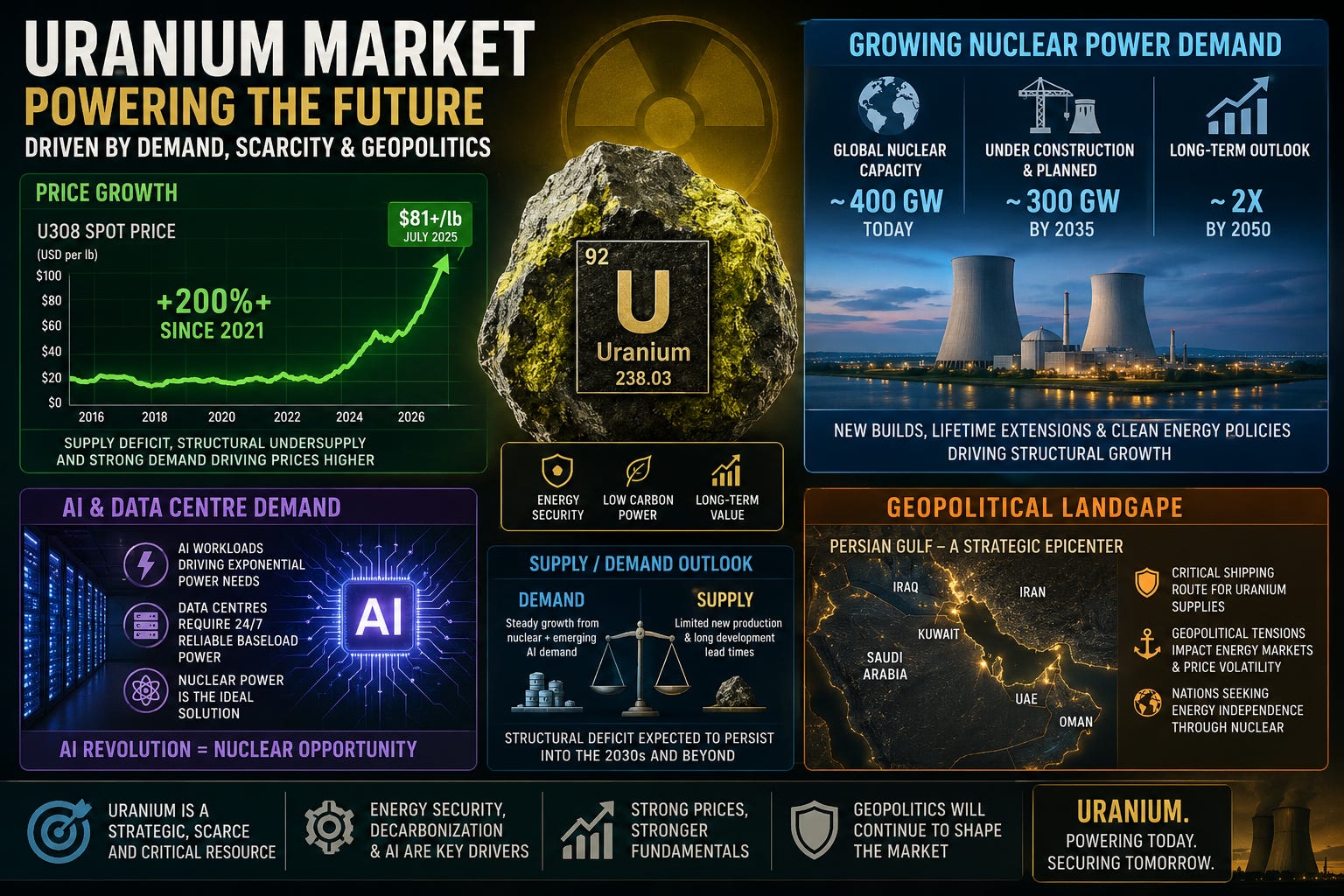
The uranium sector is gaining momentum as geopolitical events return it to a prominent place in the energy matrix, from which it was dislodged by the Fukushima nuclear power plant accident in March 2011. This reduced public appetite for nuclear energy, the energy of the future, viewing it as a relic of the past. Nuclear power has been regaining favor as the global energy narrative turned towards decarbonization as it can provide 24-hour baseload power with a fraction of the emissions of coal-, oil- or natural gas-powered plants.
Nuclear’s return to favour has been accelerated by conflict and energy security concerns. Russia’s invasion of Ukraine in 2022 saw Western states impose an embargo on Russian oil and gas exports, which put European Union countries into a bind as they had phased out their nuclear and coal-fired generation in favor of developing renewable wind and solar sources, backed by the promise of uninterrupted gas and oil pipeline supplies from Russia. The invasion of Ukraine made this policy look foolish, plunging European energy policy into a deep crisis.
More recently, the Iran conflict in early 2026 saw energy exports interrupted by the closure of the Strait of Hormuz, through which 20% of the world’s oil supply passes, and energy infrastructure in Iran and the broader region targeted by all sides in the conflict. The Iran conflict drove oil prices above US$110/barrel, as many nations scrambled for energy, leaving many to reconsider their energy futures. Industrialized nations that are energy short, including Western Europe, South Korea, Taiwan, Japan, China, among others, cannot ignore the need to include more nuclear power in their energy security mix. Here is Cameco’s (NYSE:CCJ) CEO Tim Gitzel:
“Across the global energy space, ongoing geopolitical tensions and volatility in fossil fuel supply chains are reinforcing the importance of secure, reliable and resilient baseload power.”
These conflicts leave many nations focused on achieving some semblance of energy independence to reduce their reliance on, and exposure to, oil. This is driving the bullish case for nuclear power and the uranium it needs as fuel. In effect, this is history repeating itself as France and Japan built out their nuclear power fleets in response to the Arab oil embargo in the 1970s. The advantage of nuclear for a country like Japan is that it can store enough energy density in uranium to power itself for five years. Here is Rick’s view:
“What I see as a highly likely outcome of this [Iran] conflict is renewed discussion of an appreciation of energy security. And the only fuel in the world that’s dense enough to provide energy security for most countries is uranium. Uranium has gone from being a political pariah to being fairly well accepted politically. It has gone from hated to tolerated. The absolute strategic need really adds wind in the sails of the nuclear renaissance.”

Rick is to launch a premium newsletter about a new, actively managed investment account, in which he will share the trades he makes and the rationale behind them with subscribers, including his thoughts on portfolio construction and risk management. Anyone interested in subscribing should write to:
TheRulePortfolio@gmail.com
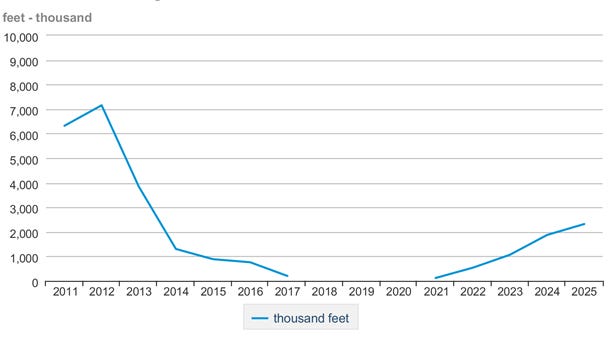
The US is the largest consumer of uranium, at 50Mlb/y, but a tiny producer at 2.1Mlb of triuranium octoxide (U3O8), or uranium concentrate, in 2025, up from 657klb in 2024, according to EIA data. US production has continued to increase in 2026, with 1Q26 production of 1Mlb, the highest first-quarter production level since 2015. Exploration drilling in the US in 2025 reached its highest level since 2013 at 1,824 holes for 1M feet, up from the 1,324 holes for 613,000ft in 2024 (see Exhibit 1). Development drilling saw 3,708 holes for 1.3M feet drilled, up from 2,462 holes for 1.3M feet in 2024.
Exhibit 1: US Uranium Drilling 2011-2025
Source: EIA
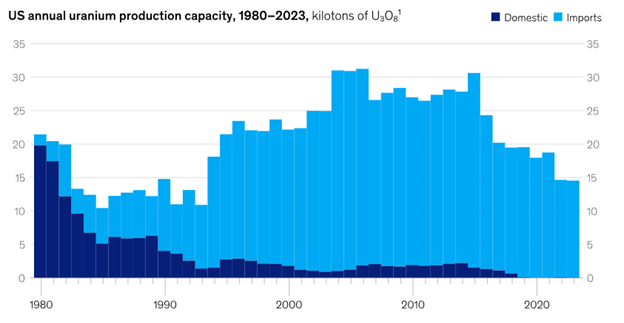
Despite this uptick, over 95% of the US uranium requirement is imported (see Exhibit 2), and not just from allies Canada or Australia, but from Russia and China. Consequently, the development of nuclear energy enjoys bipartisan support in the US as a national security issue. In October 2025, the Trump administration announced an US$80 billion partnership with Westinghouse Electric and its owners, Brookfield Asset Management and Cameco, to expand US nuclear power by deploying AP1000 reactors. As part of the initiative, the US government will facilitate financing, streamline permitting, and help secure regulatory approvals. While Rick is sceptical about whether the government will actually fund the project, Cameco CEO Tim Gitzel said the deal is essentially “a purchase order”.
The federal government is working with the domestic nuclear fuel industry through the Defense Production Act (DPA) Nuclear Fuel Cycle Consortium, to ensure the US continues to have enough nuclear fuel under the Nuclear Dominance – 3 by 33 campaign. The US last established strategic uranium reserves in 2020/2022 under a $75M initiative managed by the Department of Energy. Here is Amir Adnani, CEO of Uranium Energy Corp (NYSE:UEC):
“We’re seeing very strong bipartisan political support for rebuilding the domestic industry for uranium mining, conversion and enrichment. It’s not just government; it’s the end users too. Google, Amazon, Microsoft, the big capex spenders of the world today who are investing in energy to power their data centers, are investing in nuclear and small modular reactors. The largest companies in the world have embraced nuclear as a fundamental solution and they are realizing that the biggest problem with investing billions of dollars in new nuclear capacity is the lack of fuel. They are not going to put billions into nuclear generation capacity if you can’t ultimately fuel that properly.”
Exhibit 2: US Annual Uranium Production Capacity 1980-2023
Source: McKinsey & Co / US Energy Intelligence Administration
Here is Scott Melbye, EVP at UEC, who is also head of the uranium producers of America, which now has 20 members, a record number, six of which are in production in the western US. The group has indicated it can produce 25-30Mlb/y by 2033, coincidentally the amount of uranium the US imports from Russia, Kazakhstan and Pakistan:
“US producers have seen supportive policy in this administration and even the previous administration. We saw the Russian uranium ban, passed in a bipartisan fashion, and strong market signals are being sent to US producers to resume production. I’m the head of the uranium producers of America. Production last year reached about 1.3Mlb. We’ve already seen a 1Mlb produced in the US in the first quarter of this year, so it is working.”
As an example of how non-traditional players are getting involved in uranium, Myriad Uranium recently sold its Red Basin project to Subatomic, a group backed by venture firms 8VC and Overmatch Ventures in recognition that domestic fuel supply chains are critical for energy security for AI and electrification projects. US government policy is successfully stimulating new supply.
The resurgence of nuclear power is being boosted by a new source of demand. A report by McKinsey, said the US may need 100-300GW more nuclear capacity than planned by 2050 to meet electricity demand from AI and hyperscale data centers, which in turn, would require substantial investment in the nuclear fuel supply chain. Here is Melbye:
Nuclear power is growing at rates that we haven’t seen since the 1970s. We’re doubling nuclear generation by 2045 on the base case, and that’s just the large reactors, 440 existing, 70 under construction. That doesn’t take into account small, modular advanced reactors, hyperscalers, data centers.”
Tech companies are signing an increasing number of power agreements with utilities. Meta, the owner of social media platforms Facebook, Instagram and WhatsApp plans to build a $10B AI data center in Louisiana and buy power from a nuclear plant in Illinois from Constellation Energy; Amazon has bought a nuclear-powered data center from Talen; Constellation is restarting the Three Mile Island nuclear plant to sell power to Microsoft for AI; and Nvidia struck an AI deal at California’s last nuclear power plant. Here is Eagle Nuclear Energy CEO Mark Mukhija:
“Power is the bottleneck. When you look at AI, the most powerful countries will be able to develop the most robust models and algorithms. … Nations are starting to see nuclear as a form of energy security. The Strait of Hormuz crisis highlighted the global impact if energy is not readily available through oil, which puts an even greater strain on the already tightening uranium supply.”
McKinsey points out that US enrichment capacity has dropped significantly over time, with enrichment production now concentrated in China, Europe, and Russia. Conversion of yellowcake into uranium hexafluoride (UF₆) for enrichment also falls short, with only one uranium conversion facility in the US, which can meet about 50% of today’s US demand. Enrichment is also a highly concentrated market that falls short of US domestic needs. McKinsey estimates capital investments of $15-20B for mining and milling, $30-45B for conversion, $30-40B for enrichment, $10-20B for fabrication, and $20-45b for reprocessing, are required, some $105-170B to achieve 300 GW of incremental domestic capacity by 2050.
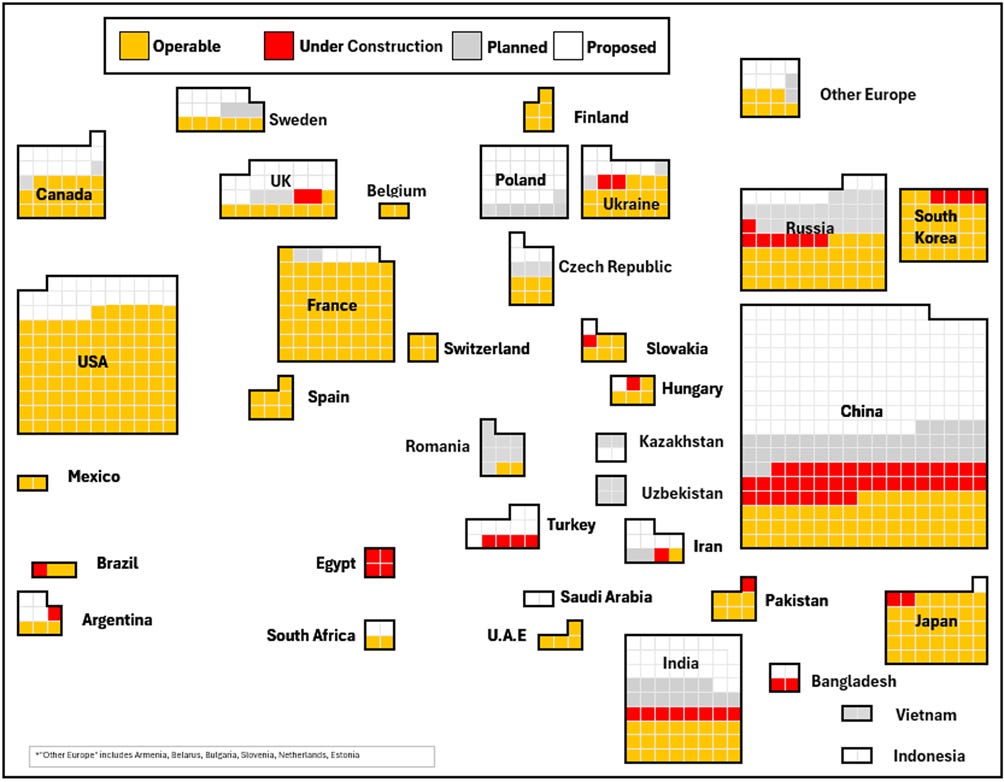
Exhibit 3: World’s Nuclear Build Out
Source: World Nuclear Association
It is not just the US building out a nuclear power fleet (see Exhibit 3), with increasing builds in Asia and Europe. China’s nuclear power capacity has nearly doubled since 2016 according to the US Energy Information Administration, increasing by 76% (24GW) according to International Energy Statistics. China has 36 reactors under construction, accounting for more than 49% of total world nuclear construction. The World Nuclear Association reported in April 2026 that there are 438 operable reactors worldwide, with projections that this will increase to 952. In its September 2025 Nuclear Fuel Market Report, it estimated that there is 372GWe of nuclear capacity installed globally, consuming 180Mlb/y of U3O8, with an outlook to grow to 686GWe by 2040, consuming 390Mlb/y. Its low-case scenario projects growth to 582GWe and consumption of 278Mlb/y. With current production estimated at 160Mlb/y, the uranium market is facing a supply deficit, and analysts forecast a uranium super-cycle driven by sustained buying from utilities, triggering significantly higher prices. Shaw and Partners suggest the deficit could exceed 200Mlb/y. Here is Shaw and Partners supply view:
“We need to add 240Mlb/y of new mine supply in the next 14 years. When you consider depletion of existing mines, the required new supply is more likely to be >350Mlb/y. It is very difficult to see where more than 150Mlb/y of that supply will come from.”
Goldman Sachs forecasts a 2.3Blb cumulative uranium deficit through 2045, driven by surging demand from AI data centers and Small Modular Reactors (SMRs). SMR deployment is expected to reach 46 GW, with the long-term supply-demand gap widening by 17% due to this new source of demand, prompting a structural long-term shortage. Here is Melbye:
“That 2Blb has to manifest somewhere and we’re beginning to see it manifest in the long-term market, which is counterintuitive. You would think it would show up in the spot market, but it is showing up in the long-term market because utilities are requesting proposals for long-term supply, and they’re seeing fewer and fewer quality offers in terms of price or quality of producer. That sets off a phenomenon where utilities either bite the bullet and further increase producers’ capacity, or they throw capacity into a spot market that can’t handle that kind of volume. It hasn’t happened yet, but we’re getting very close to that stage.”
As demand for nuclear power increases, utilities have not increased their uranium purchases and have not been contracting at replacement levels. Goehring & Rozencwajg Associates estimates that 2026 uranium mine supply will be down while reactor demand will be up, creating a global uranium market deficit before investment demand is factored in. Here is Goehring & Rozencwajg:
“Given these enormous growth assumptions, the expansion of uranium supply over the next 15 years will be critical. And on that front, the challenges are already beginning to surface. The supply problems emerging today will only deepen the structural deficits now developing in global uranium markets.”
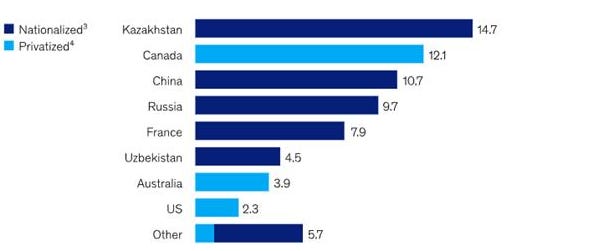
Exhibit 4: Attributable Uranium Mine Supply
Source: McKinsey & Co
While the US has the world’s greatest uranium demand, less than 1% is sourced from domestic mines. In 2023, about 90% of the uranium purchased by US reactor operators was sourced from Australia, Canada, Kazakhstan, Russia, and Uzbekistan (see Exhibit 4). Here is McKinsey’s view:
“While supplying all US uranium demand domestically remains unlikely given resource distribution and cost considerations, recent policy shifts and higher long-term pricing have improved the outlook for a modest but strategically meaningful increase in US production.”
Uranium supply faces many challenges. In Kazakhstan, the world’s leading producer, Kazatomprom, is struggling with production expansion, downsizing its plans for 80Mlb/y to around 60Mlb/y. It is not the only producer facing headwinds. Canada’s largest producer, Cameco, temporarily paused activities at some of its Northern Saskatchewan operations following flooding that washed out a bridge on a key access route to its McArthur River and Key Lake sites.
Kazakhstan increasingly represents the geopolitical crosswinds circulating around uranium. US President Donald Trump has courted the central Asian country, inviting it in 2025 to join the Abraham Accords, a key strategic alignment with US foreign policy. The budding relationship also focuses on access to critical minerals, such as uranium, and on the development of a tungsten mine and processing plant by US-backed Cove Capital. In response, Russia is flexing its diplomatic muscle to reinvigorate its historical relationship with the nation, which was a Union Republic of the USSR before its breakup, and was the location of a large store of Soviet nuclear weapons. Russia signed an agreement with Kazakhstan in May 2026 to build the first nuclear power plant in the country at a cost of about $16.5B, which Russia will partially finance, with Russian President, Vladimir Putin, in Kazakhstan for the announcement. Kazakhstan’s President Kassym-Jomart Tokayev appears to be giving a masterclass in triangular diplomacy. With the Trump agreement, Tokayev is clearly stepping out of Russia’s shadow to become an international actor in its own right. Further evidence of this is his offer for Kazakhstan to receive Iran’s stockpile of enriched uranium as a means of defusing that sticking point between the US and Iran. With a new nuclear power plant under construction, this could be a workable solution for all concerned.
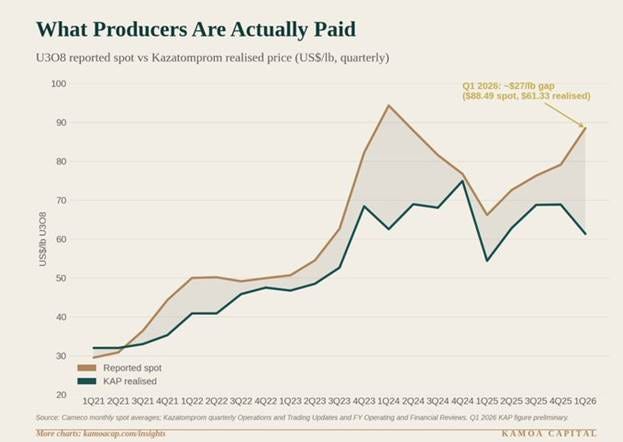
While the uranium market faces supply challenges, it is also undergoing structural change. Terms sales are common between uranium producers and the nuclear power plant buyers, who typically look to lock in multiple years of supply at terms below the spot price. Term sales benefit uranium project developers by providing bankers with long-term assurance that they can repay their capital, and similarly for nuclear power plant developers, whose bankers want to see that they have contracted for a uranium supply to secure development funding. A tight market means contract terms are modifying in a similar way that contracts for copper concentrates did a few years ago. An increasingly tight copper concentrate market has enabled concentrate providers to move away from contracts that lock prices in for three years, and uranium suppliers are looking to do the same. This change is necessary to incentivize new developments. Despite a four times increase in the spot price, global uranium supply grew by just ~14% over 13 years, according to NexGen Energy. It said:
“The industry runs on 20-year timelines, not quarterly price cycles. By 2040, the world needs 335Mlb/y. The gap cannot close without higher, sustained prices for decades.”
Here is Rick:
“Nuclear power plants require a lot of debt capital and increasingly the lenders are requiring the plant builders to have contracted in the term market enough uranium to substantially amortize the loan. This is a wonderful confluence of circumstances that will benefit the uranium market for at least 10 years. In the uranium business, both price and volume can be predetermined for the very long term, and that makes the high-quality uranium equities, the people who will have the productive capacity to fuel the demand for nuclear power plants in the future, particularly attractive speculations.”
Exhibit 5: What Uranium Producers are Paid
Source: Cameco / Kamoa Capital
No one should want physical possession of a drum of uranium, but those seeking exposure to physical material are perhaps best served by the Sprott Physical Uranium Trust (OQX:SRUUF, TSX:U.UN, LSE:SPUT) to vicariously buy physical uranium. In terms of equities, Rick said the easy money in the uranium space was made when the price moved from about $30/lb in 2021 to more than $60/lb in 2022, and then to $100/lb in 2024. The price has pulled back to about $85/lb since then, but analysts believe it will go much higher, more than doubling. Shaw and Partners forecasts uranium pricing of $175/lb in 2027 and $200/lb in 2028. It also increased its long-term price from $90/lb to $120/lb from 2032. More utility RFPs (requests for proposals) are expected going forward to secure the uranium supplies they need, often including price floors or economic disclosures that indicate the direction of travel. Here is Rick:
“The easy money is when you go from an industry average price that’s less than the cost of production to a price that allows you to earn your cost of capital. That’s over. The set of circumstances we have in front of us is unique in terms of the increasing social and political acceptance of uranium, but also the new structure of the uranium market, and the strategic implications of uranium, which were a prior driver of nuclear plant construction, are back front and center in people’s minds.
Here is Melbye:
“US$85/lb is not a bad price. It’s not high enough to really stimulate widespread new production, but it has encouraged the first or second tier production to move forward. Nobody’s talking about $60-70/lb uranium anymore.”
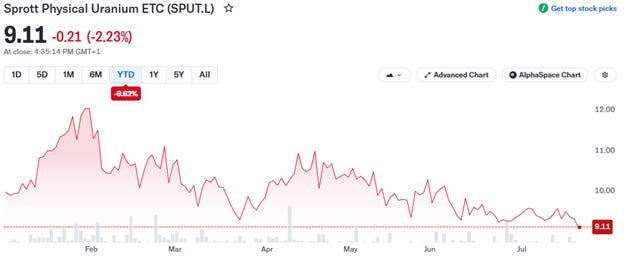
Exhibit 6: SPUT price 2026 YTD
Source: Yahoo Finance
The opportunity in uranium is not just that market participants expect U3O8 prices to rise 25-50%, but also that many stocks are trading at a discount to their net asset value (NAV). On July 17, for example, The Sprott Physical Uranium Trust (SPUT) traded at a 10.9% discount to its $ 20.59-per-unit net asset value (NAV), while its market price was $18.34. This means it is trading at below the market value of the physical uranium it holds. SPUT is trading down 10% year-to-date (see Exhibit 6). Many uranium equities, as represented by exchange-traded funds, are similarly down. The Sprott Uranium Miners ETF (URNM) is down 12% year-to-date, and more than 40% since its high in late January when the spot priced rose over $100/lb. The Global X Uranium ETF (URA) is down by about the same amount, Cameco is down 7%, NexGen Energy 4%, Paladin Energy 12%, UEC 19% and Peninsula Energy 43%. Here is Sprott:
“The diverging performance between the spot price and equities reflects a combination of near-term market uncertainty, risk-off positioning and subdued investor sentiment, rather a deterioration in the sector’s underlying fundamentals. … Uranium has consolidated after a strong start to the year, but the market’s foundations have continued to improve.”
Cameco is the Exxon Mobil of the uranium business, with forecast 2026 production of 19.5–21.5Mlb of U3O8. It produced 6.2Mlb in 1Q26, up 3% year-on-year. It also reported a 6% increase in its average realized uranium price to $66.21/lb, outpacing a 4% increase in production costs to $34.05/lb. Higher prices and volumes drove its first-quarter net earnings to jump 87% to C$131M.
NexGen is developing the Rook I project in the Western Athabasca Basin in Canada, which received final federal approvals in March 2026. A final investment decision has been made for the C$2.2B build, which is expected to take about 4 years. A conventional hard-rock mining operation will produce up to 30Mlb/y at an operating cost of $13.86/lb, and with expansion potential. Major construction is to commence in the summer of 2026. The hard rock conditions allow for underground tailings storage, which reduces surface tailings exposure to almost zero. The company has received sales commitments for 10Mlb at market-related pricing, with annual deliveries of 2Mlb scheduled from commercial production. The Arrow deposit hosts reserves of 4.56Mt @ 2.37% U3O8 containing 240Mlb. NexGen has district potential with more than 150 exploration target identified across 27 key corridors on its 190,000+ hectare land package in the Patterson Corridor East.
Goehring & Rozencwajg is more sanguine about the Rook I’s timeline, noting that, in addition to mine development, it entails the construction of a full ore- and uranium-processing complex. It reflected that the last major uranium mine built in Canada was Cameco’s Cigar Lake, which encountered severe development issues that triggered years of delays and came on stream eight years behind schedule. It said:
“We want to emphasize that any delays should not be interpreted as a reflection on the quality of the project or its management. They would simply be the natural consequence of the complexities inherent in building a mine of this scale.”
See Rick’s pre-event company interview here.
Is a US-focused uranium platform with 1.46Blb of physical uranium inventory, which gives it $800M in liquid assets, including $400M in cash. The company has an M&I resource base of 230.1Mlb, with total resources of more than 500Mlb, the majority of which are permitted, including resources previously held by Rio Tinto and Rosatom, Russia’s nuclear energy company. UEC restarted production at Christensen Ranch/Irigaray in the Powder River Basin in Wyoming with 12.1Mlb/y of U3O8 licensed capacity. Burke Hollow in Texas is built and now in production, positioned for staged production growth as regulatory approvals progress. It is also looking to have a third mine under construction in Wyoming. The company has a US Department of Energy contract to supply 300,000lb U3O8 to the strategic uranium reserve at a 20% price premium.
UEC also has vertical integration ambitions through refining and conversion, launching US Uranium Refining & Conversion Corp to become the only vertically integrated US company from U3O8 to uranium hexafluoride, the feedstock for uranium enrichment. Here is CEO Amir Adnani:
“The key is to do what the Chinese and the Russians do. They don’t just mine uranium, they convert it. It’s a lot like oil and gas. If you just pull oil out of the ground, but you can’t refine it, you’re a less valuable entity. If you can refine uranium to support enrichment, you become much more valuable. UC is the only company that has an active plan to combine mining with conversion.”
Is one of a handful of near-term US uranium producers with direct exposure to US utility demand. Its Lance ISR project in Wyoming restarted production in late 2024 after a five-year hiatus and achieved first yellowcake production in 2025. It hosts a 58Mlb U3O8 resource and is ramping up low-pH ISR operations, with near-term output of 400,000-600,000lb/y in 2026-2027, and a pathway to 2-3Mlb/y through wellfield expansion and satellite feed.
It is a uranium producer with cash flow from the Langer Heinrich mine in Namibia, following a $120 million restart in 2024, and has guided the production of 4.5-4.8Mlb U3O8 for 2026. It has 22Mlb of production contracted until 2030, about 45% of production. For growth will come from the high-grade Patterson Lake South (PLS) project in Saskatchewan, following its December 2024 acquisition of Fission Uranium. PLS hosts the shallow, high-grade Triple R deposit in Saskatchewan’s Athabasca Basin, which has a feasibility study for producing ~9Mlb/y for 10 years, with a 28.2% after-tax IRR at a $90/lb uranium price, following a $1.2B development. The project received EIS approval from the Saskatchewan government in February 2026 and is advancing with the Canadian Nuclear Safety Commission (CNSC) construction licence process.
See Rick’s pre-event company interview here.
Homeland Uranium is an early stage exploration country focused on projects in the US, where it is positioning itself for an expected increase in demand for domestically sourced uranium. Its Coyote Basin and Cross Bones properties are in the Colorado Plateau in NW Colorado, a past-producing uranium district where Union Carbide produced about 5.3Mlb U3O8 from the Maybell mine between 1950 and 1983. Cross Bones hosts a historical resource of 7.1Mt @ 0.31% U3O8 containing 44.2Mlb from surface. At Coyote Basin, drilling in early 2026 returned Ur concentrations of up to 30ppm, lower than anticipated. HLU is led by President & CEO Roger Lemaitre who has been in the Ur industry since 2001. He began at Cameco as a field geologist, working up to manage the Saskatchewan and then the global exploration portfolio, also be part of its M&A team. Here is Lemaitre:
“The premise of the company is to build meaningful pounds that we could define as a 1Mlb/y operation for 10-years out of conventional resources. HLU is about finding quality assets that can move forward, shallow open pits and bringing the last 45 years of technology in the mining space to conventional resources in the US. Heap leaching has never been applied in the US to conventional resources. I think we can make open pit uranium with heap leaching very economic at the right scale.”
Comments
Nothing yet. Say the first thing.
Sign in to join the conversation.