

The outlook for mining in British Columbia has improved as Canada seeks to strengthen domestic resource development amid an increasingly uncertain trading relationship with the US. The province has approved several major mine permits, marking a sharp acceleration in approvals for an industry that until recently viewed the province as one of the hardest places in the world to build a mine. Projects receiving approvals include Hudbay Minerals’ (TSX:HBM) New Ingerbelle expansion at Copper Mountain, Skeena Gold & Silver’s (NYSE/TSX:SKE) Eskay Creek project, Centerra Gold’s (NYSE:CGAU) Mount Milligan expansion, and a mine life extension to Imperial Metals’ (TSX:III) Mount Polley. I relish the opportunity to bring my political science background into this newsletter, so let’s hear from Thomas Jefferson:
“With the change of circumstances, institutions must advance also to keep pace with the times.”
Soon after taking office, Canada’s Prime Minister Mark Carney began implementing mining-policy changes in response to a major external shock to the country’s economy, as US President Donald Trump hit Canada with trade tariffs. These impacted exports in general, and those of steel, aluminum and copper in particular. Carney moved quickly to back mining in an attempt to offset this hit from Canada’s most important trading partner. The provincial government led by David Eby of the NDP party moved in tandem, pushing a mining revival to transform the province into a leading mining jurisdiction.
This is a major policy change as the NDP party that Eby represents for many years seemed bent on stifling the sector through permitting delays and regulatory uncertainty. This exemplifies the political expediency that Jefferson alluded to. Provincial politics sees the Conservative party gaining voter appeal, which represents a political swing away from the urban core of Vancouver towards non-suburban interests, which are largely economic. There is a veneer of wokeness Eby hitching his wagon onto the critical minerals clean energy movement, and his pivot faces friction related to Indigenous land rights and regulatory freezes. Old habits die hard though, as in June the NDP provincial government extended the mineral tenure freeze across parts of northwestern and north-central BC for another seven months, which means companies cannot register new mineral claims.
There is much to do if BC is to become a mining powerhouse, as a 2024 S&P study found Canada had among the world’s longest mine-development timelines, averaging 27 years from discovery to production. Carney has sought to address this through the establishment of the federal Major Projects Office built around a “one project, one review” system to coordinate federal and provincial permitting so that project proponents do not have to undertake two separate processes. Conscious of the difficult history mine developers have had in the province, consulting firm PwC describes the overall environment as a narrow window of opportunity, “likely measured in years, not decades,” for BC to establish itself as a reliable critical-minerals supplier before rival jurisdictions catch up. Here is PWC’s Gemma Stanton-Hagan, director of economics and policy:
“The government’s rhetoric is very pro-natural resources, and it aligns very well with doubling down in areas where Canada is already strong and has real potential to diversify exports.”
Following the US tariffs, in February 2025 BC designated several critical mineral and energy projects for fast-tracked coordination, including four mines representing about C$20B of combined investment. These included Skeena’s Eskay Creek, the expansion of Red Chris, a 70:30 joint venture between Newmont (NYSE:NEMM) and Imperial Metals, Teck Resource’s (TSX:TECK) Highland Valley Copper extension and Centerra’s Mount Milligan. The list also includes Northisle Copper & Gold’s (TSXV:NCX) North Island project, Surge Copper’s (TSXV:SURG) Berg project and Defense Metals’ (TSXV:DEFN) Wicheeda rare earth project.
Project development will also be supported by more than C$100M of federal and provincial funding for regional clean power transmission upgrades through BC Hydro. Groundbreaking is planned to start in August 2026 for BC Hydro’s North Coast transmission line, a 750km, C$10B project in three stages. The first is funded with C$3B, and will double the high-voltage power line to assist mineral project development in the Golden Triangle in the north of the province.
Federal money is backing the policy shift too. In July 2026, Teck signed a strategic agreement with the Canada Growth Fund (CGF) and Natural Resources Canada under the new Canada Critical Minerals Accelerator, with CGF to invest up to C$400M to roughly double germanium and antimony production capacity at Teck’s Trail smelting and refining complex, and potentially add gallium capacity. This includes an offtake structure with the federal government. Here is Minister of Energy and Natural Resources, Tim Hodgson:
“Our new Canada Critical Minerals Accelerator is about turning Canadian resource abundance into real projects by giving industry the certainty they need to invest and grow, even in a volatile global market.”
Ottawa is also backing the block cave expansion at Red Chris with up to C$500M, plus C$195M for nearby highway improvements. Newmont received an amended Environmental Assessment Certificate and Mines Act permit for the project in June 2026, to extend its life into the mid-2040s. This will lift Canada’s copper production by an estimated 15%. The mine produced 42kt of copper and 92koz of gold in 2025 and holds reserves of 3.6Moz gold and 900kt of copper.
Seabridge Gold (NYSE:SA) has benefited from the pro-mining policies, particularly the Northwest transmission line project. Here is chief executive Rudi Fronk:
“This was a game-changer for us, as it brought hydro power past our project. We have tied in and almost completed the switching station to take that power to KSM. Being able to buy from the grid really helps the project from an economic perspective and means we can consider an electric fleet as a feasibility optimisation, rather than bringing diesel to site.”

Rick is to launch a premium newsletter about a new, actively managed investment account, in which he will share the trades he makes and the rationale behind them with subscribers, including his thoughts on portfolio construction and risk management. Anyone interested in subscribing should write to:
TheRulePortfolio@gmail.com
The mining sector has responded to the improving investment conditions. Newmont made a strategic pivot towards British Columbia with its acquisitions of GT Gold in 2021 and Newcrest Mining in 2023 that created a critical mass for it in the province around the Red Chris and Brucejack mines. Newmont has the Galore Creek development project, a JV with Teck, but will its northern BC consolidation play continue?
Teck has been the BC local hero for decades, where it operates the Highland Valley copper mine and the Trail smelter, although this has diminished since it sold its interest in the Elk Valley steelmaking coal operations to Glencore (LSE:GLEN) in 2024 for US$7.3B. Highland Valley and Trail are a key feature of Teck’s US$53B merger with AngloAmerican, which is expected to close in 2027. Trail in particular is a strategic asset, and one expected to play an increasingly important role in Canada’s critical minerals plans, particularly production of niche elements, such as germanium and gallium.
Other recent M&A featuring BC projects include Coeur Mining’s (NYSE:CDE) acquisition of New Gold to create a US$20B precious metals company that includes the New Afton copper-gold mine; and Contango ORE’s (NYSE-A:CTGO) merger with Dolly Varden Silver to create Contango Silver & Gold, which adds the Kitsault Valley silver project in BC to Alaskan gold assets.
Centerra is also looking to grow. In addition to expanding its Mount Milligan gold-copper operation, it took a 9.9% stake in Thesis Gold & Silver (TSXV:TAU) in April 2025, citing potential synergies with its nearby Kemess project. Freeport McMoran (NYSE:FCX) has taken a 60% stake in the AuRORA project in the Toodoggone district, a JV with Amarc Resources (TSXV:AHR) and most recently, in July 2026, Barrick Mining (NYSE:B) took a 9.9% stake in copper-gold explorer Kingfisher Metals (TSXV:KFR) with a C$20.9M investment at a 31% premium, following a high-grade porphyry drill hit at the Highway 37 project.
It is not just the miners moving in. Some of the smartest money in the business is coming into the province. Wheaton Precious Metals (TSX:WPM) advanced US$55M to Spanish Mountain Gold (TSXV:SPA) via a royalty agreement to advance the Spanish Mountain gold project, while Osisko Development (NYSE:ODV) secured more than US$650M in financing in August 2025 to build its Cariboo gold project, including a US$450M loan credit facility from Appian Capital Advisory.
It is worth noting that projects in BC often enjoy a lower cost of capital because of the home team financial infrastructure in Vancouver and the ethnocentric nature of people, even though, until recently, many of the projects on the development slate were economically marginal. Higher metals prices mean they can be decent market performers in the near term, but they are potential money traps in the long term, as they may be unable to thrive when the metals price cycle inevitably swings downwards.
There is much excitement and many tailwinds for mining in BC, but these are also generating turbulence. Some First Nations are concerned that the urgency to permit projects may see corners cut during environmental and social evaluations, and that their rights may be overstepped. This potential for conflict comes as First Nations’ position has strengthened through the province’s 2019 Declaration on the Rights of Indigenous Peoples Act (DRIPA). This aligned BC law with the UN Declaration on the Rights of Indigenous Peoples (UNDRIP), and established a right to free, prior and informed consent before projects proceed on traditional territory.
This is a critical factor at the staking and exploration stage after the BC Court of Appeal ruled in 2025 that the province’s mineral claims system did not comply with DRIPA. Cases brought by the Gitxaała and Ehattesaht First Nations argued that the province’s automatic mineral-claim registration process failed to consult or obtain consent from affected communities. A 2023 BC Supreme Court judicial review had already found that the province’s Mineral Tenure Act’s claims system was unconstitutional. The province committed to consulting First Nations before allowing companies to stake exploration claims on their territories, but the resulting Mineral Claims Consultation Framework drew a sharp warning from the Association for Mineral Exploration (AME). AME Chair Trish Jacques called it: “an existential crisis for the exploration industry” because the consultation process meant stakers would lose momentum, reveal their hand to competitors, and potentially give First Nations a veto over who can obtain claims in their territories. AME said this could continue the trend of a 25% decline in BC exploration spending from C$740M in 2022 to C$552M in 2024, and a 45% drop in metres drilled over the same period.
Provincial permitting decisions continue to end up before the courts. In June 2026, the Supreme Court of BC found the province had not adequately consulted the Tsetsaut Skii km Lax Ha Nation before designating Seabridge Gold’s KSM project “substantially started”. Although Justice Emily Burke found the underlying determination reasonable, she found the consultation process insufficient, even though the larger Tahltan and Niska First Nations agreed to KSM’s substantially started designation.
First Nations also challenged the approval to extend operations at Mount Polley to 2033, with a particular concern about plans to expand the tailings dam that failed catastrophically in 2014, releasing more than 24M cubic metres of mine waste.
Conversely, some First Nations look to obtain greater utility from the projects in their territories beyond those outlined in the Impact and Benefits Agreements miners negotiate with them. In addition to providing an increasing array of services to projects, some nations are also investing. The Tahltan nation has invested in Skeena and Imperial, while the Nisga’a nation rolled its royalty interests in the Brucejack, KSM and Premier projects in the Golden Triangle into listed company Nations Royalty (TSXV:NRC).
Nations Royalty is interesting because it is a publicly-listed royalty company 77% owned by the Nisga’a Nation, the first majority-Indigenous-owned public mining royalty company. This gives the Nisga’a Nation additional exposure to the upside of mining project development, and more fully aligns them with project success. This could be a durable, sustainable competitive advantage, as it could help those with projects on Nisga’a Nation territory obtain their blessing for them to advance. First Nations are important players in the political sphere, and if a First Nation wants a project to advance, the BC government in Victoria is unlikely to oppose too strongly. Will other First Nation’s will follow the Nisga’a Nation’s example?
We must also consider what could go wrong with this set-up. As in any political body, it is unusual for all members to think or want the same things. Internal discordance within First Nations, and among different First Nations, is not unheard of. Opinions and desires change over time too. The chief development officer of Nations Royalty is Kody Penner, a member of the Tahltan First Nation, which has not contributed any royalties into the company. There could come a time when some members of the Nisga’a Nation are no longer in agreement with this set-up, and could cite this as another example of them being swindled out of their rights. What then? The Nisga’a Nation owns 77% of the company, but as Nations Royalty grows it will have to issue more shares, diluting Nisga’a ownership. The company has some real peaches in its portfolio; what happens if a bigger royalty company seeks to buy it?
Let’s look at some of the key mining districts in BC.
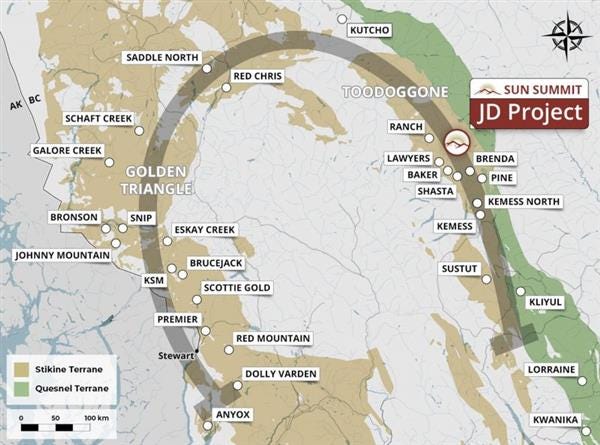
Exhibit 1: The Golden Horseshoe comprising the Golden Triangle and Toodoggone
Source: Sun Summit
BC’s highest-profile mining district is the Golden Triangle in the province’s north, where receding glaciers are exposing new ground, and ongoing road and power investment is lowering the hurdle for development. M&A in the Golden Triangle adds up to US$4.8B since 2018. The main active mines are Newmont’s Brucejack and Red Chris, but more are set to follow.
Skeena’s Eskay Creek project is in construction, having obtained environmental approval earlier in 2026, which was jointly signed off by the Tahltan Central Government in February 2026. It is now more than half built, and targeting first production in 2027. A 2023 feasibility study outlined average production of 450koz/y AuEq in the first five years from reserves of 4.6Moz AuEq @ 3.6g/t, including an 88Moz silver reserve. This will make Eskay Creek a leading silver producer. Nearby, Skeena’s Snip deposit carries a 2023 indicated resource of 823koz @ 9.35g/t gold, and it could become a satellite development opportunity for Eskay Creek.
The elephant in the development pipeline is Seabridge’s KSM copper-gold-silver project, which hosts reserves of 47.3Moz gold, 7.3Blb copper and 160Moz silver, from which it will have an initial 33-year mine life. The mining world is waiting to hear who Seabridge will pick as its JV partner to develop the US$6.4B project. Chief executive Fronk has been coy about who this may be for a while, but it seems a partner has been chosen, given the 20 July 2026 announcement that Seabridge received an unsecured US$100M short-term loan. Fronk expects the capital cost to rise, although the company has made a head start in developing certain aspects as part of obtaining its substantially started designation in July 2024. A feasibility study is due in late 2027. Here is Fronk:
“A lot of that work is already advanced. We are tying into the power line and building the access road. We built the first fish compensation area, a bridge and a large camp, which has taken a bite out of the US$6.4B. The capex will be higher than that, but it will be more than offset by higher metal prices. The PFS yielded a base-case net present value of US$8B. At today’s metal prices, it is north of US$30, which can capture a lot of capital cost escalation.”
Cambria Gold Mines (TSXV:CAMB) (formerly Ascot Mining), backed by the Fiore Group and run by CEO Robert McLeod, who has spent much of his career in the Golden Triangle, is attempting a turnaround at Premier after Ascot failed to produce enough ore to feed its 2,500tpd mill. Cambria plans to develop feed sources from the nearby Red Mountain deposit, which hosts M&I resources of 783koz @ 7.63g/t Au.
Elsewhere in the region, Scottie Resources (TSXV:SCOT) is pursuing a direct-shipping-ore concept at its Scottie project, with a feasibility study due in 2027, and Kingfisher Metals and its Highway 37 porphyry copper-gold discovery have leapt into focus as a result of a blind porphyry discovery with a drill hit of 425m @ 0.4% CuEq, and Barrick’s investment.
The less-developed Toodoggone district is inland from and parallel to the Golden Triangle. Together they form the Golden Horseshoe.
Centerra is the dominant player in the Toodoggone through its Mount Milligan mine that will produce up to 155koz gold and 60Mlb copper this year, and whose life has been extended until 2045. It could add to its regional position through the redevelopment of the old Kemess mine, which has a PEA for an initial 15-year mine life to produce 171koz/y gold and 61Mlb/y copper following an initial capital cost of $771M. A PFS is expected in mid-2027.
Thesis outlined a PFS for its Lawyers-Ranch project in December 2025 for a 13,700tpd operation to produce 187koz/y AuEq over 15 years. Centerra Gold took a 9.9% stake in Thesis in April 2025, citing potential synergies with its nearby Kemess project. AngloGold Ashanti (NYSE:AU) also owns a 5% stake.
Another exciting recent greenfield discovery was by the Amarc-Freeport partnership at AuRORA in the emerging Joy gold-copper project. It promises a rare combination of grade, continuity and geometry. A drill hit of 70m @ 2.6g/t Au, 0.42% Cu & 5g/t Ag in hole 57 encouraged Freeport to continue its earn-in, and it now owns a 60% interest in the AuRORA Minerals JV, having funded expenditures of C$35M, and exercised its right to earn an additional 10% by investing a further C$75M, for a total earn-in investment of C$110M. Drilling this year with a budget of C$20M is focused on expanding AuRORA and the TWINS Discovery.
Next door is TDG Gold (TSXV:TDG), which began a PEA in June 2026 for its Shasta Au-Ag project that hosts an indicated resource of 516koz @ 1.35g/t AuEq, and another 506koz in inferred resources. This is adjacent to AuRORA, and the AuRORA deposit, which straddles the property boundaries of TDG and Amarc. TDG counts Skeena as an investor with an 11% equity stake.
Around Merritt in south-central BC, Westhaven Gold (TSXV:WHN) brought in Dundee Corp (TSX:DC) as a strategic partner for its Shovelnose gold-silver project, with Dundee investing an initial C$30M as part of an C$85M earn-in toward 60% ownership. Shovelnose hosts a 1Moz resource, and a March 2025 PEA outlined an 11-year underground operation producing 56koz/y gold.
Nearby, Kodiak Copper (TSXV:KDK) is drilling its MPD project between the producing Highland Valley and Copper Mountain mines, with a December 2025 maiden resource of 82.9Mt indicated and 356.3Mt inferred at comparable grades to its neighbours; an oversubscribed C$15M raise in June 2026 saw the company expand its 2026 drill program. Hudbay’s Copper Mountain is expected to average 144kt/y of production over the next three years. Its New Ingerbelle expansion was approved in 2026 to extend the mine’s life by 12 years to produce 750kt Cu, 900koz Au and 5.5Moz Ag over its remaining life. Teck’s Highland Valley is to produce up to 137kt/y of copper through 2046.
In Central BC, Artemis Gold (TSXV:ARTG) approved a C$1.44B phase-two expansion of its Blackwater mine to lift throughput to 21Mtpa and production above 500koz/y, positioning it among Canada’s three largest gold mines. The Phase 1A expansion to lift throughput to 8Mtpa, was 57% complete at the end of 2Q26 and remains on schedule for 4Q26 commissioning at a capital cost of C$120M. Major works on the EP2 expansion have begun to lift throughput to 21Mtpa by 4Q28. ARTG hedged its downside risk with put options on 173koz Au at C$5,300/oz covering over 80% of expected spot sales through the build.
Nearby, Osisko Development has raised more than C$600M to fund the construction of its Cariboo gold project, where an optimised feasibility study for a 4,900tpd operation detailed the production of 190koz/y of gold for 10 years following an initial capital cost of C$881M.
Surge Copper has a PFS for its Berg project that outlined a 28-year operation producing 308Mlb/y CuEq, while Northisle Copper & Gold has reserves of 1.2Bt containing 5.8Blb Cu, 687Mlb Mo, 160Moz Ag and 800koz Au. Actual copper production will be about 80ktpy, and with the high copper price and byproduct credits, the mine would have negative C1 cash costs. Berg has yet to be permitted of course, and there is many a slip betwixt cup and lip, particularly as it has a $4.7B development cost.
An important caveat is that BC’s gold-copper, copper-gold porphyries have traditionally been viewed as too marginal to be developed. At current metals pricing, economics for many projects look amazing, but it behoves the investor not to get carried away by splashy numbers. Berg has a C$4.7B development cost, while Surge has a market capitalization of C$183M, which means it will not be Surge that develops Berg. Who will buy copper development projects? There is a copper deficit and a thin pipeline of projects with which to fill it, but copper majors tend to be very quick to obtain a toehold in companies with projects they think are interesting. Freeport moved quickly to invest in Amarc, and Barrick quickly invested in Kingfisher after they each made impressive drill hits.
There are many more companies active in BC than we can mention, but here are some highlights.
Skeena is advancing the Eskay Creek Gold-Silver Project in BC’s Golden Triangle. Fully permitted and under construction, with initial production targeted for 2Q27. Positioned to be one of the world’s highest-grade open-pit precious metals operations.
Market cap: ~US$3.56B
52-week range: US$13.81–38.77
Kingfisher is a junior copper-gold explorer in the Golden Triangle. Its HWY 37 project, where a new blind Cu-Au porphyry system was confirmed below the Hank epithermal Au-Ag system in early 2026. Barrick's C$20.9M investment boosted its cash position to C$47M, with at least 80% directed to HWY 37.
Market cap: C$174–176M (July 2026)
52-week range: C$0.215–1.45
Amarc is a Hunter Dickinson–affiliated copper-gold porphyry explorer with a multi-project portfolio in BC. Core assets are the IKE copper-molybdenum-silver discovery, the JOY copper-gold porphyry district adjacent to Centerra’s Kemess mine, and the DUKE and AURORA districts.
Market cap: C$207M
52-week range: C$0.49-1.52
Centerra is a Canadian mid-tier gold and copper producer operating the Mount Milligan mine in BC and Öksüt in Türkiye. It also has a mMolybdenum Business Unit in the US and Canada. It pays a 7c per quarter dividend.
Market cap: US$3.4B
52-week range (NYSE): US$6.71–21.17
Westhaven is a gold-focused exploration company targeting high-grade epithermal mineralization in the Spences Bridge Gold Belt in southern BC. It controls four gold properties: Shovelnose, Prospect Valley, Skoonka, and Skoonka North.
Market cap: C$78M
52-week range: C$0.125 -0.35
Nations Royalty is Canada’s first majority Indigenous-owned public royalty company, partnering with First Nations to convert future Benefit Agreement payments into equity. Its royalty portfolio includes interests in Brucejack (producing), Premier, Red Mountain, KSM (Seabridge Gold), and Kitsault. Cambria Gold commenced early works on the Red Mountain access road in June 2026, a key development milestone. Continued progress at Seabridge’s KSM Project represents a long-term portfolio optionality driver.
Market cap: C$186M
52-week range: C$0.43–1.98
No posts
Comments
Nothing yet. Say the first thing.
Sign in to join the conversation.