
We are taught the importance of setting goals to give us direction, focus, and motivation—a way to move ourselves toward a new state of being. Lose the weight. Start the business. Hit the revenue target. Learn a new skill.
The conventional wisdom says that to ensure success, goals should be specific and actionable so we can follow through. This wisdom was based on research that said higher goals lead to higher effort in a linear relationship.1
So that’s what we do. We plant a shiny flag way off in the distance—its glint meant to serve as a beacon, keeping us motivated as we take each incremental step across the chasm between where we are and where we want to be.
At first, it works. We take those early steps with determination and energy. But then something gets in the way. An unexpected obstacle shows up. The demands of daily life push us sideways. Or the flag still looks so far away that the progress we’ve made starts to feel insignificant.
What happens next is so familiar. We judge our progress almost entirely by whether we’ve achieved the outcome. And when we don’t—or don’t fast enough—it’s easy to start questioning our capability. We feel discouraged. We lose momentum. Sometimes we stop altogether. Even when learning and effort are happening, it feels like we’re failing.
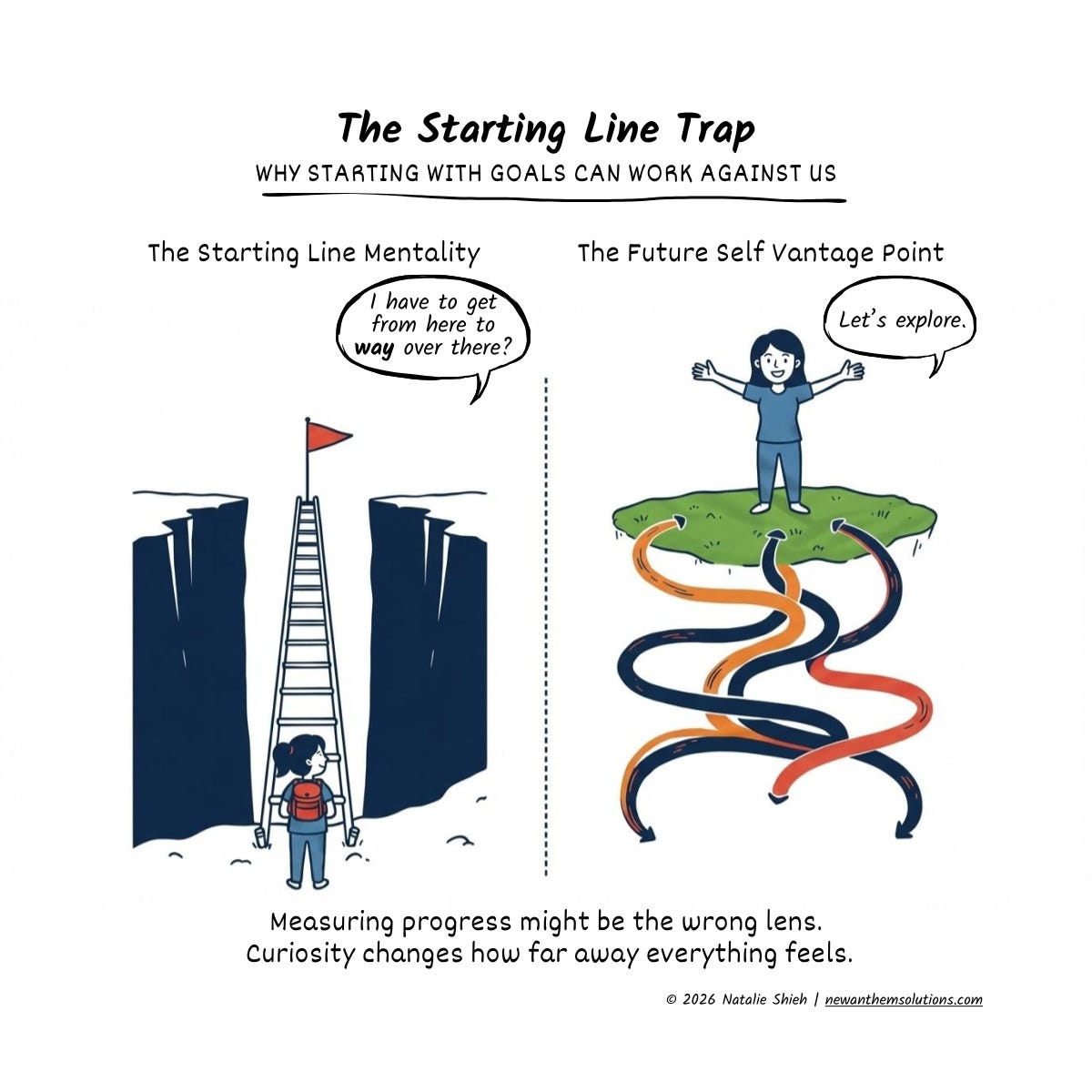
Studies back this up. When people miss a difficult, specific goal in lab experiments, their mood and self‑esteem drop and they often choose easier tasks next, pulling away from challenge instead of leaning into it.2 Self-regulation research suggests this isn’t a character flaw; it’s a built-in feedback glitch.3 Goals act as reference points, and when we keep seeing ourselves as “behind schedule” on a goal, negative emotion accumulates and eventually nudges us to scale back or disengage.
Here’s the flaw in traditional goal-setting. It pushes us into binary thinking. You either hit the goal or you don’t. You succeed or you fail. And because the outcome lives in the future, that sense of failure can creep in long before anything has actually failed.
But what if the problem isn’t discipline or follow-through?
What if it’s the way we’re taught to evaluate progress in the first place?
Instead of chasing goals, what if we started with a belief about our future selves?
Research on future‑self and identity shows that people are more willing to do hard things when those actions feel like expressions of who they are—or who they’re becoming—rather than pass‑fail tests of worth.4 5 In Atomic Habits, James Clear hits on this when he talks about identity-based habits. The idea is to flip the script: instead of focusing on the outcome and hoping your behavior follows, you start with the identity and let the actions flow from there.
But if we flip it, we’re left with a practical question: how do I decide which actions or habits to start forming?
Say I want to be a better cook. I picture a future version of myself who can put together a great meal without following a recipe—someone who knows instinctively which spices to add and how to balance a dish.
How did that version of me get there? Did I take classes? Try a new spice once a week to learn about flavors? Learn by watching friends and experimenting along the way?
Once I frame it that way, as a process of learning through exploratory trial-and-error, curiosity takes over, imagining the story of future me. I find myself pulling out my phone and searching for cooking classes nearby. Not because I’m trying to hit a target, or find the “best” way to get there, but because I’m exploring what practices might move me in that direction in a way that is—dare I say—fun.
Do you see the difference?
The same dynamic shows up at an organizational level.
Imagine a team sets a goal to “increase revenue by 25% this year.” It’s clear. It’s measurable. But as the months pass, progress is uneven. A deal stalls. A hiring plan slips. External conditions change. Even when the team is learning, adapting, and improving how they work together, the looming outcome starts to dominate how success is judged.
The energy in the room shifts. Meetings become tense and defensive. Risk-taking narrows because everyone is afraid of a “miss.” The mood moves from inspired to “behind schedule.”
Now imagine starting somewhere else.
Instead of leading with the outcome, the team gets clear on the kind of organization they’re becoming. A company known for truly understanding their customers, not through marketing statistics, but through hands-on engagement. For using that knowledge to build products deliberately instead of reactively.
From there, different paths open up. How do teams need to work differently? What capabilities need to be practiced? Where do leaders need to model new behaviors?
Progress looks different in this frame. It shows up in new innovations, better handoffs, engaged teams—long before revenue numbers fully catch up. The work still aims toward results, but people aren’t evaluating themselves only by whether the final number has landed yet.
Instead of stepping toward a distant outcome and judging ourselves by whether we reach it, we retrace our steps backward from a future state of being. We explore paths with curiosity rather than measuring results. The pressure lifts and we recognize the process of learning as progress again.
In my own life and in my work, I anchor myself to this philosophy:
You become what you believe through what you practice, and what you practice shapes what you believe.
More on this in my next newsletter.
For now, take a look at one of your goals and ask yourself these two questions:
What does the goal reveal about who you want to become?
And what is that person practicing today?
Thanks for reading! Feel free to share this post with someone who will find it helpful.
Locke, E. A., & Latham, G. P. (1990). A theory of goal setting & task performance. Prentice-Hall, Inc.
Höpfner, J., & Keith, N. (2021). Goal missed, self hit: Goal‑setting, goal‑failure, and their affective and motivational consequences. Frontiers in Psychology.
Carver, C. S., & Scheier, M. F. (1990). Origins and functions of positive and negative affect: A control-process view. Psychological Review.
Rutchick, A. M., et al. (2018). Future self-continuity is associated with improved health and increases exercise behavior. Journal of Experimental Psychology: Applied.
Oyserman, D. (2008, 2024). Identity-based motivation and the motivational consequences of identity-congruent actions. Social and Personality Psychology Compass.
Comments
Nothing yet. Say the first thing.
Sign in to join the conversation.