
The (Re)align Perspective: We usually view growth as a distance to be covered toward a specific goal. I’m interested in shifting that focus—starting with a theory of what we will become. This is a practice of moving toward our “Future Self” through curiosity and trial-and-error, rather than binary success or failure.
Our philosophy is simple: You become what you believe through what you practice, and what you practice shapes what you believe.
I’ve talked about why goals can backfire and make us bail before we even begin.
What I haven’t talked about yet is what happens when we actually reach them.
For example, in the 1920s, psychologist Bluma Zeigarnik noticed something perplexing in a Berlin café. Waiters could remember incredibly complex, unpaid orders with perfect clarity—up until the moment a bill was settled. Afterwards? They couldn’t recall a single item a customer had eaten.1
Decades later, in 1966, psychologists Edwin Locke and Judith Bryan asked university students to search for matching sequences across long rows of five-digit numbers. One group was told to “do your best.” The other was given a specific, challenging goal.
The goal group came out of the gate with high-intensity effort, but as they got close to the target, they began to pump the brakes. Meanwhile, the “do your best” group worked at a steady pace.2
Or how about this? In 1990, organizational researchers Barry Staw and Richard Boettger asked their study participants to proofread a business school brochure riddled with small grammar mistakes—and major factual errors too. They instructed one group to “find all the grammar errors,” and the other group to “try your best.”
The grammar-focused group was great at catching typos, but not so much with the bigger, more damaging mistakes. The “try your best” group, by contrast, noticed far more of the substantive problems.3
These experiments suggest that three things tend to happen when crossing the finish line:
Erasure, aka the Zeigarnik Effect: when something is incomplete, it stays active and vivid in our minds, helping us focus and persist. But once the task is checked off, the mental energy attached to it disappears.
Slowdown: when we approach the finish line, we ease up on the intensity of our efforts.
Tunnel Vision: when we’re focused on a specific goal, we develop blinders and open ourselves to the risk of missing other issues.
In combination, you get the perfect recipe for what Dr. Tal Ben-Shahar coined as the Arrival Fallacy: the illusion that reaching a goal will bring lasting happiness.4
I’ve experienced this myself more than once. I spent years working toward massive “mountain peak” job milestones—projects like city-wide zoning reform and major rail station hub redevelopment. They required relentless focus. And you do feel that relief of reward once the deal is signed, the pats on the back happen, and the celebrations get going.
But afterward? You’re asking yourself, “well, now what?”
What surprised me most was how quickly everything faded. Not just the adrenaline, but the meaning and the sense of why it mattered.
All of that information you’ve mastered for the project loses its importance and starts fading away.
We feel empty after a big achievement because a specific goal is a double-edged sword. It gives us energy to work hard and persevere, but it also gives us permission to ease our focus the moment we cross the finish line. And once we ‘arrive’ and start looking around, we may realize we’ve chased something so specific and start noticing how many other meaningful directions are possible.
All signs point to this: goals don’t motivate us for very long.
So what can motivate us? Self-determination theory says our sense of autonomy, efforts we think will be effective, and the connection we feel fuel the type of motivation that comes from within.5
That last element—the need to connect—is instinctual, based on a need to belong in order to survive. And here’s what’s amazing: our minds can conceive of the future self as a member of our clan—like a community elder who can impart wisdom and guidance to us.
Daphna Oyserman and Cécile Nurra saw this exact phenomenon in a series of studies where they gave one group of children a diagram of two overlapping circles representing their present and future adult selves, and gave the other group diagrams showing the circles separate and far apart. Oyserman and Nurra wanted to understand the effect on their motivation at school.
The second group saw their future selves as a “judge” to impress, and felt discouraged by any setbacks, prone to giving up when things got tough. Meanwhile, the first group saw their future selves as “guides,” and applied more sustained effort at school.6
What’s more, that sustained effort fits with something else we know: we’re capable of caring deeply about our future selves.
Prof. David DeSteno’s research on gratitude shows that we can feel the same deep sense of care for our future selves that we feel for our neighbors. The more we practice gratitude, to more likely we are to view our efforts as a “social favor,” or a gift we’re happy to pay forward to our future selves.7
So all of your hard work isn’t about satisfying a harsh “judge,” it’s about helping a “guide” you love to find their way.
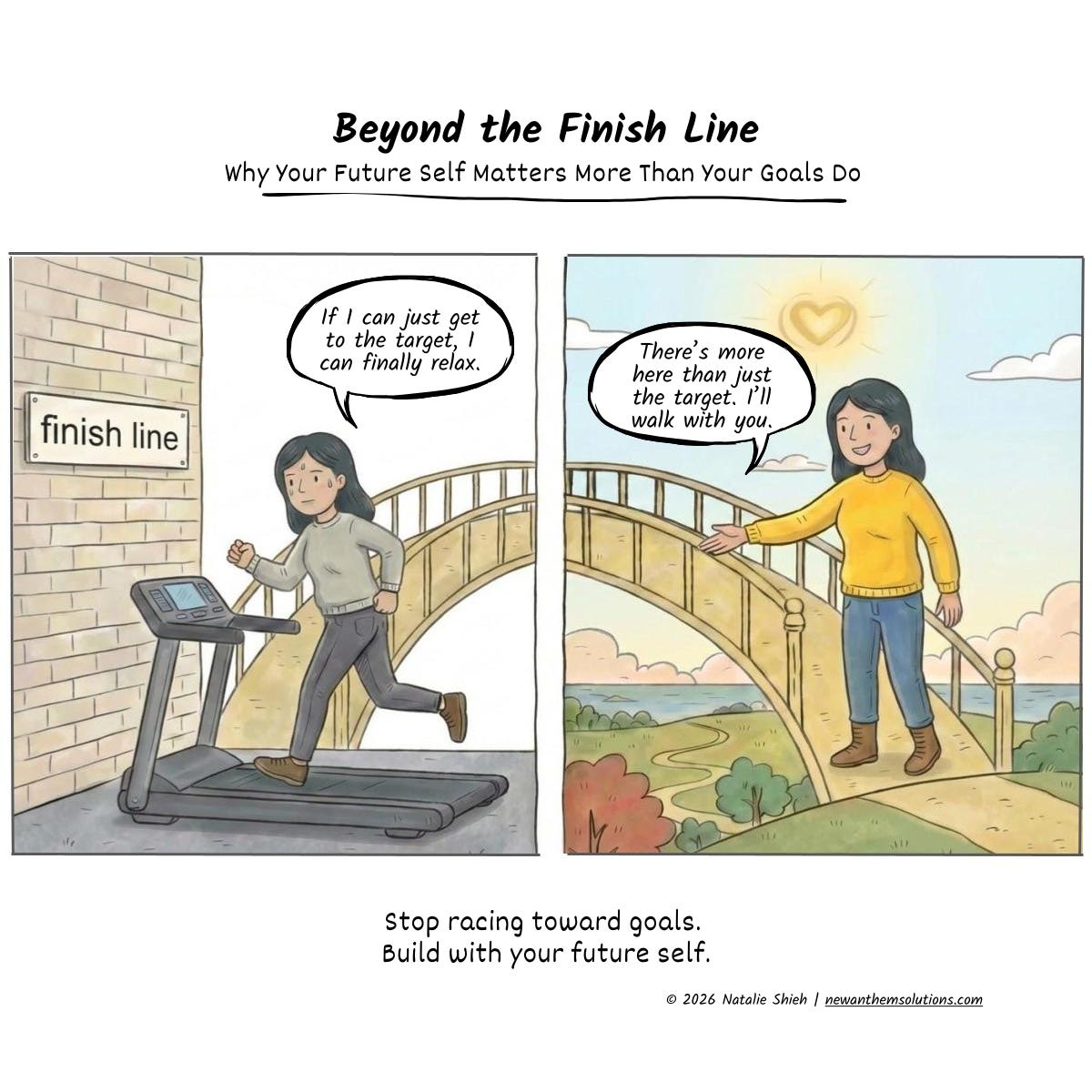
When you view your current effort as such a gift, the nature of the work itself changes. It stops being a chore to satisfy a deadline and becomes an enjoyable, meaningful investment in a person you love. It allows you to reclaim the meaning of work.
And this isn’t just personal. For leaders, the same dynamic applies. A clear, credible picture of an organization’s future is often what helps people feel connected to the work, and motivated to carry it forward together.
Will it still be hard at times? Yes. Will you find it fulfilling? Also, yes.
As Simon Sinek describes it, this is the transition from a finite game of traditional goal-setting to an Infinite Game. In an Infinite Game, the goal isn’t to “win” and quit; it’s a game played for the purpose of continuing to play.8
In the end, the real reward isn’t the finish line. It’s learning to work in partnership with the person you’re becoming.
So then, how does someone actually use their future self as the sage guide?
Turning scientific insight into real life is what gets me fired up. That’s what I’m working to explore next.
Thanks for reading! Feel free to share this post with someone who will find it helpful.
Zeigarnik, B. (1927). Das Behalten erledigter und unerledigter Handlungen (On Finished and Unfinished Tasks). Psychologische Forschung.
Locke, E. A., & Bryan, J. F. (1966). Cognitive aspects of psychomotor performance. Journal of Applied Psychology.
Staw, B. M., & Boettger, R. D. (1990). Task Revision: A Neglected Form of Work Performance. Academy of Management Journal.
Ben-Shahar, T. (2007). Happier: Learn the Secrets to Daily Joy and Lasting Fulfillment. McGraw-Hill.
Ryan, R. M., & Deci, E. L. (2000). Self-determination theory and the facilitation of intrinsic motivation, social development, and well-being. American Psychologist.
Nurra, C., & Oyserman, D. (2018). From future self to current action: An identity-based motivation perspective. Self and Identity.
DeSteno, D. (2018). Emotional Success: The Power of Gratitude, Compassion, and Pride. Houghton Mifflin Harcourt.
Sinek, S. (2019). The Infinite Game. Portfolio/Penguin.
Comments
Nothing yet. Say the first thing.
Sign in to join the conversation.