

At ReadOn, we don’t just report the markets. We help you understand what truly drives them, so your next decision isn’t just informed, it’s intelligent.
Join ReadOn's WhatsApp Community
$3.2 trillion. That’s how much M&A activity the world clocked in the first half of 2026, up 44% year-on-year, according to JPMorgan’s Global M&A Mid-Year Outlook. It’s the busiest first half on record.
India didn’t sit this one out either. Deal value here jumped 31% to $86.9 billion in the same period. Deal count actually fell 8%. Translation: fewer deals, much bigger cheques.
Here’s the thing. This isn’t just a story about companies buying companies. It’s a story about boards deciding that standing still is now the risky move. And India, for once, isn’t just the target. It’s increasingly the one holding the chequebook.
Let’s see what’s going on!
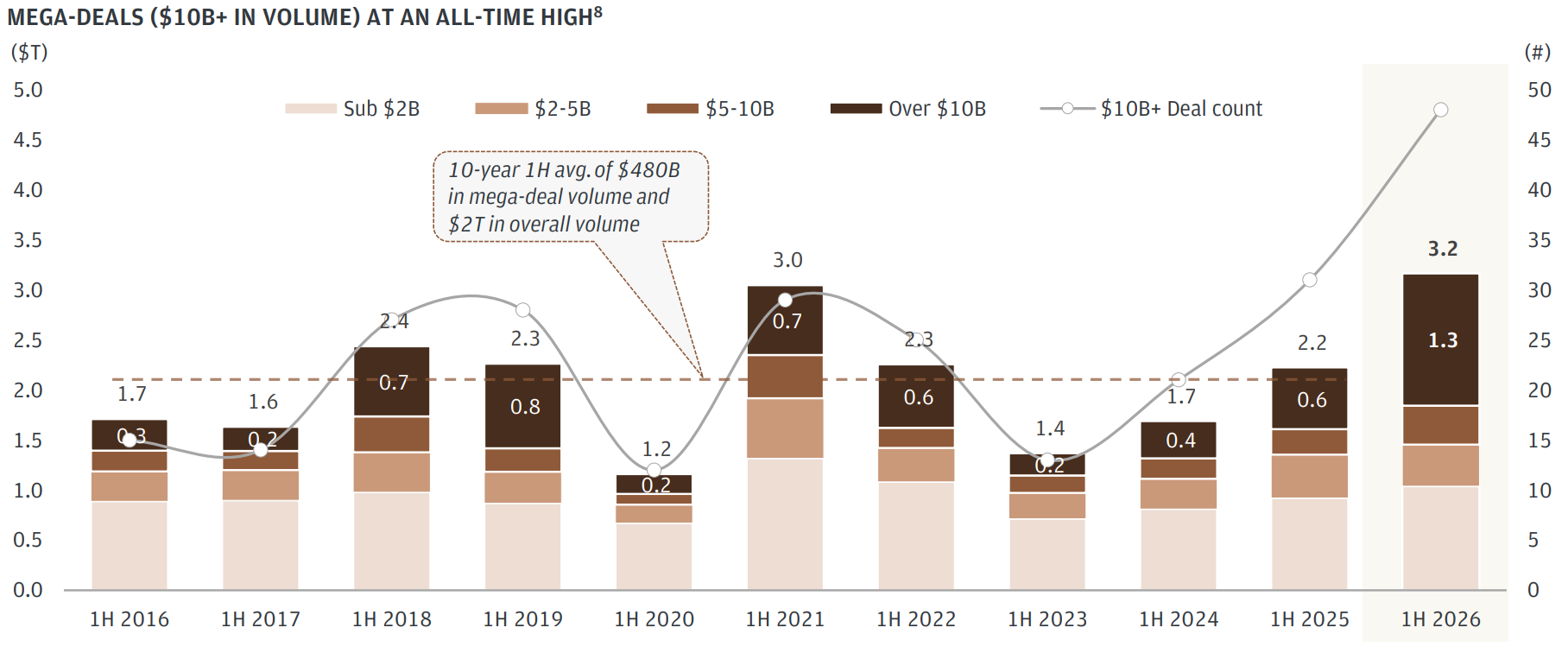
The global number that jumps out isn’t the $3.2 trillion topline. It’s the mega-deals, transactions worth $10 billion or more. There were 48 of them in H1 2026, worth $1.3 trillion combined. That’s a record. It’s also up 114% from the $616 billion across 31 mega-deals in H1 2025.
Put that $1.3 trillion in context. It’s roughly the size of Spain’s entire GDP, moved through boardroom decisions in six months.
India’s version of the same story played out on a smaller scale but with an identical shape. Q2 alone brought in $66.9 billion, more than triple Q1’s number and the highest quarterly total since Q2 2022. Fewer deals, bigger ones, concentrated into one blowout quarter. Grant Thornton’s data tells a similar tale. Q2 M&A value alone jumped 302% sequentially to $27.9 billion, even as deal count fell 12%.
Everyone’s doing the same thing right now. Fewer bets, sized up.
For years, the corporate playbook leaned toward giving cash back to shareholders. Buybacks, dividends, the works. That’s flipping.
Boards globally are now pivoting from capital returns toward reinvestment, leaning on capex and M&A as the credible path to stay competitive. One telling detail is that deals are increasingly being paid for with a mix of cash and stock, at 33% of large deals in H1 2026, versus a 10-year historical average of just 25%. That’s dealmakers getting creative to bridge valuation gaps rather than walking away.
Markets are rewarding this. Companies that credibly build scale are getting valuation premiums of roughly 25% in the US and 40% in Europe. Growth, right now, is worth more than it has been in years.
Regulation helped too. Merger investigations in the US hit their second-lowest level ever in 2025, and abandonments (deals that die mid-process) dropped 90% as regulators favoured settlements over drawn-out litigation. In the EU, over 80% of investigations saw remedies cleared in the first phase, up from 50% the year before. This means that if your deal has a clean rationale and you’ve done your diligence upfront, it’s actually easier to get it through today than it was two years ago.
Interestingly, a huge chunk of what looks like “deal activity” right now isn’t classic M&A at all. It’s AI companies raising money through minority stakes and mega funding rounds.
AI-linked stake sales hit $370 billion in H1 2026, and just six mega funding rounds, including ones for OpenAI, Anthropic, and xAI, accounted for around 40% of all minority investment volume and 8% of total global deal volume. Four of the top five global deals in H1 2026 were tied to AI and its infrastructure needs.
The flip side of this AI euphoria showed up brutally in public markets. In February 2026, the S&P 500’s Software & Services index shed roughly $1 trillion in what got nicknamed “software-mageddon,” as investors realised that AI could replicate a lot of what basic, seat-based software companies were charging for. Capital is now splitting hard between “AI-resilient” businesses (power, data centres, physical infrastructure) and software companies that suddenly look replaceable.
If you’re tracking Indian IT services or SaaS names, this is the exact dynamic to watch. The market isn’t asking “does this company use AI?” It’s asking “can AI just build this in-house?”
This is the part that should matter most to an Indian reader. For a long time, the India M&A story was mostly about foreign capital coming in. That’s still happening (inbound M&A hit $13.8 billion in H1 2026, up 28.8% and the highest first-half total since 2024). But increasingly, it’s Indian companies doing the shopping abroad.
Sun Pharma’s roughly $11.75 billion all-cash acquisition of US women’s health company Organon is, by some counts, the largest pharmaceutical acquisition an Indian company has ever attempted. Coforge bought Encora in an all-stock deal worth $2.35 billion, pushing further into IT consolidation abroad. Tata Motors closed its €3.8 billion takeover of Italy’s Iveco Group.
Grant Thornton’s Q2 numbers make the shift explicit: outbound acquisitions alone made up 84% of India’s total M&A value that quarter, driven by five separate billion-dollar cross-border deals.
There’s also a structural change that could fuel more of this. Starting July 1, 2026, the RBI is letting Indian banks fund up to 75% of an acquisition of control over a non-financial target, something they couldn’t do before. That’s a real unlock. Indian companies chasing global assets no longer have to rely purely on cash reserves, foreign debt, or equity issuance to fund a big swing.
None of this scale-chasing is happening in a vacuum. Shareholder activists are having a record year too, with 260 public campaigns globally in H1 2026, up 15% year on year, and Japan alone seeing 87 campaigns, up 34%. A big chunk of that activism is aimed at forcing companies to simplify, spin off underperforming units, and focus.
That’s fuelling a parallel wave of divestitures. Global divestiture activity hit $1.4 trillion in H1 2026, the second-highest half-year total ever. Companies that split off weaker units are getting rewarded with meaningfully higher valuations than similarly sized conglomerates that don’t. It’s the same instinct as the mega-deal boom, just running in reverse: get smaller and sharper here, so you can get bigger and bolder somewhere else.
The pattern to watch through the rest of 2026 isn’t whether deal volumes stay high. It’s whether Indian companies keep showing up on the buying side of these headline numbers, now that the RBI has handed them a bigger chequebook, and whether the AI-resilient versus AI-exposed split that just wiped $1 trillion off American software stocks starts drawing the same lines through Indian IT and SaaS names.
For years, the question in Indian dealmaking was who’s going to buy us. Increasingly, in 2026, it’s who are we going to buy next.
No posts
Comments
Nothing yet. Say the first thing.
Sign in to join the conversation.