

At ReadOn, we don’t just report the markets. We help you understand what truly drives them, so your next decision isn’t just informed, it’s intelligent.
Join ReadOn's WhatsApp Community
India scores 0.865 on the OECD’s index for how closed its legal services market is. Out of 51 countries measured, that makes India the 3rd most restrictive place in the world to be a foreign lawyer. Only the Philippines and Poland do worse.
Now here’s the twist. This is the same India that’s the 7th largest exporter of services globally, holding a 4.3% share of world services exports in 2024, more than double what it held in 2005.
So how does a country get this good at selling services to the world, while staying this locked when it comes to the professionals who actually deliver them?
A new NITI Aayog report on professional services regulation basically answers that question. And it’s a weirder story than you’d expect.
India’s Economic Survey has a favourite line for the services sector. It calls it an “old war horse”. It’s the thing that’s carried India’s GDP growth for three decades while everyone was busy talking about manufacturing.
Professional services, specifically legal, accounting, architecture, engineering, and healthcare, are the strongest suit of that horse. In 2024-25, professional and management consulting services alone made up nearly 20% of India’s total services exports, growing at an 18% CAGR between FY15 and FY25.
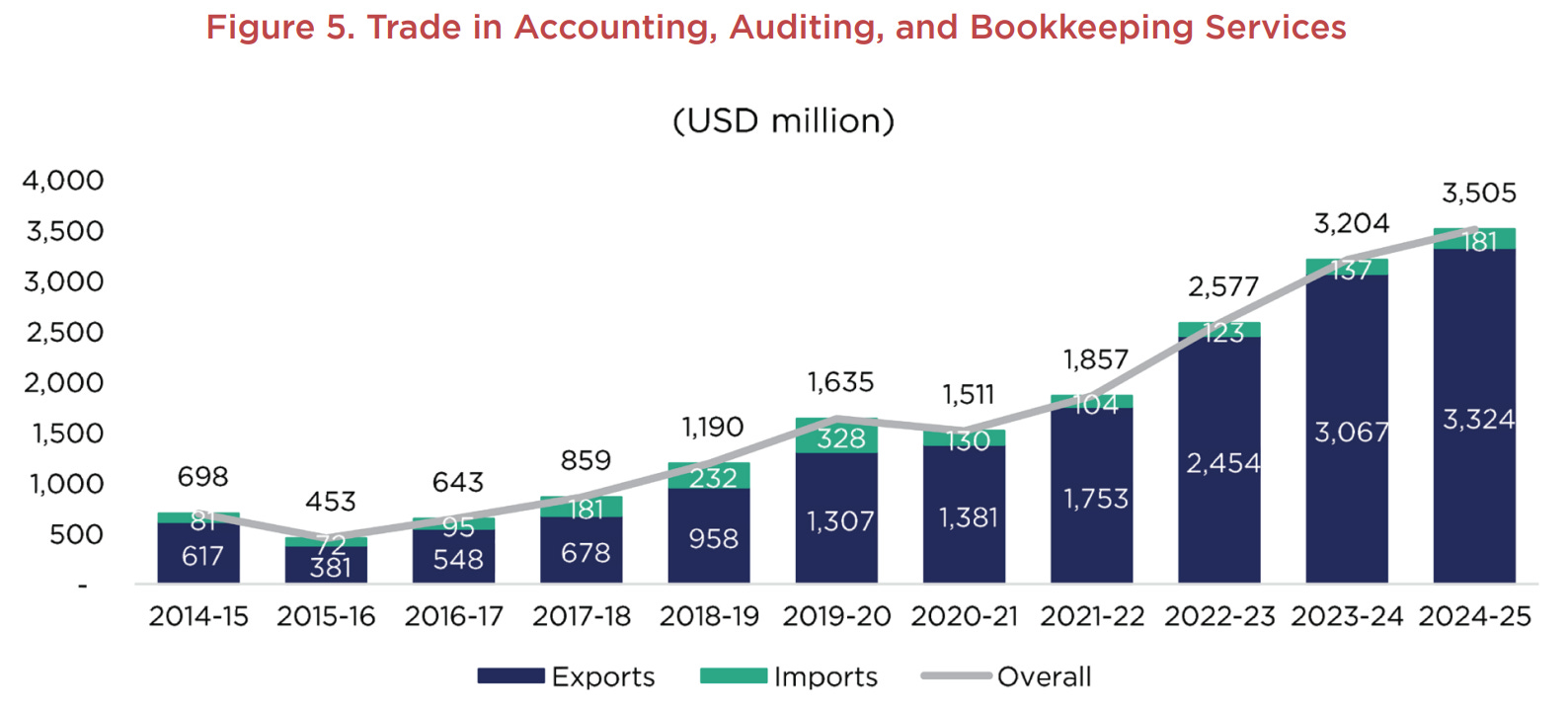
To put a number to that growth, accounting, auditing and bookkeeping exports went from $617 million in 2014-15 to $3.3 billion in 2024-25. That’s more than a 5x jump in a decade, and it happened almost entirely through Indian CA firms doing cross-border work for foreign clients, not through Indian firms setting up shop abroad.
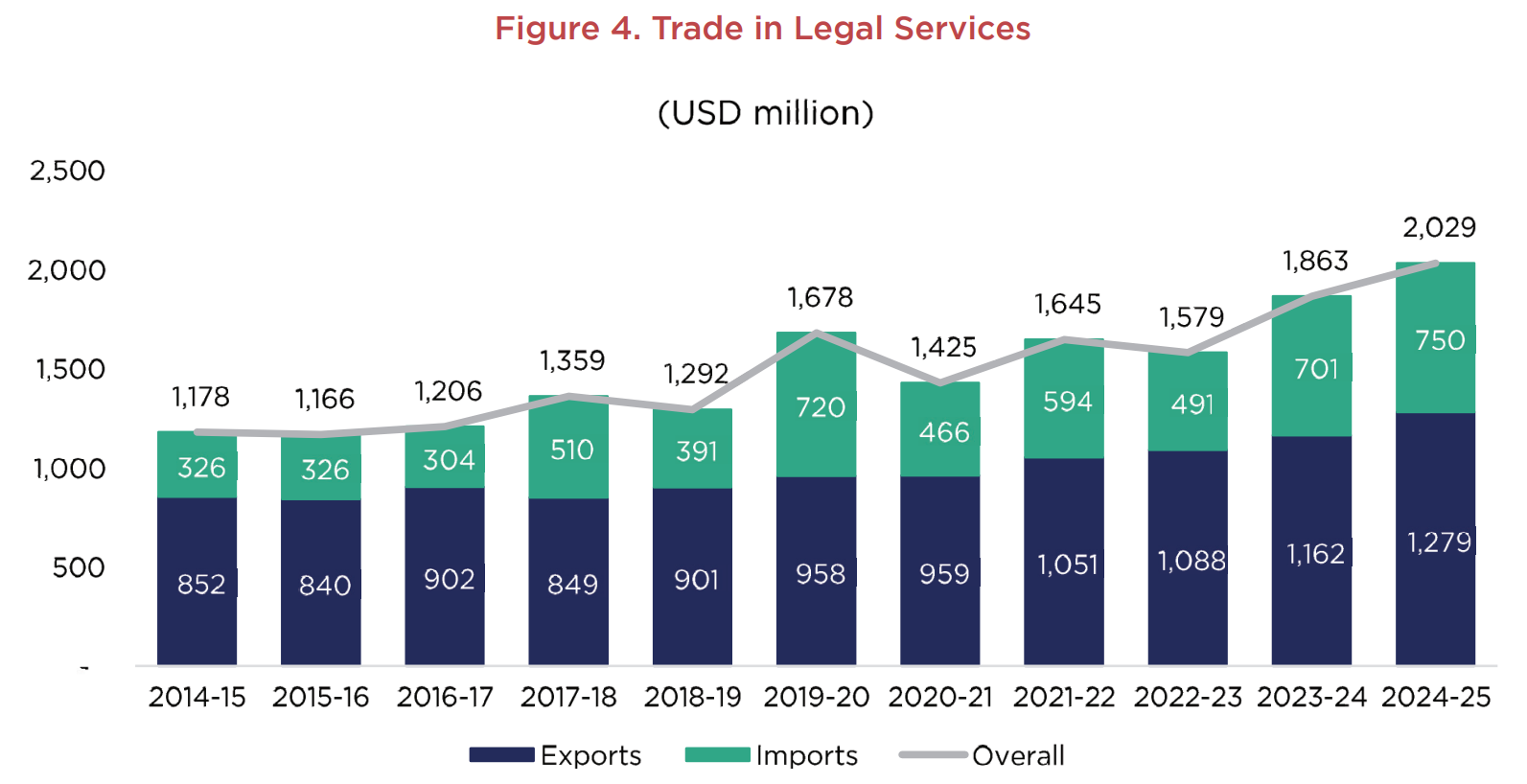
Legal services exports grew too, from $852 million to $1.28 billion over the same period. That’s smaller, but it’s still real money.
Both these numbers should be much bigger. And the report’s own data tells you exactly why they aren’t.
This is where it gets interesting for anyone who’s ever thought about the words “Chartered Accountant” or “Advocate” next to their own name.
Under the Chartered Accountants Act, 1949, a firm of CAs in India cannot incorporate as a company. Full stop. They’re capped at being a sole proprietorship, a partnership, or an LLP. Same story for Company Secretaries and Cost Accountants under their respective 1959 and 1980 laws.
Lawyers have it even stricter. The Advocates Act, 1961, and the Bar Council of India’s own rules say an advocate cannot be a salaried employee of anyone. Which means a group of Indian lawyers legally cannot form a company and hire other lawyers as staff the way, say, a consulting firm does.
Why does this matter? Because a partnership can’t raise equity capital the way a company can. It can’t easily bring in outside investors. It can’t scale the way a Deloitte or an Accenture scales.
There’s more. Until 2008, advocates in India couldn’t even maintain a website with their own qualifications listed on it. CAs only got a similar relaxation to advertise this year, in April 2026. For decades, professional services in India operated a bit like a guild that had decided modern marketing simply didn’t apply to it.
Foreign professionals had it worse. Foreign law firms were formally locked out of India for over 30 years. In 2009, the Bombay High Court ruled in Lawyers Collective v. Bar Council of India that even a foreign firm’s liaison office in India was effectively practicing law, and therefore illegal. The door stayed shut until 2022.
That door has now opened, but just barely.
In May 2025, the BCI notified amended rules letting foreign lawyers and firms register to practice in India. But read the fine print. They’re restricted to non-litigious matters involving foreign law, international law, and arbitration. No Indian law. No appearing in Indian courts. And their presence is capped at 60 days in any 12-month period.
The logic here is arbitration. India wants to be a global arbitration hub, the place where cross-border commercial disputes actually get resolved, the way Singapore or London currently are. Indian parties are already consistently among the top users of arbitration institutions like SIAC and the ICC. Letting foreign counsel show up for arbitration work is meant to close that loop.
Turns out, not everyone’s thrilled. The Society of Indian Law Firms, which represents India’s elite firms, actually opposed the liberalisation. For decades, a small club of large Indian firms had informal referral tie-ups with foreign firms and quietly cornered the cross-border work. Opening the door properly threatens that arrangement. Mid-sized Indian firms, on the other hand, stand to gain access to work they were previously frozen out of.
So, is that it? Not quite. Because right next door, in a sector nobody talks about, India tells a completely different story.
Engineering services score just 0.155 on the same OECD restrictiveness index, ranking 38th out of 51 countries. That makes it one of the more open professional sectors in India, not a closed one.
Why the gap? Simple. There’s no Bar Council of India or ICAI equivalent gatekeeping engineers. No law stops an engineering firm from incorporating as a company, raising capital, or hiring foreign staff freely. Which is exactly why you already see global EPC and infrastructure consulting firms operating in India without the drama that surrounds foreign law firms or accountancy networks.
Same story, roughly, for healthcare. India’s Mode 2 trade, or foreign patients travelling here for treatment, is already a real business, built on India’s cost advantage and a lightly gatekept system for allied health professionals.
The pattern that emerges is almost funny. India is simultaneously one of the world’s most closed markets for its lawyers and accountants, and one of its more open markets for its engineers. Same country, same government, two completely different regulatory instincts.
This part should matter to you directly, especially if you’re a CA, a CFA candidate, a law graduate, or even just someone with one eye on India’s services boom.
NITI Aayog’s own fix is a four-pronged one. Push more mutual recognition agreements, modernise the legal forms professionals can operate under, phase in accreditation pathways for foreign professionals, and lean harder into continuous skilling.
None of this is hypothetical. ICAI already has mutual recognition agreements with accounting bodies in the UK, Australia, Canada, and South Africa, among others. A CA in Kolkata today can, in theory, get recognised in Sydney faster than a Big Four consulting firm can legally hire a salaried lawyer in Mumbai.
The template for opening up already exists. It just hasn’t been extended evenly.
By 2047, India wants professional services to be one of the pillars of a $30 trillion-plus economy. Whether that happens depends less on how many CAs or lawyers India produces every year, and more on whether the 1949 and 1961 laws governing them ever catch up to 2026.
The old war-horse has carried India this far on tied legs. Imagine what it does once someone finally unties them.
Until we find out, ReadOn!
No posts
Comments
Nothing yet. Say the first thing.
Sign in to join the conversation.