
We’ll never forget seeing Michael Jordan in a Wizards jersey. The Last Dance reminded Bulls fans all about seeing B.J. in a Hornets jersey, and Bulls fans probably remember Steve Kerr and Will Perdue on the ‘99 Spurs. Obviously Horace made his mark in Orlando and on the Lakers, Harp won two titles with the Lakers, Scottie had memorable years in Portland, Dennis had fun cameos in L.A. and Dallas, Scott Williams became a vital starter on a great 2001 Bucks team. And on and on.
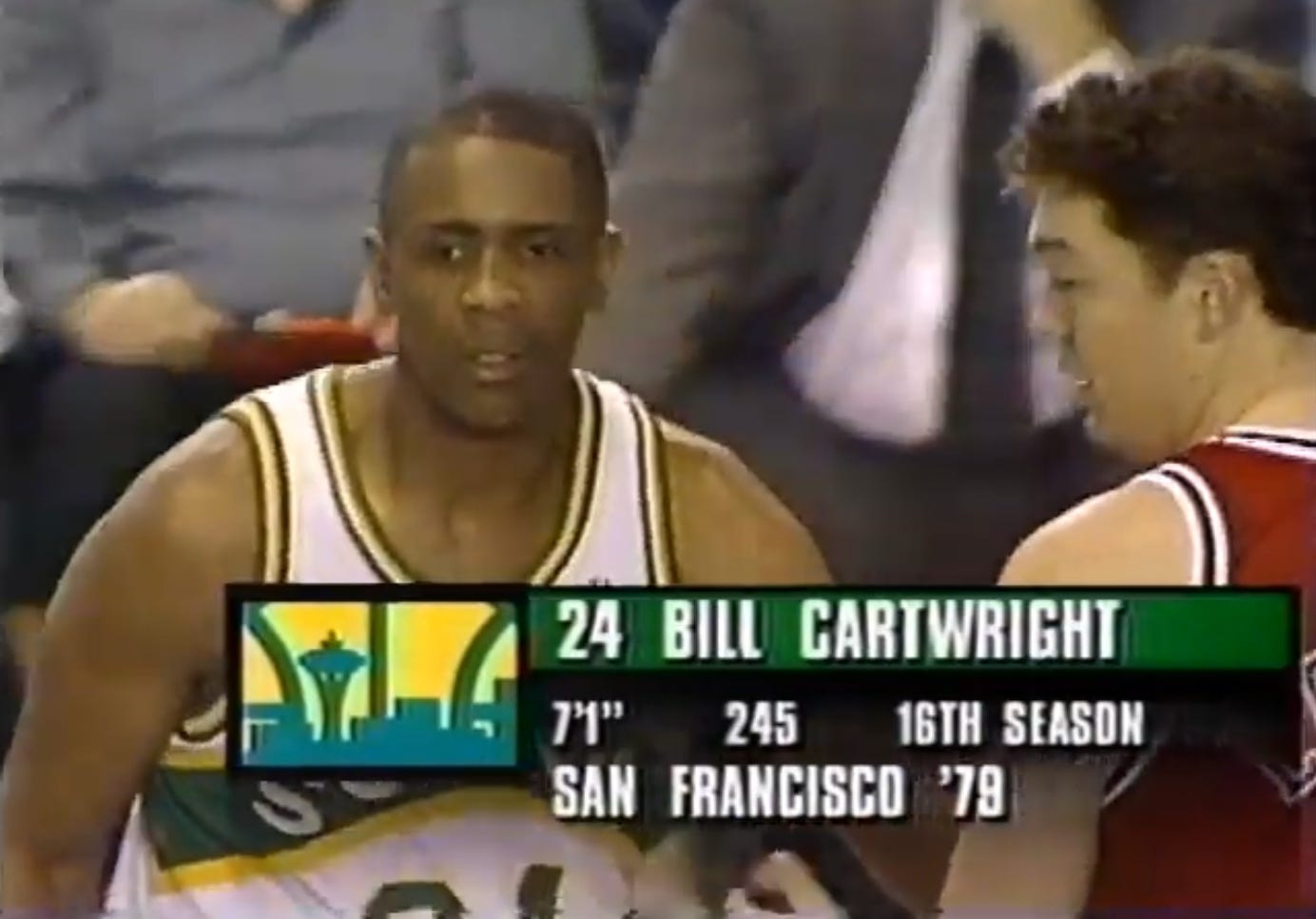
But do you remember Bill Cartwright finishing his career in Seattle?
Cartwright had a lot to say about the difficulty of that one season in his new memoir, Living Life at the Center, and shared insights into the difference between a Hall of Fame coach in George Karl and arguably the greatest coach ever in Phil Jackson.
After the 1994 season, Cartwright considered retirement until Karl and the SuperSonics sold him on the importance of veteran leadership on an explosively talented but disappointing club. In 1993, the young Sonics of Shawn Kemp and Gary Payton lost a hard-fought seven-game series to the Suns in the Western Conference Finals. They seemed on the verge of taking over the league. In 1994, they won a league best 63 games, and easily won the first two games of their first-round series against Denver…
…only to drop the final three, becoming the first #1 seed to lose to the #8 seed.
The Sonics wanted veterans who could help instill a winning culture. They added Cartwright and Lithuanian legend Šarūnas Marčiulionis1.
“My big thing is, Bill has won three championships,” Karl said after the Sonics signed the 37-year-old center. “We have no one on our team who has won a championship.”
Added Cartwright: “You have to sacrifice yourself, and a lot of times that’s hard. That’s a big part of winning a championship.”
With Michael Jordan retired for a year and a half, the NBA title was there for the taking in ‘94 and ‘95 for a whole host of bridesmaids. Charles Barkley, Karl Malone and John Stockton, Patrick Ewing, Hakeem Olajuwon, David Robinson, Clyde Drexler: this was the time for the Dream Team generation to break through and bag a title. Right along with them were the Kemp-and-Payton SuperSonics. And while Barkley, Malone/Stockton, Ewing, Robinson and Drexler all ran into the buzzsaw that was Hakeem the Dream, the Reign Man and the Glove didn’t even reach that point.
They lost to the Nuggets in the first round in ‘94. Then in ‘95 they won 57 games, had home-court in the first round, and lost to the post-Magic / pre-Shaq Lakers in four games.
As for Cartwright and Marčiulionis, those veterans who Karl was going to lean on for their playoff experience? He didn’t play them a single minute.
“Even though we had a really good team, veteran players, and an established coaching staff, our team played the season well but did not improve over the year,” Cartwright wrote. “Coach Karl played a short rotation, including in the playoffs. … What was strength in Chicago was detrimental in Seattle. It was a real lack of trust from Coach Karl.”
Bill broke it down in his book, and showed one of the big differences between Karl and Phil Jackson: disciplining players who were late, specifically Shawn Kemp. As Cartwright noted, “Undisciplined players cost us the season.”
Another difference between Chicago and Seattle was the standard of conduct for the players. Gary Payton and Shawn Kemp were held to different standards than the rest of the team. These guys were constantly late, especially on our flights. This would not have been tolerated in Chicago. Ultimately, this came back to bite us in the playoffs. We were busing over to shoot around before the last playoff game. We were scheduled to leave at 10 a.m.; the entire team was on the bus except Shawn Kemp. At 11 a.m., we were still on the bus waiting for Shawn to appear.
Shawn was eventually found, and we went on to shoot around. That set the tone for the game and the season — we lost to the Los Angeles Lakers in the first round of the playoffs. Undisciplined players cost us the season. It was a lousy way to end my playing career.
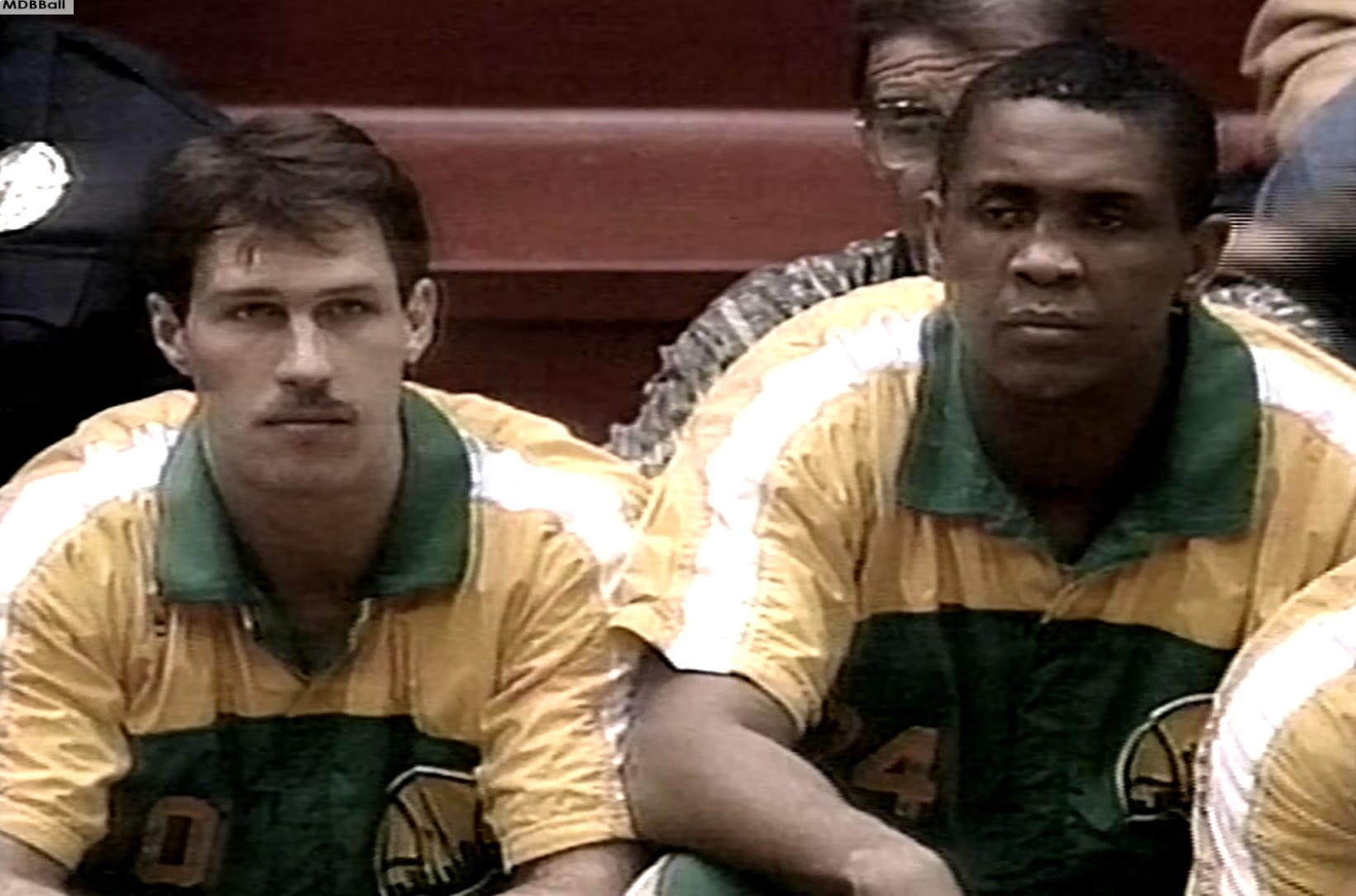
Here is how George Karl remembered it in his book “This Game’s the Best!”:
For the 1994-’95 season, we again added a little experience and a lot of talent. We picked up Sarunas Marciulionis and Bill Cartwright and thought we had again answered needs to take us further.
(Karl went on to note that he had to take minutes from the two vets and give them to Kendall Gill)
Well, by abandoning old veterans like Marciulionis and Cartwright to give Kendall more minutes, I probably made the right decision. But I can only say probably, because obviously it did not work.
Cartwright remembered it differently, thinking that Karl actually left Kendall on the bench too. That’s probably because Kendall went from averaging 29 minutes a game in the regular season with 58 starts to playing just 18 minutes a game in the playoffs with zero starts.
This year, Gill described his time in Seattle as “bittersweet”:
“My time with George Karl was bad. We all know now from the stories about George Karl what type of dude he is. I’m not going to hold my tongue about him, I don’t like the guy even still to this day.”
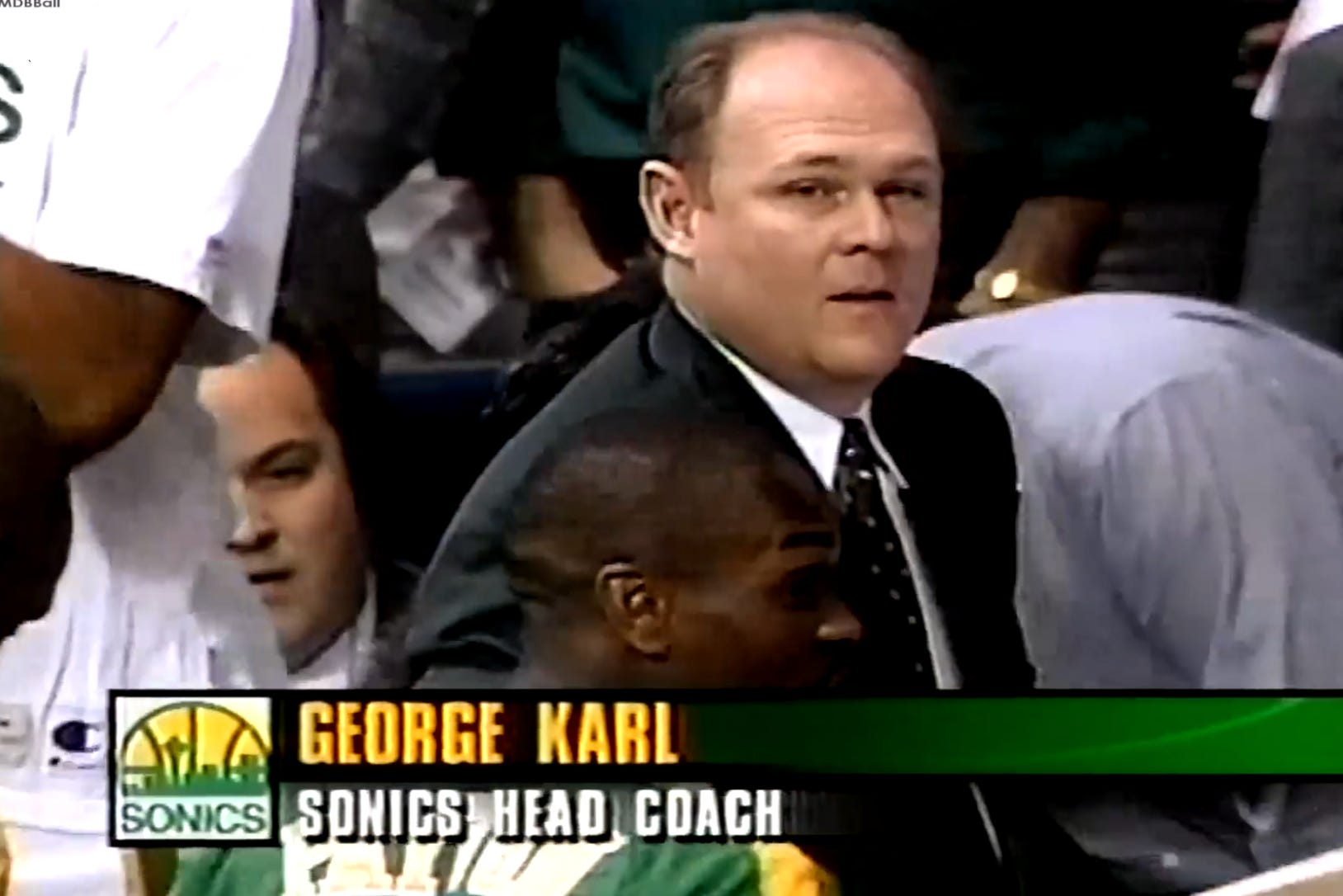
Kendall Gill is not alone among Karl’s former players talking about how they disliked him. Karl seems to have created two results at nearly all of his coaching stops: a playoff run and disillusioned players. That was true in Seattle (Cartwright, Gill), Milwaukee (Ray Allen), Denver (Carmelo Anthony) and, without the playoff run, Sacramento (DeMarcus Cousins). Kobe even talked about his beef with Karl because the coach benched him in the fourth quarter, preventing Kobe from challenging Jordan (Karl’s fellow UNC Tar Heel) for the game’s MVP.
What strikes me about all of this is that even when players disagreed with him, Phil Jackson maintained a pretty solid reputation among his former players. Scottie had his disagreements with Phil, yet was largely complimentary of him in his 2021 memoir. Pippen wrote:
I totally bought into what he was saying about a basketball team being a pack, not a collection of separate individuals. More than the X’s and O’s, that was Phil Jackson’s most valuable contribution to the Chicago Bulls. He got us to bond. To be one.
Scott Williams told me about many of his issues with Phil, yet still landed on a final note of praise:
“The great thing about Phil Jackson, which I probably didn’t appreciate at the time, because I think he screwed me in some other ways, was when you go around this league and you spend 30 years in the NBA at the highest level in college basketball, you understand how difficult it can be to mesh egos on a roster where only five guys can play at a time. That’s probably the most difficult thing. Whether it’s playing time or status or whatever the case might be, that’s one of the most difficult jobs. And Phil Jackson did a nice job of keeping the situation extremely competitive but with a goal in mind that all of us would work together.”
Despite Will Perdue’s frustrations with Phil, he also shared with me his high respect:
“Phil (was) constantly chipping away (at MJ), chipping away, chipping away. ‘Michael you’ve got to understand: this is what you need to do. This is the hour. It has to work. What is everybody talking about you right now? Best player in the league, but does he make anybody better? Has he won a championship?’ He was holding him accountable.”
Phil’s detractors like to say, “Anyone could coach Hall of Fame players.” Not only is that false, but the challenge is that you can’t only coach the Hall of Famers. You have to coach the role players too, and you have to help every player know their place on the team and feel connected whether they are a transcendent talent, a journeyman or anyone in between.
While I always liked George Karl from afar, Bill Cartwright’s insights into the 1994-95 season shows just how big a gap there is between a Hall of Fame coach in Karl and someone in the running for the greatest coach ever in American sports in Jackson.
I always think of 1994 as Phil’s best year as Bulls coach, just because of the incredible challenge of suddenly losing MJ one month before the season. I could also make a case for 1991, 1992 or 1993 as Phil’s best year. But yes, perhaps his best season was 1998, in which he made all the right moves to squeeze one final ring out of a team often running on fumes. For the same reason, this might be Michael Jordan’s best season, too.
Here’s what Cartwright wrote about Phil’s coaching job in 1998:
I think Phil was at his best. Acknowledging that this was his last year, he deemed that season “The Last Dance.” That was also the season I learned how to coach. I learned how to stay balanced during 82 games of wins and losses from Phil Jackson.
One big takeaway Cartwright took from Phil was managing challenging personalities, specifically Dennis Rodman. Writes Cartwright:
Dennis was known for not showing up at practice. Often, he was found at home eating cereal and watching cartoons. I thought Phil handled it well by addressing the team and telling the team, “We’ll just spank him later,” as if he were a little kid.
What Phil always knew was that treating players fairly didn’t mean treating them all the same. He was able to explain to his team his approach to handling Rodman, something Cartwright did not see George Karl do in handling Kemp.
Insightful stuff from the man they called “Teach.”
Congratulations to Bill Cartwright on your book!
Missed my latest story? Subscribe today and learn the backstory of the Jordan-Gretzky-Bo Jackson cartoon “ProStars” through my interview with Andy Heyward!
Marčiulionis starred on the 1988 gold medal-winning USSR team and the 1992 bronze medal-winning Lithuanian team, and averaged almost 15 points a game over four seasons with some excellent Warriors teams, including 21 a night in the ‘92 playoffs. In the book Dream Team, Michael Jordan specifically discusses the challenge of defending him.
No posts
Comments
Nothing yet. Say the first thing.
Sign in to join the conversation.