
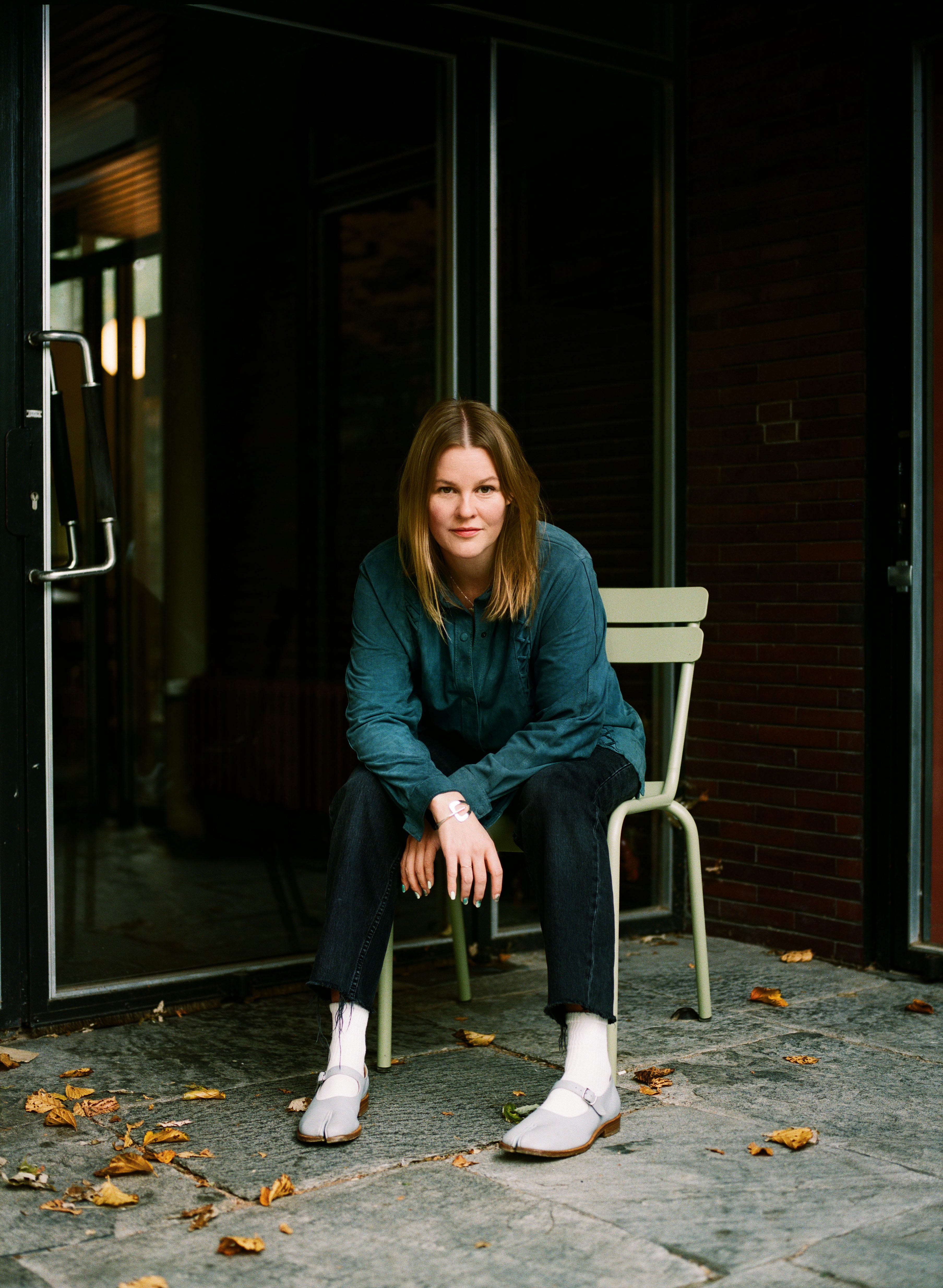
I first heard about Theresia Enzensberger in 2022, when she published her second novel Auf See. My friend Anna, who has recommended many wonderful books to me over the years, passed this one along too and it opened up worlds for me in a way I hadn’t experienced since reading books like Tintenherz as a teenager. It’s a quietly unsettling story about a young woman growing up in a floating libertarian city in the Baltic Sea, written with an almost architectural precision. I couldn’t put it down and it immediately made me want to find out more about the person behind it. Which makes it all the more special to now have the chance to ask Theresia a few questions.
Theresia Enzensberger grew up in Munich, studied Film and Film Studies at Bard College in New York, and has lived in Berlin since 2011. As a freelance author, she writes prose, essays, reportages and criticism for, among others, the FAZ, Zeit Online and Monopol. Her debut novel Blaupause (2017) was translated into several languages and awarded the Alfred Döblin Medal; her second novel Auf See (2022) was nominated for the German Book Prize. Most recently, she published a slim, sharp and philosophical essay about sleep in the Hanser Berlin Reihe Leben.
Alongside her literary work, she runs the newsletter Reading List Berlin together with Patrik Gräb. In their words an “entirely subjective list of things happening in Berlin”, which is one of the most personal and attentive guides to the city’s cultural life. It’s the kind of newsletter that feels less like a curated feed and more like a recommendation from a friend who always knows what’s worth your time. (Theresia will share some exciting news about it at the end.)
What fascinates me most about Theresia’s writing is the worlds she builds. Worlds so precisely crafted that you can surrender to them completely, let yourself be carried by them and yet they can feel unsettling and suffocating at the same time. Whether it’s the Baltic Sea or sleep you simply can’t find your way into. I’m so glad we got the chance to introduce her to you.
What are you currently reading?
Theresia: I always read two or three books at the same time. Currently it’s a bit research based: Dürrenmatt’s crime fiction for an original detective story, and re-reading Cusk’s Outline for the stories-within-a-story. Other than that, I just stumbled upon this brilliant non-fiction book called The Yahoo Boys, where the narrator goes on a trip to find out more about Nigeria’s scammers. It reads almost like a novel, but not without touching upon the more interesting aspects of this shadow economy.
Do you have a reading routine and if so, what does it look like?
Theresia: I like to ask people the same thing! I feel like we’re all struggling to make time for reading. The first thing I do in the morning is to delete all social media from my phone – sadly a necessary first step. Then I have to tell myself that reading is part of my work and I’m allowed to read during a workday (something that feels indecently luxurious). So the routine is something like: Read a bit in the morning, read for about an hour after lunch, and another little bit before bed.
Your work moves between novels, essays and journalism. Do you think of these as very different modes of writing, or do they all feed into each other?
Theresia: They’re both incredibly distinct and have their own qualities and pitfalls AND they feed into each other. I’m definitely not a purist when it comes to categories, and I think a novel can always profit from a little bit of factuality.
You studied film studies before you wrote fiction. How has that shaped the way you see and construct a story?
Theresia: When I was at film school, my professors would tell me that the way I think was too literary, and now that I write fiction, people tell me my prose is very cinematic. I think maybe it has something to do with how much I’m inspired by genre, and that I don’t think entertainment is a dirty word. Also: at film school, I was taught to think in images, and I think I never quite stopped doing that.
You've been publishing Reading List Berlin for a while now. Does Berlin itself ever feel like a text you're trying to read in a way to make sense of it?
Theresia: No, I think a city is much less abstract than that – which is what makes it beautiful. It consists of people, and we’re so lucky to have that many talented, active participants in our culture in this town. Patrik Gräb, my partner in this endeavour, is himself a host to Literaturhaus Neukölln, an event series that takes his cue from the notorious sentence by a former Neukölln mayor: "Neukölln ist überall.” ("Neukölln is everywhere.”)
And starting in November, we’re going to get an opportunity to talk to these participants on stage: We’re hosting Berlin Reading List at Roter Salon at Volksbühne, a format where we ask writers what books they were reading while writing a specific text. There is also going to be a podcast. We’re very excited!
Is there a book you find yourself recommending constantly, almost regardless of who you're talking to?
Theresia: I’ve had a years long obsession with Mating by Norman Rush, and I know I’m not alone in this, but after breathlessly recommending it to everyone that I came across, I realized that it’s a very polarizing book. Some people find it tedious, others brilliant. When I get asked for recommendations, I now usually ask what people usually like reading.
Were there books you read as a child or teenager that you still think about today?
Theresia: Animorphs! Does anyone remember this? It was a series in which these kids were inhabiting the bodies and consciousnesses of animals. I loved it.
What are you working on right now and are you willing to share a glimpse of it?
Theresia: As you can maybe tell from the research books I’ve shared above, I’m currently working on a crime novel. I’m not quite ready to talk more about it, so that’s all I’ll share. I’m also writing a book of essays that continues my interest in all things “extrastate”, so organizing outside of nation state structure.
Thank you so much for this beautiful insight into your work and thoughts, Theresia.
— Shirley
Comments
Nothing yet. Say the first thing.
Sign in to join the conversation.