

My brain has been messing with me lately. I no longer enjoy the writing that I used to. Everywhere I look, I’m starting to see traces of slop. Some imagined, some real – and all of it disconcerting.
In reading the works of a post-war Turkish writer from Ankara, I inhabit his world. I feel what he feels. Good writing is a time machine – beaming me across time and space. But for it to work, I need to know that the emotions it conveys are human. That it’s not a statistical rehash, predicting one token at a time.
Just a few weeks back I was reading a story on quantum computing published in The Walrus. Even here, in this bastion of good writing, I could see a shadow behind the lines. Enough to jolt me out of the piece, the spell of good writing broken.
The line that threw me off: “But that’s the thing with the future: it swerves.”
It’s a beautiful turn of phrase, actually. Knowing Walrus, it’s likely that Andrew Seale wrote this sentence himself, each word clattered onto the keyboard with mammalian hands. But it’s also how ChatGPT writes, trained as it was, on magazine writing.
Good writing, for me, is losing its magic.
Most writing on social media platforms is starting to look the same. Posts on LinkedIn have become so gross that I now have Feed Blocker blank out my newsfeed. Everyone is posting neat little 200-word parcels of business wisdom, five days a week. A sea of sameness punctuated only by hustle-culture pictures of teams going to the gym together. Or, the occasional maternity ward selfie, cradling a newborn after delivery.
LinkedIn is, by its very nature, a self promotion platform. That’s cool. That’s why we’re all there, job seekers, startup founders, sales reps. Thumbs-upping each other’s posts in a grand circle jerk.
But what about Substack?
Show, don’t tell, they say. So let me show you:
The figs will rot if you don’t eat them. The jasmine blooms for three weeks and then it’s over. Your body at twenty-five will never come back, and neither will your body at forty-five. Everything you’re saving for later spoils in the waiting.
That person who makes your pulse quicken when they walk into a room? Temporary. The way afternoon light falls across your kitchen table in September? Seasonal. The feeling of being so happy you forget to be afraid? Fleeting. And somehow that makes it more, not less.
This post has been liked 42,500 times, restacked 7,700 times. It briefly tugged at my heart, I almost shared it with friends, but something felt off. It was too... perfect. All the rough edges filed off for easy consumption. The writer, one Vidya from Goa, describes herself as “a woman in memory, myth & lineage.” Her publication, Mouth Full of Marigolds, “a slow-burning hearth for women who want to live inside their softness without apology.”
That’s the kind of contemplative prose you’d find in an off-campus literary magazine – the pages clumsily stapled, all raw and authentic. But no – this one is 100% fake. When I ran passages from this Substack on Pangram, an AI detection startup, it flashed “Fully AI Generated.”
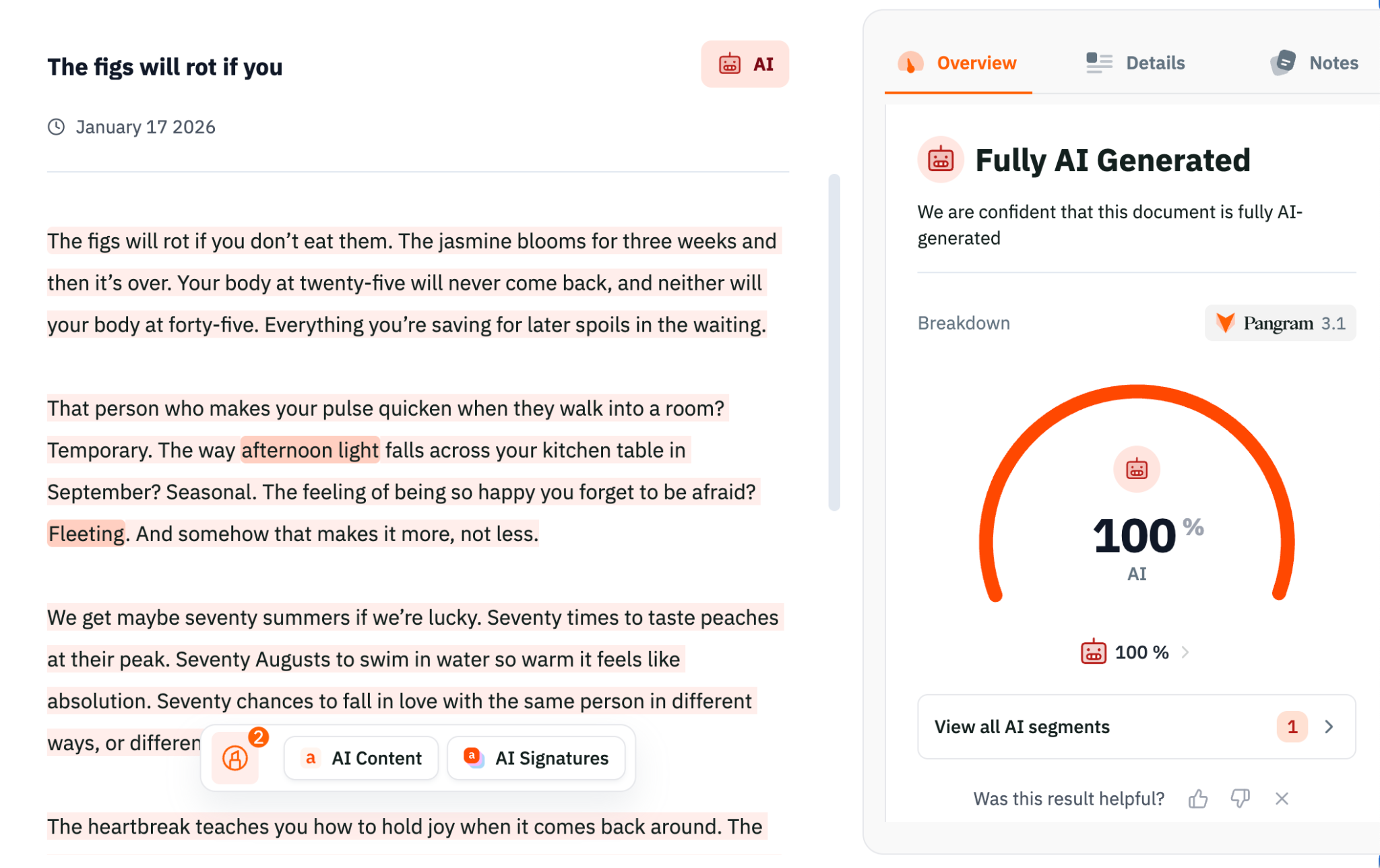
There is slop that is so obviously slop, like tripe on LinkedIn – and then, there is this. Human experience that feels real to thousands of well-educated reader-types, but is actually nothing at all. Devoid of humanity, it’s just gibberish.
Here’s another example:
Rowan Atkinson, a legendary icon of comedy, television, and cinema, has left even the world’s richest and most powerful figures stunned—not just with his words, but with decisive action.
At a glamorous red-carpet gala in Los Angeles on December 20, attended by film moguls, tech billionaires, and Hollywood’s most elite stars, Rowan Atkinson took the stage to receive a Lifetime Achievement Award. But instead of offering a conventional acceptance speech, he chose a moment of truth—direct, fearless, and deeply human.
He did not thank the Academy. He did not reminisce about Mr. Bean, Blackadder, or decades of global laughter. Instead, Atkinson looked straight into the audience of wealth and influence and declared:
“We sit here surrounded by diamonds and artistic glory while the world outside is falling apart. If your voice can move millions and you choose not to use it for those who have no voice, then you are not creating change—you are creating noise.”
The room fell into complete silence. Film executives and invited guests sat motionless, struck by the weight of his words. He continued, unwavering: “If you have more than you need, it no longer belongs only to you. Your responsibility is to lift up those who are still beneath you.”
And he did not stop at words.
That very night, Atkinson announced that all profits from his archived works and future creative projects—estimated at 160 million USD—will be donated to fund children’s health initiatives, climate action programs, and arts education for underprivileged youth.
His message was unmistakable: “Legacy is not built on what you earn. It is built on what you give.”
Powerful stuff. 20,100 likes and 3,800 restacks.
Gary Marcus, the former NYU professor famous for his AI skepticism, even shared it to his 99,000 Substack followers.
Turns out the whole thing is fake – and AI generated.
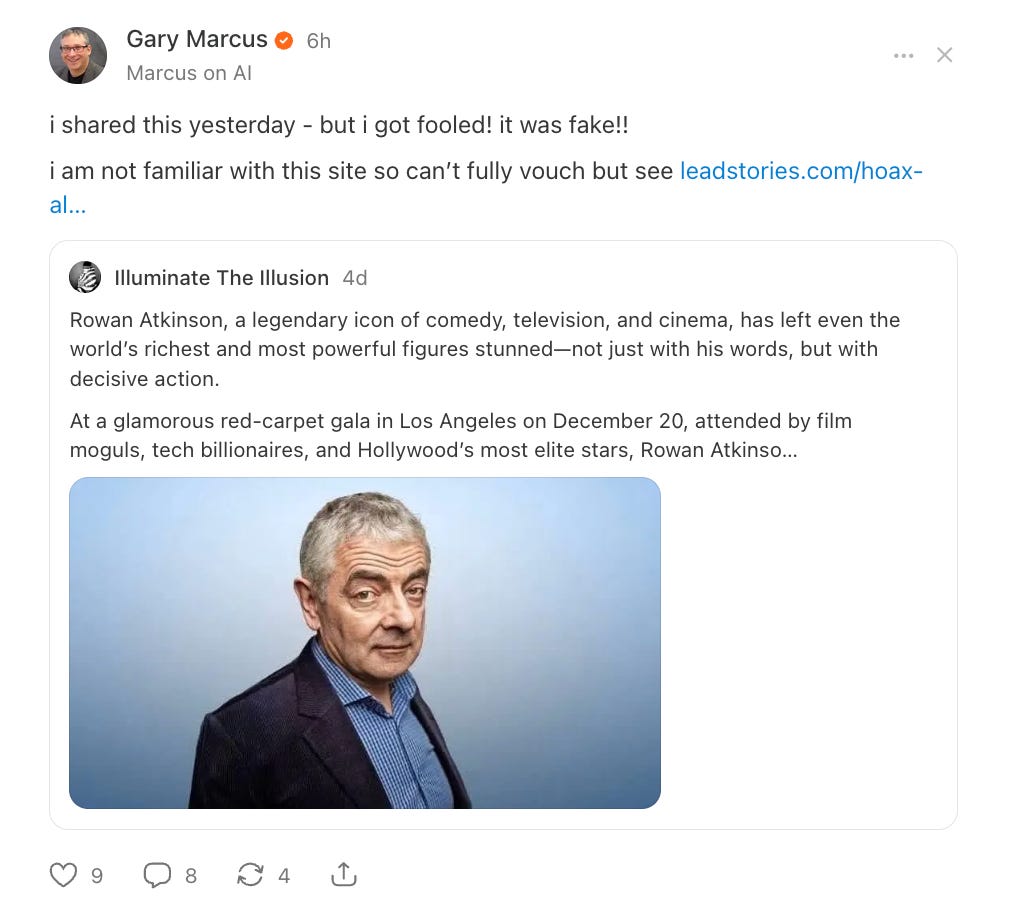
If a scientist and “leading voice in AI”, like Marcus, can get fooled into reposting slop, what chance do the rest of us have?
Writer Cate Hall calls this the “yassification of language.” The subtle version of AI slop is more insidious, yes. But what’s worse is that even non-AI assisted writing is starting to sound the same.
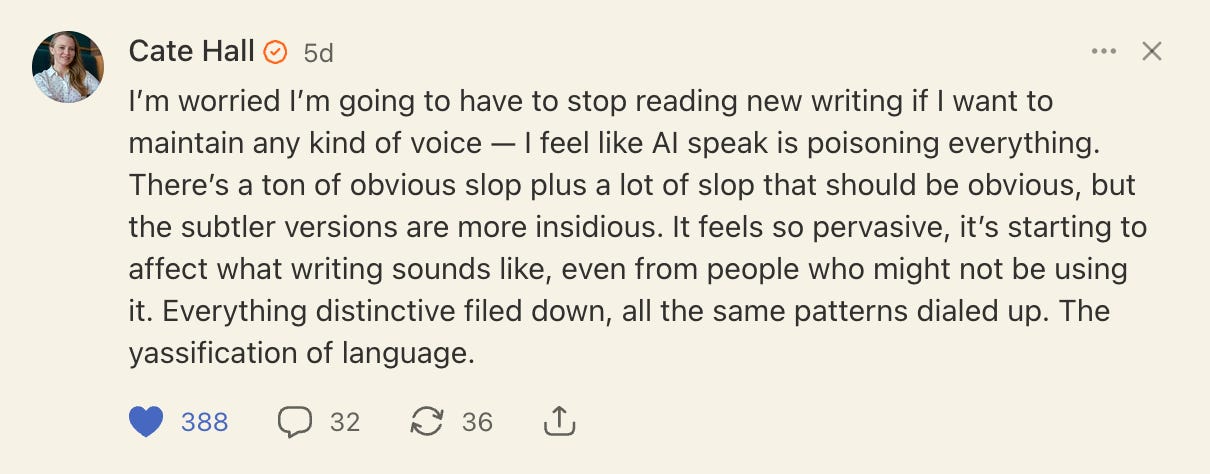
Turns out Cate (and I) are not imagining stuff – real people are indeed starting to sound like chatGPT.
A team of researchers at Max-Planck Institute in Germany analyzed over 740,000 hours of YouTube videos and conversational podcasts. They found an abrupt increase in ChatGPT-speak after its release. People seem to delve into things more than before. They’re also increasingly swift and meticulous.
Now, many podcasts are scripted – with chatGPT as the script-writing assistant. But as people hear more chatGPT passing for human-speak, it influences how they construct their own sentences, how they form arguments – how they think.
So, how will this all shake out? I have no effing clue, no hot-take to offer. But I can tell you what I’m doing.
I’m going back to older texts - books published pre-LLM.
I’m going back to high calibre publications - think Walrus, Harper’s, Atlantic among the mainstream, or niche ones like Works in Progress or Asterisk.
Within social media, I’m filtering for credentials now. I look up writers before I read them.
We are on a turbo escalator to Black Mirror, the least I can do is look the other way.
No posts
Comments
Nothing yet. Say the first thing.
Sign in to join the conversation.