
“Have you guys been following the reproducibility crisis?” said the research scientist as he settled into his chair. We were at IBM’s Watson Research Lab in New York, the iconic 1961 building by Eeri Saarinen. Light flooded into the hallways, but our meeting room was windowless.
This was in 2018, and the crisis hadn’t yet made the mainstream press.
Reproducibility is what differentiates science from the tripe that passes as corporate “thought leadership.” With a research paper, anyone with the right skills should be able to follow the method and get the same result. Turns out – there are ways to game this.
The academic imperative to “publish or perish” has created perverse incentives. To secure tenure or grants, researchers must publish feverishly, and ideally, with findings that support novel, headline-grabbing hypotheses. Negative results – learning what doesn’t work – don’t get you into Nature or Science. So great is the pressure to stand out that the margins of science have begun to fill with crap. This ranges from “p-hacking” or running experiments until you get the results that support your hypothesis – to outright fabrication.
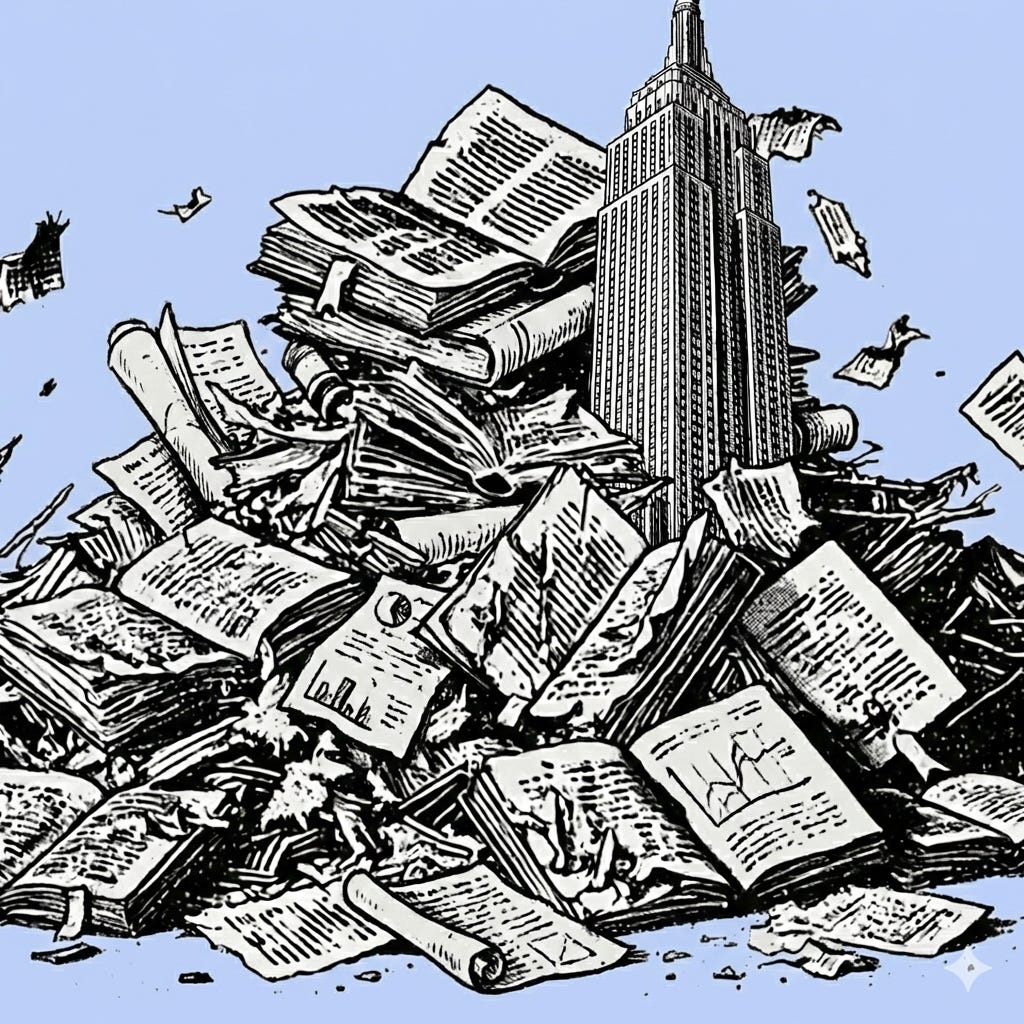
This pressure to publish produces a colossal amount of research. If the research papers published last year on Arxiv, a pre-print platform, were printed and stacked up, they would nearly reach the top of the Empire State Building. The real story though, isn’t the monumental scale of this research output, nor the dubious activities at the margins of scientific discovery. It’s that despite this gargantuan effort, science is slowing down. And the stakes of this couldn’t be higher.
To understand why this is such a big deal, we need to turn to a paper published in 1957 by a young economist at MIT. Robert Solow, who won the Nobel 30 years after his landmark paper was published, posited that once you control for capital and labor, economic growth is largely a function of technical change. In fact, at some point, throwing more money or people at the problem is no longer effective. What makes economies grow over the long term is innovation - and that boils down to the number of researchers and their productivity.
Ideas getting harder to find
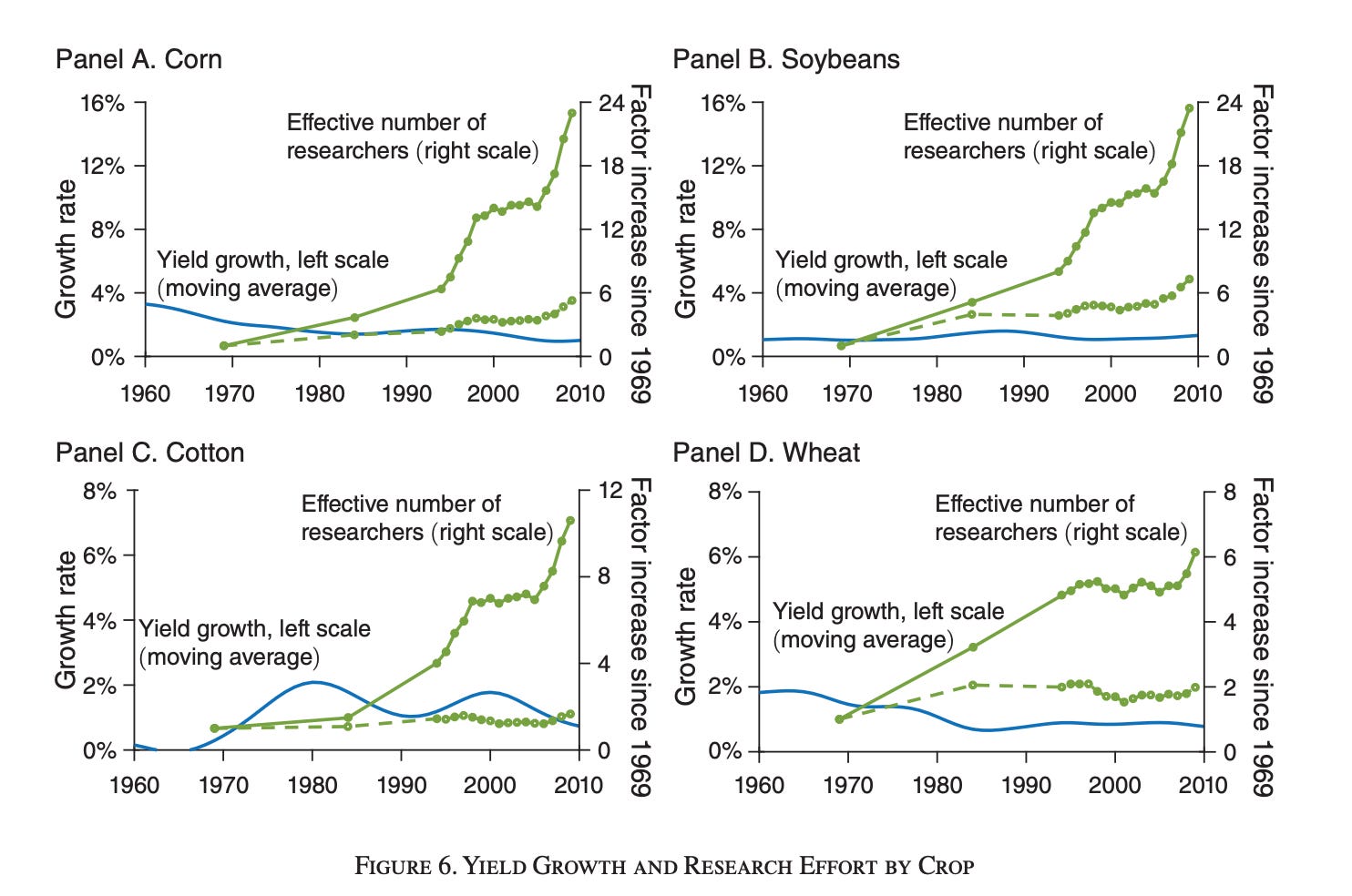
In 2020, a team of Stanford economists published a paper with surprising findings on research productivity. Instead of starting with the big picture (aka macroeconomic view), this team zoomed into specific industries and firms to piece together how investments into R&D are translating into outcomes. Let’s start with the boring stuff, like, y’know, the food we eat. The team collected the growth in yields for corn, soybeans, cotton and wheat and compared that with the number of researchers focused on each crop. They found that while the yield growth has averaged around 1.5% since the 1960s for these four crops, the number of researchers has risen sharply. It now takes 25 times the number of researchers to get the results compared to the 1960s baseline.
Closer to tech-bro land, we see the same thing happening with Moore’s law. Gordon Moore posited that the number of transistors packed onto an integrated circuit would double approximately every two years. The ‘law’ has held for nearly fifty years. While people talk about how the law would soon hit against the unforgiving (and real) laws of physics - the doubling has more or less continued. Here’s the catch though: keeping that growth rate going is getting exceptionally hard. It takes 18 times the number of researchers to get the same growth rate.
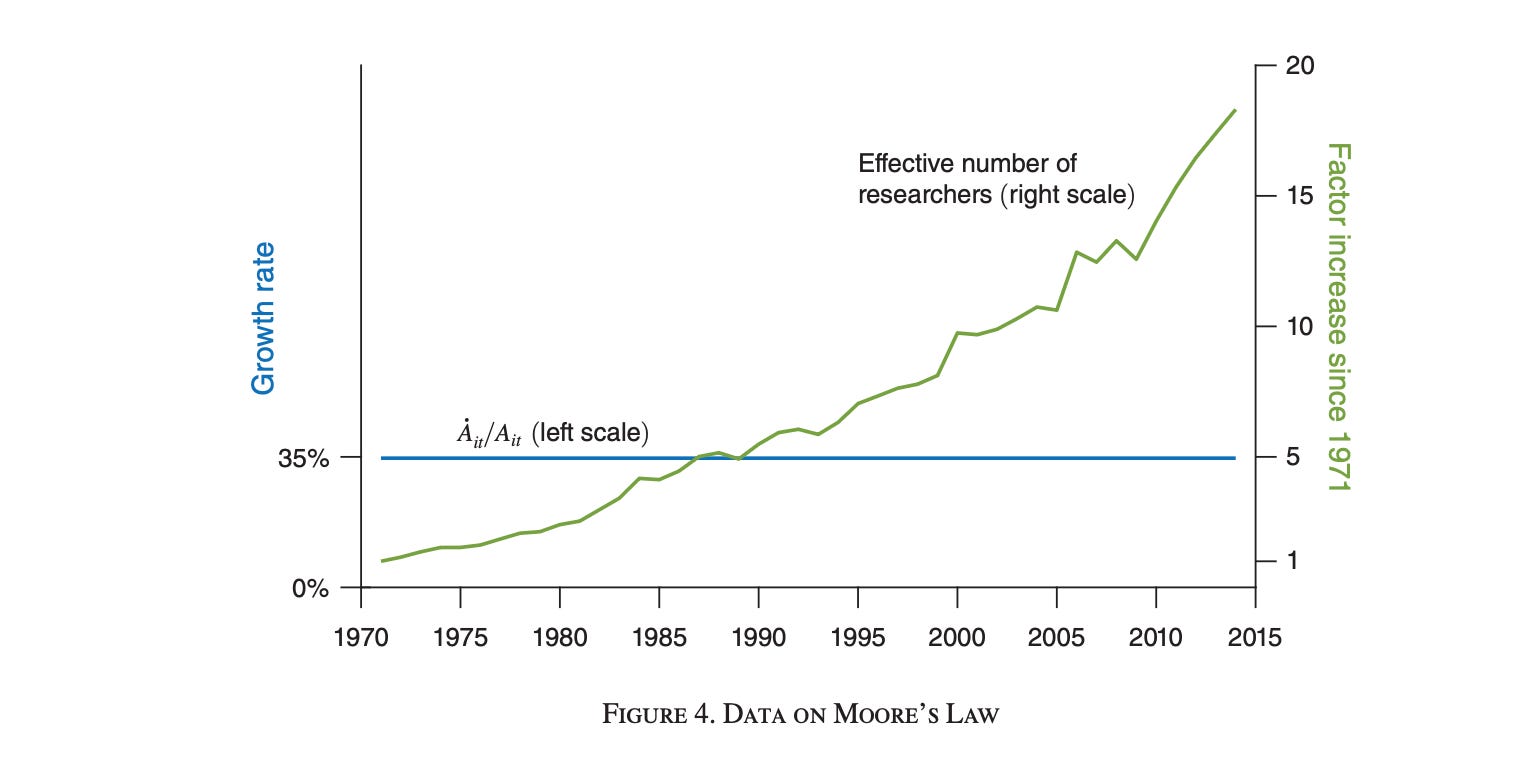
In a way, this is the tyranny of exponentials. In 1975, achieving 35% growth meant adding a mere 1600 transistors to a chip. Today, maintaining the same growth means adding 28 billion. The same logic applies, whether we’re looking at crops or human lifespans. The problem is that our economic engine sputters when we feed it linear improvements. It feeds on high-octane exponentials - and “everywhere we look we find that ideas, and the exponential growth they imply, are getting harder to find,” say the authors of the paper.
Papers becoming less disruptive
In an award-winning paper that made the cover of Nature magazine, Michael Park, now an assistant professor of organizational behaviour at INSEAD, took a very different approach to understand whether science is slowing down. Park and team did what management theorists (and by extension, management consultants) love doing - they created an index. But unlike the spurious indices that give many a consultant’s deck that veneer of rigour, this one is backed by analysis on 25 million scientific research papers and 3.5 million patents. By analyzing the web of citations, their index, CD5, quantifies if a paper was disruptive or if it merely consolidated prior knowledge. The index ranges from -1 for consolidation to +1 for disruption.
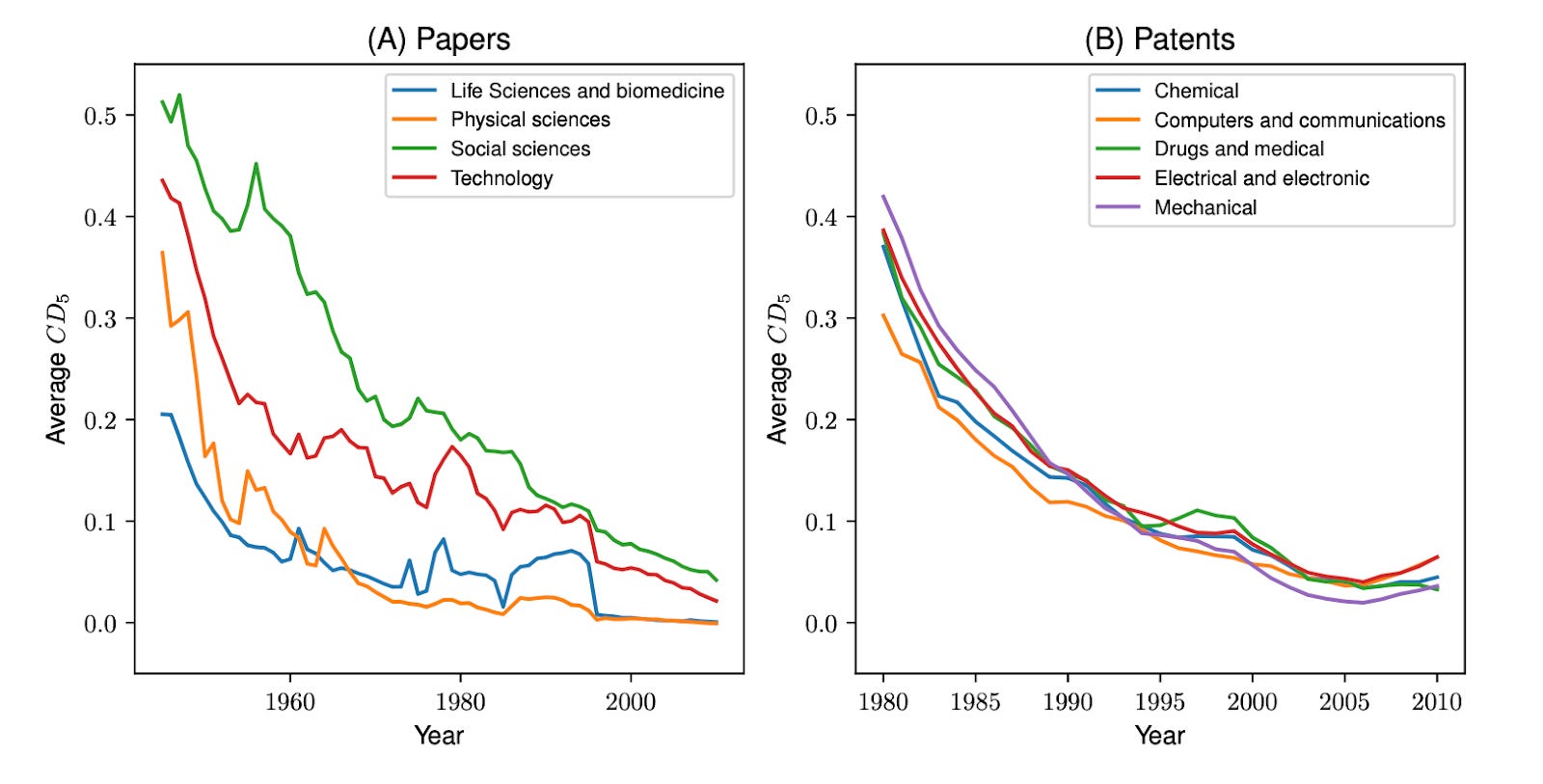
As it turns out, papers and patents seem to be getting less disruptive over time, and that trend holds across disciplines. Interestingly, papers and patents are relying on narrower slices of existing knowledge compared to decades past and the share of citations to the top 1% most cited has also risen sharply. It’s almost like the power-law distribution of the internet is also infecting science – a bit like that Youtuber who keeps gaining subscribers simply because he’s already big on Youtube.
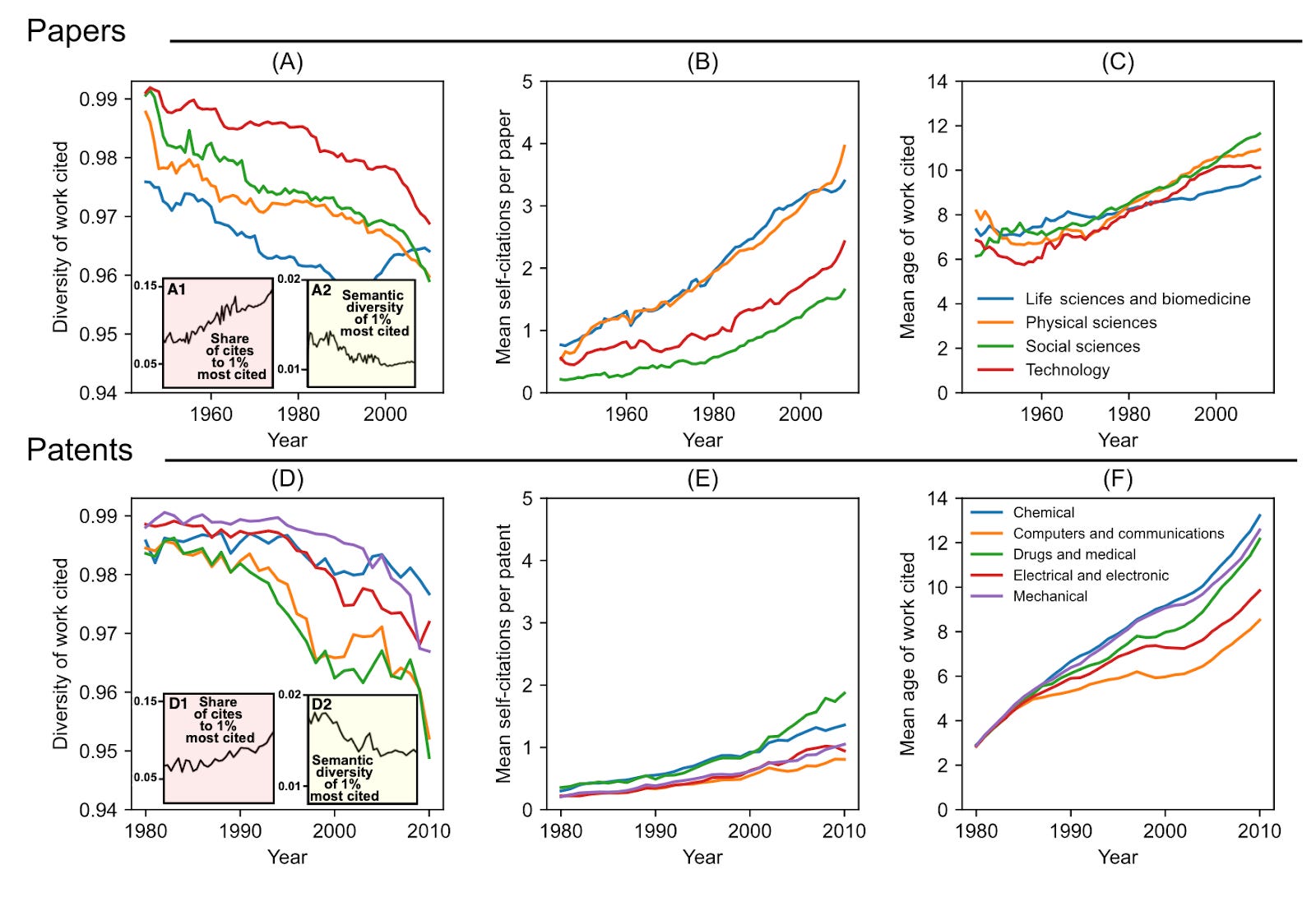
I’m generally skeptical of complex indexes, and while the intuition behind CD5 is relatable, the computation is convoluted, relying on noisy citation data. What it does indicate, though, is “that slowing rates of disruption may reflect a fundamental shift in the nature of science and technology,” say the authors.
Reading through these econ papers at the library one weekend, I wondered what scientists think about this. It was time to phone a friend. W, a scientist in the faculty of medicine at the University of Toronto, agreed that a lot of research appears pointless, and likened the production of researchers to puppy mills. But then he added, “we don’t really know what little discovery today would contribute to a breakthrough in 30 years.” That’s just how basic research works.
W is alluding to the “shoulder of giants” theory, a nod to Newton’s quote that if he could see farther, it’s because he was standing on the shoulders of giants. Scientific progress is cumulative, where prior knowledge provides the foundation for future progress. Given that view, the explosion of research should allow us to move faster, farther – but that doesn’t seem to be happening. There is of course a counter view that explains the slowdown in science, called the ‘low hanging fruit.’ It’s as straightforward as it sounds. Perhaps the easier discoveries have been made, and we just have to slog harder now.
There is a still more pessimistic view: “cognitive closure”. In an echo of past mysticism, heavyweights like Colin McGinn and Noam Chomsky argue that there is an evolutionary ceiling that limits human understanding, much like “what is closed to the mind of a rat may be open to the mind of a monkey.” We may simply lack the ‘wet hardware’ to grasp deeper truths.
Even if such a ceiling exists (I’m doubtful), we are a long way from hitting it. We see this in the marvels we regularly uncover. Some, like mRNA vaccines, make headlines and win Nobels. But most progress relies on knowledge that accumulates in obscurity until it is summoned, like the bacterium found in a hot spring in 1969 that, decades later, made the DNA replication machines of modern medicine possible.
Perhaps the problem isn’t so much that science is slowing down, as the system in which science happens.
The management meth
To most corporate types, academia seems like a meritocratic utopia where the best ideas (and people) rise to the top. You just need to spend one afternoon with a postdoc to be disabused of that notion. Universities now operate a lot like corporations – if anything, their structure exaggerates the dysfunctions of managerialism. Metrics like papers published and impact factors are easy to measure, hence career incentives are linked to these goals. Time spent thinking and synthesizing knowledge, not so much.
But what if a machine could do the thinking for you? Building AI that autonomously does research and recursively self-improves has been held by futurists as a pre-condition to the singularity – the point when AI surpasses humans. Last year, a group of AI forecasters estimated that by June 2027, there would be a country of geniuses in a data centre. In this spuriously precise future, 250k AI scientists are working round-the-clock discovering knowledge, unconstrained by human cognition.
This report, titled AI 2027, was read by millions within weeks of its publication. The authors went on a media tour, drumming up fear and excitement. Policy-makers lapped it up. Turns out, the prediction is more fiction than forecast. Most of the authors do not have a credible background in scientific research - but they know what makes a good headline. The puff-piece these AI hypsters wrote - and the wide attention it received - ironically has a clue on why AI (alone) won’t solve the problem with research productivity.
To understand why, we need to go back to 2005, when John Ioannidis, Stanford professor and meta-researcher, set off a firestorm. Using a mathematical model, Ioannidis demonstrated that in many scientific fields, published research findings are false. But he didn’t stop there. He deduced six corollaries – statements that hold true based on his analysis. Here is Corollary 5: “The greater the financial and other interests and prejudices in a scientific field, the less likely the research findings are to be true.” In plain Charlie Munger-speak: show me the incentive and I will show you the outcome.
AI is moving science forward. After all, Demis Hassabis, founder of Google’s Deepmind AI lab, received the 2024 Nobel Prize in Chemistry for his work on protein structure prediction. So there’s real potential here – but AI also amplifies current dysfunctions, which is why there’s so much slop science.
At the frontier of this slop, is AI research itself. Submissions to the International Conference on Learning Representation have increased by 70% year-on-year, while the average quality scores have declined. Similarly, at Neurips, the other major AI conference, submissions have more than doubled. In a recent post on LinkedIn, Hany Farid, a computer science professor at UC Berkeley, wrote that there’s “a dangerous reduction in the quality and integrity in scientific publishing” from the explosion of submissions.
Ioannidis is more blunt. “Nowadays, we have a massive production of fraudulent papers,” he said in an interview published in Mad in America. “In the past, creating a fraudulent paper was a work of art. It took time and effort to create a fraudulent paper. Now, you can have AI create literally millions of fraudulent papers overnight.”
Speaking of which, I better start vibe-coding my paper. It’s getting kinda late, and it’s due tomorrow.
No posts
Comments
Nothing yet. Say the first thing.
Sign in to join the conversation.