
A small stamped object from Phaistos has resisted translation for more than a century. But if one bold reading is even close, it may not be a hymn or a prayer at all, but a voice of land, duty, children, trade, and community.
There is a small round object in the Heraklion Archaeological Museum that has caused more argument, hope, frustration, and wonder than almost anything else found in Crete. It is not gold, not large, and not obviously grand in the way a sword, a crown, a painted wall, or a great law code can be grand. It is only a disc of fired clay, about the size of a saucer, with signs pressed into it on both sides. Yet people stop before it. They lean towards the glass and look at the tiny stamped pictures, a head with a strange crest, a shield, a bird, a fish, a flower, a hide, a little walking figure, and many shapes that seem almost familiar, then slip away again.
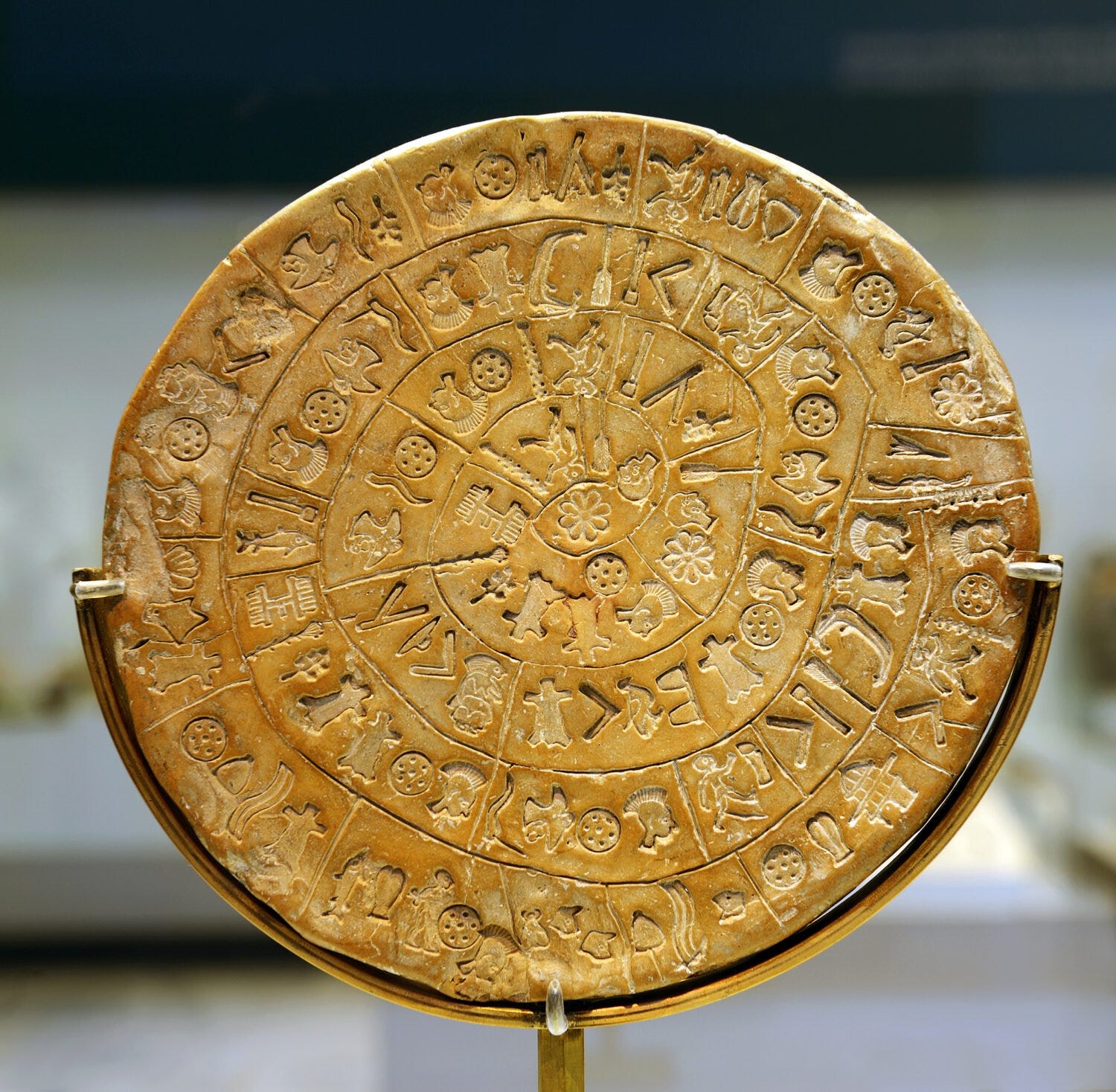
This is the Phaistos Disc, and it has that rare quality of seeming to be on the edge of speaking. It was found on 3 July 1908 by Luigi Pernier, an Italian archaeologist working at the great Minoan palace of Phaistos, above the Messara plain in southern Crete. Phaistos is a place of wind, stone, distance, and authority. Knossos may have the fame and the painted reconstructions, but Phaistos has always felt to me like a more honest survivor. It does not shout. It does not perform. It lets the stones, the mountains, and the wide plain do some of the talking.
That is where the disc came from. Not from a fairy tale, not from Atlantis, and not from some lost race invented by modern imagination. It came from Minoan Crete, from one of the great centres of the Bronze Age island, from a palace world of storage rooms, courts, processions, scribes, seals, workshops, farmers, traders, rituals, and officials. It came from a society that already knew how to organise land, goods, power, and memory.
The disc is roughly 16 centimetres across. It was made of clay and fired. Before it was fired, while the clay was still soft, someone pressed signs into it with stamps. That is one of the most astonishing things about it. The signs were not scratched by hand, one after another, in the ordinary way of many ancient inscriptions. They were impressed, stamped, and repeated. There are 45 different signs, used again and again in different combinations. In total, there are just over 240 impressions, arranged in a spiral on both sides of the disc.
Little dividing lines separate the signs into groups, which are often called words, although we must be careful with that word. They may be words, names, phrases, or something else. The usual view is that the inscription should be read from the outside of the spiral towards the centre, and that feels natural when one looks at it. The eye follows the path inward, as though walking a little road. But even that has been debated, because almost everything about the disc has been debated. The great difficulty remains that we cannot read it with certainty.
The people of Minoan Crete were not illiterate. That needs to be said clearly, because the silence of the Phaistos Disc can give the wrong impression. Bronze Age Crete had writing systems. There was Cretan Hieroglyphic. There was Linear A. Later, after the Mycenaean Greek presence in Crete, there was Linear B. Linear B can be read because Michael Ventris and John Chadwick showed that it records an early form of Greek. Because of that, the Linear B tablets from Knossos and elsewhere can tell us about flocks, oil, bronze, land, chariots, workers, offerings, and the machinery of palace administration.
Linear A is different. We can recognise many signs and make some cautious guesses, especially because it is related in some ways to Linear B. But Linear A itself remains undeciphered. We do not securely know the language behind it. We can touch its edges, but we cannot properly read it. The Phaistos Disc is different again. It is not Linear A. It is not Linear B. It is not the usual Cretan Hieroglyphic script either, although it belongs to a world where symbols, seals, clay, and writing were well understood. It has its own set of signs, and that is why it has caused so much trouble.
If we had dozens of Phaistos Disc texts, the situation would be different. If we had a long archive in the same script, scholars could compare patterns, repeated endings, names, numbers, titles, and formulae. If we had a bilingual text, with the same words in another known language, everything might change. If we had even one more complete object in the same writing system, the discussion would be much stronger. But we do not. We have one disc.
That is why no translation can yet be accepted as final. This is not because scholars are stubborn, and not because they do not want the mystery solved. It is because a single object cannot carry the whole burden of decipherment. It is like hearing one sentence through a wall in a language you do not know, then being asked to reconstruct the grammar, the dictionary, the history, and the meaning of the whole conversation. This has not stopped people from trying.
The Phaistos Disc has been translated many times, or at least claimed to have been translated. It has been read as Greek, Hittite, Luwian, Semitic, Egyptian, Basque, Slavic, Sanskrit, and several other languages. It has been called a hymn, a prayer, a calendar, a legal text, a magical charm, a board game, a military message, a birth record, a funeral text, a song, a myth, a list of offerings, and even a kind of early printed document.
Some of these attempts are clever. Some are romantic. Some are careful in parts. Some are far too confident. A few feel as if the translator decided in advance what the disc should say, then bent the signs until they said it. That is always the danger with ancient mysteries. The object becomes a mirror, and people see their own idea reflected back. A proper decipherment has to be testable. It needs rules, consistency, and the ability to work beyond one example. It needs to explain not only one attractive phrase, but the whole object in a way that other scholars can check.
Linear B did that. Once Ventris’s method was accepted, many tablets could be read. The system worked. It was not merely a pleasing guess. The Phaistos Disc has not reached that stage, so we must hold two thoughts together. The disc almost certainly has meaning. It was made with care, pattern, and intention. But we do not yet have a proven way to read it. That is not a failure of imagination. It is simply honesty.
The signs themselves are part of the magic. There is a plumed head, or what looks like one. There are human figures, birds, fish, shields, flowers, branches, vessels, hides, and tools. Some signs seem easy to name, but even naming them is a little dangerous. If we call one sign a fish, that does not mean the sign meant fish. In a writing system, a picture may stand for a sound, a syllable, an idea, a category, or something else entirely.
Egyptian hieroglyphs teach us that lesson very well. A bird is not always a bird. A picture can be a sound. A picture can be part of a word. A picture can clarify meaning without being spoken. Ancient scripts are often more complicated than they appear to the modern eye. The number of signs on the disc suggests that it may be syllabic. There are too many signs for a simple alphabet and too few for a system where every sign is a whole word or object. A syllabary, where each sign represents a syllable, would fit the number better.
Linear A and Linear B are syllabic scripts too, though the Phaistos Disc does not use their ordinary sign set. The dividing lines between sign groups suggest structure. Some groups repeat. Some signs appear often. Others appear only once. There is rhythm and pattern. It is not random decoration. The stamping technique also matters. Whoever made the disc had stamps ready before the disc was made, which means planning. It may even mean there were other stamped texts once, although none have survived in the same form. Or perhaps this was a special object, made with stamps created for this one purpose. That is one of the haunting things about it. The disc looks like part of a system, but we have only the one example.
Because the Phaistos Disc is unique, some people have questioned whether it is genuine. The idea of forgery has followed it for many years. It was found in 1908, at a time when archaeology in Crete was full of excitement, ambition, rivalry, and national pride. Knossos had already become famous through Arthur Evans. Phaistos, excavated by the Italians, had its own importance and prestige. A sensational object from Phaistos naturally attracted attention, and a few critics wondered whether Luigi Pernier, or someone around him, might have produced a fake.
It is a dramatic theory. It turns the disc into an early twentieth-century archaeological scandal rather than a Bronze Age mystery. But the forgery argument has weakened over time. The disc fits better into the material world of Phaistos than early sceptics realised. Later finds and later studies have shown that impressed marks, stamped decoration, potters’ marks, sealings, and related clay practices were part of the local world. Some motifs and techniques have parallels that were not known in 1908. That matters because a forger working in 1908 could not easily copy later discoveries.
The disc is still unique as an inscription, but it is not quite the lonely alien object it once seemed. It belongs to a Cretan world of clay, signs, seals, symbols, and formal impressions. It is usually treated today as genuine. Not because everyone has stopped asking questions, but because the balance of evidence points that way. The disc is most likely an authentic Bronze Age object, made in or connected to Minoan Crete. That still leaves the bigger question of when it was made.
The Phaistos Disc is usually dated somewhere around the eighteenth to seventeenth century BC, often roughly around 1700 BC, although the exact date remains debated. It was found in a context associated with the palace, but the archaeological situation was not perfectly simple. Some surrounding material belonged to different phases, which makes exact dating difficult. Still, most serious discussion places it broadly in the Middle Minoan period, around the end of the First Palace period or the beginning of the Second Palace period.
This was a fascinating time in Crete. The first palaces had already risen. Phaistos, Knossos, Malia, and other centres were part of a remarkable island-wide system of power, storage, production, religion, trade, and administration. These were not palaces in the later fairy-tale sense. They were not simply royal houses. They were working centres of authority. They stored grain, oil, wine, wool, and other goods. They organised labour, hosted ceremonies, received and redistributed wealth, and controlled landscapes.
Then, around this broad period, the first palaces suffered destruction. Earthquakes may have played a part. Fire may have played a part. Political change may have played a part. Crete rarely gives us one neat cause. Life on the island has always been layered. Earth movement, sea routes, rival centres, drought, abundance, ambition, and fear all leave their mark. The palaces were rebuilt, and the second palace period followed with even greater architectural and artistic confidence.
If the Phaistos Disc belongs near that turning point, it becomes even more interesting. It may come from a time of renewal, disruption, rebuilding, or reassertion. It may have been made before a destruction and kept afterwards. It may have belonged to a ritual or administrative world that bridged two phases of palace life. We cannot say with certainty, but the likely date places it in a Crete already rich in organisation and symbolic power. The disc was not made in a simple society. It was made in a complex one.
To understand the disc, we must think about Phaistos itself. The palace stands above the Messara plain, one of the great agricultural regions of Crete. The land below is broad and fertile, and it has always mattered. Grain, olives, vines, animals, roads, storage, and movement all belong to that landscape. Nearby was Hagia Triada, another important Minoan centre. Further towards the sea was Kommos, the great harbour site that connected this southern world to wider routes across the Mediterranean. Phaistos was not isolated. It was part of a network.
This matters because the disc was not only an object of mystery. It was also an object of place. The Messara was not a dreamscape. It was a working landscape. Crops were planted and harvested. Goods were moved. People travelled. Ships came and went. The palace gathered, counted, stored, displayed, blessed, and controlled. It was a place where the practical and the sacred were probably not separate in the way we separate them now.
Modern people often split life into boxes. Religion here, government there, trade somewhere else, and family in another corner. Ancient Crete may not have worked like that. A ritual could be political. A storehouse could be sacred. A seal could be administrative and symbolic at the same time. A palace could be a centre of economy, ceremony, and identity all at once. That is why the Phaistos Disc may have been many things at the same time. A written object. A display object. A ceremonial object. Perhaps even an instruction, a rule, or a statement of order. We should not imagine it floating above life. It came from life.
There is something else that stays with me when I walk around Phaistos. Among the stones of the site, I keep noticing odd cuts, marks, and worked shapes that seem to echo some of the characters on the disc. I am not saying this proves anything. It may be a coincidence. It may be masons’ marks, later working, damage, reuse, or something entirely practical. But when you are there, moving slowly through the palace stones, you begin to feel that the disc did not come out of nowhere. Its signs seem less isolated. They seem to belong to a wider habit of marking, cutting, shaping, and recognising symbols.
Perhaps that is only instinct, but instinct matters when it comes from standing in the place itself. The disc in the museum is silent, but Phaistos has its own quiet way of answering back. And if we follow that thought a little further, another possibility opens. What if the disc was not meant to be unique at all? What if it was one of many such objects, perhaps made by stamping signs into clay from a prepared set, carrying a short body of rules, duties, traditions, or reminders for men living within the community?
That would make the stamping technique more understandable. You do not create a set of stamps unless repetition matters. Perhaps the disc we have is the only survivor, not the only one ever made. In that light, the odd stone cuttings around Phaistos begin to feel more interesting. Again, they may be masons’ marks, setting marks, later cuts, damage, or practical symbols connected with building work. But if some of them do echo the disc signs, then they could have acted as small visual reminders, familiar marks in a familiar public space. Not a full text, perhaps, but signs that people recognised.
A symbol cut into stone might say, in effect, Remember this. Remember the rule. Remember the duty. Remember what tradition asks of you. That would place the disc in a very human setting, not as a mysterious one-off charm hidden from ordinary life, but as part of a wider public language of order. A society does not live by law codes alone. It lives by repeated reminders, by symbols, by sayings, by customs, by the shapes people see often enough to understand without needing everything explained. If the Phaistos Disc carried rules of conduct, and if similar signs appeared in the stones of Phaistos, then perhaps we are looking not at a lonely mystery, but at the last surviving voice of a whole system of communal memory.
One of the most tempting things about the Phaistos Disc is the stamping. The signs were made by pressing prepared stamps into clay, and that sounds a little like printing. Some people have called it the earliest example of movable type, or even the first printed document. That is a wonderful thought. Crete invented printing more than three thousand years before Gutenberg. It is tempting, and I understand why people like it.
But it needs care. The Phaistos Disc certainly uses repeated sign stamps. That is extraordinary enough. Printing, as we normally mean it, implies a system for reproducing texts, and we do not have that. We do not have another copy of the disc. We do not have a group of stamped books, tablets, or documents. We do not have the stamps themselves. We do not know whether this method was used often or only once.
So perhaps it is best to say this. The disc shows a remarkably early use of pre-formed stamps to create a structured inscription in clay. It is not printing in the later historical sense, but it is a brilliant technical idea. Its uniqueness makes it more mysterious, not less. If this were such an efficient method, why do we not find more examples? Perhaps there were more, and they have not survived. Perhaps they remain undiscovered. Perhaps this was not meant for ordinary record-keeping. Perhaps it was special. Or perhaps it was once ordinary enough in its own setting, and time has simply taken the rest away.
There is one proposed translation I would not want to dismiss too quickly. Vitaly Surnin, in his book Hieroglyphs of the Phaistos Disc: History and Full Text Translation, offers a complete reading of the disc through an Egyptian hieroglyphic approach. His work is not accepted as the final answer, and that must be said plainly. No translation of the Phaistos Disc can yet be accepted as certain because the disc is still unique. There is no second copy, no longer archive, no bilingual inscription, and no matching text that allows the system to be tested properly.
But that does not mean every attempt is equal. Surnin’s translation has something about it that feels worth listening to. It does not turn the disc into another vague prayer to a goddess. It does not make it a misty hymn, a magical chant, or one more Bronze Age sacred object with all the usual fog around it. His reading speaks to a man, and perhaps more than that, it speaks to society.
In one part of his translation, sector B9 is read as referring to “planted [and] grown crops, fertile lands transported”, with the sense that people, products, and other goods are being carried, moved, and traded. In another part, sector B11 is read as “[every] man by tradition brings up children”. Now that is interesting. It is not vague at all. That is land, crops, movement, trade, children, and tradition. These are the bones of a society. These are the things people live by. Food, fertile land, transport, exchange, family, custom, the raising of children, and the continuance of a people.
This is why I find Surnin’s reading compelling, even while knowing it cannot be proven. It reminds me, in feeling if not in date, of the later laws of Gortyn. The great Gortyn Law Code is much younger, of course. It belongs to the first millennium BC, while the Phaistos Disc belongs to the Bronze Age. They are not the same text, and they do not come from the same political world. But there is a voice one recognises, or thinks one recognises.
The Gortyn laws do not float in poetry. They are direct. They speak of marriage, divorce, inheritance, property, status, injury, penalty, and responsibility. They are human society talking to itself in stone. They say, this is how we live, this is what is owed, this is what happens if order breaks. If Surnin is even close, the Phaistos Disc may carry an earlier version of that same Cretan seriousness. Not the same law, not the same city, not the same language, but the same deep concern with order, land, children, custom, and conduct.
That feels plausible to me because Crete was never only a land of frescoes and priestesses. It was a working island. People planted crops. They raised children. They moved goods. They traded. They inherited land. They obeyed tradition. They settled disputes. They carried obligations. They lived inside rules, whether those rules were spoken, remembered, stamped, or carved. If Surnin’s translation is right, or even partly right, then the disc may not be a priestly object hovering above ordinary life. It may be a compact statement from within life itself.
It may have spoken to a man. It may have spoken to a household, a group, a class of people, or a community. It may have carried a reminder of order, duty, tradition, land, produce, children, and social conduct. That feels very Cretan. Still, we must keep our feet on the ground. The disc remains singular. A single object cannot prove a whole system. Until another related text appears, every translation must remain provisional. But Surnin’s reading deserves a fair place in the discussion because it gives the disc a human voice.
Sometimes the oldest mysteries are not mysterious because they speak of gods. Sometimes they are mysterious because they speak of crops, land, trade, children, and tradition, and suddenly the people behind them seem very close.
The comparison with Gortyn is not meant as proof. It cannot be proof. The Gortyn Code was carved many centuries later, in a different Crete, in a Greek-speaking world with city laws, public inscriptions, and a legal tradition we can recognise more clearly. But emotionally, the comparison matters.
Anyone who has stood before the Gortyn laws knows the feeling. There it is, carved in stone, turning back and forth in that old boustrophedon style, line after line of public order. It is not grand in the way a temple is grand. It is grand because it shows a society trying to define itself. Who owns what? Who owes what? What happens to a woman in a divorce? What is inherited? What is punished? What is witnessed? What is accepted as lawful? It is practical, but it is also deeply human.
So when a proposed reading of the Phaistos Disc speaks of crops, fertile lands, transport, tradition, and bringing up children, it rings a small bell. It suggests that Bronze Age Crete, too, may have had formal words for the duties and structures of life. Of course, it did. How could it not? Palaces do not function on pretty frescoes. They function on land, storage, labour, custom, authority, and obedience.
The Minoans may not have carved their law in the same way the people of later Gortyn did. Their systems may have been very different. But they surely had rules. They had obligations. They had traditions. They had ways of raising children, passing goods, using land, moving produce, making offerings, and keeping order. The disc may not be a law code. It is too small, too strange, too isolated for that claim. But it may belong to the same broad human need that later appears so clearly at Gortyn, the need to put order into words.
That is what makes this reading so attractive. It turns the disc from a silent museum puzzle into something that might once have had a public or social function. It makes the object less ghostly. It gives it weight.
Even with Surnin’s translation, even with the Gortyn echo, and even with the possible stone marks around Phaistos, the disc remains undeciphered in the strict sense. This is not a small technical objection. It is the heart of the matter. For a decipherment to be accepted, it must do more than sound plausible. It must be tested. The signs must have stable values. The grammar must work. The language must make historical sense. The same method must be able to read other texts. Other scholars must be able to follow the method and get the same result.
The Phaistos Disc resists all of this because it is alone. It is possible that Surnin has come close. It is possible that another translator has glimpsed something true. It is possible that the marks in the stones at Phaistos are part of the same symbolic world. It is possible that one day a new finding will prove one of these ideas right. But at present, certainty is not available.
Perhaps that is part of the lesson. The past does not always give itself up on demand. We can measure, compare, photograph, catalogue, and argue, but ancient people did not leave everything in a form designed for us. Their private meanings may remain private. Their signs may stay locked until another accident of survival gives us the key. The disc asks us to be curious and humble at the same time, which is not a bad thing.
Today, the Phaistos Disc has become one of the great symbols of Crete. It appears in books, posters, jewellery, shop windows, museum displays, souvenirs, and discussions about the Minoans. It is one of those objects that seems to stand for the island’s deep time. For visitors, it is a mystery. For scholars, it is a problem. For Crete, it is something more.
It is a reminder that this island was thinking, making, writing, stamping, trading, and organising itself nearly four thousand years ago. Before classical Athens, before the Parthenon, before Rome, before Byzantium, before Venice, before the Ottomans, before modern Greece, Crete had palaces, scripts, seal stones, sea routes, workshops, rituals, and administrative systems. That matters.
Too often, Minoan Crete is reduced to prettiness. Dolphins, lilies, bare-breasted goddesses, elegant cups, and bright palace walls. The Phaistos Disc pushes back against that softness. It is not merely pretty. It is disciplined, structured, and deliberate. It has the look of a made message. Whether it speaks of ritual, law, social order, land, children, or something else, it comes from a serious world.
That is the Crete worth knowing. Not a fantasy island of gentle dancers and painted flowers, but a clever, organised, hard-working, sea-facing civilisation with its own systems of thought. A civilisation that did not simply receive ideas from elsewhere, but made its own. The Phaistos Disc is small, but it carries that confidence.
The thing I keep returning to is the hand. Someone pressed those signs into wet clay. Not the Minoans in the abstract. Not civilisation as a museum label. A person. A trained person, most likely. Someone with stamps. Someone who knew the sequence. Someone who understood the purpose. Someone who expected the object to mean something.
That person may have been a scribe, a craftsperson, a ritual specialist, an official, or someone whose role does not fit our modern categories. They prepared the clay, pressed the signs, followed the spiral, and fired the disc. Then nearly four thousand years passed. Palaces fell. Fires burned. Earthquakes came. Languages vanished. Scripts were forgotten. New people arrived. Greek cities rose. Rome came. Gortyn became the capital. Byzantium followed. Arabs, Venetians, Ottomans, rebels, soldiers, farmers, shepherds, archaeologists, tourists, and museum guards all became part of the island’s long story.
And still the disc remained. That is astonishing. It is easy to treat museum objects as dead things. The Phaistos Disc refuses that. It feels alive because it still contains an intention. We cannot hear the voice clearly, but we can feel that there was one.
That is why Surnin’s translation appeals to me. When it speaks of crops, land, transport, trade, children, and tradition, it gives that intention a human shape. It does not solve the disc for us, but it helps us imagine it as something made for life, not merely for mystery. That is why the marks in the stones of Phaistos matter to me too. They may not prove anything, but they keep the disc close to its landscape. They remind us that symbols do not live only in museums. They live in walls, thresholds, roads, courts, habits, and memories.
The Phaistos Disc is worth knowing because it teaches us what good history often teaches us. The world before us was not simple. Ancient Crete was not a soft prelude to Greece. It was not a decorative chapter before the serious men of Athens and Sparta took the stage. It was a powerful island world with its own centres, symbols, movements, and rules. It faced the sea. It fed itself from plains and hills. It organised labour. It used writing. It made things with extraordinary skill.
The disc also teaches patience. We live in a time that dislikes uncertainty. Everything must be solved, named, explained, turned into a headline, or reduced to a little certainty. The Phaistos Disc will not allow that. It sits in its case and says, Not yet. That refusal is valuable because it reminds us that mystery is not the same as ignorance. We know a great deal about the disc. We know where it was found. We know much about the world around it. We know its signs were stamped. We know it has structure. We know it is probably genuine. We know it most likely belongs to the Minoan palace world of Phaistos. We know it has attracted many translations, none of which have been finally proven. We know that some readings, including Surnin’s, deserve attention because they may catch something human and practical in the object.
But we do not know everything, and that is honest history. One day, perhaps, another fragment will be found. A stamped sherd. A second disc. A tablet from Phaistos, Hagia Triada, Kommos, Malia, Knossos, or some unexpected hillside village. A little piece of clay pulled from the earth with the same signs on it. That could change the whole discussion. Until then, the disc remains what it has been since 1908, a small round challenge, a clay silence, a possible instruction, a possible law-like voice, a possible ritual object, a possible social text, and a Minoan message without its key.
I like to think of the Phaistos Disc not as a riddle to be conquered, but as a voice not yet fully heard. It may speak of sacred things. It may speak of social order. It may speak to a man. It may speak to a community. It may speak of land, crops, children, transport, tradition, and the hard practical duties of life. It may speak of something else entirely. We cannot yet know. But it speaks, and that is the important thing.
The signs are not random. The spiral is not careless. The stamping is not accidental. This was a made object with a made message. It came from a civilisation that understood the power of signs. It came from Phaistos, from the Messara, from a Crete that was already ancient before much of later history had begun. When we stand before it, we are not looking at a puzzle in the modern sense. We are looking at a surviving act of communication. It has crossed nearly four thousand years to reach us. The tragedy is that we cannot yet answer it. The wonder is that it reached us at all.
That is enough to make it one of the great objects of Crete. Not because it gives us certainty, but because it keeps us honest. It asks us to imagine without inventing too much. It asks us to respect scholarship without losing instinct. It asks us to leave room for a translation like Surnin’s, which may not be proven but still has a human force. It asks us to remember Gortyn and the later Cretan voice of law, order, inheritance, responsibility, and society. It asks us to look again at Phaistos itself, at the stones under our feet, and wonder whether some old signs once reminded people how to live.
People planted crops, moved goods, raised children, held traditions, made rules, pressed signs into clay, and cut marks into stone. One of those pieces of clay still waits in Heraklion, round as a small moon, quiet as a held breath, carrying a message from the deep heart of Crete. We cannot yet read it with certainty, but we can feel its weight.
Comments
Nothing yet. Say the first thing.
Sign in to join the conversation.