
There is a bell beneath the village of Kamariotis. At least, that is what the old people used to say.
I first heard the story more than fifty years ago, although it had slipped into one of those quiet corners of memory where old voices wait until something calls them back. Recently, while looking into the history of Kamariotis and its war memorial, I suddenly remembered an old man asking whether I had heard the bell.
Of course I had not. The bell had been missing for centuries.
That was the beginning of the story, but to explain how I came to hear it, I have to return to the late 1960s and early 1970s, when tourism in Crete was still young, and the island was a very different place.
In those years, I worked as a designer and courier for tours leaving from Iraklion, as we generally called Heraklion then. Italian cruise ships came into the port carrying passengers who had only a few hours to see Crete before the ship sailed again.
I organised coaches to meet them. They were large German-built buses, MAN diesels if I remember correctly, with a driver at the wheel and me acting as courier. I planned the route, arranged the stops and tried to make sure everyone returned to the ship on time.
A typical excursion might be intended for Arkadi Monastery. We would leave Iraklion with a programme, a timetable and every intention of following it. Yet the journey often developed a life of its own.
Many of the passengers were Greek Americans or Greek Canadians. Some had been born in Crete and taken abroad as children. Others were the children or grandchildren of Cretan emigrants. A few belonged to families that had been outside Greece for several generations.
They carried old village names within them, but often little else.
Someone’s grandmother had come from a village beyond a mountain. A father had spoken of a church, a spring or a square with a great plane tree. A family surname was associated with a place that no one aboard the coach could immediately locate. The memories had been passed from parent to child across kitchens and dining tables in New York, Chicago, Montreal, Toronto and other distant cities.
Then, as we drove through the Cretan countryside, somebody would see a name on a road sign.
“That is my village.”
It might not even be the correct village. Sometimes it was only a similar name, but I could hardly drive past without stopping. We would turn from the planned route and take the coach up a narrow road that had never been included in the day’s programme.
Arkadi would have to wait.
The arrival of a large bus in a small village created immediate curiosity. Doors opened, old men left their chairs, and women appeared from houses. The visitors would descend carrying family names and fragments of stories. Questions were called from one side of the road to the other.
“Whose child are you?”
“Who was your grandfather?”
“What was your mother’s name?”
Within minutes, relationships were being discovered or invented with complete confidence. Someone always knew an uncle, cousin or family connection. Even when no direct relative could be found, the visitors were welcomed as if they had returned home.
Coffee appeared first. Then came raki, bread, cheese, olives, fruit and whatever had been cooking in nearby houses. Sometimes the entire busload was fed. Tables were brought out, chairs appeared from nowhere and the carefully planned timetable disappeared beneath plates of food.
We might reach Arkadi very late. On some days, we hardly reached it at all.
At the time, I occasionally worried about schedules and cruise-ship departure times. Looking back, those unplanned village visits were probably more important to the passengers than anything I had officially arranged. They were not merely sightseeing. They were journeys into inherited memory.
One of those journeys brought us to Kamariotis, a mountain village beneath Psiloritis. I cannot now remember every detail of that day, but I remember the question.
Someone asked whether I had heard the bell.
I did not know what they meant. There was no bell ringing, and nothing in my notes explained it. Eventually, an old fellow told me the story.
The church in the village had once possessed a wonderful bell. Its clapper, or perhaps the striking ball at its end, was made of gold. When the bell rang, its voice carried across the mountains and could be heard as far away as Chania.
When the Ottomans came, the people feared that the bell would be seized. They removed it and hid it beneath a rock. The hiding place was lost, and despite many searches, the bell was never found.
Perhaps, the old man said, it remained beneath the rock on which the church itself had been built.
For years I remembered only pieces of this tale. Age has a strange way of returning things to us. The more recent past sometimes becomes uncertain, while a voice heard in a Cretan village half a century ago suddenly speaks again with astonishing clarity.
I now know that the story is still remembered in Kamariotis. It is not a tale that I misunderstood or attached to the wrong village. The lost bell is one of the best-known traditions of the place.
The bell belonged to the Church of Agios Georgios, not to the old Church of the Panagia where the village celebrates the Dormition each August.
Agios Georgios is a three-aisled, barrel-vaulted church standing upon a great rock. It dates from the later Byzantine or Venetian centuries, although accounts differ over whether its earliest form belongs to the fourteenth or sixteenth century. Like many Cretan churches, it may contain work from more than one period.
The church preserves signs of the complicated history of Crete. A lion of Saint Mark, the emblem of Venice, can be seen above the western entrance. Elsewhere appears the double-headed eagle associated with Byzantium and with the powerful Kallergis family.
Those symbols meet at Kamariotis as naturally as the mountain roads meet there. Venice ruled Crete for more than four centuries, but Orthodox belief and Byzantine identity survived beneath Venetian government. Families such as the Kallergis moved between rebellion, negotiation and local power.
The church was already old when Ottoman forces completed the conquest of Crete in 1669. Its bell would have been more than an instrument for calling people to worship. It was the voice of the Christian village.
A bell could announce a feast, a death, a marriage or danger. Its sound crossed fields and reached shepherds beyond the houses. People could identify their own village bell from its tone.
The bell of Agios Georgios was remembered as exceptional. The local tradition says that its striking ball was golden and that its sound travelled all the way to Chania.
A village couplet preserves the boast:
Saint George of Kamariotis, of Kastro and Rethymno,
they strike your bell and hear it all the way in Chania.
No bell could truly be heard across such a distance. That is not the point. The story tells us how the villagers understood its voice. It was so clear and powerful that ordinary measurements were not enough.
The concealment of the bell has a believable historical background.
After the Ottoman conquest, Christian churches faced restrictions on ringing bells. The regulations varied from one period and district to another, but bells were frequently removed, silenced or forbidden. In some places they were ordered to be taken from villages to the towns.
A church bell carried religious and political meaning. Its sound declared that a Christian community remained present and organised. Ottoman authorities might tolerate a church building while objecting to a bell whose voice travelled publicly across the district.
Christians often used a semantron instead. This was a wooden or metal board struck with a mallet to call people to worship. It made a sound, but it did not have the carrying voice of a bronze bell.
Some villages surrendered their bells. Others concealed them. A bell might be lowered into a well, buried in a field, placed inside a cave or hidden in a crack in the rock.
The people of Kamariotis are said to have hidden theirs rather than allow it to be taken. Perhaps the location was known only to a few trusted men. If they died during war, imprisonment or displacement, the secret could easily have vanished.
There is also the question of the gold. A solid gold clapper would have been impractical because gold is comparatively soft, although the heavy striking ball might have been gilded, mixed with another metal, or merely described as golden because of the purity of the sound.
Old bells attracted stories about precious metals being thrown into the molten bronze during casting. Silver or gold was believed to give a bell a sweeter voice. The science may be uncertain, but the belief was widespread.
In Kamariotis, the golden ball explained both the beauty of the bell and the danger that it faced. Such an object could not be left for soldiers or officials to carry away.
The church stands directly upon rock, and that rock became the centre of the mystery. Villagers wondered whether a fissure or concealed hollow beneath Agios Georgios contained the bell.
When restoration work began in 2004, hopes rose that the work might reveal an opening. People watched for a hidden chamber, an unusual stone or some trace of metal within the rock.
No bell was found.
Perhaps it was concealed somewhere else. Perhaps somebody recovered it quietly long ago. It may have been melted, sold or carried away during one of the many unsettled periods in the history of Crete.
Yet a legend does not require certainty. In fact, certainty would almost spoil this one. As long as the bell remains undiscovered, it has never entirely left Kamariotis.
It is still beneath the rock, silent and waiting.
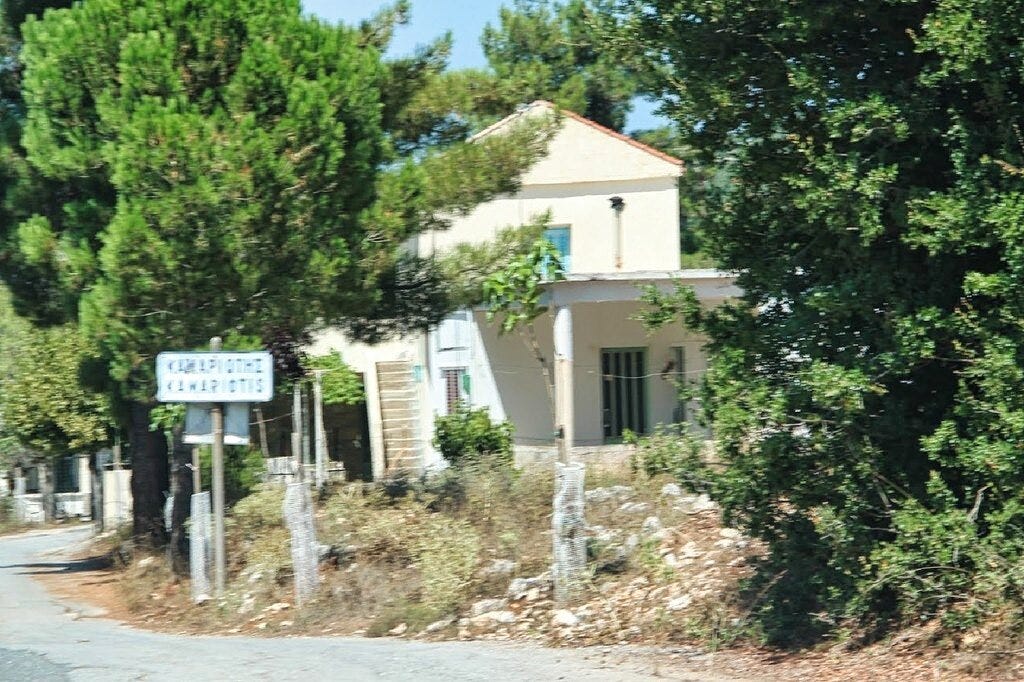
Kamariotis lies in the mountainous interior of Malevizi at an altitude of about 620 metres. To the south, the land rises towards Psiloritis. Around the village are olives, vines, walnuts, fruit trees and the rougher country used by shepherds.
At the western side of the settlement, enormous rocks form passages, strange shapes and natural enclosures. The landscape can resemble a labyrinth. In such a place, stories of hidden bells and concealed chambers do not feel impossible.
The village belonged historically to Mylopotamos and appeared in records connected with Rethymno. Today it forms part of the Municipality of Malevizi in the Heraklion regional unit. Its location explains the old couplet linking Kastro, the name long used for Heraklion, with Rethymno.
Administrative borders mattered less than family and mountain connections. People moved between Kamariotis, Kamaraki, Astyraki, Gonies, Sisarha and the higher country around Anogeia. They married across villages, shared pasture and followed roads that had existed long before modern boundaries.
The village once supported a much larger population. By the beginning of the twenty-first century, the number of permanent residents had fallen sharply. Many families left after the 1960s, some for Heraklion and Athens, others for countries much farther away.
The stone houses remained. Some were abandoned, while others were restored by descendants returning to the place their parents had left.
This is why the story of the bell feels so appropriate. The bell itself disappeared, and the people scattered, but neither was entirely lost. The memory continued to call them home.
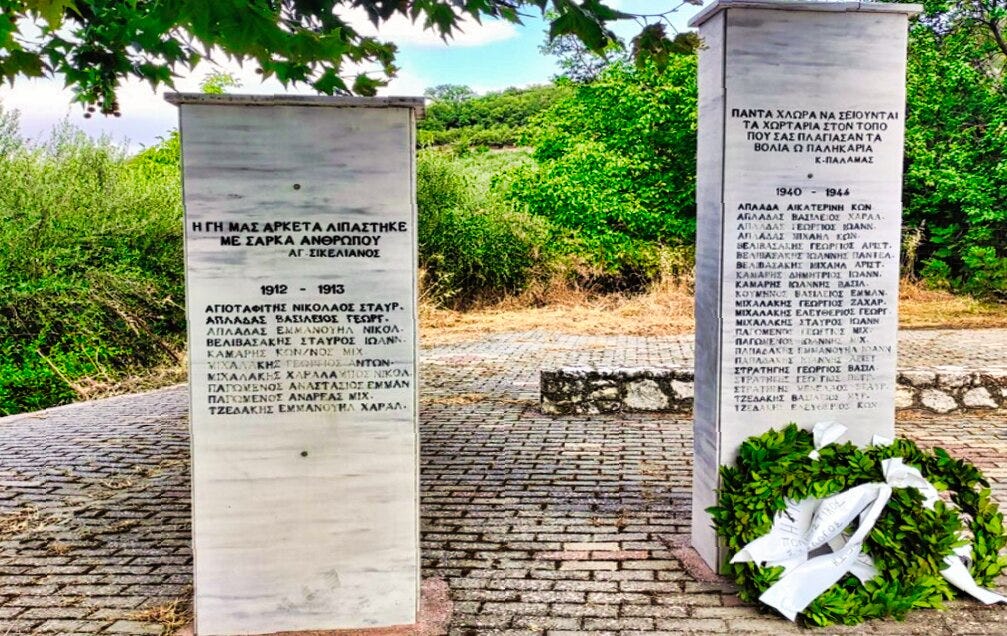
Kamariotis also remembers through names carved into stone. Its war memorial stands beneath trees on a paved area within the village. It consists of two plain marble pillars.
The first is headed 1912–1913, and records men lost in the Balkan Wars. These were the conflicts through which the Ottoman Empire was driven from much of its remaining European territory.
Crete had not formally completed its union with Greece when the First Balkan War began, but Cretans volunteered in large numbers. Some of the Kamariotis men named on the memorial may have died far from home in Macedonia or Epirus.
Above them is a severe line attributed to Angelos Sikelianos. It speaks of the earth being satisfied and enriched by the flesh of men. There is no easy glory in the words. The land receives the young, and their families are left to live with the cost.
The second pillar bears the years 1940–1944. These dates encompass the Greek campaign in Albania, the German invasion, the Battle of Crete and the occupation.
Above the names is a verse by Kostis Palamas:
May the grasses always wave green
upon the place where the bullets
laid you down, brave lads.
The words belong naturally to the setting. Trees and cultivated land surround the monument. Grass grows close to the place where the villagers gather to remember.
Approximately twenty-two names appear beneath the dates 1940–1944. The stone records members of the Apladas, Velivasakis, Kamaris, Kouminos, Michalakis, Pagomenos, Papadakis, Stratigis and Tzedakis families.
Four members of the Apladas family are named. They include Aikaterini, Vasileios, Georgios and Mikhail. The presence of Aikaterini reminds us that this is not simply a military roll of honour. Civilians and women were also drawn into the violence of the war and occupation.
Three men of the Velivasakis family appear, Georgios, Ioannis and Mikhail. The Kamaris family lost Dimitrios and Ioannis, while Vasileios Kouminos is also named.
Georgios, Eleftherios and Stavros Michalakis follow. Georgios and Ioannis Pagomenos are commemorated, along with Emmanouil and Ioannis Papadakis.
Three members of the Stratigis family appear near the lower part of the pillar. The final names include Vasileios and Eleftherios Tzedakis.
The repeated surnames reveal the true weight of the loss. One family might bear four names, another three and another two. For a small village, this was not a distant war measured in national figures. It entered particular houses and left particular chairs empty.
The heading does not say that every person died in one incident. Some may have been killed while serving with the Greek army in Albania. Others may have died during the invasion, in resistance activity or through German executions.
The village ceremony particularly honours residents remembered as having been executed by the German occupation forces. Their complete individual stories have not all reached us, but Kamariotis kept their names.
Italy attacked Greece on 28 October 1940. Cretan soldiers were sent to the northern front, exchanging the weather of their island for the snow, rain and mud of Epirus and Albania.
The Greek army drove the Italians back, but the victory could not survive the German invasion of April 1941. The Cretan Division remained stranded on the mainland, leaving Crete without many of its own trained men when German paratroopers attacked on 20 May.
The main Battle of Crete took place around Maleme, Chania, Rethymno and Heraklion, but every village soon felt its consequences. Cretan civilians had fought the invaders with hunting guns, old rifles, farm tools and captured weapons.
German commanders responded with collective punishment. Villages were burnt, hostages were taken, and civilians were executed. Assisting an Allied soldier or failing to report a resistance fighter could bring death to an entire family.
Kamariotis stood in the mountain country through which messages, fugitives and resistance groups moved. Roads connected Malevizi with Anogeia, Mylopotamos and the high pastures of Psiloritis.
A shepherd might carry information without ever calling himself a resistance fighter. A woman might bake bread for men hiding in the hills. A child could watch the road and warn that German soldiers were approaching.
These small actions sustained the resistance, but they placed entire communities at risk.
By the summer of 1944, Germany was losing the war. The occupation forces on Crete knew that they might eventually have to withdraw towards the western part of the island.
The mountain roads had become dangerous for them. Resistance groups operated around Psiloritis, supported by settlements that knew every path, cave, spring and livestock enclosure.
In April 1944, British officers and Cretan resistance fighters abducted General Heinrich Kreipe. The operation humiliated the German command and increased pressure upon the villages accused of sheltering resistance groups.
Further incidents followed in August. German prisoners taken from Anogeia were freed by resistance fighters, and a German detachment was ambushed near Damasta.
Friedrich-Wilhelm Müller, the commander of Fortress Crete, ordered the destruction of Anogeia. During the night of 12 to 13 August, German battalions began a large encirclement of Psiloritis.
The operation brought soldiers into villages, fields, pastures and mountain shelters. Houses were searched, livestock was taken, and civilians were arrested. Anogeia was looted and systematically destroyed.
For the villages beneath the mountain, the days around the Dormition were days of fear. Smoke rose from Anogeia while German patrols moved along the roads. Families hid their men, and nobody knew where the next arrests would take place.
The main Psiloritis operation was halted on 20 August after the resistance groups escaped the German encirclement.
On the following day, soldiers of the German 65th Grenadier Regiment moved from Sisarha towards Heraklion. They arrested civilians from Kamaraki, Astyraki and the surrounding countryside. Shepherds from Anogeia and men connected with other nearby communities were also seized.
The prisoners were taken to Porofarango, near the exit of the Gonies Gorge. Twenty-three men were executed there.
Ioannis Soultatos of Anogeia, known as Alisavogiannis, survived by throwing himself into the ravine. A carob tree broke his fall, and he hid in a rocky fissure.
Most of those who died were from Kamaraki, but the group included men from several neighbouring villages. Mikhail A. Velivasakis of Kamariotis appears to have been among them.
His name stands on the Kamariotis war memorial because this was his village. He is also remembered at Porofarango because that was where he died.
The two places share his memory. One was his home and the other the place where his life ended.
Every 15 August, Kamariotis celebrates the Dormition of the Theotokos in its old Church of the Panagia. It is one of the days when the village fills again.
People return from Heraklion and farther away. Descendants enter the church where their parents and grandparents worshipped. Candles are lit, bread is blessed, and hymns fill the old building.
The icon of the Virgin is then carried through the streets. Familiar roads become part of the religious procession, passing houses whose families may now live elsewhere.
After the service, the people gather at the village war memorial. A memorial prayer is sung for the residents who lost their lives in war and under the German occupation. Wreaths are laid by the Municipality of Malevizi, the local community, village organisations and the families of the dead.
The ceremony joins celebration with remembrance. The Dormition is concerned with death, but not with despair. It speaks of departure, hope and continuing life.
That makes it a fitting day for Kamariotis to honour its fallen. Their names are not visited in silence by a few officials on an empty weekday. They are remembered when the church is full, and the scattered village has come home.
The date should not be treated as proof that all the people on the memorial died on 15 August. The stone covers four years and many different experiences of war.
Yet the closeness of the date to August 1944 gives the ceremony an added depth. Anogeia was being destroyed during those same days. German forces were crossing the district, and the Porofarango execution followed on 21 August.
Today the feast belongs once more to the village. The people of Kamariotis pray, carry the icon and honour the dead in freedom.
Those old bus journeys taught me something that I did not fully understand at the time. Memory does not always travel through books and official records. It travels through people.
A Cretan emigrant in America told a child the name of a village. The child repeated it to another generation. Years later, a passenger on a cruise ship saw the name on a sign and asked a young courier to stop the bus.
An old man in Kamariotis then told me about a bell hidden when the Ottomans came. More than fifty years passed before the story returned to me.
Perhaps some details changed as it travelled. That is the nature of oral memory. What matters is that the centre of the story remained intact.
The bell belonged to Agios Georgios. It had a golden striking ball and a voice that could be heard across Crete. The people hid it, and it was never found. It may still lie inside the rock beneath the church.
The visitors I brought to the villages were also searching for something hidden. They carried inherited names, half-remembered places and stories without endings. They hoped that somewhere in Crete an old person would recognise a surname and open the way back into the family.
Often that was exactly what happened.
Coffee was poured, food arrived, and strangers became relatives. A journey intended for Arkadi became something far more personal. The tourists had not merely seen Crete. For an hour or two, they had returned to it.
Kamariotis has two powerful ways of remembering.
The war memorial gives memory a physical form. Names are cut into marble so they cannot easily be lost. Each August, people stand before them, lay wreaths and speak prayers.
The bell belongs to another kind of memory. It cannot be seen, and no one can prove where it lies. Yet its story has survived invasion, emigration and the decline of the village population.
The two forms of memory belong together.
The memorial names those who were taken by war. The bell recalls something precious hidden from conquest. One stands openly beside the road, while the other is imagined deep within the rock.
Both call the people of Kamariotis home.
The bell no longer has to be heard as far away as Chania. Its story has travelled much farther than its sound ever could. It crossed the Atlantic with emigrant families, lived in their memories and returned with their descendants.
It also remained with an English courier who once brought a bus into the village and did not understand why somebody asked whether he had heard the bell.
I understand the question now.
To hear the bell does not mean hearing bronze struck by a golden clapper. It means listening to what a village has carried through the centuries. It means hearing the voices of people who hid what they loved, mourned those they lost and trusted later generations to remember.
On 15 August, the church fills, and the icon of the Panagia passes through the streets. Prayers are said at the war memorial, and wreaths rest beneath the names of the fallen.
Somewhere nearby, Agios Georgios stands upon its rock.
The bell may still be beneath it. Perhaps it will never be found. Yet whenever the story is told, it rings again.
Comments
Nothing yet. Say the first thing.
Sign in to join the conversation.