

Disclaimer: This content is for informational purposes only and should not be construed as investment, financial, or tax advice. Investing in CLO ETFs involves financial risk, including loss of principal. Yields and historical default data are subject to change and do not guarantee future performance. Always perform your own research or consult a licensed financial advisor before investing.
Treasuries, CDs, High Yield Savings Accounts (HYSA) and money-market investments offer relatively high-quality income, but investors seeking higher yields generally have to accept some combination of credit risk, interest-rate risk, duration risk or liquidity risk.
CLOs are securities backed primarily by diversified portfolios of corporate leveraged loans. Their capital structures divide investors into different layers, or tranches, with different levels of risk and return.
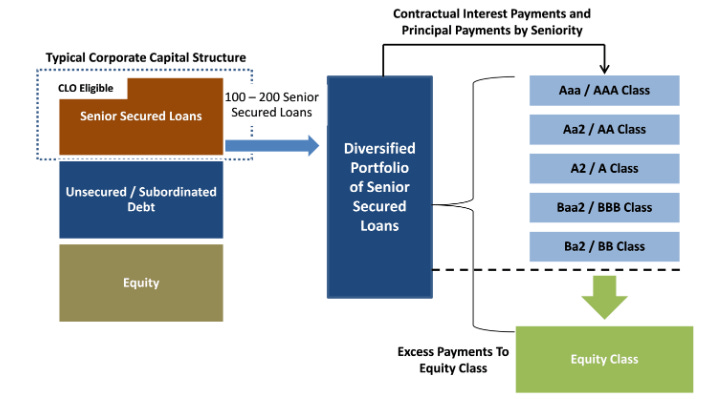
Image Source: SEC
CLO debt offers a yield premium over similarly rated traditional corporate bonds. Because CLOs are floating-rate instruments tied to short-term benchmarks like SOFR, their duration is near zero, protecting capital during rate-hiking cycles.
First-Lien Claim: The underlying loans hold senior secured status on corporate assets, placing them ahead of unsecured corporate debt and equity.
Subordination Layers: Junior layers absorb credit losses first, shielding senior tranche investors from initial portfolio impairments.
CLOA (iShares AAA CLO Active ETF): 30-Day SEC Yield 4.83%
JAAA (Janus Henderson AAA CLO ETF): 30-Day SEC Yield 4.87%
JBBB (Janus Henderson B-BBB CLO ETF): 30-Day SEC Yield 5.97%.
CLOZ (Eldridge BBB-B CLO ETF): 30-Day SEC Yield 6.73%
* yields as of Aug 14th
The performance of CLO tranches across crisis periods highlights their unique risk profile compared to corporate bonds:
2008 Global Financial Crisis: Zero US AAA or AA rated CLO tranches defaulted or suffered principal impairment.
2020 COVID-19 Shock: Secondary market prices dipped sharply in March 2020 during broad market liquidations, but underlying cash flows remained intact, and valuations recovered within months.
2022–2024 Fed Tightening: Floating-rate resets allowed CLO ETF yields to expand alongside rising benchmark rates without experiencing the severe duration-driven price drawdowns seen in traditional fixed-rate bond indices.
Multi-decade default studies by S&P Global Ratings show that capital losses in rated debt tranches are exceedingly low compared to single-name corporate bonds.
AAA Tranches (CLOA, JAAA): ~0.00% Default Rate. S&P Global recorded zero AAA CLO tranche defaults across thousands of rated deals spanning over 30 years.
BBB Tranches (JBBB, CLOZ): ~0.1% to 0.4% Cumulative Default Rate. Mezzanine tranches carry modest credit risk but maintain default rates significantly lower than similarly rated BBB corporate bonds.
During a market panic, CLO ETFs can experience a meaningful temporary decline without the underlying CLOs ultimately suffering the same magnitude of permanent credit loss. Usually the CLO ETFs recover after the panic is over.
No.
JAAA and CLOA are ETFs, not single AAA CLO tranches. The ETF itself can trade below its NAV.
An investor could therefore buy an AAA CLO ETF, experience a temporary 5% or 10% market decline during a liquidity shock, and still ultimately avoid a comparable permanent credit loss in the underlying securities.
That is why an investor’s time horizon matters.
Someone who needs the money next month has a very different risk profile from someone who can hold through a full credit cycle.
The history of CLOs offers two very different lessons.
The first is reassuring:
Senior CLO tranches have demonstrated remarkable credit resilience.
S&P’s latest study shows no defaults among originally AAA-rated CLO tranches in its global historical dataset through 2025.
The second is a warning:
CLOs are not immune to market stress.
During COVID-19, BlackRock’s data show a roughly 10% maximum 20-business-day drawdown for AAA CLOs and roughly 30% for BBB CLOs.
Therefore:
Low probability of permanent principal loss does not mean low probability of temporary market-value loss.
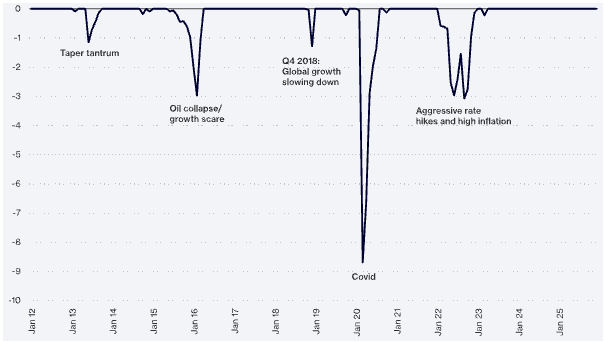
Source: JPMorgan. CLO refers to the JPMorgan CLO Index. Drawdown figures are percentages
For some investors, potentially yes.
The appeal is strongest in the senior AAA portion of the market.
AAA CLO ETFs such as JAAA and CLOA currently offer yields around 4.8%, combined with floating-rate exposure, very low duration and historically exceptional credit performance.
Moving down to JBBB and CLOZ increases the potential income to roughly 6%–7%, but the investor also moves into lower-rated tranches and accepts greater credit and market risk.
That suggests an important principle:
The sweet spot may not be the highest-yielding CLO ETF. The sweet spot is the level of risk an investor is comfortable accepting for the additional income.
For a conservative income investor, that may mean focusing on AAA CLOs.
While CLO ETFs offer compelling yield potential, smart investing is never one-size-fits-all. Reach out to schedule a discussion on how to structure a strategy built specifically for your financial goals.
Sources:
Comments
Nothing yet. Say the first thing.
Sign in to join the conversation.