
Bipolar Disorder Incidence During Pregnancy and in the Postpartum Period: A Population-Based Study
The timeline of postpartum psychosis is striking; it is the first few weeks following birth which are high risk, with many women experiencing onset of symptoms in the days or even hours following parturition. For me, this is a big clue towards a hormonal trigger.
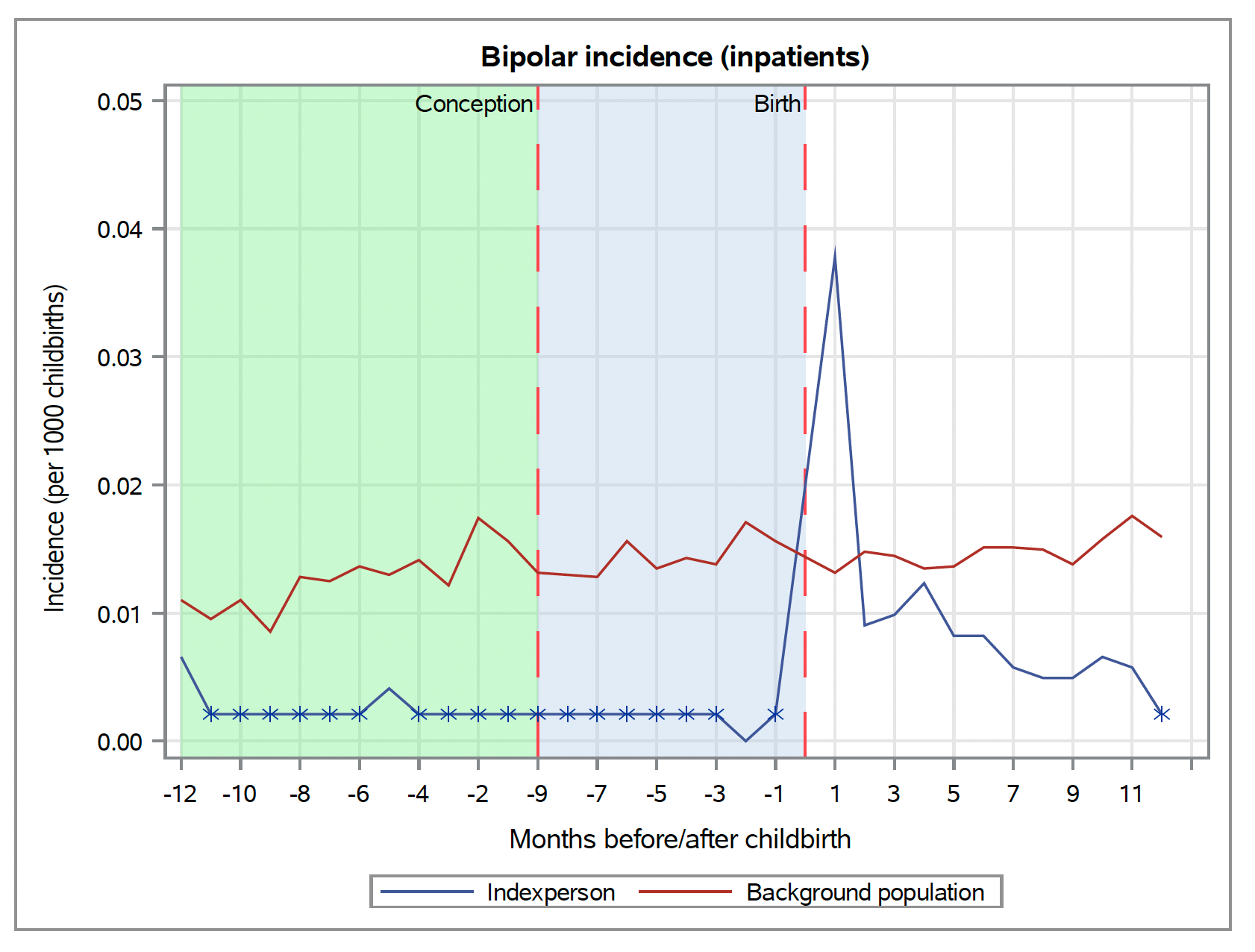
A record-linkage study led by Professors Veerle Bergink and Trine Munk-Olsen examined new bipolar diagnoses in relation to childbirth. They found a spike in new cases the first month following birth, which drops back below the background population risk by month two. This peak was found in inpatients but not outpatients (I guess because postpartum psychosis is a condition that generally requires hospitalisation).
Escitalopram and brain reactivity to aggressive stimuli in premenstrual dysphoric disorder
An elegant neuroimaging study from a team including Manon Dubol and Erika Comasco examined a curious finding in PMDD - why do SSRIs act so much faster (within hours to days) compared to their usual action as antidepressants (days to weeks). Their work implicates serotonergic functioning in corticolimbic circuits, suppressing the key symptom of irritability/anger.
Hormone blindness in precision psychiatry
It amazes me that people can talk endlessly about precision psychiatry without mentioning hormones - surely some of the most tractable biological processes relevant to mental health. This BJPsych editorial makes the case for taking reproductive transitions and hormone dynamics into account for psychiatric research.
You may remember me getting excited about pramipexole as a treatment for depression. This trial takes a novel approach of targeting anhedonia, whether this was in the context of major depressive disorder, dysthymia or bipolar disorder. The effect on (a) anhedonic symptoms and (b) light physical activity, shown below, are impressive.
Another clinically important Stefan Leucht meta-analysis showing symptom improvement over time following antipsychotic prescription. Irritability and excitement improve first, then positive symptoms, and finally negative and cognitive symptoms. Improvements plateau from week 15 (~3 months) onward - much longer than I would have expected! Take-home message: don’t give up on a medication prematurely.
Yes, it’s 2026 and we still don’t know how lithium works in bipolar disorder. This study showed lithium uptake into the brain correlates with serum levels. Twice-daily dosing resulted in more stable brain lithium exposure over the day, whereas once-daily and twice-daily regimens showed similar brain and serum measurements at standard 12 hour sampling.
All prescribers of antipsychotics should be mindful of their metabolic side-effects. There is a lot of excitement about GLP-1 analogues to reduce antipsychotic associated weight gain. Where I work, it isn’t possible to prescribe these in routinely (£££) but there’s nothing stopping us using metformin (cheap as chips), which here showed an average reduction of 3.9 kg.
Emulated target trials are in vogue, but they only show moderate concordance when replicating their randomised controlled trials.
The RCT still reigns supreme!
This is a pre-print so obviously we need to wait until the findings are peer-reviewed and published in a journal…or do we? A belief of mine that pre-prints don’t usually change substantially in their finalised published form is confirmed here. It refocusses the question of why we go through such time and effort to publish in prestigious journals.
Shared Genetic Architecture Between Endometriosis and Psychiatric Conditions May Explain Comorbidity
Another pre-print (no need to wait for it to be published) suggests that the comorbidity between endometriosis and mental disorders is explained by genetic overlap.
I’m not sure how to feel about this Spectator article by Michael Simmons. On one hand I can see how someone who grew up with a visible, stigmatised disability is frustrated by so many people describing themselves as disabled. On the the other, mental disorders, particularly severe mental illness, can be genuinely disabling.
Antidepressants stole my orgasm
Important first person account of sexual dysfunction following SSRI use. As this side effect gets more attention, I wonder if we’ll see increasing prescriptions of alternative antidepressants like vortioxetine and, dare I say, bupropion.
Inside the NHS unit helping mothers with postpartum psychosis
Good coverage on the importance of mother and baby units.
Richard Dadd review – can his mental illness help explain these arresting, bizarre images?
A new exhibition from a former Bethlem and Broadmoor patient, who was admitted after killing his father in response to psychotic symptoms. Many of his noted works, including those of fairies, were painted as an inpatient.
Michael Halassa - The Dawn of the Muscarinics
We are incredibly fortunate to witness a new class of medications for schizophrenia (a generation of psychiatrists never had this). Mike gets this more than anyone else.
For seventy years, psychiatry had exactly one lever for psychosis: block dopamine, and vary the side effects. There are now, demonstrably, at least two levers that work, built independently by different people. That is what a watershed looks like in this field: the moment a mechanism stops depending on whether a single company’s molecule happens to be good, and starts existing as a category clinicians can build on. The muscarinics are here to stay. What they will ultimately be able to do for patients is being written.
Dr Oli Delgaram-Nejad - When Preston Begins to Feel Again
Excellent personal account of stopping antipsychotics. A lot of subtlety and nuance which you can’t get from clinical research, demonstrating the value of a first person view. Also a reminder of the cognitive side-effects of dopamine-blocking medication. The author has also published personal account of antipsychotic medication in Schizophrenia Bulletin.
Endopsychoscope - Paul Janssen’s radical stance on depression and its treatment
Turns out Paul Janssen, yes of Janssen Pharmaceuticals, yes who discovered haloperidol, didn’t believe in antidepressants.
Erik Svenssons Substack - The coming demise of the hard problem of consciousness and the death of panpsychism? via Samei Huda
Will the hard problem of consciousness go the same way as vitalism?
Greg Katz, MD - What Longevity Doesn’t Understand About Medicine
Many of these points are applicable to the wider biotech field.
Counterpoint to the drive for redistribution of research funding across the country.
Anamnesis - Historical timeline of developments in psychiatry
Very nice timeline which puts everything into perspective.
Go big, big pharma

Ruxandra Teslo 🧬@RuxandraTeslo
I loved this trial directly comparing tirzepatide (from Eli Lilly) to semaglutide (from Novo), which proves tirzepatide's superiority in weight loss. Many pharma companies run their trials against placebo instead of the next best alternative. While this makes it easier to show

12:07 PM · Jul 6, 2026 · 12.4K Views
13 Replies · 11 Reposts · 142 Likes
My money is against biological clocks speeding up and slowing down across the lifespan

Saloni@salonium
This is a fascinating chart: it shows the rate of aging based on 'biological clock' data. Apparently, after 33, your aging slows down, then it picks up again at 53, then slows down again at 69, then picks up again at 76, and then it slows down at 78. Multiple people looked at

4:56 PM · Jul 11, 2026 · 23.4K Views
15 Replies · 29 Reposts · 329 Likes
Highly relevant, especially for mania

Alasdair MacLullich@A_MacLullich
10 principles of verbal de-escalation - from the American Association for Emergency Psychiatry. Many of these can be applied when a person with #delirium is distressed and "agitated".

7:28 PM · Jul 12, 2026 · 867 Views
1 Reply · 8 Reposts · 22 Likes
Is there already a term for this?

Samuel Hume@DrSamuelBHume
Curious examples where one disease protects against another - Sickle-cell trait protects against severe malaria - Down syndrome reduces the risk of most solid tumors - Huntington's disease and dementia seem to lower cancer risk - HLA-B27 positivity (as in ankylosing
8:12 PM · Jul 12, 2026 · 98.1K Views
42 Replies · 42 Reposts · 375 Likes
Sad how this story rings true - ultimately academia is a feudal system with certain individuals holding power over others

Adam Rochussen@AdamRochussen
It’s been an extremely strange past few months in the Panda lab. Rumours, gossip, secrecy, lies, manipulation. It’s been confusing, taxing, and relentless for all of us (to say nothing of what it must’ve been like for the most recent victim!). Very grateful to @Sara_Reardon for

News from Science @NewsfromScience
Exclusive: Satchidananda Panda, a prominent biologist known for his work on circadian rhythms, light sensing, and intermittent fasting, will resign next month after 22 years at the Salk Institute for Biological Studies. https://t.co/KtQ0cU4rdk
6:33 PM · Jul 17, 2026 · 73.8K Views
5 Replies · 19 Reposts · 119 Likes
Dark humour

Shailin Thomas@shailinthomas
Someone should write a thriller about a radiologist who confesses to murder in the body of every report but gets away with it because everyone only reads the impression.
5:21 PM · Jul 28, 2026 · 38.9K Views
21 Replies · 34 Reposts · 558 Likes
No posts
Comments
Nothing yet. Say the first thing.
Sign in to join the conversation.