
The diagnosis of mental disorders, as everyone knows, must improve. Our current classification systems are based on syndromes, not biology. Diagnoses can change over time, we know. They show poor agreement between raters, we are told. There are no clear boundaries between diagnostic categories.
In short, they do not carve nature at its joints.
This has been a longstanding concern. Professor Sir Robin Murray is fond of dropsy as an analogy for our current classification of psychosis. Dropsy was a syndrome in which fluid accumulated in the extremities and abdomen, sometimes accompanied by shortness of breath. We no longer use this term. We now know there are various causes of this syndrome, such as liver failure, congestive cardiac failure, or renal disease like glomerulonephritis. The term dropsy has become obsolete.
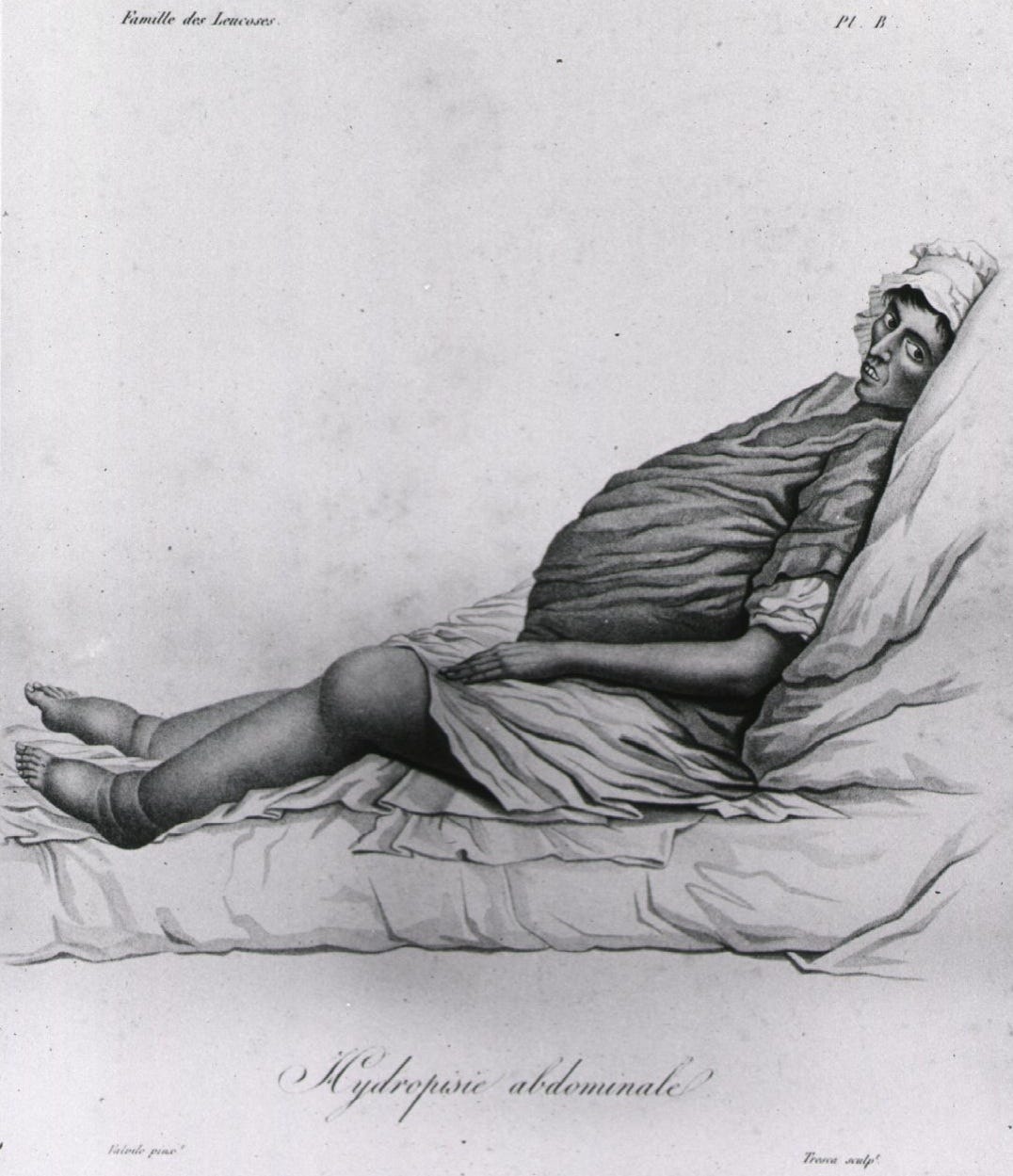
Robin suggests the syndrome of psychosis will eventually be replaced by more causative categories. While rare secondary causes of psychosis can occasionally be found, these do not apply to the majority of patients.
One attempt at better classification, based on biomarkers, is the Bipolar-Schizophrenia Network for Intermediate Phenotypes (previously covered by Awais Aftab and Michael Halassa). This initiative aimed to use clinically relevant investigations, like EEG, MRI and cognitive tests, to produce more meaningful categories across the bipolar-schizophrenia psychosis spectrum.
The BNSIP project identified three ‘Biotypes’ :
Biotype 1: cognitive impairment, ↓ background EEG activity, ↓ sound-evoked EEG activity, ↓ eye-movement responses
Biotype 2: cognitive impairment, ↑ background EEG activity, ↓ inhibitory control
Biotype 3: intact cognition, EEG markers overlapping with healthy controls
I am hopeful these Biotypes will produce insights into the neurobiology of psychosis, though they are still a distance away from changing clinical practice.
Truth be told, we are already under-utilising our current diagnostic classification when it comes to these disorders.
This is due to the expansion of a diagnosis, not found in official classification guidelines, first episode psychosis.
Consider this common scenario. A young woman (let’s call her Patient A) presents with acute manic psychosis. She has had a few weeks poor sleep, culminating in not sleeping at all, and going out at all hours. Her speech is fast and uninterruptible. She becomes fixated on religious themes, carrying a Bible and hearing the voice of God, telling her she is the chosen one. She is admitted to hospital due to dangerous and chaotic behaviour, which has put her safety at risk. In hospital, she is treated with olanzapine and makes a good recovery.
In another scenario, a young man (Patient B) has become increasingly isolated over the past year. He drops out of university. He spends more time in his room, refusing to leave the house, as he worries that the secret service are tracking his movements. He suspects these agencies are listening to his thoughts through an advanced AI. He stops eating because he believes trackers are concealed in food. His GP refers him to community mental health services who attempt to engage with him and encourage him to take antipsychotic medication.
In a third example, a thirty-something man (Patient C) presents to the ED with acute paranoia. He believes gang-members, intent on killing him, have been pursuing him across the city. He thinks his flatmates are involved and are communicating behind his back using hand gestures. Of note, he engages in recreational drug use and has been experimenting with methamphetamine (crystal meth) at parties.
In each of these hypothetical (but recognisable) examples, the patient receives the same clinical diagnosis of first episode psychosis. This is despite our current diagnostic systems (imperfect as they are) having better categories.
Before moving forward, it’s worth taking a step back. How did first episode psychosis become the term for all initial presentations of psychotic illness? After all, you may remember the Kraepelinian dichotomy, dividing the major psychoses into dementia praecox (now called schizophrenia) and manic depressive insanity (now called bipolar disorder). You may also have read about schizoaffective disorder which has features of both.
The conceptualisation of first episode psychosis, can be traced back to a 1991 NIMH workshop - Research on First-Episode Psychosis. A century after Kraepelin, his dichotomy was unified. Much of the motivation was tied to the emerging movement of early intervention in psychosis. This saw first episode psychosis as a heterogenous category, a pluripotent state that could result in a single episode of illness, an episodic course with intermittent recovery, or a deteriorating trajectory where a person never really gets back to their baseline.
Defining patients by their first episode makes sense from a research perspective. Studying patients early in their trajectory, before the confounding effects of chronic mental illness, could provide a cleaner phenotype. Recruiting participants at their first episode might help identify predictors of illness outcome and maybe even treatments to improve outcomes.
First episode psychosis has become the de rigueur diagnosis of early intervention services, the biggest transformation in psychiatric services in recent years (though see my skeptical take). However, in losing the distinction between different psychotic presentations, the baby has been thrown out with the bathwater.
My contention is that our current diagnostic systems, for all their faults, have advantages when used optimally. Some of the qualities we want in a better classifications - biological relevance, consistency over time and raters, and predictive power for both treatment and prognosis - are already present when we diagnose psychotic disorders properly.
From my examples above, Patient A meets criteria for an ICD-11 diagnosis of 6A60.1 Bipolar type I disorder, current episode manic, with psychotic symptoms. ICD allows the diagnosis of bipolar I based on a single manic episode (without the need to wait for further depressive or manic episodes). As I’ve previously discussed, we can say with near certainty that someone experiencing a manic episode will also go on to experience depressive episodes. We know that bipolar disorder, unlike schizophrenia, should be treated with lithium.
Patient B meets ICD 11 criteria for 6A20.0 Schizophrenia, first episode. This requires two symptoms from persistent delusions, persistent hallucinations (most commonly auditory), disorganised thinking, self-disorder (thought alienation, passivity or control) lasting for at least one month. While schizophrenia, like bipolar disorder, can be treated with dopamine antagonists (antipsychotics), if a patient does not respond to at least two adequate trials, their illness would meet criteria for treatment resistance and should be treated with clozapine (licensed solely for treatment resistant schizophrenia).
Compared with bipolar disorder, schizophrenia patients tend to have more severe cognitive impairment and worse functional outcomes. Copy number variants (deletions or duplications of large chunks of the genome) are a feature of schizophrenia but not bipolar disorder - this type of genetic variant is also associated with cognitive impairment.
Patient C meets criteria for 6C46.6 Stimulant-induced psychotic disorder including amphetamines, methamphetamine or methcathinone, what we call drug-induced psychosis. Symptoms should occur shortly after use or withdrawal of the stimulant but should be beyond what we would expect from drug intoxication. It shouldn’t persist after a long period of abstinence (ICD-11 suggests the cutoff of a month). We know that about a quarter of drug-induced psychotic episode will eventually develop into schizophrenia. These patients may well require antipsychotics initially, but a big focus of treatment will be to abstain from drugs, in the hope this will prevent further psychotic episodes.
These three patients could all acquire the same diagnosis of first episode psychosis which then obscures important clinical differences, treatment decisions and prognostic indicators. Grouping these presentations together may be helpful in some research scenarios but for individual patients, we should be using the best diagnostic descriptors available.
A regular criticism of psychiatry diagnoses is an absence of dividing lines (zones of rarity) between categories. Diagnoses aren’t distinct, they overlap with fuzzy boundaries. This is true for psychotic illness, with substantial overlap between bipolar disorder and schizophrenia. It manifests clinically in a category of schizoaffective disorder, in which features of both bipolar and schizophrenia exist within a patient. It manifests in substantial overlap in genetic propensity for both illnesses. It manifests in certain medications (antipsychotics) being effective for both conditions.
Diagnoses existing on a spectrum isn’t that unusual in medicine though. Inflammatory bowel disease is traditionally divided into Crohn’s disease and ulcerative colitis. However, both conditions have overlapping pathologies, genetic architecture and treatments. There is even a category, indeterminate colitis, that has features of both diseases.
Closer to the brain, we traditionally think of dementia as being made up of distinct categories; Alzheimer’s disease, vascular dementia, Lewy body disease. However, in reality most patients have a mixture of these pathologies.
It is therefore plausible that the overlap between bipolar and schizophrenia isn’t a deficiency of our diagnoses but a reflection of shared biological mechanisms contributing to these categories.
Validity of diagnostic categories also depends on their stability over time and between raters. We don’t want a patient continually changing categories over the course of their illness or two psychiatrists disagreeing as to which diagnosis fits best.
The good news is that both schizophrenia and bipolar type I have among the highest inter-rater agreements for any ICD-11 metal disorder with joint rater agreement verging into ‘near perfect’ (kappa values of 0.87 and 0.84, respectively). This reassures us that these diagnoses are meaningful, that there is a consistency between psychiatrists. Over time, such diagnoses tend to stick too. A meta-analysis reports that 84% of people initially classified as having schizophrenia maintained the diagnosis at three-years follow-up, while a record-linkage study found 74% of those with bipolar type I maintained this at follow-up.
Psychiatrists can be confident that, when diagnosed properly using standardised criteria, categories of schizophrenia and bipolar disorder are reliable and stable.
Michael Halassa points out that, during an acute episode, bipolar disorder can be clinically indistinguishable from schizophrenia.
Bipolar disorder appears to be driven by a different kind of disruption. Lack of need for sleep is often the first signal of an impending manic episode, appearing days before mood changes are visible and representing one of the most reliable prodromes identified in the research literature. What follows can be frightening in its speed: energy surges, speech accelerates, confidence expands beyond the reach of judgment, and at the peak, psychosis can appear that is clinically indistinguishable from schizophrenia in the acute moment.
It isn’t easy at first assessment to make a diagnosis, particularly if past psychiatric and medical history is unknown, if substance use is unknown and collateral information not available. However, this uncertainty is nothing to be afraid of - doctors thrive on incomplete information, using this to build up a differential diagnosis.
Differential diagnosis is how doctors think. We draw up a list of possibilities, weighted by likelihood. We keep in mind serious causes not to be missed - could this be encephalitis, a brain tumour, delirium? Then we gather evidence, in an effort to refute or confirm these possibilities - what did the drug screen show? is there a family history of psychiatric illness? is there evidence of cognitive and functional decline? are there neurological symptoms, abrupt onset or other red flags? Eventually we may converge on a single diagnosis or we may keep a few possibilities.
Patient A
Diagnosis: first episode psychosis
Working diagnosis: Bipolar type I disorder, current episode manic, with psychotic symptoms
Differential diagnosis:
Schizophrenia, first episode
Schizoaffective disorder, first episode
Acute and transient psychotic disorder
Drug induced psychosis (drug screen awaited)
Autoimmune encephalitis (less likely, no red flags detected)
Patient B
Diagnosis: first episode psychosis
Working diagnosis: Schizophrenia, first episode
Differential diagnosis:
Single episode depressive disorder, severe, with psychotic symptoms
Schizoaffective disorder, first episode
Patient C
Diagnosis: first episode psychosis
Working diagnosis: Stimulant-induced psychotic disorder
Differential diagnosis:
Acute and transient psychotic disorder
Schizophrenia, first episode
Schizoaffective disorder, first episode
Unlike other areas of medicine, we don’t typically have a brain scan or blood test to confirm the diagnosis. In some respects, we only ever have working diagnoses. Nonetheless, these provisional categories, based on clinical reasoning have explanatory power. They guide treatment and give an indication of prognosis. Eventually they may even help untangle the underlying biology.
So be as precise as possible. We can do better than first episode psychosis which, let’s be honest, isn’t a diagnosis.
No posts
Comments
Nothing yet. Say the first thing.
Sign in to join the conversation.