
Human bodies are a source of endless interest for children, but of very finite interest from American picture book publishers. Still, a few striking ones about the human body have made their way to market over the years; this post is about a series that we most enjoy.
What we like in this genre: direct and informative, but not so dense you can’t read it aloud. Accurate, but not clinical. There’s room for humor, but it can’t overpower the subject, and the jokes need to offer us some craft, not mere relief. (My kids do not agree with this last criterion. They revel in pretty much any taboo-violation joke.)
And the illustrations must be central to the work! If you’re going to teach me something, particularly if you’re going to show me an unsung body part, a maligned byproduct of digestion, or a taboo-shrouded bodily function, do it with verve.
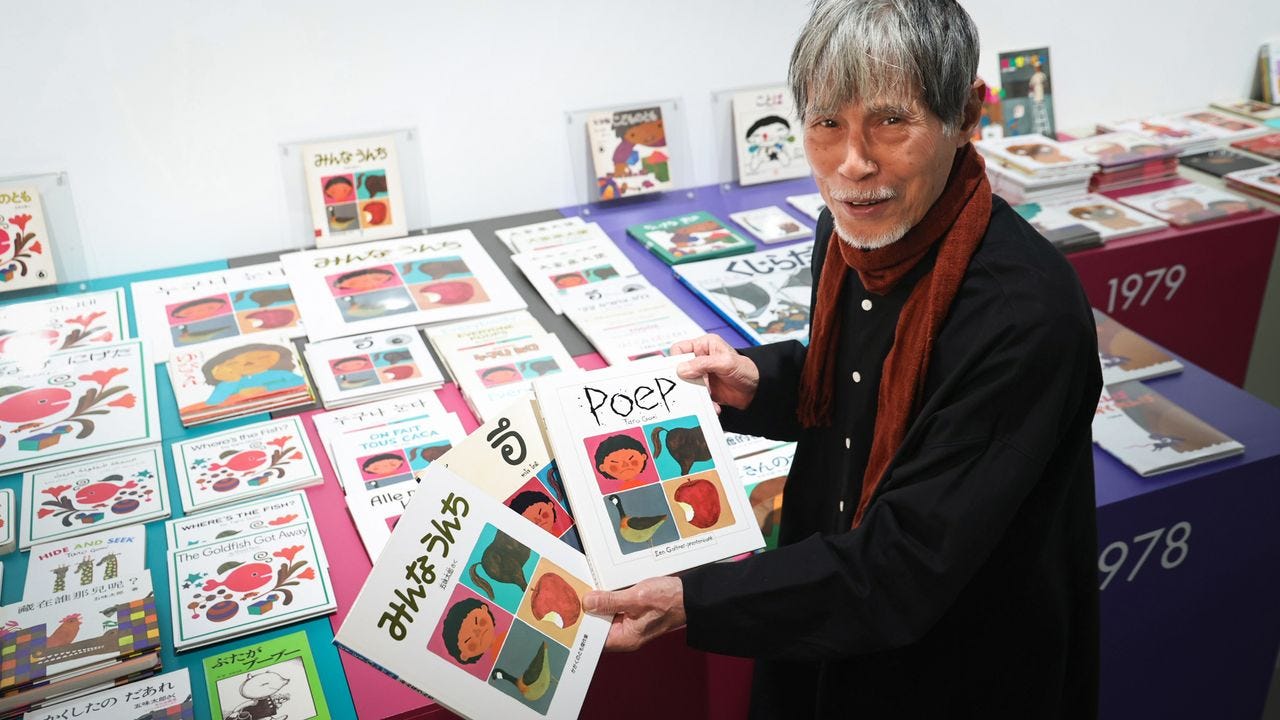
So it’s fitting to start with Taro Gomi, the prolific Japanese picture book author—an author-illustrator who leads with the visuals. (Check out his recent career retrospective.) Gomi, whose background was in graphic design before he moved into children’s books, ran at perhaps the lowest-status bodily function of all—and did so with primarily the illustrations in mind. Then, through a somewhat improbable route, became a key figure in the small universe of memorable body books for American children.
Its popularity as an adult gag gift notwithstanding, Gomi’s Everyone Poops began as a high-minded project, with not merely respect for its subject but an appreciation of its visual poetry. Here’s how Gomi tells the story of his inspiration:
“I happened to have a meeting with the head of Tokyo’s Tama Zoo. He’d asked me to get there early in the morning before the place was open, as he was busy, so around six I came in the back gate and strolled across the zoo to his office. Just then, the morning sun struck some animal droppings with steam rising from them, and I thought it was a beautiful sight. I took a lot of pictures.
“On the way back, I had the idea to draw a book about poop. There were books about food, but none with vivid pictures of the end product, after it had passed through the body and come out again. People only see the zoo after it’s been cleaned up. I’d been lucky.
At first, according to Gomi, the publishers hesitated, but eventually the publishing house Fukuinkan Shoten published it in Kagaku no Tomo (Children’s Science Companion), its influential science-based picture book magazine. Fukuinkan credits Everybody Poops with opening the door for more frank discussions of anatomical topics previously thought unfit for children’s books.
Over time, the publisher released a number of stories about the human body and its functions through Kaguku no Tomo. Many became standalone books in Japan, including Everyone Poops, published in 1977. The series spotlit, among other things, elements of anatomy that were not simply overlooked, but kept out of books due to adults’ discomfort or lack of curiosity.
One of the more prolific creators in the Fukuinkan Shoten body science series was Genichiru Yagyu, an author-illustrator who deserves more attention here. (Here’s his self-deprecating bio.) The Yagyu approach was less about highlighting the beauty of a disfavored bodily function, as Taro Gomi had done, than about bringing detailed anatomical information to children in an energetic and playful style.
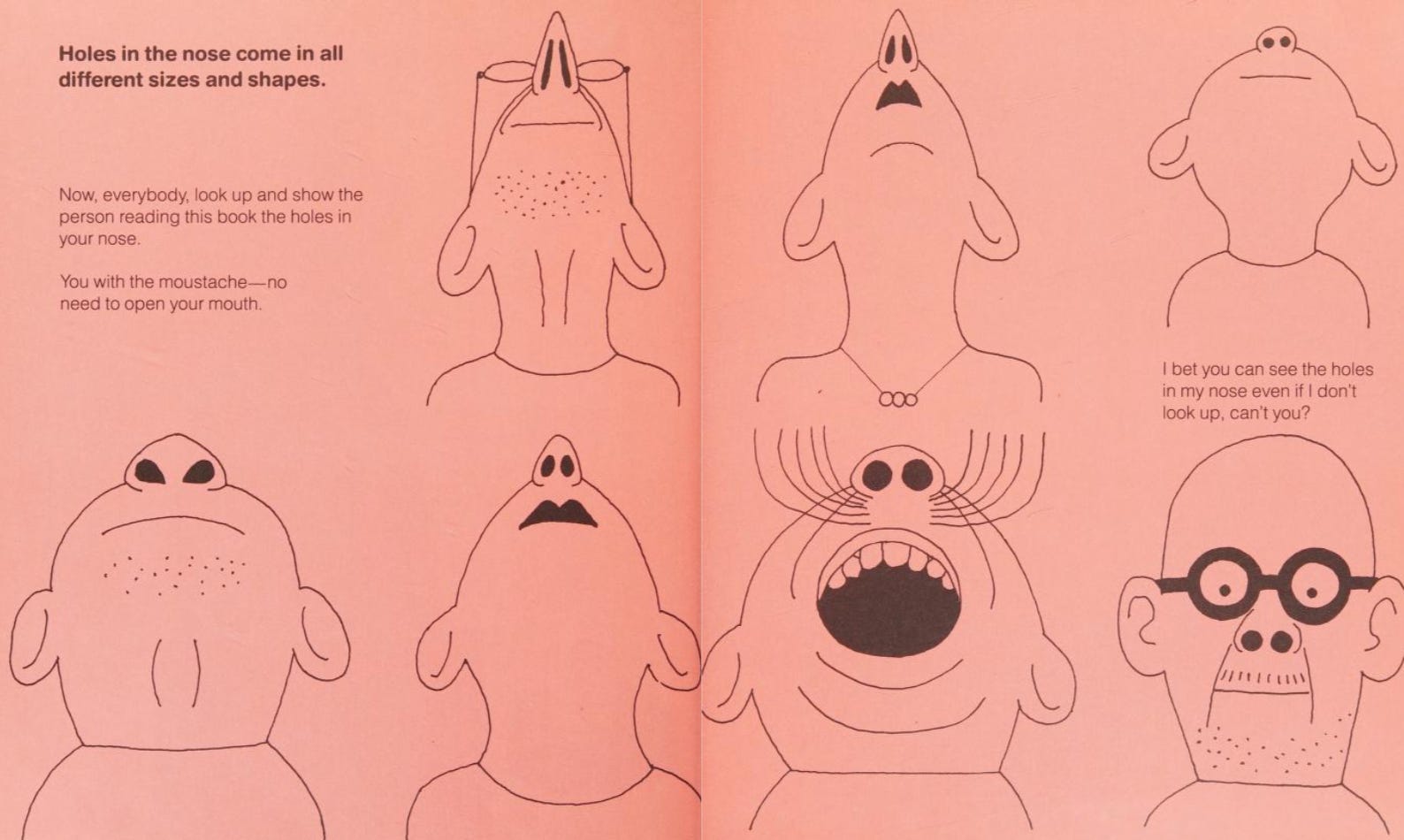
But perhaps the real raison d’être of Yagyu’s books is the joy of looking at something in a new way. Sometimes literally—as with his illustrations showing nostrils and feet from a non-canonical perspective.
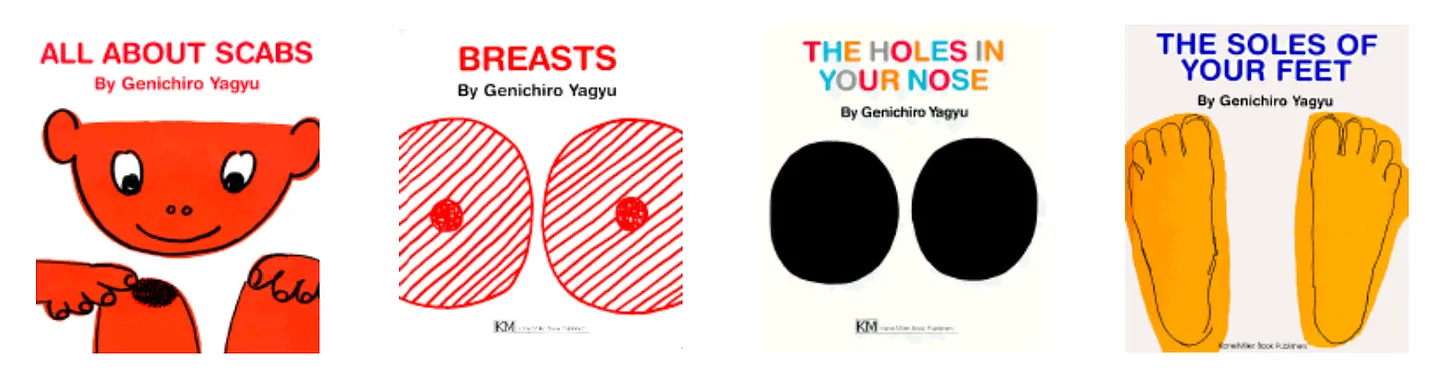
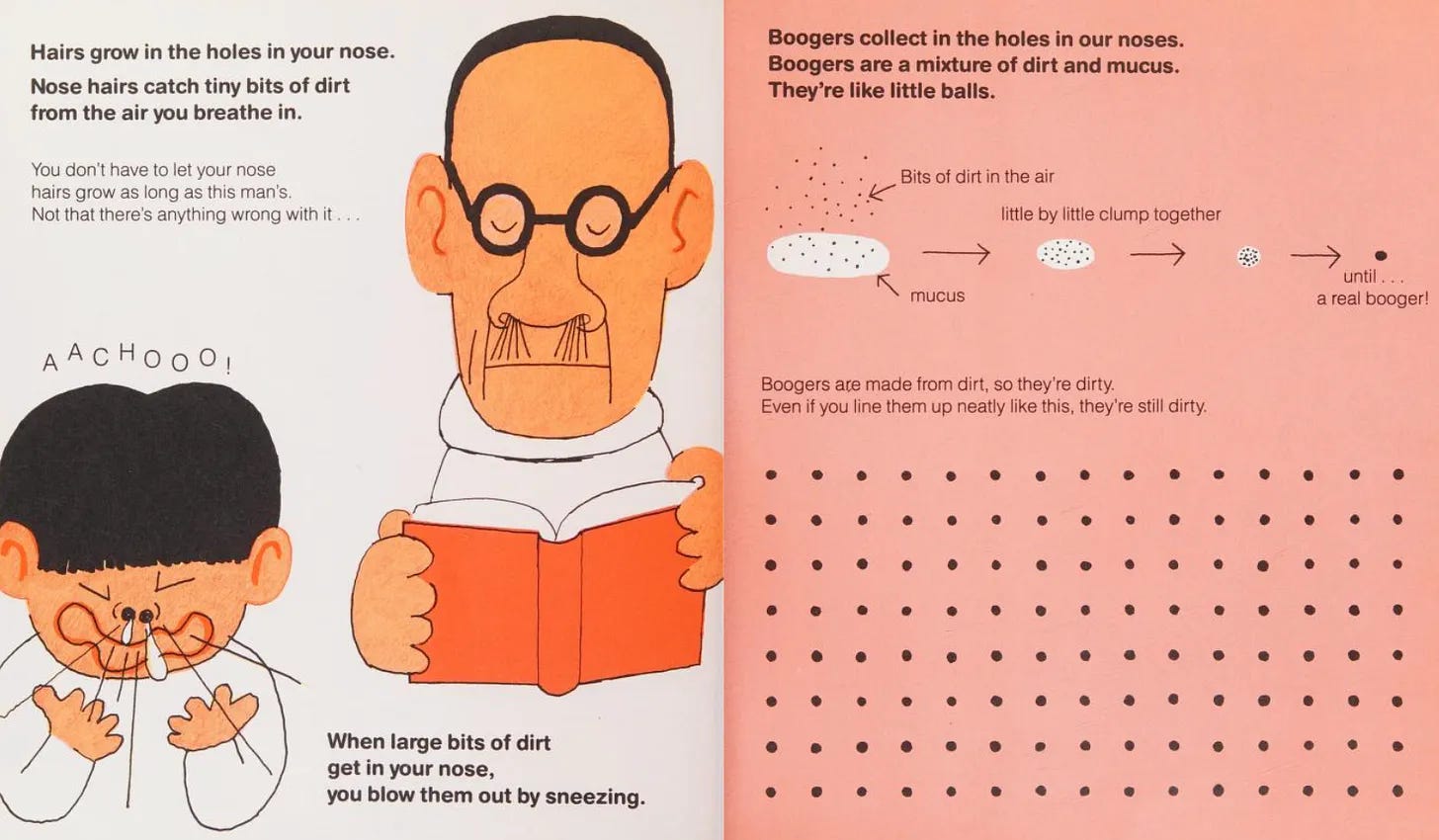
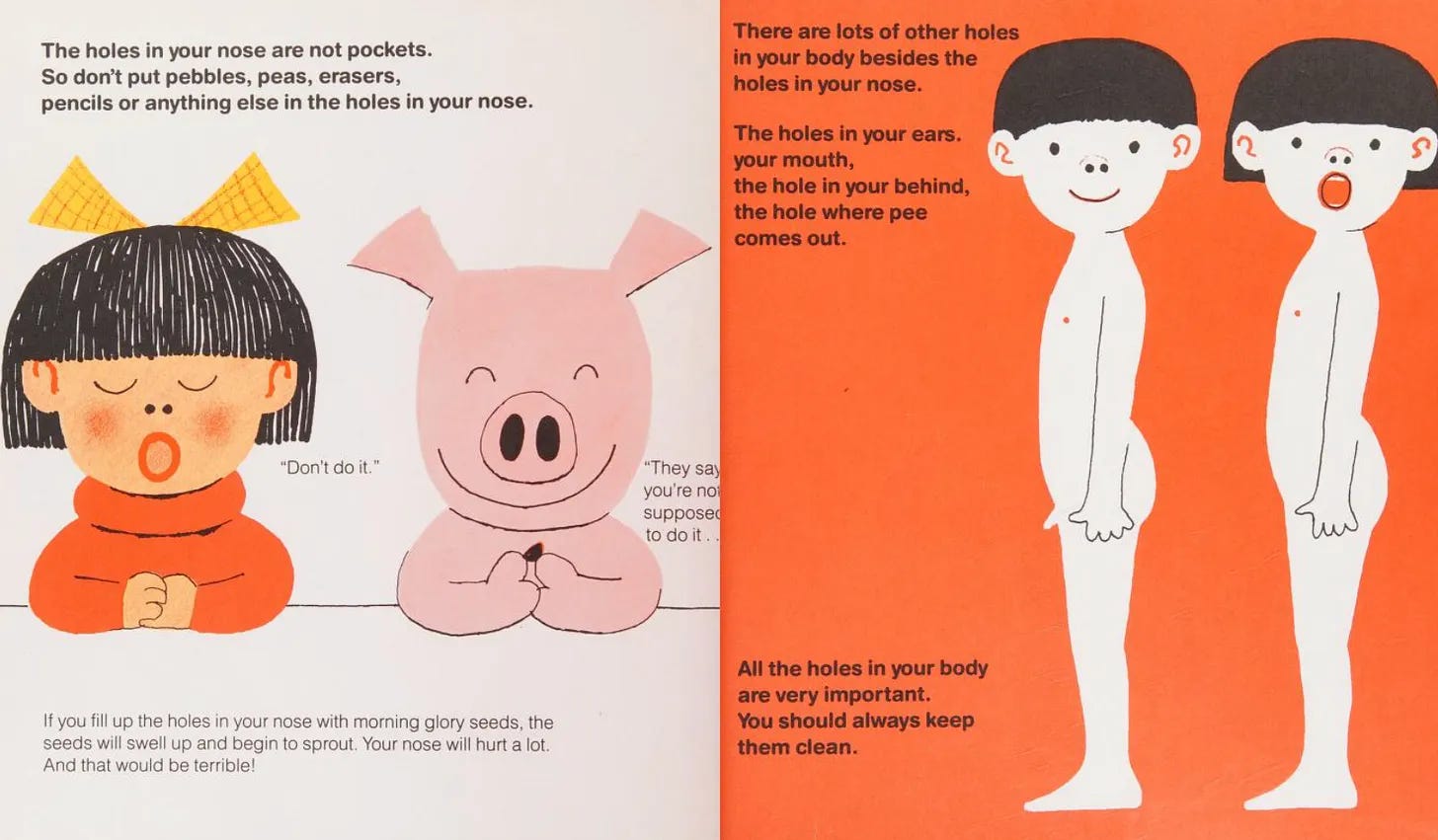
Yagyu is responsible for the majority of the books in Fukuinkan’s human body science series that wound up in English translation, including The Holes in Your Nose, my favorite. This ode is his most personal installment: He has said the unusual prominence of his nostrils embarrassed him as a child.
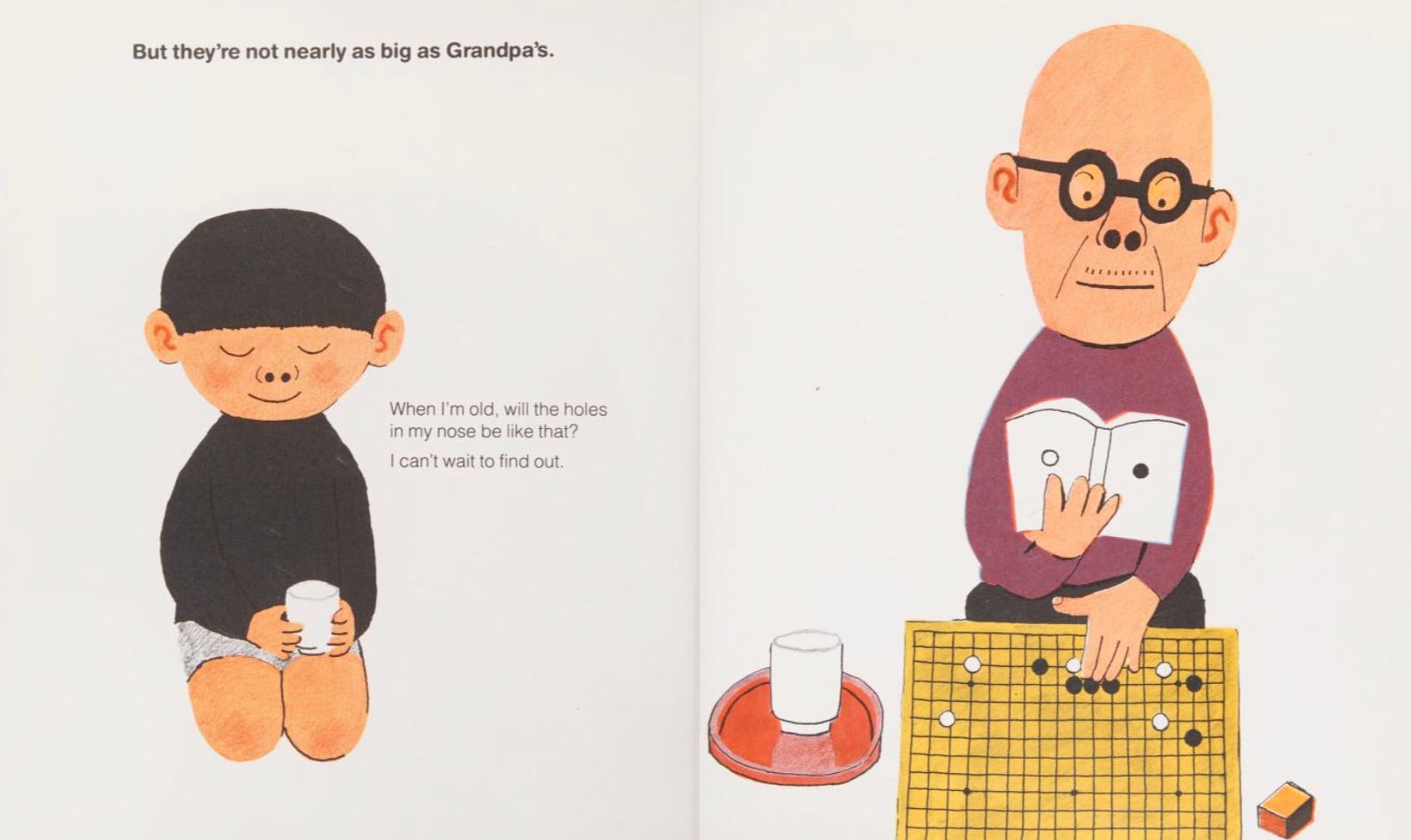
The standout of the book is a two-page spread on the fascinating shapes that nostrils make from below. Yagyu also finds a number of ways to incorporate design elements that recall the black, flat circles that make up the nostrils of his protagonist. (And those of the author’s self-insert, seen below in his coke-bottle glasses!) Here are some of the highlights:
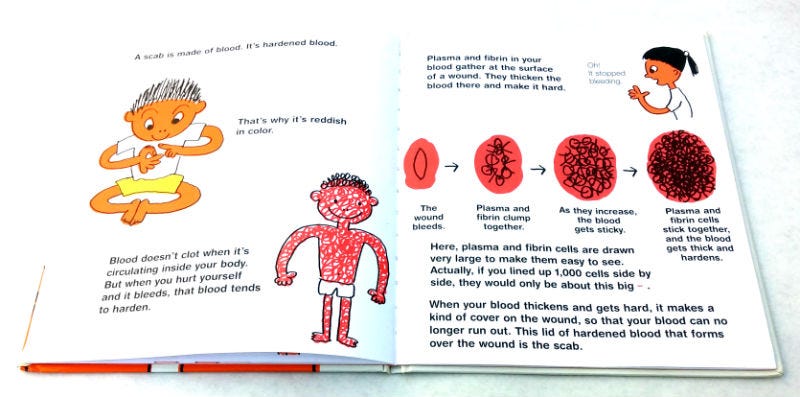
Though The Holes in Your Nose has become my favorite, but All About Scabs was the installment we first bought and loved. We were on the hunt for a preschooler-friendly book on the subject and found exactly one book, and luckily it served its public health purpose quite well. That said, I would say the visuals are a bit less inventive than some of Yagyu’s other books; perhaps because All About Scabs is the most goal-oriented of the series (don’t pick your scab!). Relevant if it’s relevant.
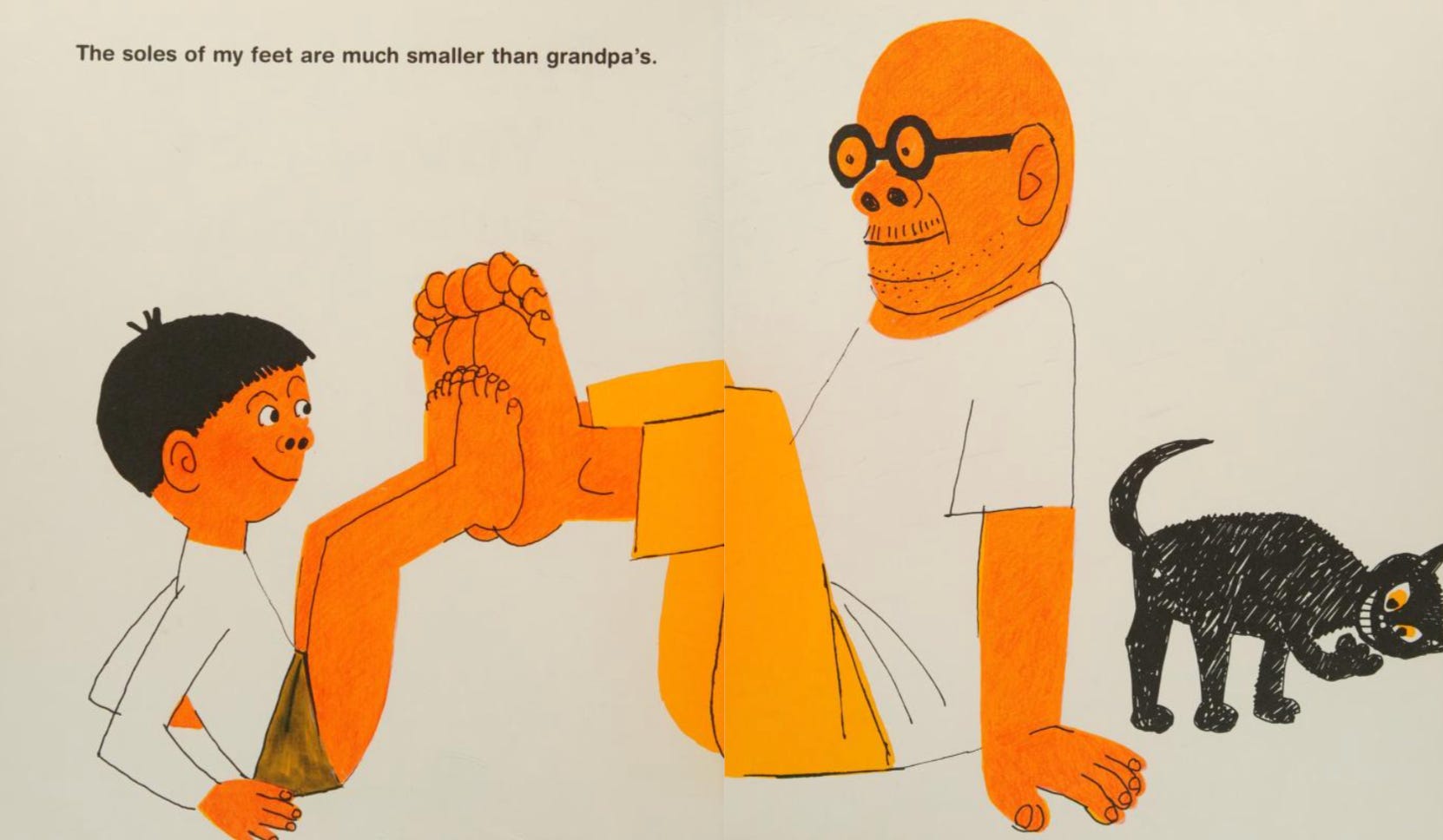
Another of Yagyu’s unexpected topics is The Soles of Your Feet, our kids’ favorite of the series. Our children most appreciated the book’s suggestion to dip your feet in paint and stamp a sheet of paper to determine whether one has high or low arches. Luckily for me water on concrete also works.
Rounding out the list of the English-translated books from Yagyu’s body science books in the Kaguku no Tomo series is Breasts. This is the only of the books that is neither available at my library nor scanned into my family’s go-to database for digitally borrowing out-of-print books, Archive.org. (It is, however, available for purchase second hand.)
So I am indebted to book maven Kate Humphreys of the online children’s bookshop Oly Oly Oxen Free Books to be able to share these images of the Breasts with the English text. If you see a copy, grab it! Humphreys recently sold the copy she had, sadly.
Incidentally the Oly Oly Oxen Free vintage and used books collection is full of treasures! A propos of anatomy picture books with charm: You can pick up from the shop right now 1966’s Straight Hair, Curly Hair—illustrated exuberantly by Ed Emberly, famous in our house for his instructional drawing books.
Here are some spreads from Breasts that give some clues to why this book might not be straightforward to shelve in the States, where there is no consensus on what body parts may be shown in children’s books, and how. Still, in my experience it covers many topics that children frequently comment or ask about.
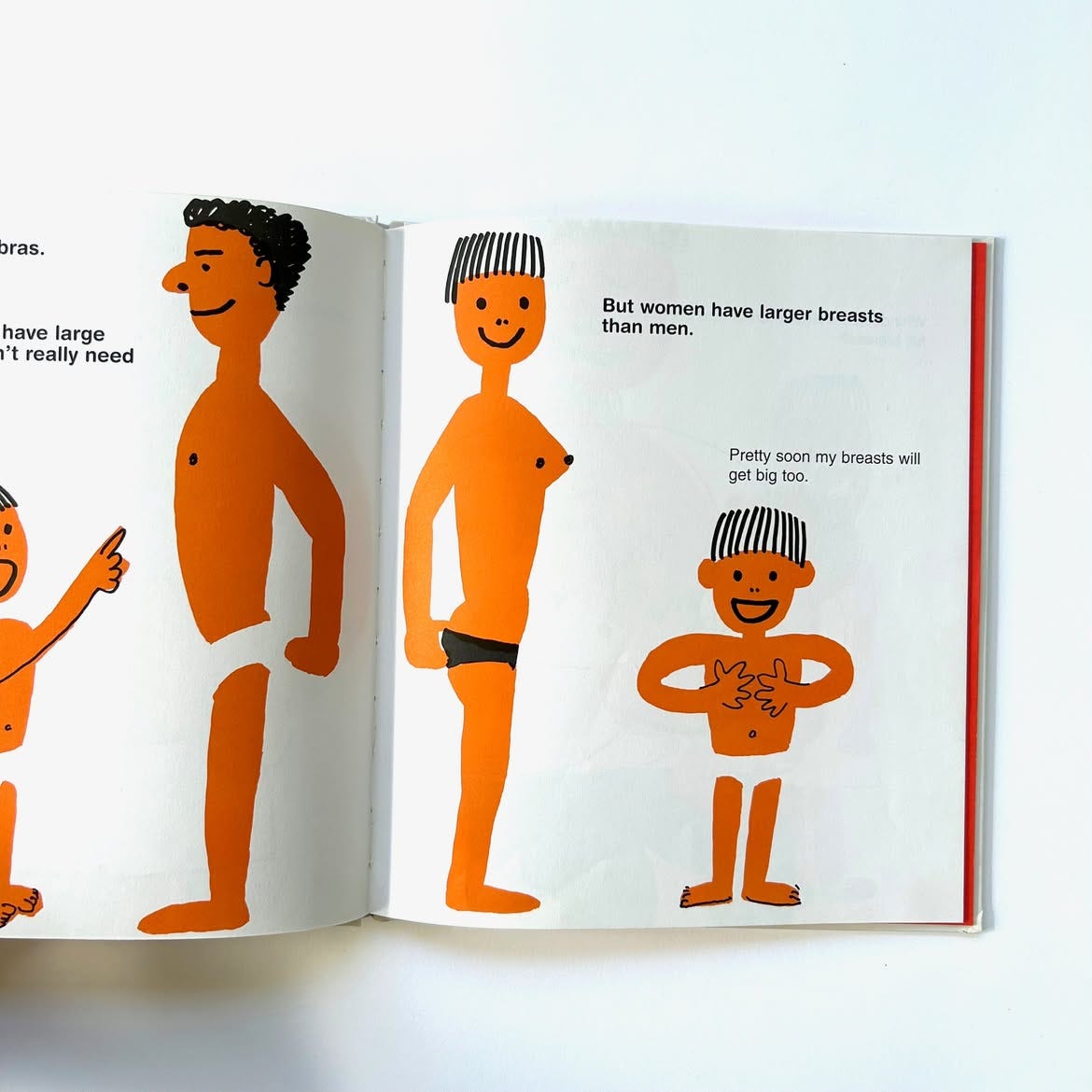
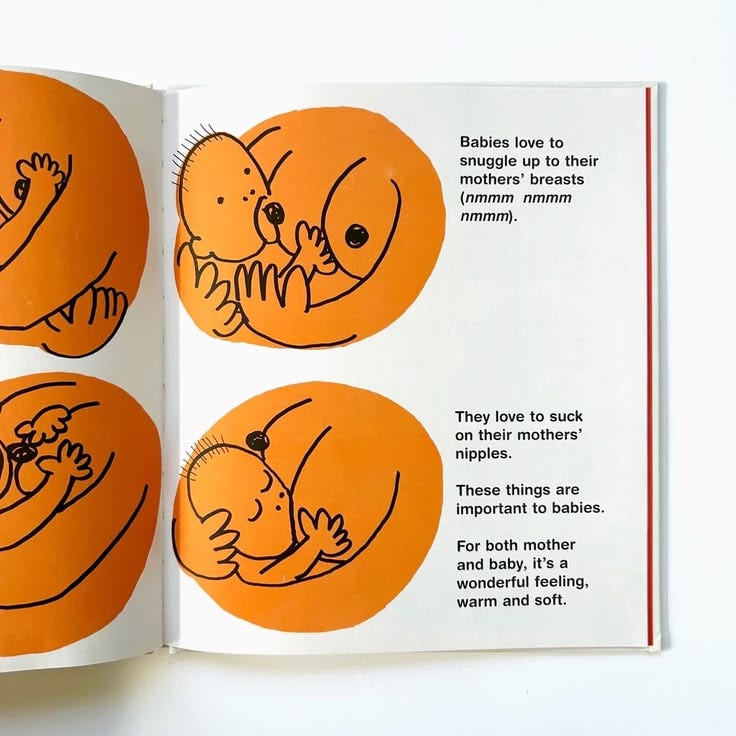
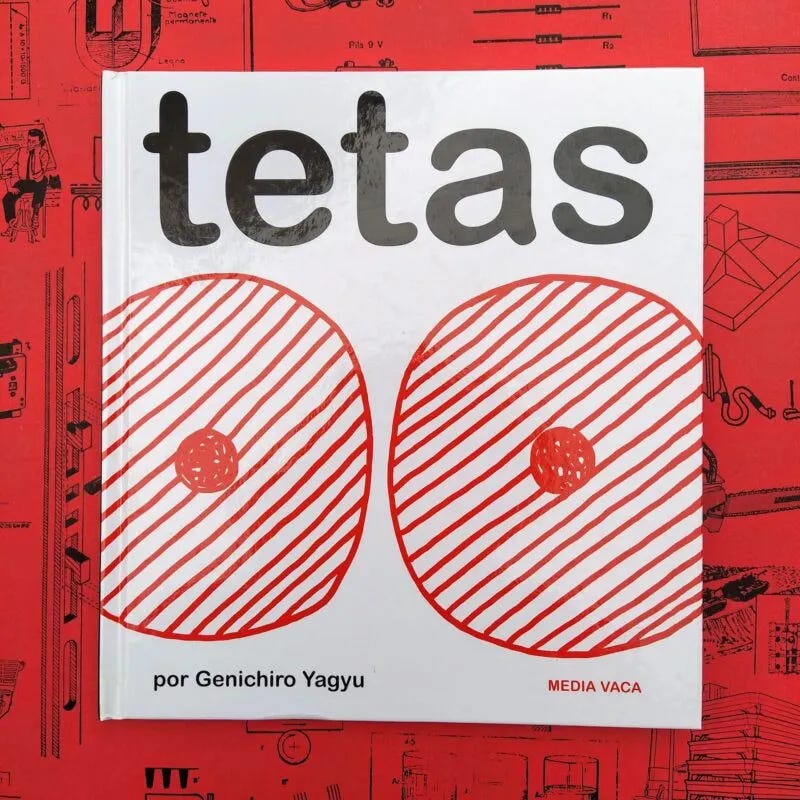
Other translations of Breasts are circulating. The Spanish translation, Tetas, is currently available in the U.S. Or buy it directly from the independent Spanish publishing house Media Vaca!
Written by Jun Nanao, illustrated by Tomoko Hasegawa (Kane/Miller, 1995)
The other body part books that made it to the U.S. from the Fukuinkan Shoten series were The Gas We Pass, written and illustrated by Shinta Cho, and Contemplating Your Bellybutton, written by Jun Nanao and illustrated by Tomoko Hasegawa. The Gas We Pass is still popular, but Contemplating Your Bellybutton is now out of print in English, though available second hand.
The bellybutton book is culturally perhaps the one in the series least in sync with American conventions in the directness with which it represents some unclothed children’s and parents’ bodies, including childbirth. Most English language bellybutton books are quite shy of showing much unclothed anatomy at all—many don’t even use humans, favoring cartoon animals.
Perhaps that is why the Children’s Library reviewer in 1995 called Nanao and Hasegawa’s work “crude and unsettling.” But to my eyes, the illustrations combine a fairly frank presentation of the bodily experiences of newborns and their parents with the warm feelings for babies one wishes to convey when explaining such a topic to one’s child.
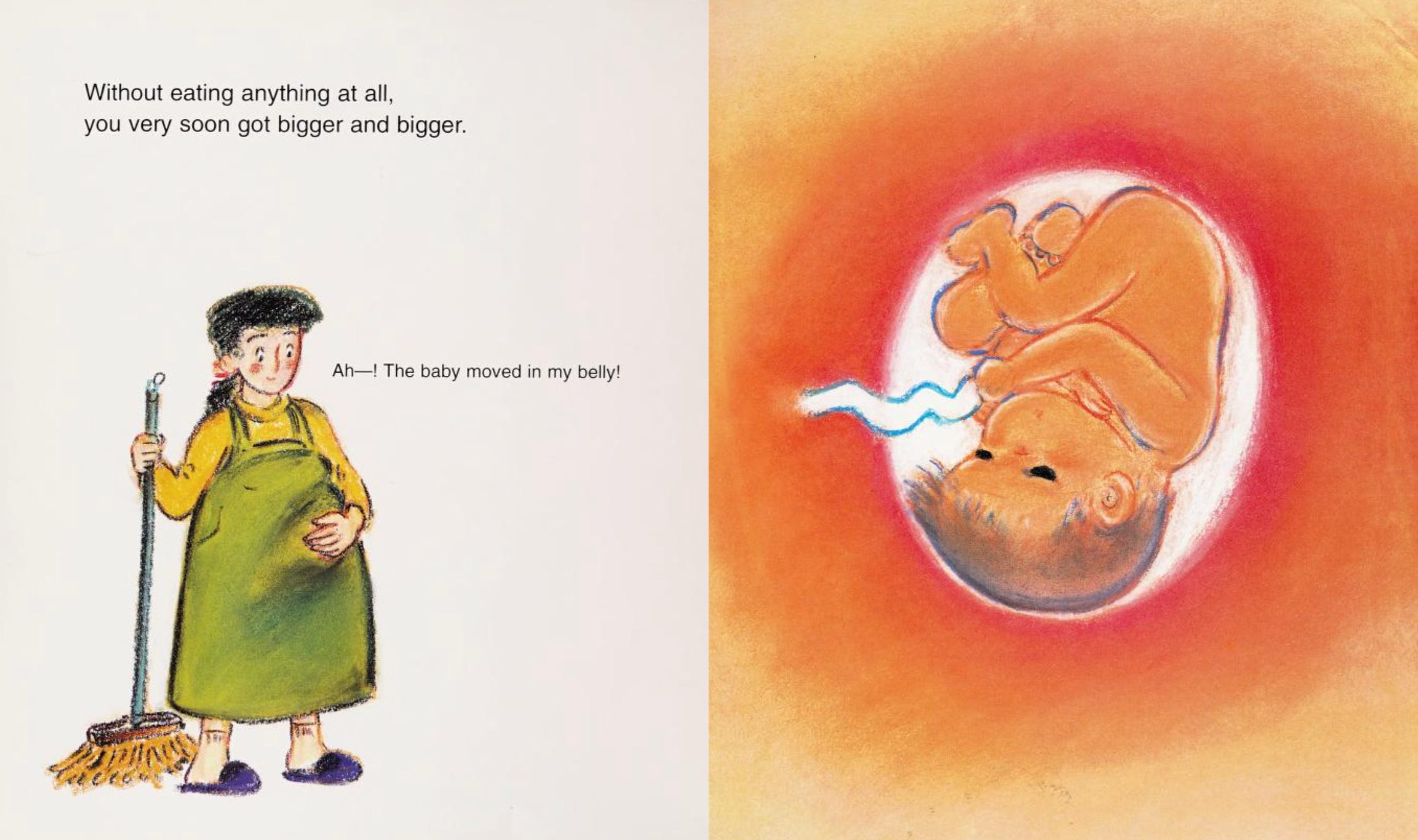
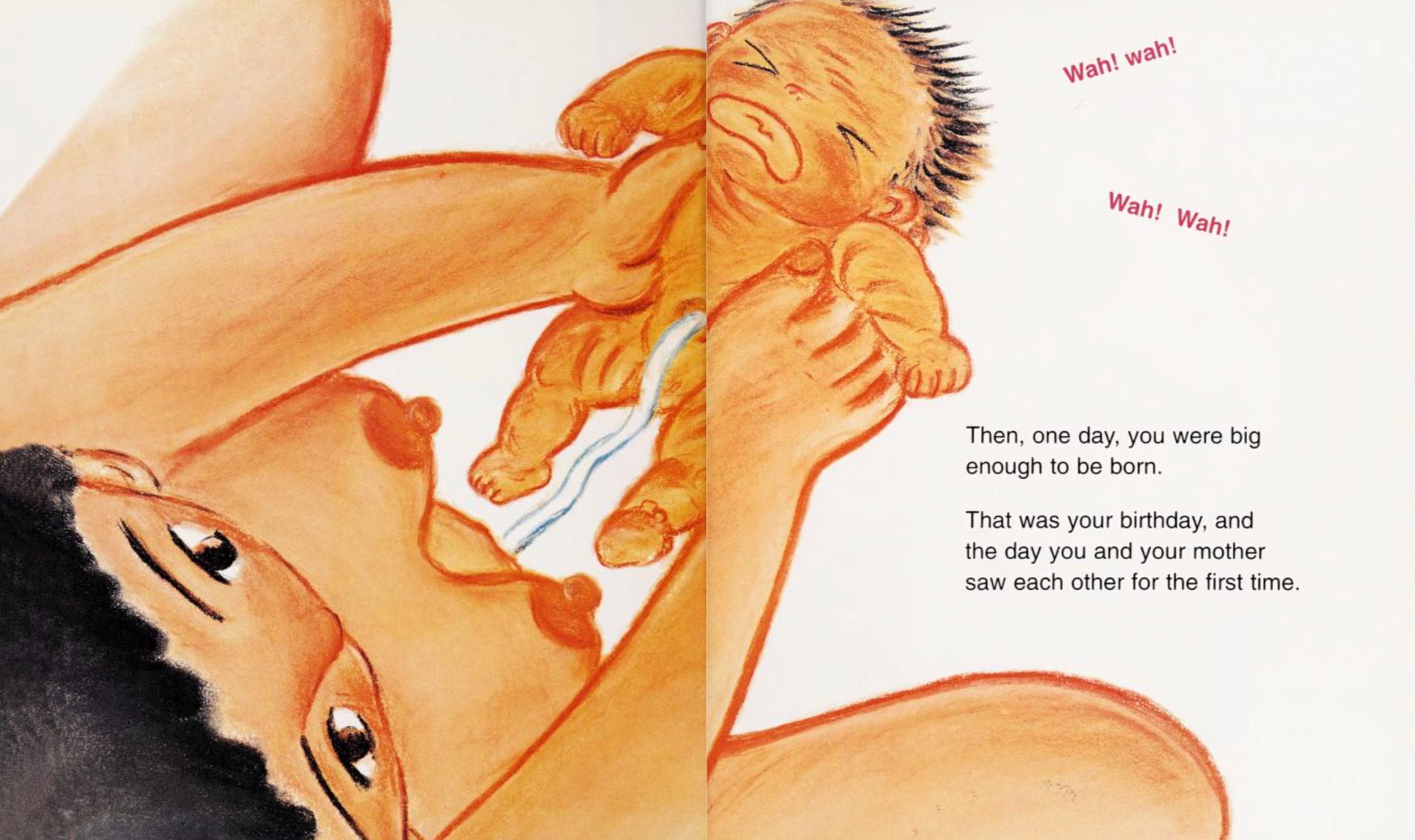
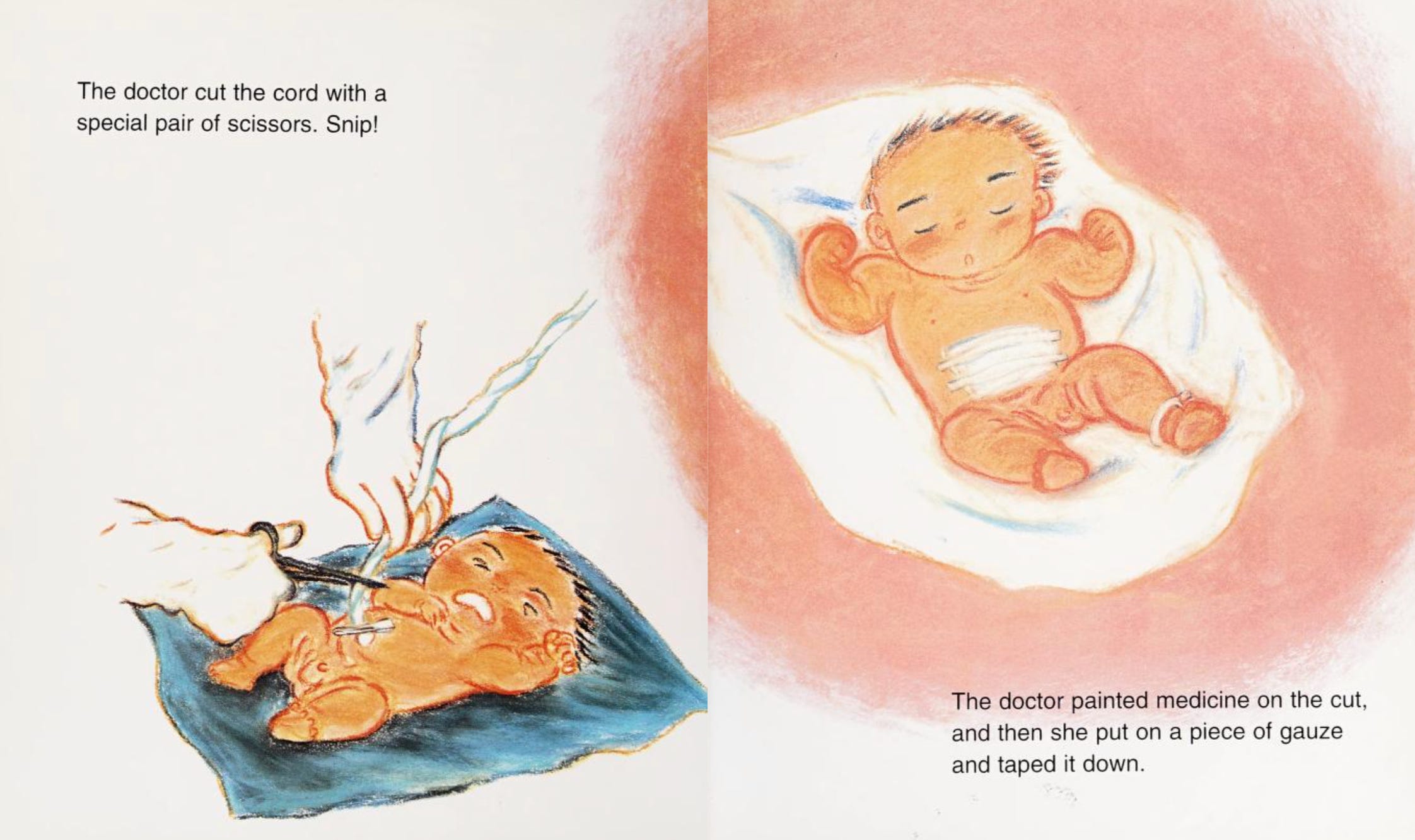
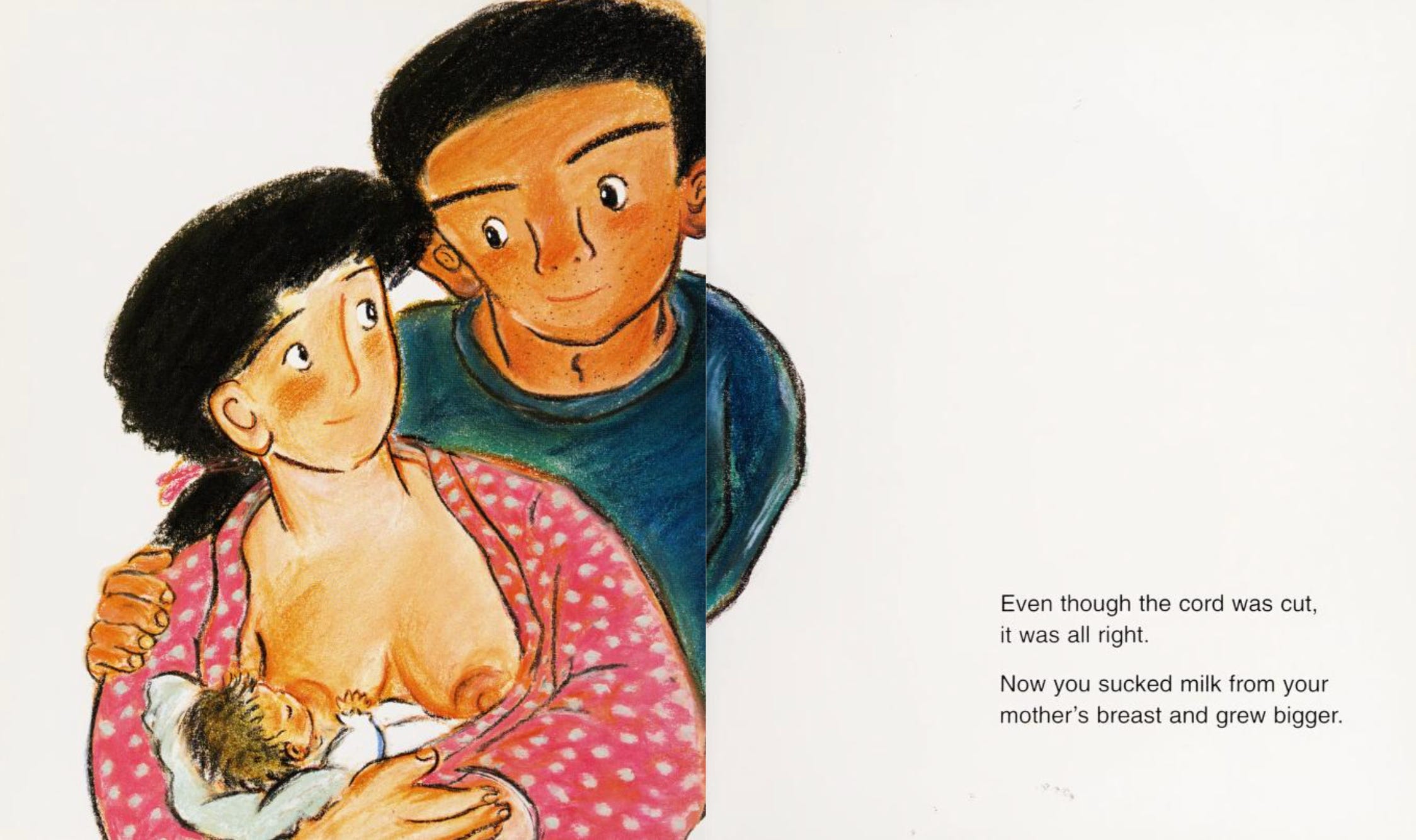
There’s also a notably exuberant spread of the young child protagonist running and jumping around without clothes, which well captures the gleeful chaos of a certain era of childhood.
Despite the commercial success of Everybody Poops from its publication in Japan in 1977, it was far from a foregone conclusion that the work would make it to the United States. For Gomi’s book to make it to American shelves, it had to wait until the 1990s, when it was taken up by a brother-sister team who were looking to foreign markets for picture books that could meaningfully expand American children’s cultural horizons.
Those siblings were Sandy Miller, coming off of founding Film Forum, and Madeleine Kane, a math teacher. They had started their publishing house, Kane/Miller, in 1984, with the goal of bringing the exceptional picture books from other countries to U.S. children. Not a totally dissimilar mission from Film Forum.
Everyone Poops became the pair’s unexpected bestseller and gave them financial security. Miller bought and renovated a church in Cobble Hill to move into (wonder which one?). Here’s an article about the book’s success from The New York Times in 1997 with a bit more on Kane/Miller’s story—including how they faced both dismissal and anger from some quarters for bringing Gomi’s book to the American market.
Kane/Miller went on to bring more books from Fukuinkan Shoten’s Kaguku no Tomo series into the United States, including The Gas We Pass, The Holes in Your Nose, Contemplating Your Bellybutton, The Soles of Your Feet, All About Scabs, and Breasts.1 The period of publication lasted from 1993 until 1999. Eventually Kane/Miller was purchased by a larger publisher and distributor, EDC, in 2008. Of the human body science books, only Everybody Poops and The Gas We Pass are still in print.
Several decades on from when these Japanese books first landed stateside, Americans are still struggling to add to the corpus of stylish human body science picture books available for young children. As part of the remedy, it would be lovely to see someone translate for today’s kids a more recent Japanese entry in the genre, Oppai no Hanashi (roughly, The Story of Breasts). Despite its broad title, the book is primarily about the role of breasts in breastfeeding, as well as the breastfeeding relationship between the mother and child.
Published in 2009, the book has the advantage of illustrator Yuki Ainoya, whose dreamy, cheerful illustrations won her recognition in the U.S. for the Sato the Rabbit series. I wrote about Ainoya’s particular genius last week. Here’s the cover art; one imagines an American publisher might have to change it.
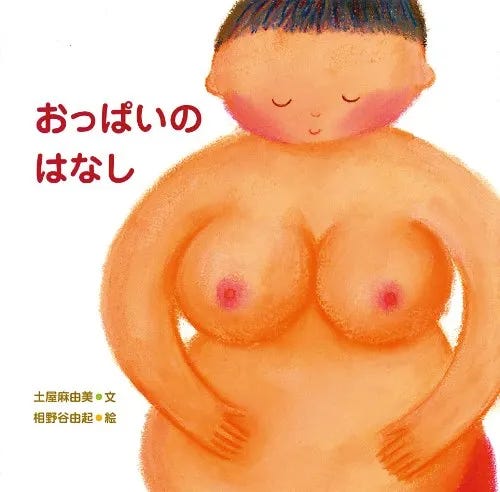
The book’s other most striking illustration shows a mother’s-eye-view shot of a chubby, red-cheeked baby as it nurses. The baby is partially obscured from view by the expansive orb of the mother’s breast—a breast that looks more like a planet. Perhaps a planet where only creatures as enchanted as Sato the Rabbit might live.
All were translated into English by Amanda Meyer Stinchecum.
No posts
Comments
Nothing yet. Say the first thing.
Sign in to join the conversation.