
This Thursday, August 6th, is the anniversary of the United States dropping atomic bombs on Hiroshima and, three days later, Nagasaki. Some American children will attend local days of remembrance or action. For most, the day will pass as any other. How our children’s generation will understand the use of atomic bombs against Japan will turn in part on how they are asked to understand the experience of the people of those places—perhaps, especially through books.
In the 1970s and 1980s, as preventing nuclear war gained urgency and momentum, several illustrated books were published that gave American young people here a startlingly close view into the destructive power of the bomb. Decades later, living memory is fading, and some of those ambitious works have fallen out of print. One of these is Maruki’s Hiroshima no Pika (1980), a masterpiece that allows parents to invite children to bear witness to sorrow together—and grow into the adults who will have the courage to be afraid and empathetic enough to work for peace.
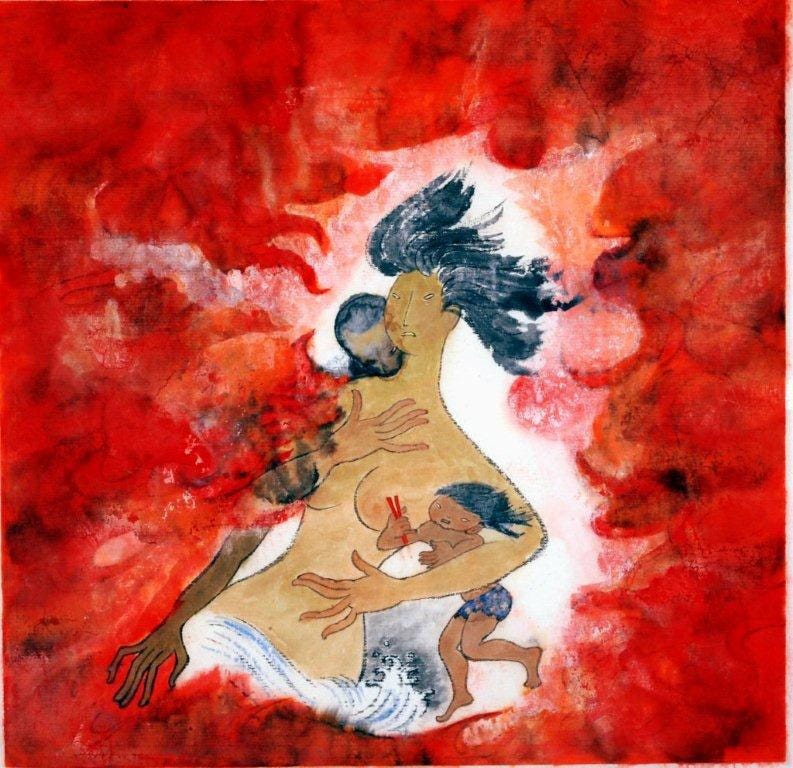
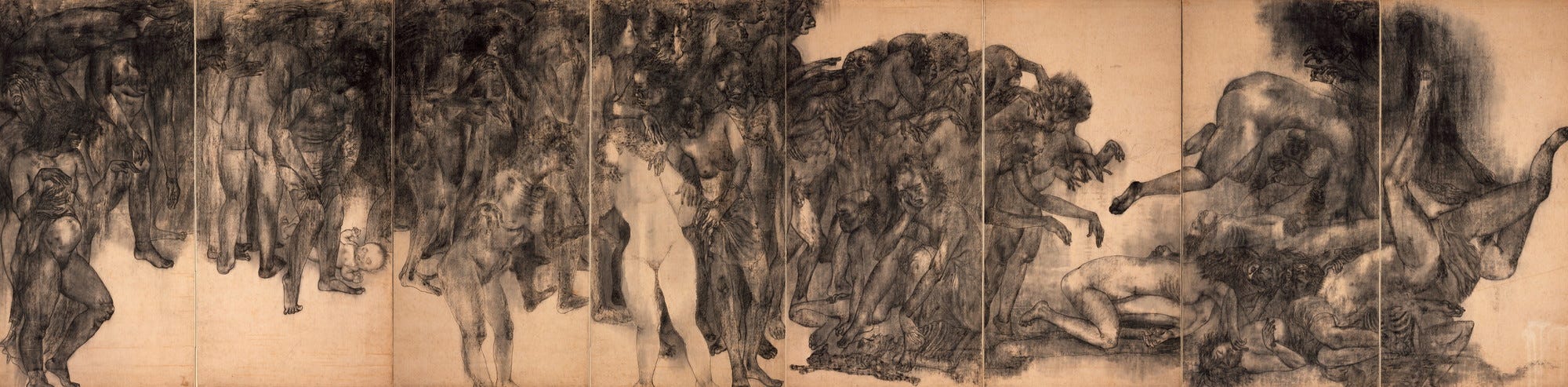
The late Toshi Maruki, who wrote and illustrated the book, is known in Japan primarily as a painter, including of the Hiroshima Panels, murals depicting the unthinkable destruction of the atomic bomb. In 1945, she and her husband Iri Maruki, also an artist, had rushed to Iri’s hometown of Hiroshima to help with relief efforts after the bombing. In the decades following the war, the Marukis created large scale murals documenting the devastation wrought by the bombs. They toured with the panels to raise awareness and counter the limitation of information available to the public on the extent of the tragedy. The couple also came to depict other atrocities, including the Nanjing Massacre and Auschwitz, and victims of environmental poisoning in Japan.
We are lucky that Maruki saw her art making as compatible with creating books for young people, because the Hiroshima no Pika makes clear what a unique calling she had for children’s literature. Perhaps part of the reason she could do both is that in Japan picture books have historically been held in higher regard.
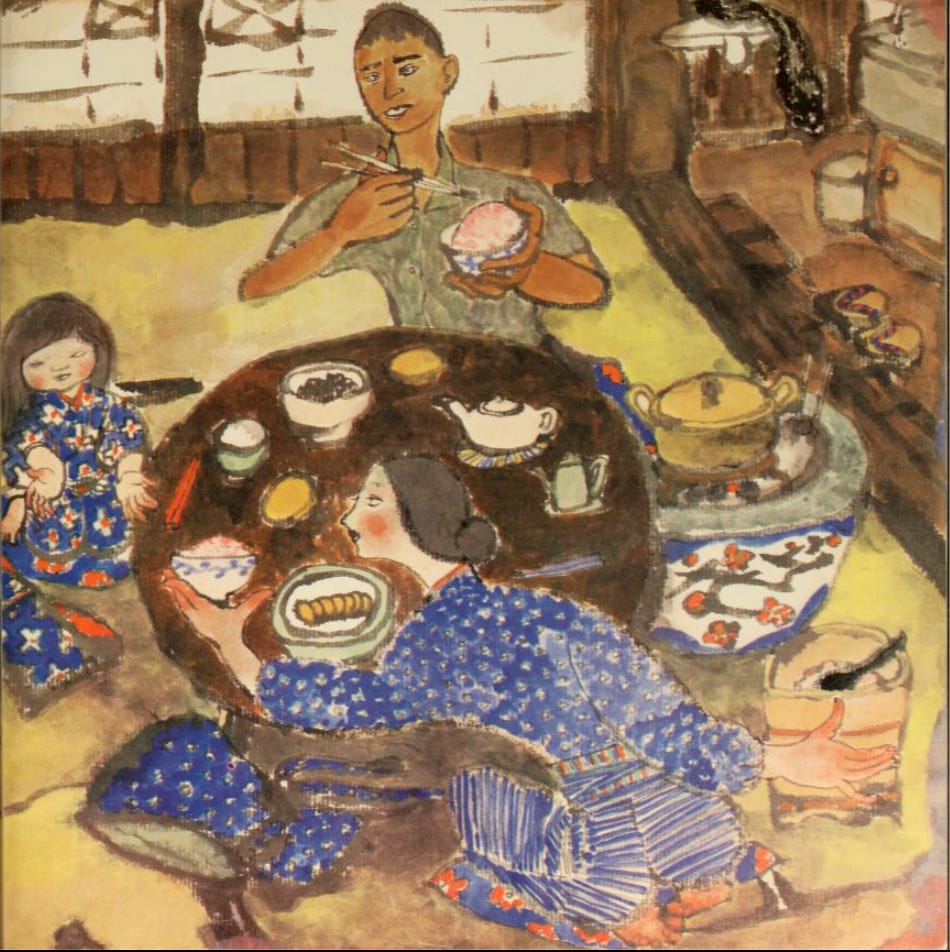
In the American edition, Hiroshima no Pika carries its Japanese title, rather than a translation, such as Hiroshima’s Flash. It’s a title that holds the reader at a distance. But once inside the book’s covers, the experience of surviving an atomic bomb is presented with intense intimacy. The story—part composite, part based on a survivor Maruki met—follows a young girl, Mii, whose family lives through the bombing. We first meet Mii and her parents at breakfast, the skies clear. Mii’s father compliments the delicious sweet potatoes her mother has prepared. Then, at 8:15 a.m., a sudden flash—and their world is an inferno. Through the rest of the book, we follow Mii as her mother guides the family as far away as she can from the flames.
Along their flight to safety, Mii witnesses a world in chaos. In Maruki’s expressive illustrations, the fleeing survivors form great waves of agony. But through Mii’s eyes, we also see individual tragedies: A sparrow that can only hop, because its wings are singed. A mother holding her lifeless baby, who walks deeper and deeper into a river until Mii can no longer see her.
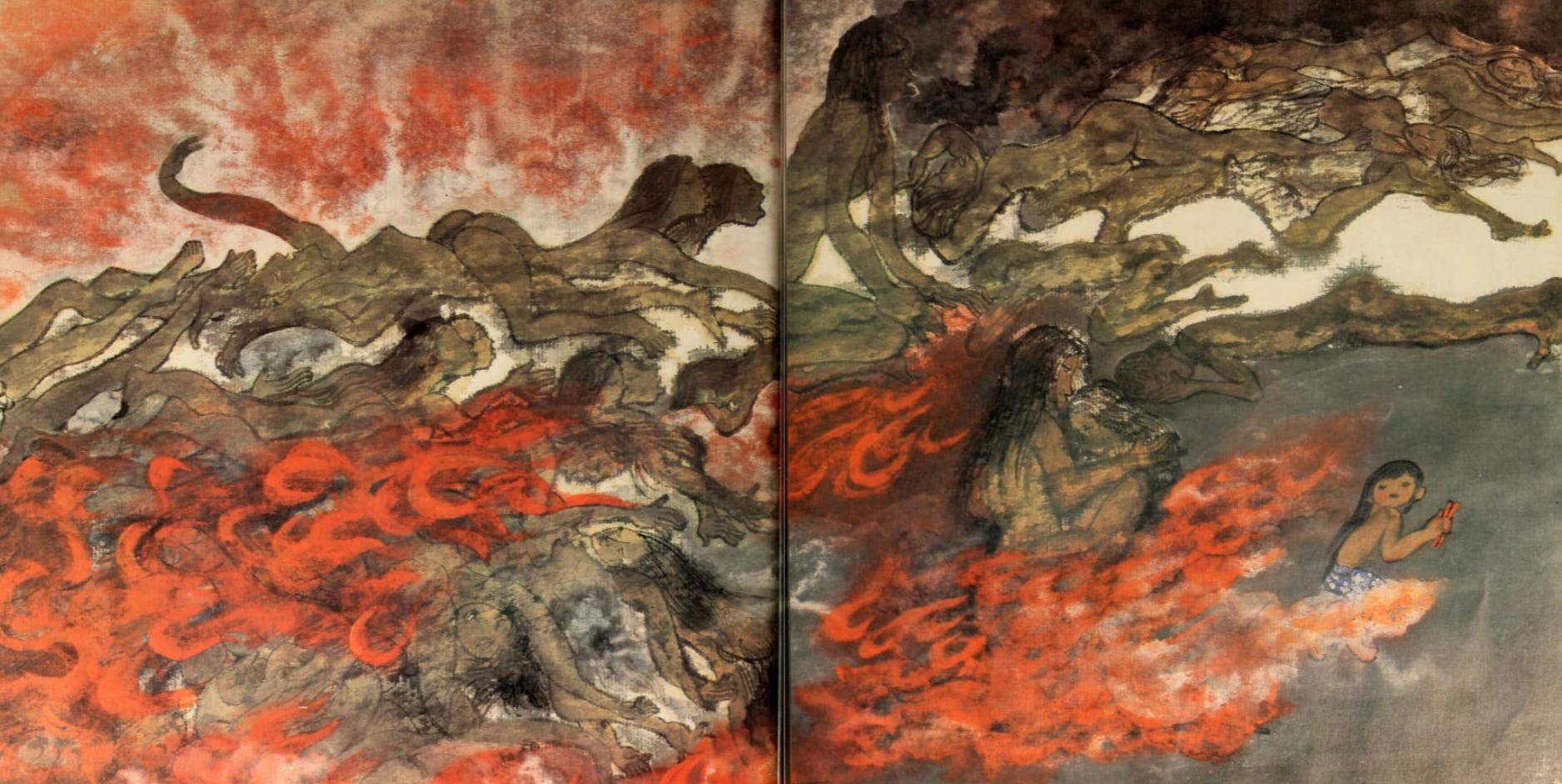
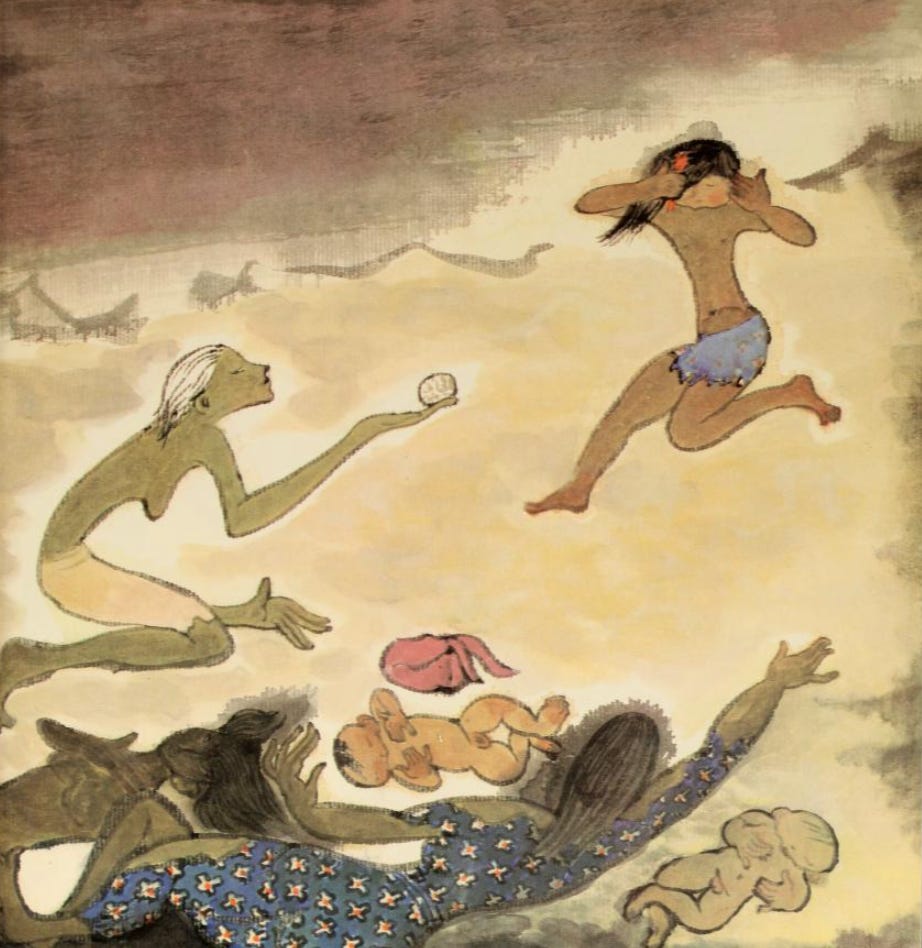
After their long flight through wreckage and across rivers, Mii and her parents fall asleep at the coastline they’ve finally reached, thinking safety is at hand. Time stops making sense. They wake up four days later as help arrives, shocked so many days have passed.
Hiroshima no pika book was very influential on me when I was young, perhaps most because of the two final spreads, which cover what happened after the chaos subsided. A child reading about disasters might be accustomed to finding their protagonist has been saved in the end. Here, the false ending at the beach gives way to new forms of suffering.
Mii never grew after that day. Many years have passed, and she is still the same size she was when she was seven years old. “It is because of the Flash from the bomb,” her mother says. Sometimes Mii complains that her head itches, and her mother parts her hair, sees something shiny, and pulls it out of her scalp with a pair of tweezers. It’s a sliver of glass, imbedded when the bomb went off years ago, that has worked its way to the surface.
Mii’s father had seven wounds in his body, but they healed and for a while he thought he was getting well. Then one day in autumn after the Flash, his hair fell out and he began coughing blood. Purple spots appeared all over his body, and he died.
Many of the people who had said, “Thank God, our lives were spared,” later became ill with radiation sickness. Though this happened in 1945, some of these people are still in hospitals. There is no cure for their disease.”
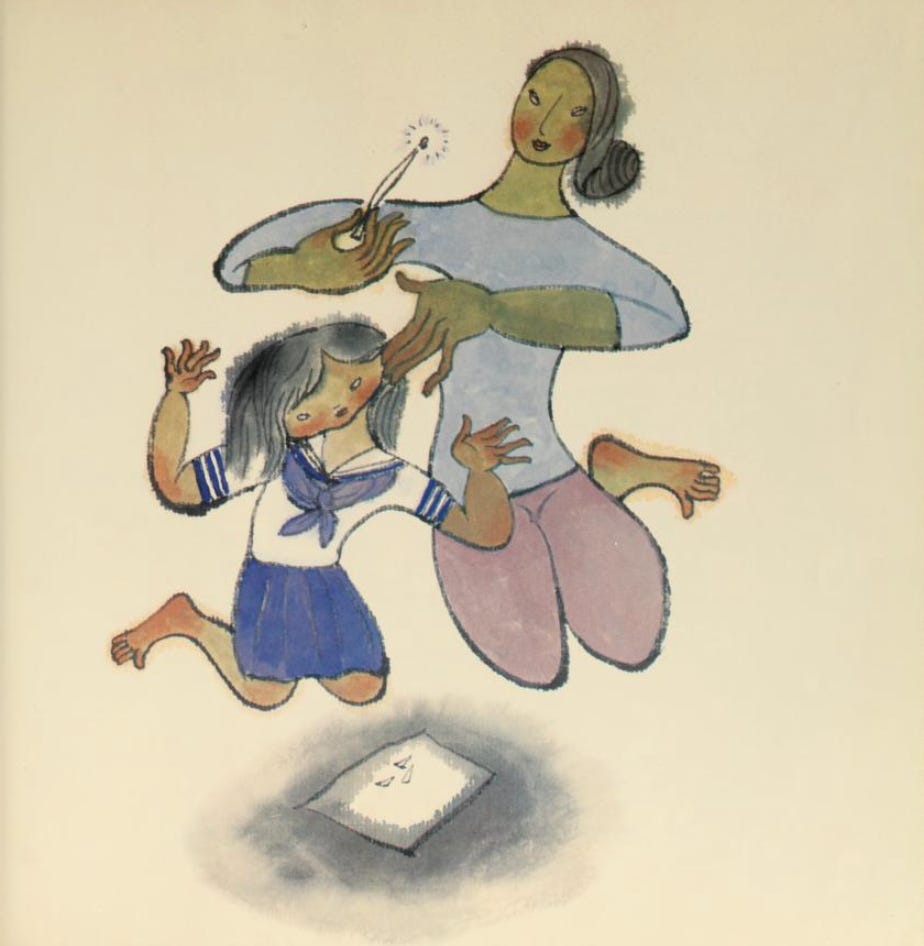
Maruki had a gift for portraying the monumental scale of devastation. But she also understood the power of the detail to wake us up. A grand scale can shock, but it can also be numbing; a sliver of truth can be fine enough to enter your heart. After reading the book as a child, I never forgot the image of a forever-small Mii, glass erupting from her scalp.
Now, rereading as a mother, I think I’ll never forget the passage when Mii’s mother realizes her daughter has been gripping her chopsticks for four days. Mii is not so many years removed from a time when she would have grasped strongly if her mother pressed a finger into her palm.
“Mii-chan! You’re still holding your chopsticks!” her mother exclaimed. “Here, let me have them.” But Mii’s hand wouldn’t open. Her mother pried her fingers open one by one. Four days after the bomb, Mii let go of her chopsticks.
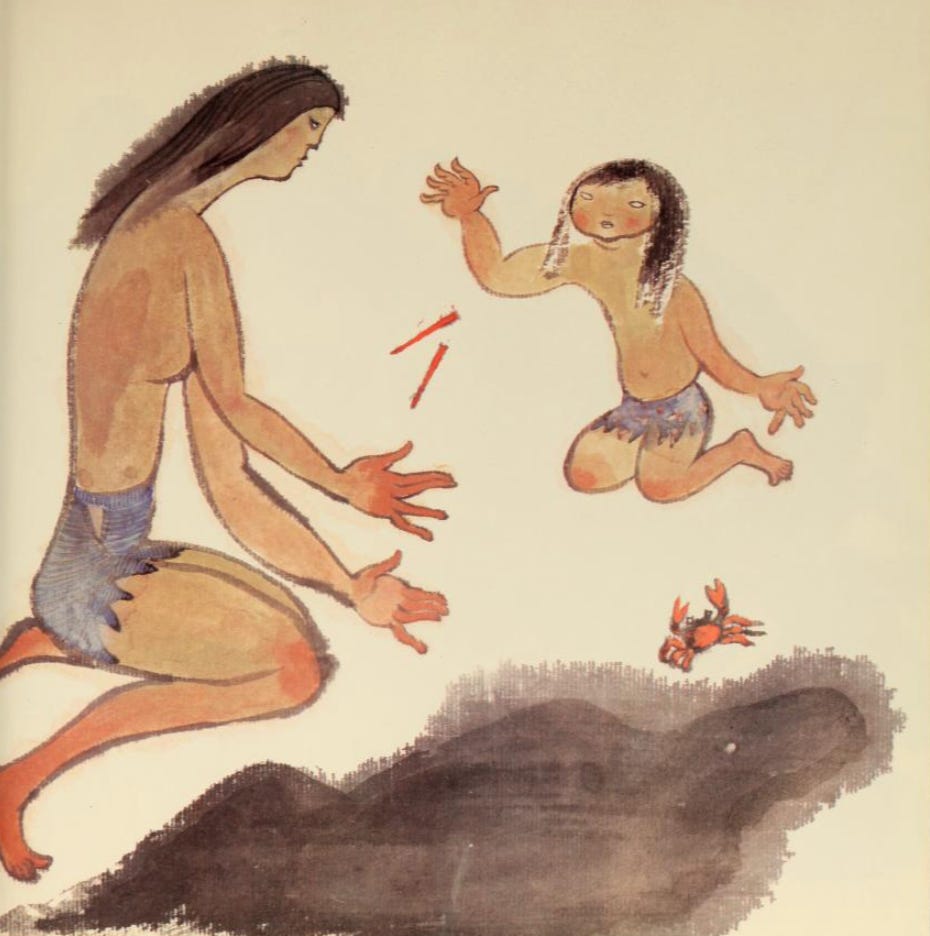
Not every sliver of truth is a painful one. Mii is witness in her journey to frenzy and death, but also to heroism and generosity. Mii’s mother carries Mii’s injured father on her back. An old woman uses what is left of her strength to offer Mii a ball of rice.
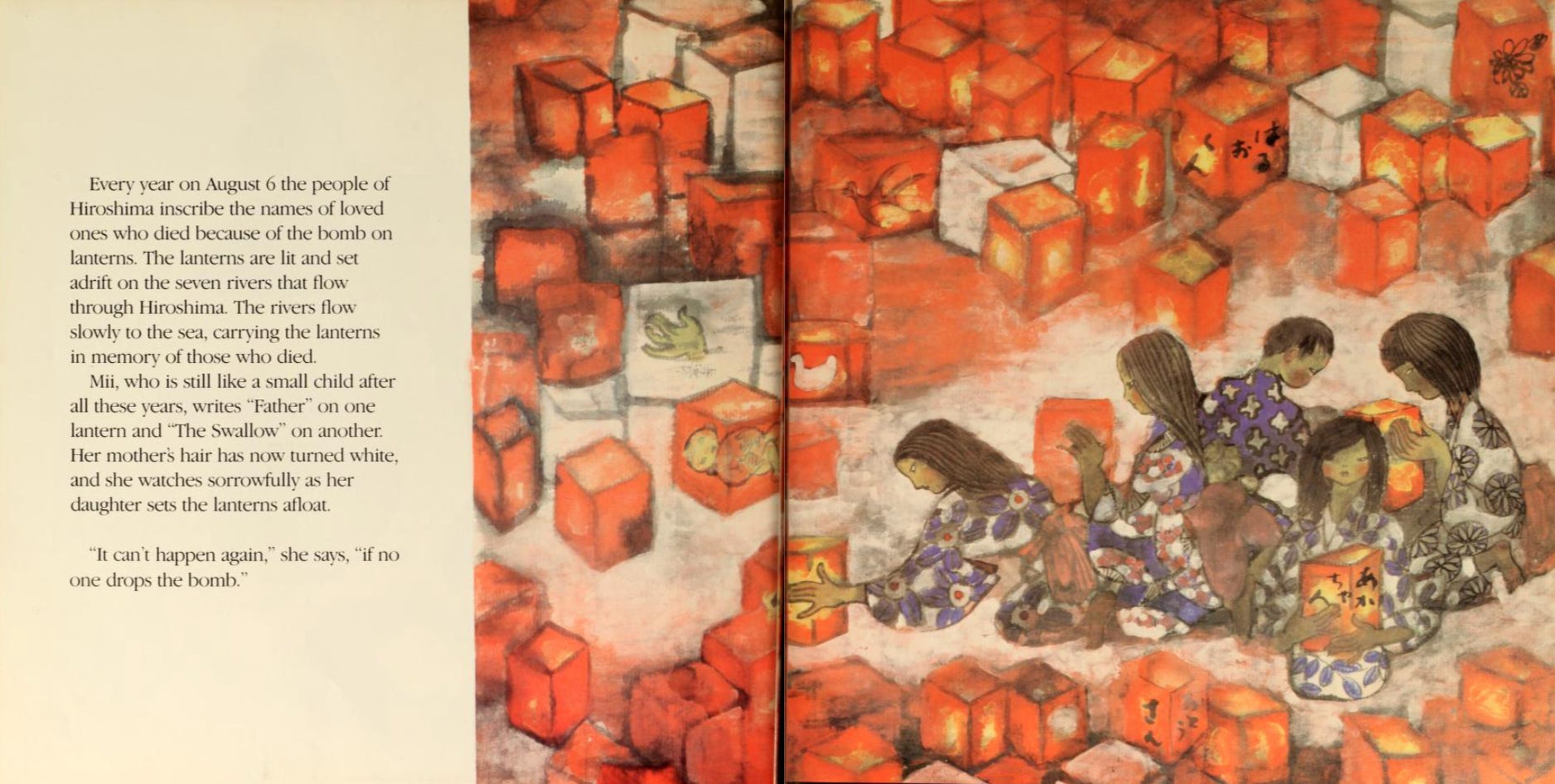
The book ends on an anniversary of the bombing, showing Mii lighting lanterns in remembrance of her father and the dying swallow she saw. Maruki closes with a simple message that is hopeful, but without the false reassurance that we are so often tempted to give as parents. “It can’t happen again,” Mii’s mother says, “if no one drops the bomb.”
This Thursday is the day of remembrance. Buy the book! But also: read a scanned copy of the book online free at the Internet Archive’s invaluable library.
No posts
Comments
Nothing yet. Say the first thing.
Sign in to join the conversation.